Skip to product information
1 of 5

Vintage and Antique Gifts

Vintage 1950s–1960s Pennsylvania Railroad Company Stock Certificate 🚂 Horseshoe Curve Orange

Vintage 1950s–1960s Pennsylvania Railroad Company Stock Certificate 🚂 Horseshoe Curve Orange

Regular price 6.95 USD
Regular price Sale price 6.95 USD
Sale Sold out
Shipping calculated at checkout.
Quantity

Could You Hold the Corporate Heartbeat of a Nation in Your Hands? 🚂

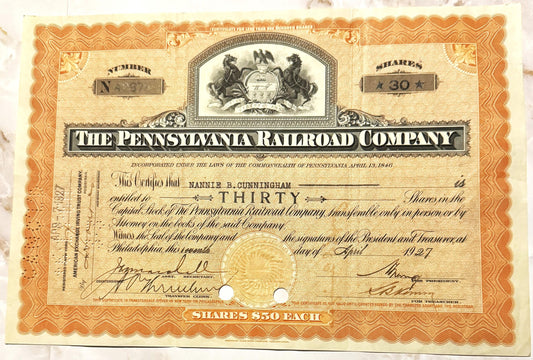
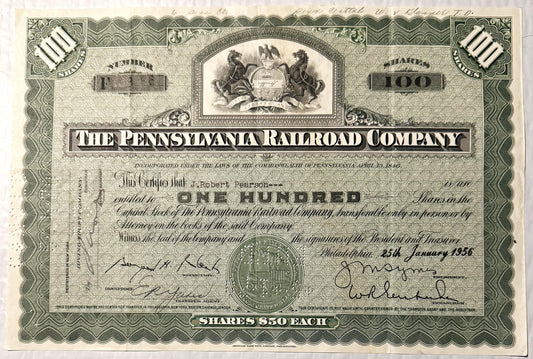
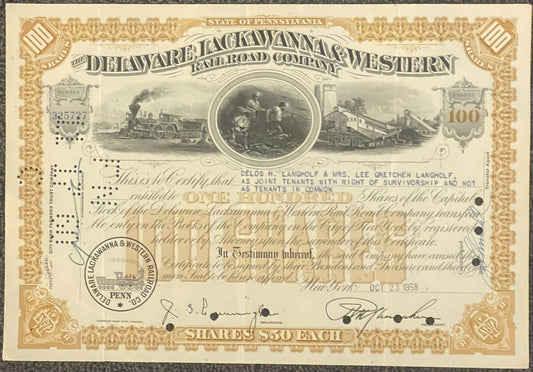
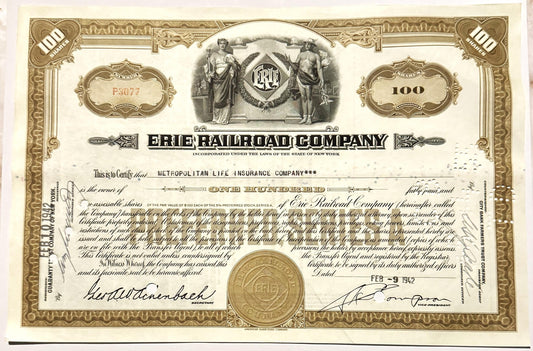
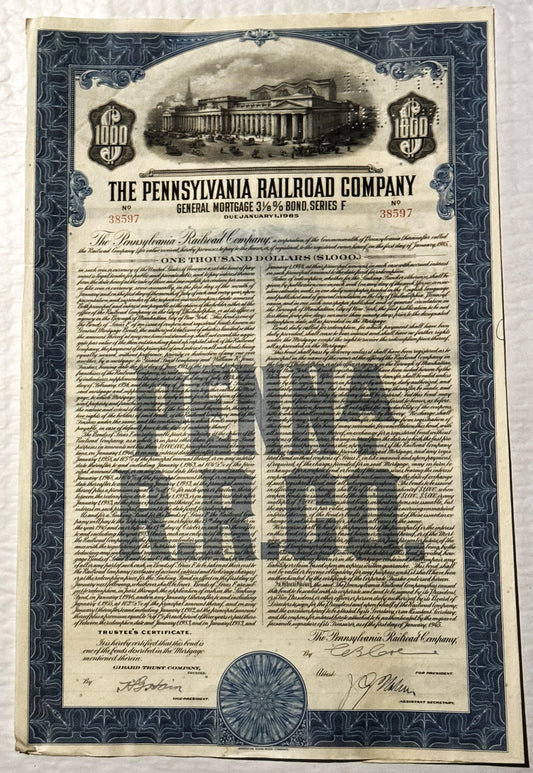
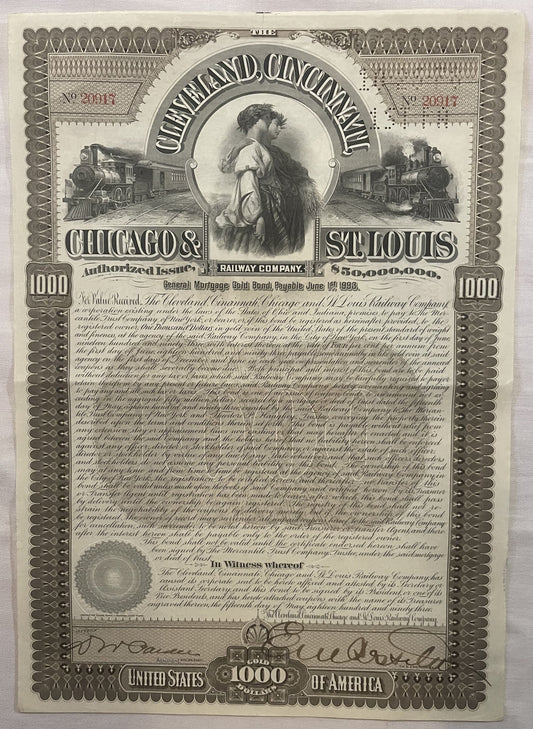
There is a particular stillness that comes over you the first time an original Pennsylvania Railroad stock certificate is laid flat in front of you. It isn't quite reverence, though reverence is part of it. It's something older and quieter — the feeling of a document that once meant something enormous to somebody, carried carefully forward through the decades until it landed here, still crisp, still vivid, still carrying every ounce of the gravity it was engraved with. The orange-gold border hasn't gone soft with time. The Horseshoe Curve vignette at its center still pulls the eye the way it was designed to, the way it has for generations of hands that held this exact same piece of paper and understood, instinctively, that it represented something bigger than themselves. This is not a reproduction. This is not a novelty print made to look old. This is an original American Bank Note Company engraved security, and you can feel the difference the moment it's in front of you.

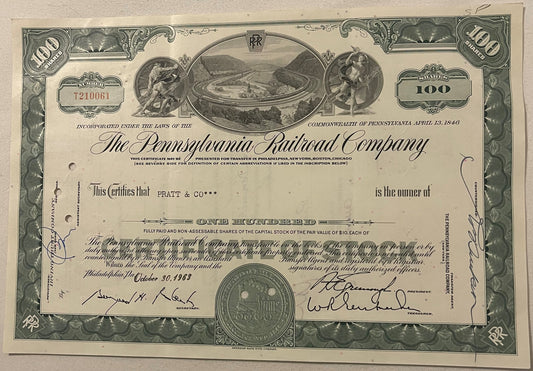
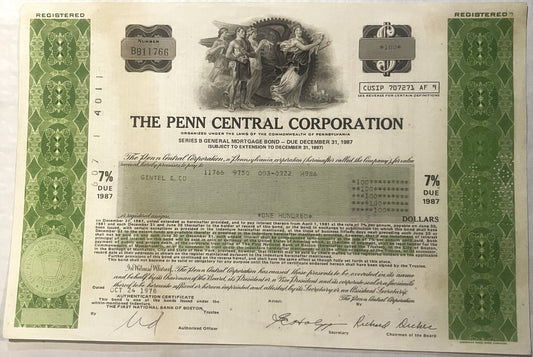
This is an original Pennsylvania Railroad Company capital stock certificate, incorporated under the laws of the Commonwealth of Pennsylvania on April 13, 1846, engraved and printed by the American Bank Note Company — the same house responsible for some of the finest security printing this country has ever produced.

It measures a substantial 12 x 8 inches (approximately 30.5 x 20 cm), printed on heavy certificate stock in a warm orange-gold palette with intricate lathe-work borders and razor-fine intaglio linework throughout. At the top, the keystone-shaped PRR monogram anchors the design with the same quiet authority it carried on locomotive tenders and depot signage across half the country.

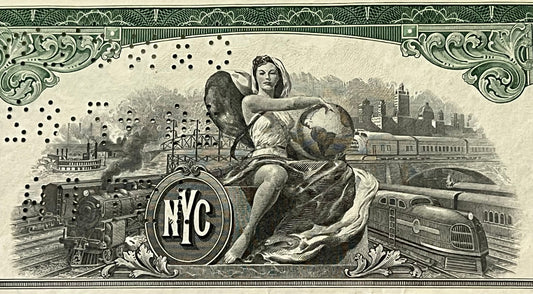
Centered beneath it, framed in an oval border of geometric guilloché engraving, sits a detailed vignette of the Horseshoe Curve — twin passenger trains sweeping around the great bend in the Allegheny Mountains, mountains rolling away behind them into an engraved sky. Flanking that central oval are two round medallions, each holding a classical allegorical figure rendered in the muscular, sculptural style bank note engravers reserved for their most important commissions: a winged figure evocative of Mercury, messenger of the gods and patron of speed and commerce, and a powerful workman figure set against a great spoked wheel, evocative of Vulcan and the forge — labor and industry standing shoulder to shoulder with speed and trade, exactly the pairing a railroad company would want carved into the paper that represented ownership in it.

Bold script across the certificate declares "The Pennsylvania Railroad Company," with printed text noting the certificate is transferable in Philadelphia, New York, Boston, Chicago, and London, and designated for holdings of fewer than 100 shares at a par value of ten dollars each. This is an issued piece of financial Americana — completed in ink, countersigned and registered, and punch-cancelled when it came back through the transfer agent's hands.


🛤️ The Pennsylvania Railroad — "The Standard Railroad of the World"

To understand what this certificate represented, you have to understand how enormous the Pennsylvania Railroad actually was. Chartered in 1846 to build a rail line connecting Philadelphia to Pittsburgh over the formidable barrier of the Allegheny Mountains, the PRR grew, within a generation, into the largest corporation in the world — not the largest railroad, the largest corporation, full stop, measured by revenue, by track mileage, by sheer capital under management.

For much of the late nineteenth and early twentieth centuries, the PRR proudly billed itself as "The Standard Railroad of the World," and it wasn't idle boasting. The company's engineering standards, its signaling systems, its locomotive designs, and its management practices were studied and copied by railroads on multiple continents.

Its keystone logo — the same shape crowning this certificate — became one of the most recognized corporate marks in American industry, chosen deliberately because Pennsylvania is the Keystone State, the wedge-shaped stone at the top of an arch that holds the whole structure together. It was a quiet, confident piece of branding for a company that saw itself, without much exaggeration, as the load-bearing structure of American industrial life.

The PRR's reach went far beyond passenger travel. Its lines carried the coal that fired the nation's furnaces, the steel that built its bridges and skyscrapers, the raw materials of Pittsburgh's mills and the finished goods of Philadelphia's factories, moving east to the ports and west to the interior in an endless procession of freight. During both World Wars, PRR trackage became critical national infrastructure, hauling troops, munitions, and matériel across the industrial heartland at a pace the federal government itself depended on. Collectors of railroad history often point out that no company did more to knit together the mid-Atlantic's coal, steel, and manufacturing economy than the Pennsylvania Railroad — and every share represented by a certificate like this one was a stake, however small, in that entire enterprise.


🌄 Horseshoe Curve — An Engineering Marvel Carved Into the Mountains

The vignette at the heart of this certificate isn't decorative filler — it's a portrait of one of the most celebrated feats of American railroad engineering. Horseshoe Curve, built by the Pennsylvania Railroad in the 1850s just west of Altoona, solved a problem that had stumped engineers for years: how to get a railroad up and over the Allegheny Mountains without impossibly steep grades. The solution was audacious in its simplicity — instead of attacking the mountain head-on, the line was built to curl back on itself in a great 220-degree horseshoe bend, gaining elevation gradually along a gentler grade while trains looped almost completely around, so that a train's locomotive and its rear cars could, for a moment, be seen facing nearly opposite directions across the same small valley. It became, almost immediately, a marvel that people traveled specifically to witness, and it remains one of the most photographed stretches of railroad in the country.

Its importance didn't stop at engineering pride. Rail historians and old-timers along the line have long passed down the story of just how strategically vital the Curve became during wartime — a single, irreplaceable choke point through which enormous volumes of coal, steel, and war matériel had to pass. Lore among collectors and railroad buffs holds that the Curve was considered such a critical piece of infrastructure that it was watched around the clock during the tense years of the Second World War, a quiet acknowledgment that if this one bend in the mountains were ever put out of commission, it could have genuinely disrupted the flow of American industry at the worst possible moment.

Whether or not any single story about it is embellished in the retelling, the underlying truth holds: this small stretch of curved track carried outsized weight in the American war effort, and it's fitting that the PRR chose to immortalize it on the very certificates that represented ownership in the company. Horseshoe Curve remains in active use today and has been recognized as a National Historic Landmark, a rare case of a piece of working railroad infrastructure earning that designation for what it represents to American engineering history.


🏙️ Altoona and Philadelphia — The Two Poles of the PRR's Empire

Horseshoe Curve exists because of Altoona, Pennsylvania — a town that, in a very real sense, the Pennsylvania Railroad built from scratch to serve as its mountain-crossing headquarters. The PRR's Altoona Works grew into one of the largest railroad shop complexes in the world, employing thousands of machinists, boilermakers, and mechanics who built and repaired locomotives for the entire system. Old-timers in the region still talk about Altoona as a company town in the truest sense — its rhythms, its paychecks, and its identity bound up entirely with the whistles and schedules of the railroad shops. At the other end of the PRR's world sat Philadelphia, the company's corporate seat since its 1846 incorporation and home to the grand Broad Street Station, once one of the busiest rail terminals on earth before it was demolished in the mid-twentieth century — itself now a piece of railroad legend, remembered by collectors as a symbol of just how much civic pride the PRR commanded in its home city. This certificate, printed with Philadelphia named first among its transfer cities, carries that hometown identity plainly on its face.


🖋️ American Bank Note Company — Engraving at the Level of Currency

The craftsmanship on this certificate is not incidental — it's the signature of one of the most trusted names in American security printing. The American Bank Note Company built its reputation engraving currency, bonds, and stock certificates for governments and corporations across the Western Hemisphere, and its engravers were held to standards nearly identical to those used for printing paper money itself: fine intaglio linework too intricate to counterfeit by hand, geometric lathe-work borders generated by precision rose-engine machines, and figural vignettes cut by hand by artists trained specifically in that discipline.

That's why the allegorical figures flanking the Horseshoe Curve scene here have the sculptural, almost classical weight they do — the same engraving houses that produced currency portraits for the U.S. Treasury were, in their off hours from government contracts, lending that exact skill set to corporate stock certificates for companies like the Pennsylvania Railroad.

Collectors of scripophily — the hobby of collecting historical stock and bond certificates — often say that American Bank Note Company work represents the high-water mark of the field, the certificates every serious collection eventually gravitates toward.


📈 A Certificate That Passed Through Wall Street

Certificates like this one rarely stayed in a single pair of hands. Because the printed design carries the designation for holdings of fewer than 100 shares at ten dollars par value, these were working securities — bought, sold, and transferred through the great brokerage houses of the mid-twentieth century, the storied Wall Street firms whose names collectors still recognize on the backs of old certificates decades after those firms themselves disappeared into mergers and buyouts. It was common practice for shares to be registered in a brokerage's own name — held "in street name," as the old term goes — on behalf of a private client, which is why so many surviving PRR certificates carry the printed or handwritten name of a long-vanished brokerage house rather than an individual investor. It's a small but genuine window into how mid-century American capitalism actually worked on the ground: not just factories and rails, but the paper trail of Wall Street firms quietly moving ownership of the nation's largest corporation back and forth across their desks.


🚉 The Pennsylvania Railroad's Legacy Today

The Pennsylvania Railroad itself no longer exists as an independent company — in 1968 it merged with its longtime rival, the New York Central, to form Penn Central, a merger so troubled it became one of the largest corporate bankruptcies in American history at the time, and out of that collapse eventually came Conrail, and later Amtrak inherited much of the passenger service the PRR once ran with such pride.

But the physical legacy is everywhere still. Horseshoe Curve carries freight and Amtrak's Pennsylvanian passenger service to this day, wrapping around that same mountain bend the engravers captured on this certificate more than half a century ago. The keystone logo still turns up on collectible railroadiana at swap meets and in museum collections devoted to American industrial history.

And certificates exactly like this one have become one of the most sought-after entry points into scripophily precisely because they combine everything a collector wants — genuine historical weight, beautiful hand-engraved artwork, a company whose story touches nearly every corner of American industrial history, and a level of surviving supply that still lets new collectors bring home a real piece of it rather than only reading about it in a book.


🖼️ Display Ideas

  • 🖼️ Framed alone in a simple black or brass frame above a desk or in a home office, letting the orange-gold engraving carry the whole wall
  • 🚂 Paired in a shadow box alongside a vintage PRR timetable, ticket stub, or model locomotive for a dedicated railroad-history corner
  • 📚 Displayed in a library or study among other Americana and financial-history pieces — old bonds, ledgers, and antique maps
  • 🎁 Given as a gift to a grandchild, parent, or grandparent with a genuine love of trains, Pennsylvania history, or Wall Street lore
  • 🏫 Used in a classroom or historical society display to illustrate mid-century American industry and the golden age of railroading
  • 🎄 Set out seasonally near a model train display, connecting the toy railroad under the tree to the real one that once ruled the rails

🎁 Who Collects These

Scripophily collectors seek out Pennsylvania Railroad certificates as cornerstone pieces precisely because of the company's outsized place in American business history and the exceptional quality of American Bank Note Company engraving. Railroad historians and railfans want them for the Horseshoe Curve artwork alone, a scene that ties directly into an active National Historic Landmark. Genealogists and Pennsylvania natives collect them as a tangible link to the industries — steel, coal, manufacturing — that built their family's hometowns. Finance professionals and Wall Street history buffs appreciate the brokerage-house provenance these certificates carry. And gift-givers return to them again and again for train enthusiasts, history lovers, and anyone with roots in Pennsylvania's industrial corridor, because there are very few gifts that pack this much genuine history into a single framed piece.


❓ FAQ

What exactly is a stock certificate like this, and why do people collect them?

This is an original engraved capital stock certificate from the Pennsylvania Railroad Company, once used to formally represent share ownership in the corporation. The hobby of collecting historical stock and bond certificates is called scripophily, and collectors prize pieces like this for the combination of genuine corporate history, fine engraving artwork, and tangible connection to a company or era.

Is this certificate still valid as stock, or worth anything financially as an investment?

The Pennsylvania Railroad merged into Penn Central in 1968 and no longer exists as an independent, publicly traded company, so certificates like this no longer carry financial share value. Their worth today is entirely as historical and collectible Americana.

What is Horseshoe Curve, and why is it featured on the certificate?

Horseshoe Curve is a famous engineering feat built by the Pennsylvania Railroad in the 1850s near Altoona, Pennsylvania, allowing trains to climb the Allegheny Mountains on a gentler grade by curving nearly back on themselves. It became one of the company's proudest achievements and a recognized National Historic Landmark, which is why the PRR chose it as the centerpiece image for its stock certificates.

Who printed the certificate, and how can I tell it's genuine engraving work?

It was printed by the American Bank Note Company, one of the premier security printing houses in American history, known for engraving currency-quality intaglio linework, guilloché border patterns, and hand-cut figural vignettes — all clearly visible in the fine detail of the Horseshoe Curve scene and the allegorical medallion figures.

What size is the certificate?

It measures 12 x 8 inches (approximately 30.5 x 20 cm), a substantial size well suited to framing and display.

What does "for holdings of fewer than 100 shares" mean?

The Pennsylvania Railroad printed different certificate designations depending on the size of the holding being represented; this certificate's printed text designates it for share holdings under 100, a genuine detail of the original issue rather than anything specific to a single certificate.

Is this a good gift for a train enthusiast or history lover?

It's exactly the kind of gift collectors describe going back to again and again — a framed piece of genuine American railroad and industrial history that connects directly to a real company, a real engineering landmark, and a real chapter of the country's industrial age.

These are issued instruments rather than blanks. Certificates of this type were filled in for a holder in ink, countersigned by the transfer agent and registered by the registrar, then punch- or cut-cancelled when they were redeemed and retired. Expect financial writings, markings, stamps, hole punches and staple holes as part of the life of the instrument: endorsements and signatures, transfer-agent and registrar stamps, revenue or documentary tax stamps, cancellation punches, staple holes from being bound into a transfer book, pencil ledger notations. That is the paper trail of a security that actually did its job, and it is what separates a document that lived from a blank that never did. No two are alike: share counts, holder details, serial numbers, dates, signatures, stamps and punch patterns vary from example to example, so the photographs show the type rather than the exact sheet that ships.

Shipping

🚚 Shipping & Handling

  • Shipping costs and timing are calculated at checkout.
  • Items curated and shipped directly by me include U.S. shipping at no additional cost, professionally packed to ensure safe arrival of your artifact.

Items from Vetted Pro Collectors
Shipping for items offered by vetted Pro Collectors is determined at checkout. All Pro Collector listings are reviewed to ensure fair, reasonable shipping practices.

For full details, please refer to our Shipping Policy.

Returns & Exchange

Take your time — you've got a full six months. If a piece isn't right for you, send it back the way it reached you and we're good.

In the first 30 days your money goes straight back the way you paid. After that it's store credit, so you can put it toward something you'd rather have.

Return shipping we sort out between us, case by case. I don't make this difficult.

If something arrives damaged, or it isn't what I said it was, send me a photo within 48 hours and I'll make it right.

Email info@vintageantiquesgifts.com or call 802-356-9872 — that's me answering, not a call center.

The only things I can't take back are custom or special-order pieces and gift cards.

View full details
  • 5 stars: 8 (100%)
  • 4 stars: 0 (0%)
  • 3 stars: 0 (0%)
  • 2 stars: 0 (0%)
  • 1 star: 0 (0%)
h
h***8 (2062)

Arrived quickly and as described

t
t***t (67)

Was in great condition the appearance of the certificate was as shown in the pictures just amazing! Great value for a quality product!

m
mstinak

My grandson is a train and history enthusiast, and he will love adding this to his collection. Thank you!

L
Lydia

fast shipping, item is in beautiful condition we are very pleased!!

Thank you, Lydia! We're over the moon to know that you're pleased with your vintage monopoly stock certificate purchase. Your feedback brightens our day and your appreciation genuinely means the world to us!

B
Bkm

It looks exactly how it did on the website. Very pleased

a
arnbur77

POS SELLER...

Thank you!

E
Erik

It is the people like you that make me fell fulfilled. Your appreciation for the history books and even more than that…. Your appreciation for it all. It is your heart and soul that makes ETSY. I will not forget it. -Erik

Thank you so much for your kind words! My favorite part is the excitement when I take something new out the box and get to research it. There is so many neat facts or events that changed the way we live today. It is neat to see how it all ties together. Happy Holidays to you and your family!

c
cadillacman03

Great product, fair pricing, excellent seller and shipper, would do business with again. 5 ⭐️ ⭐️ ⭐️ ⭐️ ⭐️ thank you Travis and the kids.

Thank you so much. We hope we do see you again soon!!! Charlee reads all the reviews for us she is going to love reading this one when she gets home from school. We really appreciate it!