Skip to product information
1 of 10

Vintage and Antique Gifts

Vintage 1970s Penn Central Railroad Mortgage Bond 📜 Historic Americana

Vintage 1970s Penn Central Railroad Mortgage Bond 📜 Historic Americana

Regular price $10.00 USD
Regular price Sale price $10.00 USD
Sale Sold out
Shipping calculated at checkout.

Size: 12" x 8"

🚚 Free US Shipping — ships within one business day. International shipping calculated at checkout.

Quantity

What Happened to the Penn Central? 🚂 Penn Central 7% Series B Bond from the 1978 Reorganization

Size: 12" x 8" ~ Little to no storage wear.

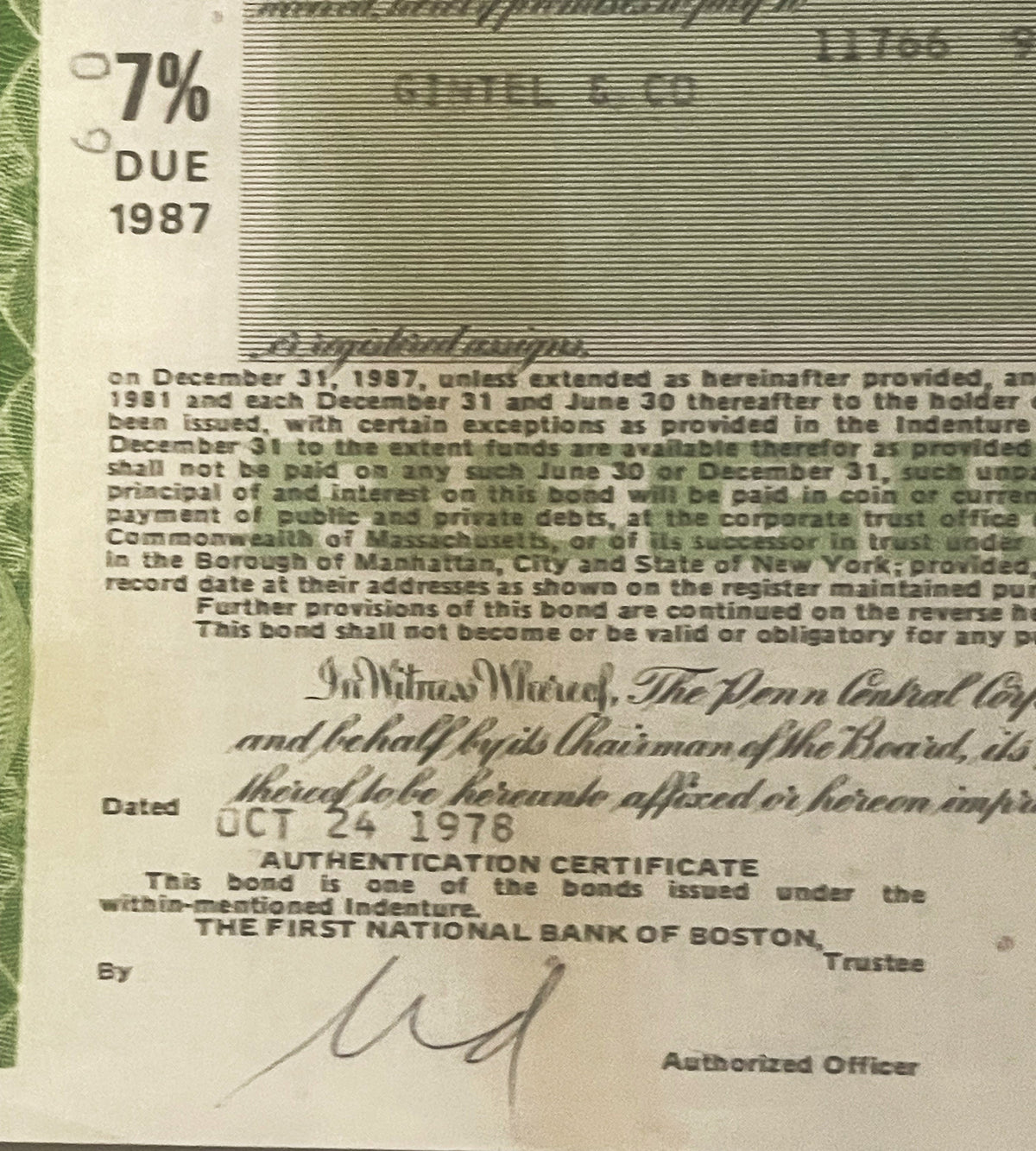
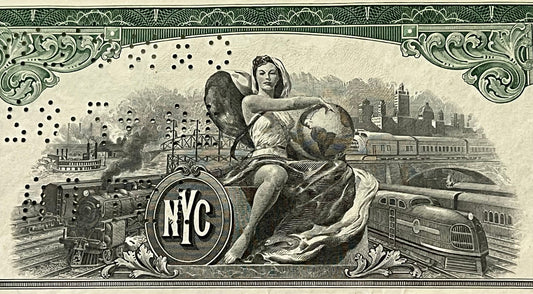
This is a registered Series B General Mortgage Bond of The Penn Central Corporation, the paper that came out of the reorganization after the biggest railroad bankruptcy in American history. It has a green lathe-work border, a finely engraved allegorical vignette of classical figures around a great gear wheel, REGISTERED at both top corners, 7% DUE 1987 at each side, and the full text of the bond printed front and back.

🏷️ What's Printed on It

  • THE PENN CENTRAL CORPORATION, ORGANIZED UNDER THE LAWS OF THE COMMONWEALTH OF PENNSYLVANIA
  • SERIES B GENERAL MORTGAGE BOND, DUE DECEMBER 31, 1987 (SUBJECT TO EXTENSION TO DECEMBER 31, 1997)
  • 7% DUE 1987 and CUSIP 707271 AF 9
  • AUTHENTICATION CERTIFICATE, THE FIRST NATIONAL BANK OF BOSTON, Trustee
  • The corporate seal: INCORPORATED PENNSYLVANIA 1846
  • On the back, the Indenture of Mortgage and Deed of Trust dated as of October 24, 1978
  • AMERICAN BANK NOTE COMPANY, the printer's line in tiny type on the face

These are issued bonds, registered to a holder, authenticated by the trustee and cancelled when they were retired, so each one carries its own paper trail: financial writings, stamps, punch cancellations and signatures are part of the life of the instrument, not damage.

My photographs can only show a fraction of how nice these are in hand. They were printed on heavy bank-note paper, a lot like a dollar bill but stiffer, with the engraving raised enough to feel. Some collectors like to research the signatures and stamps on each one. I never have - I can barely read my own signature - and years ago my mother and I decided the time it would take across thousands of certificates just wasn't worth it.

🔢 The numbers and names on the face

That CUSIP 707271 AF 9 is the bond's ID number. CUSIP stands for the Committee on Uniform Security Identification Procedures, a system the American Bankers Association built after Wall Street's paperwork crunch of the 1960s, with the first directory published in December 1968. The first six characters, 707271, name the issuer, Penn Central; AF names this exact issue; and the last digit is a check digit that catches typos.

The trustee, The First National Bank of Boston, has roots running back to the Massachusetts Bank, founded in 1784, which merged into First National in 1903. Just a few years after this bond was issued the bank renamed itself Bank of Boston in 1982, then BankBoston, then FleetBoston, and today it's part of Bank of America.

And the printer, the American Bank Note Company, was formed in New York City in 1858 when several of the top security printers merged. For well over a century it engraved banknotes, postage stamps and stock and bond certificates like this one, and its 1908 printing plant in the South Bronx is a New York City landmark today.

📉 Out of the Wreck

The Penn Central Transportation Company was born on February 1, 1968, when the Pennsylvania Railroad took over its old rival the New York Central Railroad, and regulators made it take in the bankrupt New Haven too. On June 21, 1970 its board voted to file for bankruptcy, the largest corporate insolvency in U.S. history until Texaco in 1987, and on April 1, 1976 its working rail lines went to the federally owned Conrail.

This bond is part of how the creditors got paid. In 1978 the company was reorganized, and the old Pennsylvania Railroad company renamed itself The Penn Central Corporation, which is why the seal says Pennsylvania and 1846, the year the Pennsylvania Railroad was chartered by the Pennsylvania legislature to build a line west to Pittsburgh. The Series A and Series B General Mortgage Bonds were issued under a mortgage indenture dated October 24, 1978. Beginning in 1981 both series paid 7% a year, they came due on December 31, 1987, and they were set to extend automatically for ten more years if the Valuation Case, the court fight over what the rail properties sent to Conrail were worth, hadn't been settled yet. That's the extension to 1997 printed right on the face.

That October 24, 1978 on the back isn't just a paperwork date, either - it's the birthday of the company on the front. The bankruptcy had been run out of the federal court in Philadelphia, and in an opinion that year District Judge Fullam put it plainly: "On October 24, 1978, the Penn Central Reorganization Plan was consummated," and "the reorganized company, Penn Central Corporation, came into existence." The judge had approved the plan back on March 17, 1978. Some old bondholders fought it right to the end and asked the Court of Appeals and the Supreme Court to stop it, and neither would; in January 1979 the Third Circuit affirmed the orders confirming and consummating the plan. And look at the face: the interest runs "from April 1, 1981," two and a half years after the company was born - that's when the 7% started.

🔴🟢 Red Team, Green Team

The merger never really took. The Pennsylvania men and the New York Central men ran their railroads in different ways and kept doing it, people inside the company talked about the "red team" and the "green team," the two computer systems couldn't talk to each other, and freight cars went missing in the yards. Passenger trains were losing money, the Northeast's old factories were closing, and in barely two years the new company was broke.

🏛️ Grand Central and 1978

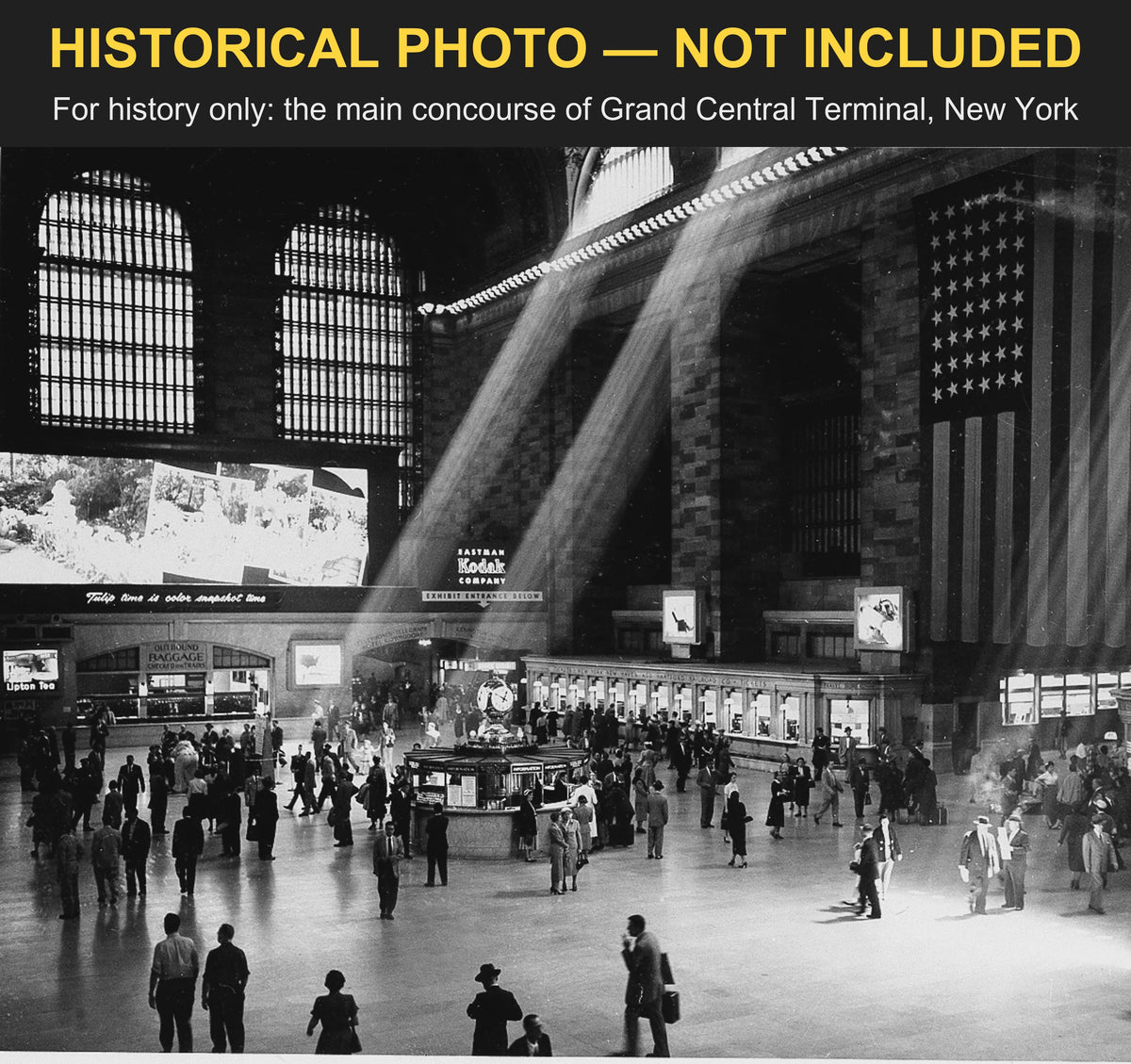
The same year as the indenture on the back of this bond, Penn Central lost a famous fight in the Supreme Court. It had wanted to build an office tower over Grand Central Terminal, New York City's landmarks law said no, and in Penn Central Transportation Co. v. New York City (1978) the Court sided with the city. That decision still protects historic buildings all over the country. The other great terminal on this story, the old Pennsylvania Station, had already been torn down in 1963.

The Penn Central Corporation went on as an insurance and industrial company, renamed itself American Premier Underwriters in 1994, and folded into American Financial Group the next year.

🏡 Display

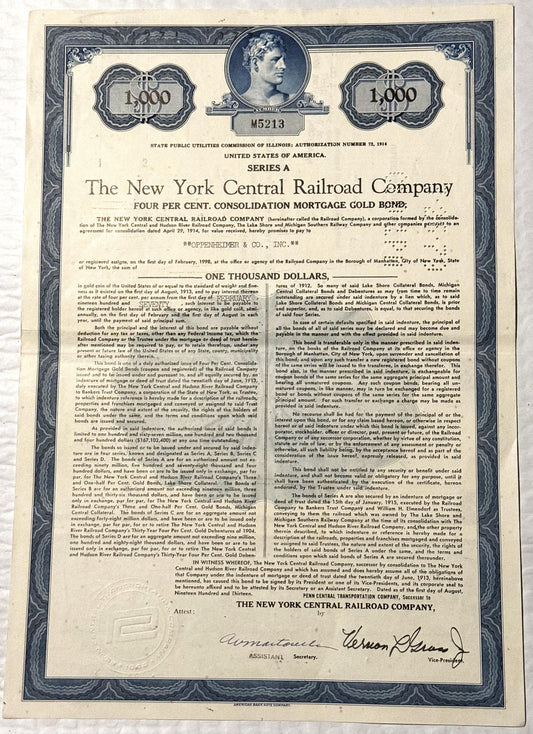
It's a great piece for any railroad fan or anybody who remembers the Penn Central crash, and it looks sharp framed in an office or a den next to a picture of Penn Station or Grand Central, the great terminals of the two railroads that made Penn Central.

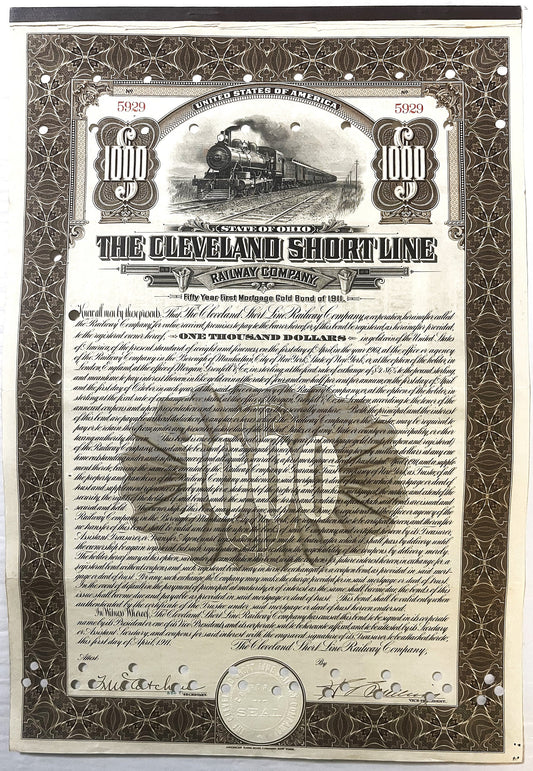
📜 Every one of these bonds had a working life, and it can show. Depending on the sheet, you may find staples or staple holes, cancellation punch holes (often right through the signatures), hand stamps from banks, brokers and transfer agents, real federal or state stock transfer tax stamps, handwriting or a filled-in transfer on the back, papers still attached, seals (a corporate seal pressed into the paper, a foil wafer seal, or a bank's signature-guarantee stamp signed across an endorsement), or a silver strip pasted over an officer's signature with the new officer's signature printed on top. That last one is what collectors call silvering: when the officers changed, the new signature could be pasted right over the old one on bonds already printed. None of that is damage. Each mark is part of the paper's own history, and they vary sheet to sheet, so no two are quite alike.

📷 The Penn Station concourse and Grand Central Terminal photos near the end are there for history only and aren't included; you get the bond.

Shipping

🚚 Shipping & Handling

  • Shipping costs and timing are calculated at checkout.
  • Items curated and shipped directly by me include U.S. shipping at no additional cost, professionally packed to ensure safe arrival of your artifact.

Items from Vetted Pro Collectors
Shipping for items offered by vetted Pro Collectors is determined at checkout. All Pro Collector listings are reviewed to ensure fair, reasonable shipping practices.

For full details, please refer to our Shipping Policy.

Returns & Exchange

Take your time — you've got a full six months. If a piece isn't right for you, send it back the way it reached you and we're good.

In the first 30 days your money goes straight back the way you paid. After that it's store credit, so you can put it toward something you'd rather have.

Return shipping we sort out between us, case by case. I don't make this difficult.

If something arrives damaged, or it isn't what I said it was, send me a photo within 48 hours and I'll make it right.

Email info@vintageantiquesgifts.com or call 802-356-9872 — that's me answering, not a call center.

The only things I can't take back are custom or special-order pieces and gift cards.

View full details
  • 5 stars: 1 (50%)
  • 4 stars: 0 (0%)
  • 3 stars: 0 (0%)
  • 2 stars: 0 (0%)
  • 1 star: 1 (50%)
W
William (Canton, US)
Antique

Received the items quickly. Better condition than expected. Thanks

I tried to communicate with the customer to try to assist and have this corrected. Unfortunately, it appears he has health issues as he couldn't remember the purchase the next day, nor anything about leaving a review. He seemed to think I was trying to sell him something when I showed him his review and item. I sincerely wish him the best and hope he recovers soon. Sending positive vibes from the kids and I.

C
Christopher

Excellent transaction. I recommend this seller. Thanks!

Rescuing American History Since 2007

— Travis & the Kids