
Skip to product information
1 of 4

Vintage and Antique Gifts

Vintage 1959 Lincoln Sesquicentennial Wooden Nickel - Albert Lea Minnesota Security State Bank Covered Wagon Token 5 ✨

Vintage 1959 Lincoln Sesquicentennial Wooden Nickel - Albert Lea Minnesota Security State Bank Covered Wagon Token 5 ✨

Regular price 5.50 USD
Regular price Sale price 5.50 USD
Sale Sold out
Shipping calculated at checkout.
Quantity
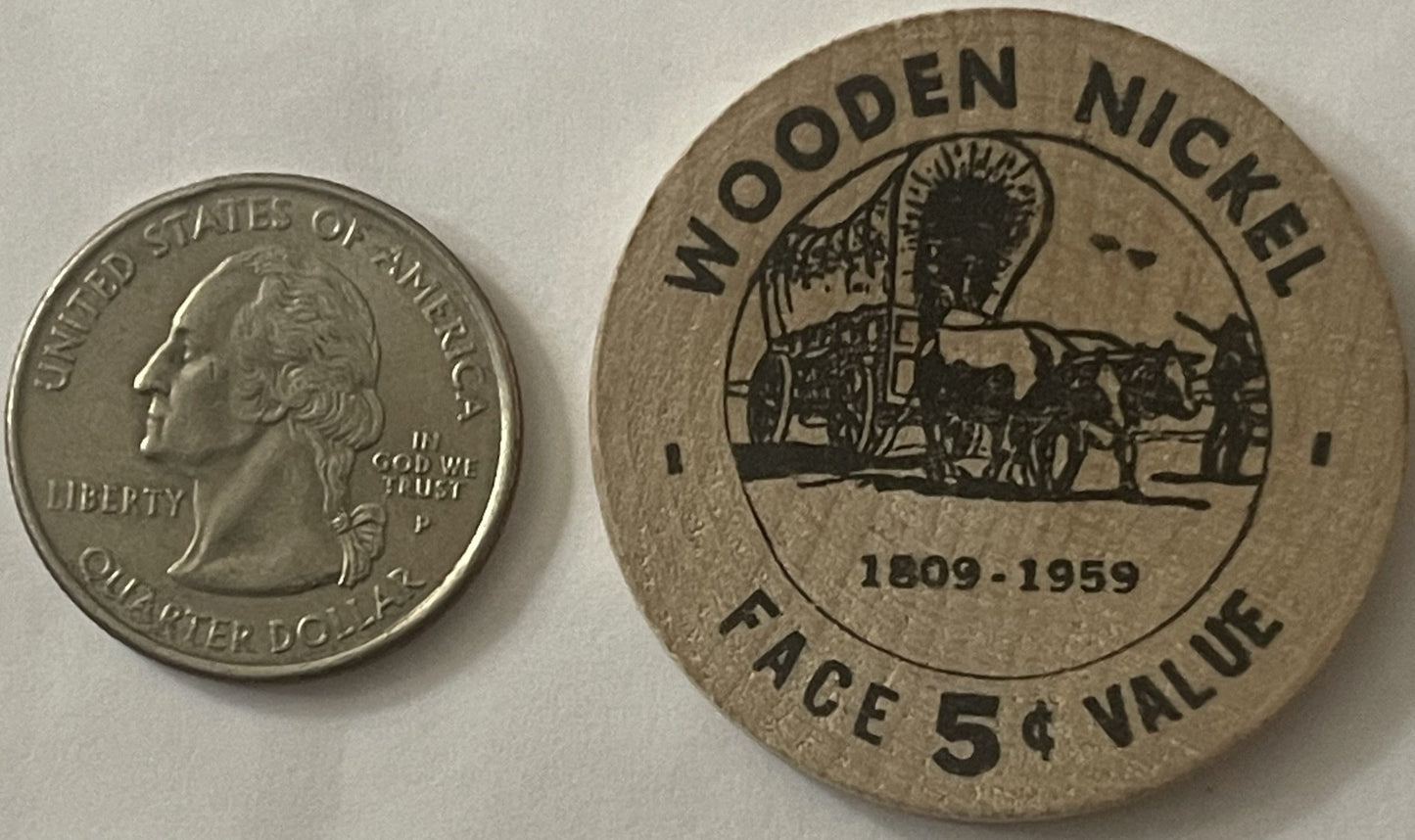
🪵 What did two hometown Minnesota banks hand their customers to mark Lincoln's 150th birthday? Picture a teller's counter in downtown Albert Lea, Minnesota, sometime across 1959. A farmer stops in to cash a check. A young couple opens their very first savings account. A regular just wanders in to talk about the weather and the price of corn. And instead of only a paper receipt, the teller slides across something smaller and stranger: a little wooden disc, stamped like money but never meant to spend a day of its life. It says so, right on its own face — "Wooden Nickel," "Face 5¢ Value" — half joke, half keepsake, pressed into a customer's palm to mark something much bigger than an ordinary bank visit. This was the year the whole country paused to remember that a century and a half had passed since a rail-splitter's son was born in a one-room cabin in Kentucky — and two small-town banks in southern Minnesota wanted their customers to hold a piece of that memory in their hand. That's the piece in front of you now. This is a wood-composite commemorative token, issued in 1959 jointly by Security State Bank and Brownlee Moore Bank of Albert Lea, Minnesota , timed to the national observance of the Abraham Lincoln Sesquicentennial — the 150th anniversary of Lincoln's 1809 birth. Stamped in bold black ink against the pale, grained wood is a full pioneer tableau: a canvas-topped covered wagon rolling beneath a rising sun, an ox team straining at the yoke, two human figures walking the scene alongside, and a scattering of birds overhead. Arched above the wagon reads "WOODEN NICKEL," and arched below, "FACE 5¢ VALUE," with "1809-1959" struck directly beneath the wagon wheels. The piece also carries the names of its two sponsoring hometown banks and a redemption window that closed on August 1st of that same year. This example is New Old Stock (NOS) — genuine, unissued 1959 bank promotional stock that never crossed a counter before that void date closed the window on it, which is exactly why a piece this small and this old can still be held in the hand today, rather than living only in a black-and-white photograph. 🎩 The National Moment: A Country-Wide Sesquicentennial To understand why a bank in southern Minnesota was handing out wooden coins in 1959, you have to understand what 1959 meant to the whole country. Abraham Lincoln was born February 12, 1809, and by the time his sesquicentennial rolled around a century and a half later, Lincoln had long since become something closer to American scripture than American history — the log cabin, the split rails, the self-taught lawyer, the president who held the Union together and freed the enslaved, the martyr shot down five days after Appomattox. The 150th birthday landed squarely in the years just after the Lincoln Memorial had cemented itself as a place of national pilgrimage and just as Lincoln's face on the penny was already worn smooth in a hundred million pockets. Communities, schools, civic clubs, and businesses across the country marked the sesquicentennial with parades, pageants, commemorative medals, essay contests, and exactly the kind of small promotional giveaway you're holding now — a way for an ordinary Main Street business to fold a piece of national memory into an ordinary week of local commerce. Banks in particular loved this kind of tie-in. A sesquicentennial gave a small-town bank a dignified, patriotic reason to put its name in a customer's pocket without looking like it was simply advertising — the Lincoln anniversary did the emotional work, and the bank's name just rode along for the trip. Old-timers in banking towns like Albert Lea still remember an era when a trip to deposit a paycheck came with a little something extra at the counter — a calendar, a yardstick, a souvenir spoon, or, in a sesquicentennial year, a wooden nickel with the boss's own bank name stamped right on it. 🏦 Two Hometown Banks, One Wooden Nickel Security State Bank of Albert Lea carried a lineage that reached back further than a customer picking up this token in 1959 might have guessed. The institution traced its roots to 1906, when it was originally chartered as Manchester State Bank. It took on the name Security State Bank of Albert Lea in January of 1946, setting up at 437 Bridge Avenue in the heart of town — which meant that when this sesquicentennial token crossed the counter in 1959, "Security State Bank" was still, in the long arc of the bank's own history, a relatively fresh name on the building, only thirteen years into that chapter. The bank kept right on growing long after this little wooden disc went void: it later moved to a new main office nearby at 427 Bridge Avenue, joined the Federal Reserve System, and eventually rebranded once more as Security Bank Minnesota — the kind of quiet, steady continuity that small-town Midwestern banks built their reputations on, never a bank that failed or vanished, simply one that kept turning pages in its own ledger. Standing alongside it on this token is Brownlee Moore Bank , the second hometown institution named right on the piece. Two banks sharing a single promotional token, both honoring the same redemption terms and the same August 1959 deadline, tells its own quiet story about a small Minnesota county seat where the banking community was tight enough, and civic-minded enough, that a national anniversary was worth marking together rather than separately — competitors, perhaps, on an ordinary Tuesday, but partners when it came to putting Albert Lea's name on something meant to be kept rather than spent. 🐂 Reading the Wood: The Wagon, the Oxen, and the Sun The artwork carried on this piece is pure American pioneer iconography, rendered in the same confident line-art style that decorated everything from feed sacks to schoolbook covers at mid-century. A Conestoga-style covered wagon rolls across the scene, its canvas top bowed and billowing, drawn by a team of oxen straining forward beneath a sun throwing rays across the whole tableau. Two human figures walk the ground beside the wagon — a driver at the animals' heads and a second figure trailing, the whole party pressing on toward that rising sun on the horizon while birds wheel overhead. It's a scene meant to be read in a glance: westward , onward , settling new ground — the same visual shorthand for the American frontier that shows up on everything from state highway shields to old Western movie posters. Oxen were the workhorse of that pioneer imagery for good reason. Slower than horses, but far cheaper to buy and far hardier on the trail, an ox team could graze on prairie grass alone, needed no expensive tack or feed grain, and could plod along at a steady pace, day after day, hauling a family's entire household across hundreds of miles of unbroken country. It's an image that would have meant something particular to a Freeborn County audience in 1959 — southern Minnesota had itself been settled within living memory of the wagon era, by families who had made exactly this kind of overland trip to break sod on the open prairie. Pairing that homesteading imagery with Lincoln's own birth year wasn't an accidental design choice; Lincoln himself came of age in exactly this world of split-rail fences and ox-drawn wagons before a rail-splitter's son from a one-room cabin ever set foot in Washington. 🌾 Albert Lea, Minnesota: A Prairie Banking Town Albert Lea sits in Freeborn County in the rolling farm country of southern Minnesota, the kind of county seat built on grain elevators, dairy cooperatives, and small independent banks that knew every farmer on their books by first name. By 1959, towns like Albert Lea had already lived through the hard lessons of the Depression-era bank failures a generation earlier, which is part of why a name like "Security" carried real weight on a bank's shingle — it was a promise as much as a name. A joint sesquicentennial token handed out by two of the town's own banks would have circulated through exactly the kind of community where a wooden nickel wasn't just a gimmick — it was a small piece of hometown pride, meant to sit on a windowsill or in a cigar box long after the redemption date had quietly come and gone. 💰 Wooden Nickels: Main Street's Favorite Running Joke "Don't take any wooden nickels" is one of those old American sayings that's outlived almost everyone who first used it in earnest — a warning, generations back, against being fooled or shortchanged. By the mid-20th century, the phrase had done something wonderfully American: it had turned itself inside out. Banks, fairs, and hometown businesses started handing out literal wooden nickels on purpose, printing the old warning right onto the very object it once cautioned against, turning a phrase about being cheated into a cheerful little souvenir nobody minded taking at all. A wooden nickel like this one was never going to buy so much as a stick of gum after its void date — and that was precisely the point. It was a promotional keepsake stamped with a redemption deadline of August 1, 1959 , meant to be claimed, remembered, and kept, not spent and forgotten. That's also exactly why an example like this one still exists in this kind of complete, unclaimed condition. As New Old Stock , this token represents genuine bank promotional inventory that sat unissued past its own redemption window — never handed across a counter, never tucked into a farmer's overalls pocket and lost to the wash. It stands today as a clean, honest example of mid-century small-town advertising craft: pressed wood, hand-set lettering, and a line-art scene struck in confident black ink, the kind of piece that captures an entire era of Main Street promotion in something you can hold between two fingers. 🕰️ Why This Little Disc Still Matters Today Wooden nickels sit in a category of collecting all their own — exonumia , the broad world of coin-like objects that were never official currency, a field with its own dedicated societies, its own price guides, and its own devoted following of collectors who chase down bank tokens, fair souvenirs, and civic commemoratives town by town. Within that world, a piece like this one checks several boxes at once: it's tied to a genuinely national historical moment (the Lincoln sesquicentennial), it's tied to a specific, identifiable hometown (Albert Lea, Minnesota), and it names two actual sponsoring banks rather than a generic novelty printer's stock design. That combination — national event, local sponsor, named town — is exactly what serious collectors of Americana and small-town banking history go looking for, because it's the kind of piece that tells two stories at once: Lincoln's, and Albert Lea's own. 🖼️ Display Ideas 🪵 Set it in a small shadow box or coin capsule stand on a shelf or desk, wagon-side facing out, as a quiet piece of Americana 🏦 Pair it with other vintage banking ephemera — a passbook, a deposit slip, an old bank calendar — for a "hometown bank" vignette 🎩 Group it alongside other Lincoln memorabilia — coins, stamps, prints — to build a small sesquicentennial collection 🐂 Display it near Western or pioneer-themed decor, letting the covered wagon artwork carry the frontier theme 🎁 Give it as a gift to a Minnesota native, a banking professional, or anyone with roots in Freeborn County 📜 Tuck it into a keepsake box or curio cabinet alongside other found "wooden nickel" tokens as a growing set 🎁 Who Collects These This piece tends to find its way into the hands of a particular kind of collector: exonumia and token collectors chasing bank-issued wooden nickels state by state, Lincoln and Civil War-era history buffs rounding out a sesquicentennial collection, Minnesota and Midwest local-history collectors hunting down anything tied to their own county seat, and banking historians tracing how small independent banks like Security State Bank and Brownlee Moore Bank marked their place in a community. It's also a natural fit for anyone drawn to genuine mid-century American advertising ephemera — the kind of small, honest promotional object that was never meant to outlast its own redemption date, and yet somehow did. ❓ FAQ What is a "wooden nickel," exactly? It's a round wooden token, stamped or printed to resemble a coin, issued by a business or civic group for promotional purposes rather than as real currency. This example was issued by two Albert Lea, Minnesota banks in 1959 with a five-cent "face value" and a redemption deadline — a novelty giveaway, never intended to circulate as money. Is this token actually from the period? No — 1809 is Abraham Lincoln's birth year, commemorated on the token because 1959 marked his 150th, or sesquicentennial, birthday. The token itself was made and issued in that era, using the 1809 date only to anchor the historical anniversary being honored. What do "Security State Bank" and "Brownlee Moore Bank" refer to? These were the two hometown banks of Albert Lea, Minnesota that jointly issued and stood behind this token. Security State Bank traced its roots back to a an earlier era charter under an earlier name and went on to a long, continuous history in the community, later operating under a different name than it carries here — the kind of steady, generations-long presence small-town Midwestern banks were known for. What condition is this piece in? This is New Old Stock — genuine, unissued 1959 bank promotional inventory that was never claimed before its redemption deadline passed, which is exactly why it survives today as a clean example of the original piece rather than a well-traveled souvenir. Why does the design show a covered wagon and oxen? The pioneer wagon scene ties Lincoln's own frontier-era upbringing to the imagery of westward settlement — and it would have carried extra local resonance in a Minnesota farm county that was itself settled by wagon within living memory of many 1959 residents. Is this a rare piece? Bank-issued wooden nickels tied to specific named local institutions and a documented national anniversary like the Lincoln sesquicentennial are a distinct and sought-after niche within exonumia collecting, prized for combining hometown specificity with a genuine historical milestone. Would this make a good gift? It's an especially fitting gift for anyone with Minnesota or Freeborn County roots, a Lincoln history enthusiast, or a collector of vintage banking and advertising ephemera — small enough to display anywhere, but rich with a story worth telling.

Shipping

🚚 Shipping & Handling

  • Shipping costs and timing are calculated at checkout.
  • Items curated and shipped directly by me include U.S. shipping at no additional cost, professionally packed to ensure safe arrival of your artifact.

Items from Vetted Pro Collectors
Shipping for items offered by vetted Pro Collectors is determined at checkout. All Pro Collector listings are reviewed to ensure fair, reasonable shipping practices.

For full details, please refer to our Shipping Policy.

Returns & Exchange

Take your time — you've got a full six months. If a piece isn't right for you, send it back the way it reached you and we're good.

In the first 30 days your money goes straight back the way you paid. After that it's store credit, so you can put it toward something you'd rather have.

Return shipping we sort out between us, case by case. I don't make this difficult.

If something arrives damaged, or it isn't what I said it was, send me a photo within 48 hours and I'll make it right.

Email info@vintageantiquesgifts.com or call 802-356-9872 — that's me answering, not a call center.

The only things I can't take back are custom or special-order pieces and gift cards.

View full details
  • 5 stars: 8 (100%)
  • 4 stars: 0 (0%)
  • 3 stars: 0 (0%)
  • 2 stars: 0 (0%)
  • 1 star: 0 (0%)
B
Barb

Great transition will use seller again

S
Sara

I had some issues with the mail and Travis was so understanding and helped me through the process of getting a replacement. His customer service was great and the handwritten card from the kiddos was precious and made me smile after a long hard day. I will definitely be heading back to his shop after such a positive experience!

Hi there! Thank you so much for taking the time to leave such a kind review. I'm so glad I could help you with the replacement and that you enjoyed the handwritten card from my little ones. It's always a pleasure to have happy customers like you and I can't wait to see you back in my shop! Thanks again!

J
James Miller (Walnut Cove, US)

Rare 1950s Wooden Nickel Bank Antique Gift from Security State

S
Stephanie

communication and product all good

S
Shawn

My stepfather always jokingly tells us not to accept any wooden nickels. I checked to see if there were any wooden nickels available and found these on Etsy. I'm looking forward to telling him "I was had" and giving it to him at his 90th birthday party, lol.

M
Madison

Order was exactly as expected, the customer service was above and beyond. I look forward to my next order with them

M
Melissa

As described and well taken care of

Hi Melissa! Thrilled to receive a 5-star review from you! We're overjoyed you're loving the vintage wooden nickel you got from us. We take pride in sourcing authentic hard to find pieces and your review is a testament to that. Hope to assist you again with your antique needs soon!

J
Jim Moore

Great love it quality fine

Hi Jim, thank you so much for the 5-star review! We're thrilled to know you're pleased with the vintage wooden nickel. Authenticity is key in what we do, and we're glad it hit the mark for you. Thank you again for choosing us for your vintage needs!