
Skip to product information
1 of 9

Vintage and Antique Gifts

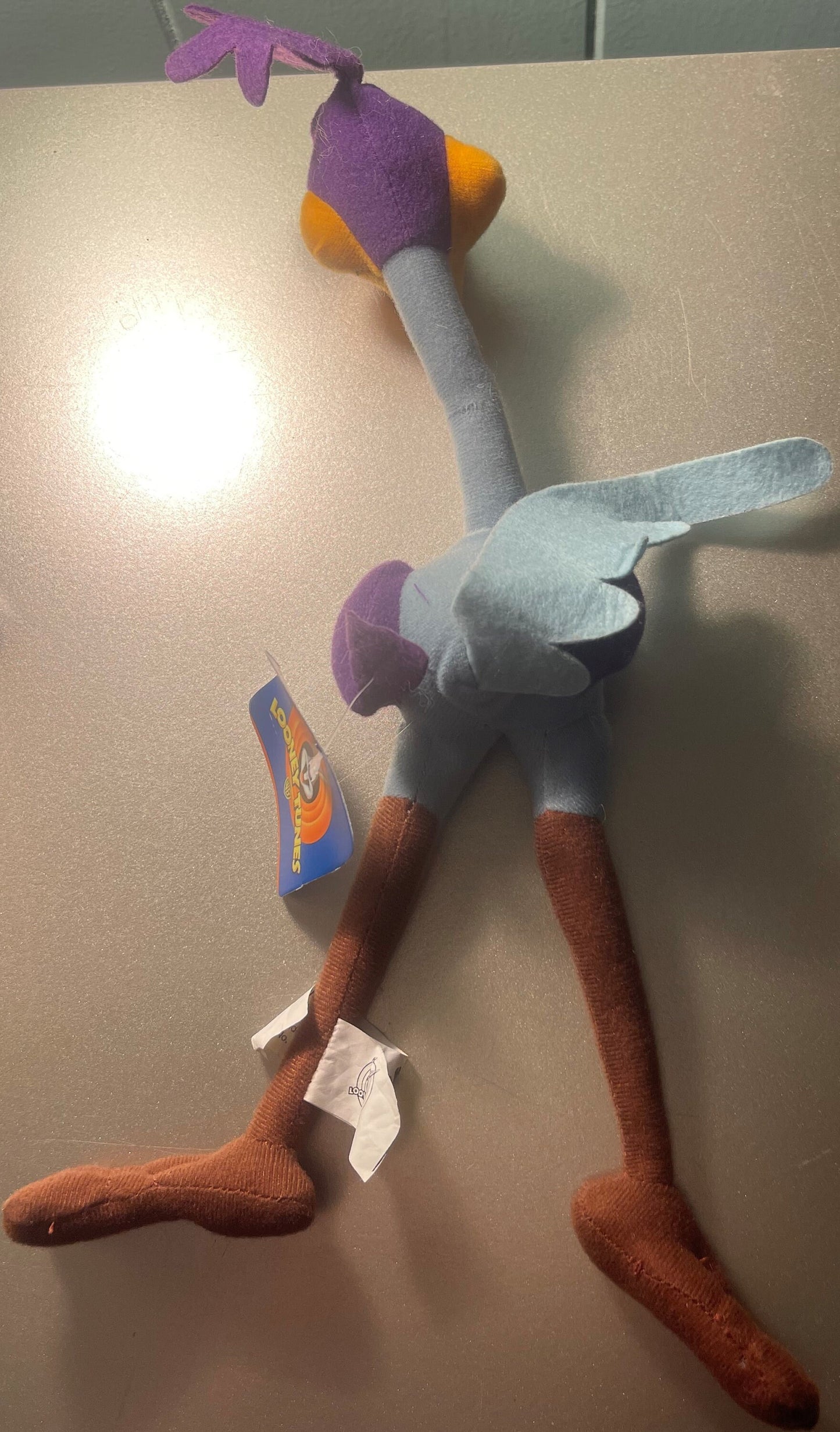
Vintage Road Runner Plush 🏃💨 Looney Tunes ACE Play-By-Play NWT 1997 San Antonio TX Card

Regular price 25.00 USD
Regular price Sale price 25.00 USD
Sale Sold out
Shipping calculated at checkout.

Description

🏃💨 Remember That Half-Second Before He Was Already Gone?

You never actually saw the Road Runner running. Not really. What you saw was a gray-and-purple blur, a puff of desert dust hanging in the air where he'd been standing a half-second earlier, and that sound — half car horn, half something no real bird on this earth has ever made — trailing off down the canyon. "Beep beep," and he was gone before Wile E. Coyote's newest ACME contraption had even finished exploding. If Saturday mornings were part of your childhood, or if you're chasing that exact feeling down for someone who wasn't even born yet when this fellow first sprinted across a movie screen, this is the kind of find that stops the scroll cold.

This is a genuine Looney Tunes Road Runner plush, produced under official Warner Bros. license by ACE, a subsidiary of Play-By-Play Toys & Novelties, Inc. of San Antonio, Texas, with a copyright date of 1997 printed right on the piece. He measures 14 inches (about 35.5 cm) from the top of that purple crest down to his oversized brown feet — a real shelf-and-desk-scale plush, not a pocket trinket, with genuine presence when he's propped up somewhere and craning that long gray-blue neck skyward. The body and neck are done in a soft blue-gray, the crest and wing patches in purple felt, the beak in a bold yellow-orange with a pink felt tongue peeking out, the legs and feet in rust brown, and the tail feathers in a pale powder blue. He still carries his original hang tag — a glossy, four-color printed card in blue, orange, yellow and white, carrying the Warner Bros. "WB" shield and the 1990s Looney Tunes logo (a laughing Bugs Bunny silhouette set inside a target-shaped orange sunburst), attached through the crest by its original plastic fastener, plus a sewn fabric law label on one leg listing fiber content and a state registry code. This piece comes to you as new old stock (NOS) — tag intact, never separated from retail inventory, exactly as it left the factory floor in San Antonio.


🎬 "Beep Beep": The Chuck Jones Cartoon Behind the Toy

The Road Runner and his eternal nemesis Wile E. Coyote didn't wander into cartoons by accident. They were built on purpose, by director Chuck Jones and writer Michael Maltese at Warner Bros. Cartoons, first appearing on screen in 1949 in the short Fast and Furry-ous. Jones himself traced the coyote's roots back further than the cartoon studio — in his memoir Chuck Amuck, he wrote that he'd "first become interested in the coyote while devouring Mark Twain's Roughing It at the age of seven," specifically the fourth chapter, Twain's own stagecoach journal through the American West. A century-old travel book, reborn as a Warner Bros. chase cartoon, reborn again as a stuffed toy on a San Antonio warehouse shelf.

Jones described the Road Runner himself as having "very little personality, as he is a force" — pure motion, nothing more. His teaching line to young animators about how to draw the character has become cartooning legend in its own right: learn to draw dust first, he'd say, and "just draw a cloud of dust and hook a Road Runner onto it." Even the character's signature sound has its own small piece of studio lore — background artist Paul Julian, arms full of paintings and unable to see where he was walking through the hallways at Termite Terrace, would call out "Beep, beep" to warn people to clear a path. Jones credited that accidental hallway warning as the origin of the most recognizable two syllables in cartoon history, and Julian's own recorded voice still carries the sound in the films today.

Jones wrote out formal rules for the series in Chuck Amuck, and two of them explain a great deal about a Texas-made Road Runner plush turning up decades later: Rule Six held that "all action must be confined to the natural environment of the two characters — the southwest American desert," and Rule Seven decreed that every gadget in the chase came from the ACME Corporation. The character was, by design, permanently rooted in the same Southwest that Play-By-Play Toys would later call home.


🍕 From a Pizza Hut Sink to a Toy Empire: Arturo G. Torres

The company behind the ACE label has one of the more remarkable founder stories in the American toy business. Arturo G. Torres fled Cuba after the Bay of Pigs invasion of 1961, sought asylum in the United States after his family's grocery, real-estate and agricultural holdings were confiscated by the Castro government, and arrived in Texas — by his own account hoping to become a cowboy. Instead, in 1965, he took a job washing dishes at a Pizza Hut. He built that single job into Pizza Management, Inc. (PMI), which grew into one of the largest privately held Pizza Hut franchise operators in the country — more than 230 restaurants stretched across Texas, Florida, California, Oregon, Illinois, Tennessee, Kentucky, Puerto Rico, the Virgin Islands, and even Spain. By 1989, PMI was doing roughly $135 million in annual sales and ranked among the largest Hispanic-owned businesses in America. Torres later spent years in federal court fighting Pizza Hut's parent company for the right to take PMI public, a battle he described as "fighting for his life," before selling his interest to PepsiCo in 1993.

It was that fortune that funded the next chapter. In 1990, Torres recruited Jay Foreman — who'd come up through the boardwalk and amusement-prize trade, supplying carnivals, fairs, and shore towns — to co-found Play-By-Play Toys & Novelties. The company went public on NASDAQ under the ticker PBYP in 1995, raising roughly $26 million in its offering. Torres remained active in San Antonio civic life well beyond the toy business, sitting on the boards of the Hispanic Association of Colleges and Universities and the University of the Incarnate Word, and running the Veladi Ranch outside the city.


🅰️ How a Seattle Name Ended Up on a Texas Tag

Look closely at the hang tag still hanging from this plush's crest and you'll notice something a little unusual: it says ACE, and it says San Antonio, Texas, in the very same breath. That's because ACE wasn't born in Texas at all — it began life as Ace Novelty Co. in Bellevue, Washington, before Play-By-Play acquired it and folded it in as a wholly-owned subsidiary. Rather than erase the name, the company's leadership chose to keep it running as its own identity. CFO Joe Guerra told the trade press at the time that Play-By-Play was "forming an Ace Novelty subsidiary, which will keep a separate identity within our company," adding that "we believe there is quite a bit of value in the Ace name and reputation." That is exactly what you're holding: a well-regarded Pacific Northwest novelty brand, still trading on its own name, now shipping out of a San Antonio warehouse.

The tag's own caution text — "Not recommended for children under 3 years of age," "Remove all Plastic fasteners and hangtags before giving to child," "May contain wire stiffeners" — along with the "MADE & PRINTED IN CHINA" line, reflects exactly how Play-By-Play described its own supply chain in its corporate filings of the period, which noted that a substantial portion of its products were manufactured by third parties in China and flagged ongoing trade-policy risk tied to that country's trade status. A small printed disclaimer, quietly carrying a bit of 1990s global trade history on its back.


🤠 San Antonio, Military City USA

Play-By-Play's corporate address of record for years ran 4400 Tejasco, San Antonio, Texas — not a downtown showroom, but a plain industrial warehouse bay in the Rittiman West park, built in the late 1970s, sitting in the shadow of Fort Sam Houston. Fort Sam is no ordinary neighbor: it's a National Historic Landmark district, listed on the National Register since the mid-1970s, home to the largest collection of historic military buildings anywhere in the Department of Defense, tracing back to an 1876 Quartermaster depot. San Antonio has long branded itself "Military City, USA," pointing to one of the largest concentrations of military installations of any American city and more than three centuries of continuous military presence. This Road Runner plush spent its warehouse life in that same industrial corridor.

The company's address of record later shifted to East Commerce Street — one of the oldest streets in San Antonio, part of the historic route linking the city's old plazas to Mission San Antonio de Valero, better known today as the Alamo. A cartoon coyote-chase toy, made under a Seattle brand name, shipped from a warehouse near Fort Sam Houston and, later, from a street that led straight to the Alamo — that's about as much genuine Texas geography as a stuffed bird can carry.


🚀 The Space Jam Boom That Made This Toy Possible

Why would a Road Runner plush be rolling off the line in 1997 in the first place? The character had already had its run on network television through the 1960s, '70s and '80s, but the real spark behind this particular production wave was the 1996 feature film Space Jam, which pulled in roughly $250 million at the global box office and touched off a Looney Tunes licensing surge across more than 200 companies. Play-By-Play's own financial disclosures from the period show exactly how hard that wave hit: Looney Tunes character sales jumped 83.4% year over year in one fiscal quarter, and by fiscal 1999 Looney Tunes products accounted for nearly half — 46.8% — of the entire company's net sales. This Road Runner, tag and all, is a direct physical artifact of that mid-1990s licensing boom, produced right at its peak.


⚖️ A San Antonio Toy Company's Brush With a Future Supreme Court Justice

Here's a genuinely improbable footnote for a carnival-prize plush maker: Play-By-Play Toys & Novelties is a fixture of American law school casebooks. A dispute over the company's spinning Tornado Taz plush — Nadel v. Play-By-Play Toys & Novelties, Inc., decided by the Second Circuit in 2000 — is still taught today as a leading case on idea-submission law. The opinion was authored by then-Circuit Judge Sonia Sotomayor, decades before she joined the U.S. Supreme Court. It's an odd but true bit of legal history to trace back to the same San Antonio company whose Road Runner tag is still hanging on this very plush.


🐦 The Cartoon Bird and the Real One

The actual greater roadrunner, Geococcyx californianus — its scientific name roughly translates to "Californian earth-cuckoo" — is a real desert-dwelling bird native to the American Southwest and Mexico, streaked brown and built for sprinting rather than flying, exactly the kind of creature Chuck Jones had in mind when he wrote that all the action had to stay confined to "the southwest American desert." The plush in front of you, by contrast, wears the bold blue-gray, purple and yellow palette Jones's studio invented purely for the screen — a piece of pure cartoon graphic design meant to read as pure speed from clear across a room, not an attempt at desert camouflage. It's a nice reminder that the character was always more force of nature than field-guide entry, exactly as Jones intended him to be.


🖼️ Display Ideas

  • 🏜️ Perched on a bookshelf or media console for an instant dose of Saturday-morning nostalgia
  • 🎨 Paired with a Wile E. Coyote plush or figure for the classic chase-duo display
  • 🎂 Set out as a centerpiece for a Looney Tunes or classic-cartoon-themed birthday table
  • 🧸 Added to a licensed character plush collection alongside other 1990s Warner Bros. figures
  • 🖇️ Displayed still-tagged, exactly as found, to preserve the NOS story for future collectors
  • 🎁 Given as a nostalgic gift to a lifelong Looney Tunes fan who grew up with the Saturday lineup

🎁 Who Collects These

Looney Tunes plush from this specific mid-to-late-1990s licensing wave draw a particular crowd: collectors chasing the Space Jam-era merchandise boom specifically, Warner Bros. character-plush completists building out full casts, Texas and San Antonio collectors interested in regional toy-industry history, and tag-and-label collectors drawn to the ACE / Play-By-Play San Antonio imprint itself. Parents and grandparents shopping for the exact character that defined their own Saturday mornings are a constant here too — nostalgia doesn't skip generations with a character this instantly recognizable.


❓ FAQ

Is this an officially licensed Looney Tunes product?

Yes — the printed hang tag carries the Warner Bros. "WB" shield and Looney Tunes logo along with the trademark notice for "LOONEY TUNES, Characters, names and all related indicia are trademarks of Warner Bros." The maker, ACE, produced it as a licensed subsidiary of Play-By-Play Toys & Novelties, Inc.

What year was this made?

The copyright date printed on the piece is 1997, which places it squarely in the merchandising wave that followed the 1996 film Space Jam.

How big is this plush?

It measures 14 inches (about 35.5 cm) tall, giving it real shelf and display presence rather than a small novelty size.

Is the tag still attached?

Yes — the original glossy printed hang tag is still attached through the crest by its original plastic fastener, and the sewn fabric law label remains on the leg, consistent with new old stock that was never separated from retail inventory.

Why does the tag say both "ACE" and "Play-By-Play Toys & Novelties, San Antonio, Tx"?

ACE began as its own novelty company in Bellevue, Washington, before being acquired by San Antonio-based Play-By-Play Toys & Novelties, Inc., which deliberately kept the ACE name and reputation alive as a subsidiary brand rather than folding it into the parent name.

Why is the Road Runner colored blue and purple instead of brown like a real roadrunner?

The palette is a Chuck Jones-era cartoon design choice rather than an attempt at natural coloring — the real greater roadrunner is a streaked brown desert bird, while the animated character was drawn in bold, graphic colors meant to read instantly as speed on screen.

Shipping

🚚 Shipping & Handling

  • Shipping costs and timing are calculated at checkout.
  • Items curated and shipped directly by me include U.S. shipping at no additional cost, professionally packed to ensure safe arrival of your artifact.

Items from Vetted Pro Collectors
Shipping for items offered by vetted Pro Collectors is determined at checkout. All Pro Collector listings are reviewed to ensure fair, reasonable shipping practices.

For full details, please refer to our Shipping Policy.

Returns & Exchange

Take your time — you've got a full six months. If a piece isn't right for you, send it back the way it reached you and we're good.

In the first 30 days your money goes straight back the way you paid. After that it's store credit, so you can put it toward something you'd rather have.

Return shipping we sort out between us, case by case. I don't make this difficult.

If something arrives damaged, or it isn't what I said it was, send me a photo within 48 hours and I'll make it right.

Email [email protected] or call 802-356-9872 — that's me answering, not a call center.

The only things I can't take back are custom or special-order pieces and gift cards.

View full details