Skip to product information
1 of 7

Vintage and Antique Gifts

Antique 1900s 1920s Riggs National Bank Check Washington DC Presidential Banking History Ephemera ✨

Antique 1900s 1920s Riggs National Bank Check Washington DC Presidential Banking History Ephemera ✨

Regular price 6.00 USD
Regular price Sale price 6.00 USD
Sale Sold out
Shipping calculated at checkout.
Size
Quantity

Size: Large 7.75 x 2.75 inches · Small 6.5 x 2.75 inches

🏛️ A Real Check on the Bank That Redeemed the Gold for Alaska — and Banked Twenty-Three Presidents

The Riggs National Bank is gone. On May 13, 2005, PNC Financial Services acquired it, closing a Washington name that had been in business since William Wilson Corcoran and George Washington Riggs formed Corcoran & Riggs in 1840. In between, it sold Mexican War bonds, redeemed the Alaska Purchase gold, financed Samuel Morse's telegraph, and kept the accounts of presidents.

This is not a souvenir of that bank. It is its working paper: an original antique cancelled check drawn on The Riggs National Bank, Washington, D.C., from the 1900s to the 1920s, with the bank's own columned building engraved at the left, written out by hand, carried to a counter, paid, and punch-cancelled.

Every check is its own. Each one was filled in by a different hand on a different day, so the check number, date, payee, amount, signature, endorsements and cancellation pattern differ from one check to the next. The one you receive is a genuine Riggs check of the kind shown, not the exact check in the photographs.


📋 Two Printings of the Riggs Form

The photographs show two different printed designs, both with the bank's building on the left and its name set in heavy blackletter with a drop shadow.

The earlier design has a large facade vignette, a shaded WASHINGTON, D.C. banner wrapped in scroll flourishes, and beneath the bank name the small line FORMERLY RIGGS & CO. A tiny printer's line under the signature space reads YOUNG & SELDEN CO. BALTO. — a Baltimore firm. One earlier check carries the printed figure 15-3 beside the bank name; another does not.

The later design sets Washington, D.C. in script, uses a smaller vignette, stacks "Pay / to the / order of" on three lines, prints the fraction 15-3 over 5, and runs a wavy safety tint through the paper. On one of these the date line comes with the decade already printed: 192_, a form made to be filled in during the 1920s.

🔢 What "15-3" Tells You

That little number is a transit number from the routing system the American Bankers Association devised in 1910 and released in May 1911 to speed the sorting of paper checks. The numbers 1 to 49 were cities, ranked by their size in 1910, and 15 is Washington, D.C. A Riggs form printed with 15-3 was printed after the system existed — a small, exact detail on a check that most people never read.

🏦 From Corcoran & Riggs to The Riggs National Bank

William Wilson Corcoran (1798–1888) opened a brokerage on Pennsylvania Avenue at 15th Street in Washington. In 1840 he took George Washington Riggs (1813–1881) as a partner, and Corcoran & Riggs grew into a successful private banking firm. In the spring of 1847 the firm sold to investors at home and abroad the bulk of two issues of U.S. Treasury Mexican War bonds, and Corcoran's own earnings came to $1 million.

Corcoran retired in 1854. Riggs bought out his stake and ran the house as Riggs & Company until his death; in 1896 it became The Riggs National Bank. That is the change the earlier check form still announces in small capitals — FORMERLY RIGGS & CO. — so customers who had banked with the private house would know the new national bank for the same institution.

Both founders left more than a bank. Corcoran bought the land for Oak Hill Cemetery, founded the Louise Home for Women, and gave Washington the Corcoran Gallery of Art, which opened in 1874. Riggs served as treasurer of the Mount Vernon Ladies' Association and advanced funds to keep Mount Vernon going during the Civil War.

🇺🇸 The Presidents' Bank

Twenty-three U.S. presidents or their families banked at Riggs, among them Abraham Lincoln, Ulysses S. Grant, Dwight D. Eisenhower and Richard Nixon. In 1868 the bank redeemed $7.2 million in gold for the Treasury check that paid for the Alaska Purchase. And it billed itself, without a trace of modesty, as "the most important bank in the most important city in the world."

🏙️ Pennsylvania Avenue

The bank's headquarters at 1503–1505 Pennsylvania Avenue NW was designed by the architects York and Sawyer in 1899 and completed in 1902, a Classical Revival banking temple that was added to the National Register of Historic Places in 1973. The vignette on these checks shows the bank the same way it wanted to be seen: a temple front with two tall Ionic columns, an eagle in the pediment, lamp standards at the steps and RIGGS NATIONAL BANK cut across the frieze.

Next door stands the American Security and Trust Company Building, also by York and Sawyer, with an exterior that closely matches its neighbour's. That one did make it onto money: it is the small building at the right rear of the Treasury on the back of the ten-dollar bill, and American Security advertised itself as "Right on the money."

✒️ How These Checks Were Closed Out

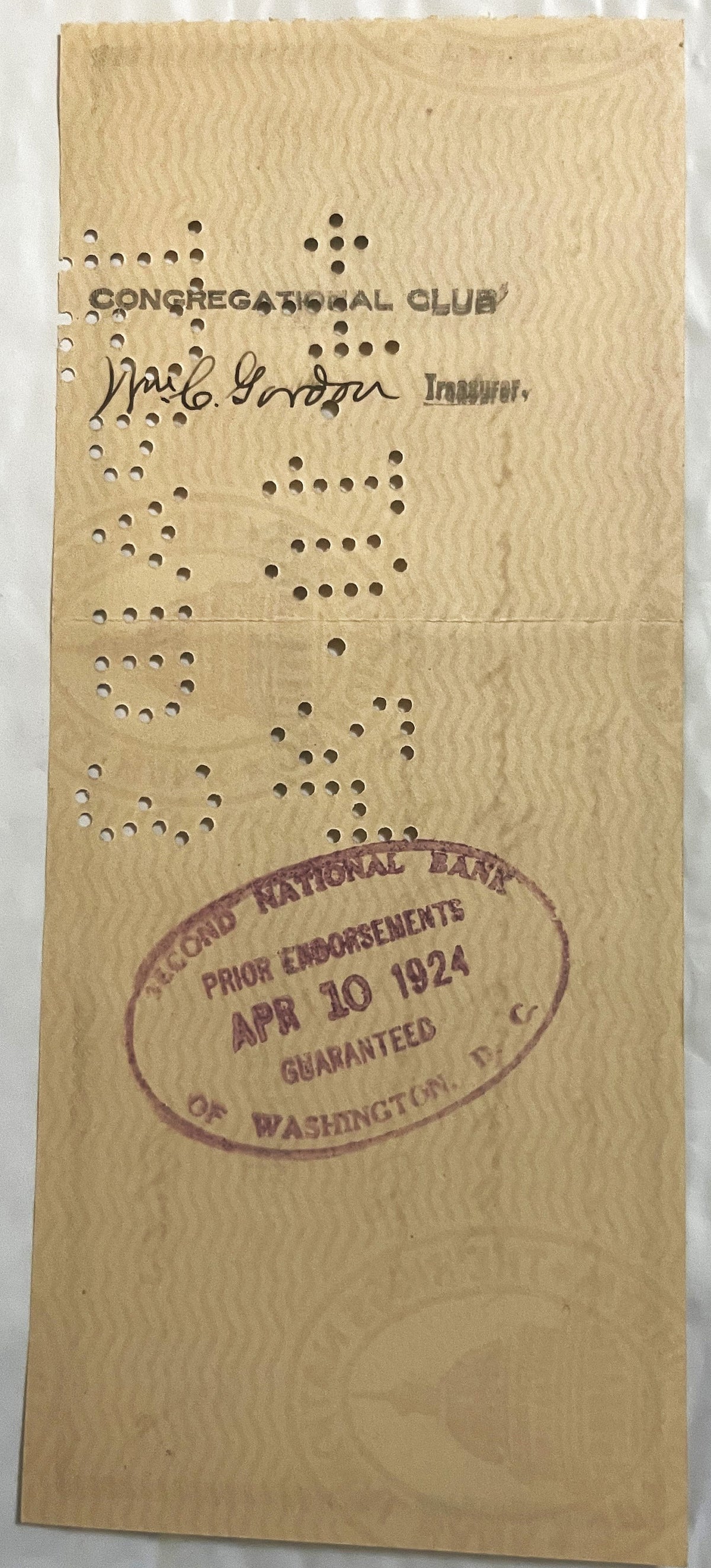
A paid check was not thrown away on the spot. These carry the marks of the trip: hand-written entries on the face, a pattern of punched holes driven through the paper once the check was paid, and on the back, endorsements plus the oval rubber stamps banks used when they passed a check along, guaranteeing the endorsements before theirs. Read together, the front and back of one check are a small map of money moving around Washington.

📜 The End of Riggs

The bank that financed a war and redeemed the Alaska gold did not end quietly. In May 2004 Riggs was fined $25 million for money-laundering violations, and on May 13, 2005, it was acquired by PNC. A Riggs check from those decades is now a piece of a Washington institution that no longer exists under its own name.


🖼️ Display Ideas

  • 🏛️ Framed with a ten-dollar bill turned to the Treasury side, where Riggs's look-alike neighbour appears.
  • 📚 In a shadow box with other Washington, D.C. paper: postcards of Pennsylvania Avenue, stamps, a period map.
  • 🖋️ On a banker's or lawyer's desk with a dip pen, front side out so the engraved building shows.
  • 🎁 For anyone who has worked at Riggs or PNC, a Washington native, or a teacher who wants a primary-source object from American banking.

🎁 Who Collects These

Check collectors want engraved vignettes, and a bank that pictured its own building on its checks is exactly that. Washington, D.C. collectors want Riggs because it was the capital's bank. Presidential collectors come for the bank Lincoln and Grant used. And banking historians collect the forms themselves — a FORMERLY line and a 1911-system transit number say more about how American banking changed than most textbooks.

❓ Questions People Ask

Is this an original check?
Yes — written out, paid and punch-cancelled at the time, not a reprint.

Will I get the check in the photos?
No two are alike. Yours carries its own number, date, payee, amount and signature.

What sizes are there?
Two, Large and Small, with the measurements at the top of this page.

What does "Formerly Riggs & Co." mean?
That was the name of the private house George Washington Riggs ran after 1854. The national charter came in 1896, and the earlier check form kept the old name printed under the new one.

Is Riggs Bank still in business?
No. PNC Financial Services acquired Riggs on May 13, 2005.

Was the Riggs building on the ten-dollar bill?
No. The note shows the Treasury, and the look-alike building behind it is the bank next door to Riggs, not Riggs itself.

Shipping

🚚 Shipping & Handling

  • Shipping costs and timing are calculated at checkout.
  • Items curated and shipped directly by me include U.S. shipping at no additional cost, professionally packed to ensure safe arrival of your artifact.

Items from Vetted Pro Collectors
Shipping for items offered by vetted Pro Collectors is determined at checkout. All Pro Collector listings are reviewed to ensure fair, reasonable shipping practices.

For full details, please refer to our Shipping Policy.

Returns & Exchange

Take your time — you've got a full six months. If a piece isn't right for you, send it back the way it reached you and we're good.

In the first 30 days your money goes straight back the way you paid. After that it's store credit, so you can put it toward something you'd rather have.

Return shipping we sort out between us, case by case. I don't make this difficult.

If something arrives damaged, or it isn't what I said it was, send me a photo within 48 hours and I'll make it right.

Email info@vintageantiquesgifts.com or call 802-356-9872 — that's me answering, not a call center.

The only things I can't take back are custom or special-order pieces and gift cards.

View full details