

Skip to product information
1 of 3

Vintage and Antique Gifts

Vintage 1995 Tampa Bay Devil Rays License Plate 🐟 MLB Genuine Merchandise Sign Express Duluth GA NOS

Regular price 7.00 USD
Regular price Sale price 7.00 USD
Sale Sold out
Shipping calculated at checkout.

Description

Remember The Day Tampa Bay Finally Stopped Waiting? 🌴⚾

There's a very specific kind of civic pride that only shows up once — the day your hometown finally gets a big-league team after years of near-misses and broken promises. If you were anywhere near St. Petersburg or Tampa in the mid-1990s, you remember it: the teal and black popping up in store windows almost overnight, a strange new manta ray logo suddenly on car bumpers and garage walls, and the slightly funny name — Devil Rays — that took a minute to feel like it belonged to anybody. This vintage license plate is a small, sturdy piece of that exact moment. It's a New Old Stock piece — meaning it was made for retail, tucked into inventory, and never once bolted to a bumper or hung on a wall. It's sat, untouched, ever since.

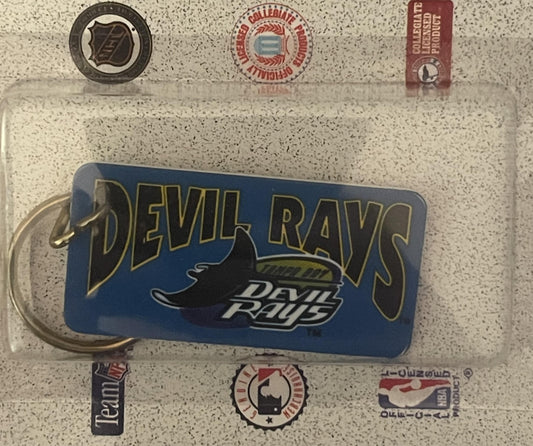
This is a licensed novelty automobile plate for the Tampa Bay Devil Rays, produced and distributed by Tag Express of Duluth, Georgia, measuring a true 12 x 6 inches (about 30.5 x 15 cm) — standard license plate dimensions, with the correct mounting slots for a bumper or garage bracket. The face is an offset color print with halftone shading, done in blue, black, yellow, white, gray, green, and purple. Across the top, bold white block lettering reads "TAMPA BAY," and beneath it the word "DEVIL RAYS" sprawls in enormous black letters outlined in gold, throwing a dramatic gray shadow across the plate like a marquee sign. Anchoring the composition is the franchise's original manta ray mascot — a sleek black ray in mid-glide, wings spread — paired with the team's oval primary logo in green, gold, and purple reading "TAMPA BAY DEVIL RAYS." A small MLB "Genuine Merchandise" seal sits in the lower corner, alongside the manufacturer's mark, "TAG EXPRESS DULUTH, GA 30136," and a printed line reading "© MLB 1995." That copyright year is stamped right into the design — it isn't the year this individual plate came off the line, but it is the year the identity itself was born, which is a story worth telling in full.


⚖️ Born From A Lawsuit: How Tampa Bay Finally Got Its Team

The Devil Rays didn't arrive through a tidy expansion process. They arrived through years of persistence and, in the end, a fair amount of legal grit. Tampa-area businessman Vince Naimoli had spent the better part of three decades chasing Major League Baseball for the Bay area, including a serious attempt to purchase the San Francisco Giants outright and relocate them to St. Petersburg. When MLB's owners blocked that sale in 1992, Naimoli sued the league for tortious interference. Part of settling that dispute involved handing his ownership group something bigger than a settlement check — a brand-new expansion franchise of their own.

On March 9, 1995, at a league meeting in West Palm Beach, MLB owners voted 28-0 to welcome two new expansion clubs into the fold at once: the Tampa Bay Devil Rays and the Arizona Diamondbacks. Two franchises, born on the very same afternoon, after Major League Baseball had rebuffed no fewer than seven separate attempts to bring a team to the Tampa–St. Petersburg area over the preceding fifteen years. That date is exactly why this plate carries a "© MLB 1995" copyright line — the Devil Rays' name, colors, and manta ray identity were locked in and licensable a full three years before the team ever threw a pitch. This piece belongs to that early wave of pre-launch and inaugural-era fan merchandise that hit stores once MLB cleared the new identity for production, well ahead of the club's actual 1998 debut season.


🐟 From "Sting Rays" To "Devil Rays": A Name Born Of A Standoff

Here's a bit of franchise trivia that even plenty of longtime fans never learned: Naimoli's original plan wasn't "Devil Rays" at all — he wanted to call the team the Tampa Bay Sting Rays. The trouble was, a minor-league outfit clear across the country, the Maui Stingrays, already held that name. Local legend passed down among collectors has it that the Hawaiian club offered to sell the naming rights for around $35,000 — a modest sum by the standards of launching a major-league franchise — but rather than pay it, Naimoli's ownership group simply pivoted to a different species of ray entirely. The Tampa Bay Devil Rays were introduced to the baseball world instead, and every version of that manta ray logo you'll ever see — including the one printed right on this plate — exists because of a naming standoff that quietly never got resolved. Collectors also like to note that jersey and cap designs bearing the new identity reached store shelves as early as November 1995, meaning fans were already wearing the logo nearly three full years before the Devil Rays played a single game.


🏟️ The Losing Years — And The Men Who Built Them

The front office that would carry the Devil Rays into their first season took shape over the following two years. Chuck LaMar, formerly the assistant general manager of the Atlanta Braves, was named the team's first general manager, and on November 7, 1997, Larry Rothschild — a pitching coach who had cut his teeth with the Marlins and the Cincinnati Reds — was named the club's first-ever manager, just ahead of the expansion draft that stocked the roster for 1998. The Devil Rays took the field for their inaugural season under Vince Naimoli's ownership, and what followed was a genuinely rough first decade. The franchise finished last in the AL East in every season but one, and in that lone exception — 2004 — they still finished second-to-last. For ten straight years, the manta ray on this exact logo was a symbol fans loved fiercely and defended stubbornly, even as the wins stayed scarce.


🌅 Dropping "Devil": Why This Logo Was Retired

Everything changed in the mid-2000s. Stuart Sternberg purchased controlling interest in the club from Naimoli, and following the 2007 season, he made the boldest branding decision in franchise history: the team shortened its name from "Devil Rays" to simply the "Rays," reframing the identity around a burst of sunshine rather than a manta ray. The turnaround that followed is one baseball historians still point to — the franchise had never posted a winning record as the Devil Rays, and it broke through for its first winning season, an American League pennant, and a World Series appearance the very next year, 1998 as the Rays. A second World Series trip followed in 2020, and the club built a reputation for a lean, analytics-driven, low-payroll approach to roster-building that stood in sharp contrast to its early struggles. That's precisely why this "Devil Rays" logo — the manta ray, the gold-outlined block lettering, the original oval crest — carries so much collector weight today. It isn't the franchise's current branding; it's the discontinued, single-decade identity of a team's hardest years, retired the moment the club started winning under a new name. Anything wearing this exact manta ray logo predates the rebrand entirely.


🏭 Tag Express And The Novelty Tag Trade Of Duluth, Georgia

Every plate like this one carries the stamp of its maker right on the face: TAG EXPRESS, DULUTH, GA 30136. Duluth sits in Gwinnett County, in the light-industrial and warehousing corridor northeast of Atlanta — exactly the kind of suburban address that, through the 1990s, quietly supplied sports bars, five-and-dimes, souvenir stands, and gas-station spinner racks across the Southeast with officially licensed fan gear. Firms working out of that stretch of metro Atlanta produced novelty plates for college programs and pro franchises alike, running the same equipment and the same offset color-print process across whatever license came through the door that season — this piece shares its production stamp with, among other things, a companion novelty plate produced for Auburn Tigers fans, evidence of a company built to serve both the college and professional sides of Southern sports fandom rather than a single team or league. Firms like this rarely left behind the kind of corporate paper trail — annual reports, trademark filings, local news profiles — that bigger manufacturers did; their footprint survives mostly in the plates, pennants, and keychains they left in circulation, which is exactly the kind of small, regional company history this piece helps keep alive. What we know for certain is stamped right into the object itself: a real Georgia address, a real MLB license, and a genuine piece of the licensed-merchandise boom that surrounded expansion baseball in the 1990s.


🖼️ Display Ideas

  • ⚾ Mount it above a home bar or man-cave shelf as a centerpiece for Devil Rays memorabilia
  • 🌴 Pair it with other 1990s Tampa Bay sports collectibles for a "birth of the franchise" grouping
  • 🚗 Hang it in a garage or workshop the way fans did the very first year this logo existed
  • 🖼️ Frame it behind glass as a piece of retired sports-branding history alongside a photo of the current Rays logo
  • 🏡 Give it a spot in a Florida beach house or lake house as a nostalgic nod to the Bay area
  • 🎁 Wrap it up for a lifelong Rays fan who remembers rooting for the team before it ever won a game

🎁 Who Collects These

This one draws a wide range of collectors: lifelong Tampa Bay baseball fans who followed the club through its Devil Rays years and want a piece of that original identity; MLB logo and mascot collectors chasing retired team branding across all thirty franchises; expansion-era memorabilia hunters who focus specifically on the class of 1995-1998, alongside Arizona Diamondbacks pieces born the same afternoon; and license-plate and automobilia collectors who prize novelty tags as a distinct category of Americana in their own right. It also appeals simply to anyone who remembers what it felt like the year Tampa Bay finally got its team — and wants that feeling on a wall.


❓ FAQ

Is this an actual state-issued license plate?

No — this is a licensed novelty or "booster" plate, made for display and fan use rather than as a legal road plate, produced under a Genuine MLB Merchandise license.

What size is it?

It measures a true 12 x 6 inches (about 30.5 x 15 cm), the standard license plate footprint, with mounting slots positioned for a normal plate bracket.

Why does it say "Devil Rays" instead of "Rays"?

"Devil Rays" was the franchise's original name and manta ray logo, used from the club's 1995 founding through the 2007 season, before ownership shortened the name to the "Rays" ahead of the 2008 season. This plate carries that original, now-retired identity.

What does the "© MLB 1995" date actually mean?

That's the year the Devil Rays name, colors, and logo were officially created and copyrighted by MLB — the year the franchise was awarded to Tampa Bay — not necessarily the exact year this individual plate was printed. Novelty goods carrying this identity were produced across the years the Devil Rays name was MLB's active licensed branding for the club, roughly 1995 through 2007.

What condition is it in?

It's New Old Stock — made for retail, held back in inventory, and never mounted or sold at the time.

Who made it?

Tag Express of Duluth, Georgia, a regional distributor of officially licensed novelty automobile plates that produced items for both college and professional sports fans through the 1990s.

Is this the same logo the Tampa Bay Rays use today?

No — this manta ray design and "Devil Rays" wordmark were retired when the franchise rebranded to the Tampa Bay Rays in 2008, which is exactly what makes this earlier identity a piece of franchise history rather than current branding.

Shipping

🚚 Shipping & Handling

  • Shipping costs and timing are calculated at checkout.
  • Items curated and shipped directly by me include U.S. shipping at no additional cost, professionally packed to ensure safe arrival of your artifact.

Items from Vetted Pro Collectors
Shipping for items offered by vetted Pro Collectors is determined at checkout. All Pro Collector listings are reviewed to ensure fair, reasonable shipping practices.

For full details, please refer to our Shipping Policy.

Returns & Exchange

Take your time — you've got a full six months. If a piece isn't right for you, send it back the way it reached you and we're good.

In the first 30 days your money goes straight back the way you paid. After that it's store credit, so you can put it toward something you'd rather have.

Return shipping we sort out between us, case by case. I don't make this difficult.

If something arrives damaged, or it isn't what I said it was, send me a photo within 48 hours and I'll make it right.

Email [email protected] or call 802-356-9872 — that's me answering, not a call center.

The only things I can't take back are custom or special-order pieces and gift cards.

View full details