
Skip to product information
1 of 3

Vintage and Antique Gifts

Antique La Amita Habana Cigar Band 🚬 Tampa Florida Perfecto Garcia and Bros Germany Printed Rampant Lion Collector Cigar Band

Antique La Amita Habana Cigar Band 🚬 Tampa Florida Perfecto Garcia and Bros Germany Printed Rampant Lion Collector Cigar Band

Regular price $5.50 USD
Regular price Sale price $5.50 USD
Sale Sold out
Shipping calculated at checkout.

Size: 2 3/4" x 3/4"

🚚 Free US Shipping — ships within one business day. International shipping calculated at checkout.

Quantity

Who Made La Amita Cigars? 🦁 Antique Embossed La Amita Habana Cigar Band, Perfecto Garcia & Bros., Tampa, Florida, Printed in Germany

Size: 2 3/4" x 3/4" ~ NOS unused stock, little to no storage wear.

A Tampa cigar factory had three best-selling brands, and La Amita was one of them. J. C. Newman says so in its history of the Perfecto Garcia factory, and the other two were Perfecto Garcia and Perla Del Mar. J. C. Newman still rolls cigars at its El Reloj factory, right beside the old Garcia building. So La Amita was no throwaway name. It was a cigar the factory was known for.

And the trade papers back that up. In 1911 The Tobacco World reported that Charles Mattheas & Co. had taken up "the 'La Amita' brand of Garcia & Bros." In 1912 it said Perfecto Garcia & Bro., of Tampa, with main offices in Chicago, were "selling a great many 'La Amitas'," and by 1914 and 1915 it was calling them the makers of "the well-known 'La Amita'." Out in California the Oakland Tribune was running display ads in 1911 and 1912 for "LA AMITA - World's Finest 12 1/2c Cigars." That's more than twice the price of a nickel cigar.

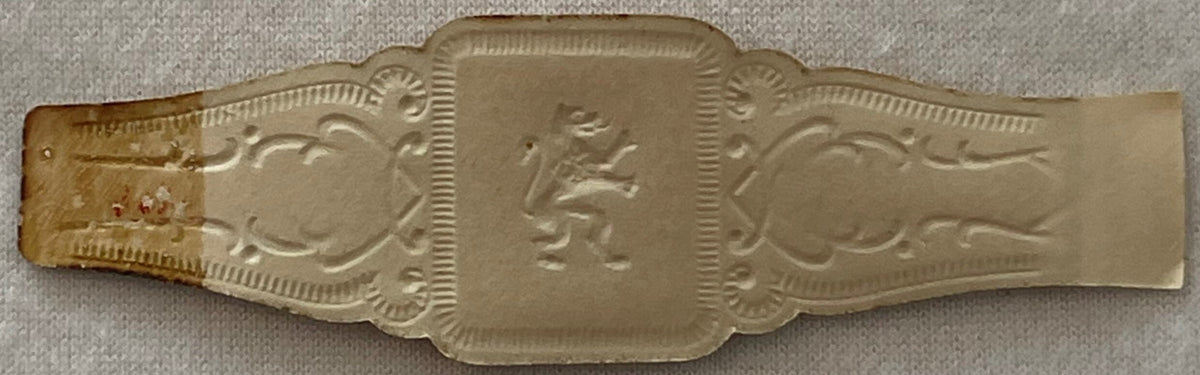
Inside a gold border, a red panel carries LA AMITA at the top, a gold lion rearing on his hind legs in the center, and HABANA at the bottom. The red wings hold white lettering inside gold scrollwork, TAMPA, FLA on one side and PERFECTO GARCIA & BROS on the other. At the end is a plain white tab with the word Germany printed sideways in red. On the back, the blank paper shows the lion, the frame and the scrolls pushed up in relief.

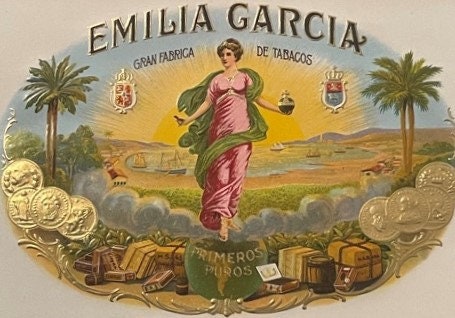
That -ita on the end of Amita is the Spanish ending for something small and affectionate. The brand also had a large box label. The University of South Florida keeps a copy in its John William Osterweil Collection of Tampa Cigar Box Labels, listed under Perfecto Garcia & Bros. and the Consolidated Lithographing Corporation and dated to the 1900s. It shows a woman looking back over her shoulder in an ornamental golden frame, with the words LA AMITA, MILD CIGARS, TAMPA, FLA. That date is really just the catalog's placeholder: Consolidated only started up on January 1, 1926, so their label is later than that, and it shows La Amita was still going after 1925.

The name itself is even older than the Garcia firm. On April 25, 1904 the Calvert Lithographing Co. of Detroit, Michigan filed "LA AMITA" for cigars with the U.S. Patent Office as a label, and it ran in the Official Gazette and in Scientific American's label list that spring. By 1911 the trade was calling it the brand of Garcia & Bros.

🌍 Germany on the tab

Collectors have long told a story about this. The best bands for Tampa's top factories, they say, came from German lithographers in places like Hamburg and Leipzig, who printed enormous runs and shipped them across the Atlantic flat. The word on the tab shows plainly that this band was printed in Germany. And the record bears the collectors out. American label makers testifying at the 1909 tariff hearings said that in cigar bands "the European manufacturers have taken the largest part of the market." When the First World War cut off German imports, the American lithographers took the work, and in October 1919 The Tobacco World was warning that "German cigar bands and German labels will be offered to the cigar manufacturers" again, with imports "marked with the country of origin" - which is exactly why that one word sits on the tab. American printers wanted that trade too. William Steiner and Isaac Rosenthal founded a New York lithography firm in 1884 to print cigar bands exclusively. Around 1911 it issued a sample book called German Process Cigar Bands, in embossed color lithography, and its advertising said every design was perfect and superior to most imported bands.

✨ Embossing and gold

The gold on a band like this stands up from the paper because a die pressed it from behind. By 1892 label printers had 38-ton presses and precisely machined dies for the job, and they used strong rag paper, because its long fibers stretch where cheaper paper would tear. The embossing process highlighted the raised areas with 22-karat gold or bronze leaf. The golden age of stone lithography is usually put between about 1870 and 1920, and in the 1920s photographic printing took over.

Collectors pass along a bolder claim. The most prestigious Tampa houses, the old-timers say, demanded real gold and not gold-colored ink, which is why the best surviving examples still glow warm instead of looking brassy like cheaper ones. People have been repeating that for generations.

🌴 Ybor City

Vicente Martinez Ybor fled Cuba in 1869 and settled in Key West, where he opened a cigar factory. In October 1885 he bought forty acres of scrubland northeast of Tampa, lured by a $5,000 subsidy from Tampa's Board of Trade, and he moved his business up from Key West. His brick factory opened in late 1886 and was the biggest cigar factory in the world at that moment. Ignacio Haya of Sanchez & Haya beat him to the first cigar, rolling it on April 13, 1886. Tampa annexed the neighborhood in 1887.

The workers were mostly Cuban and Spanish, and Italians came later. A cigar called clear Havana was made in the United States from Cuban tobacco, mostly by Cuban hands, and that got around the steep tariff on finished cigars shipped in from Cuba. The leaf the top Ybor factories went after came from the Vuelta Abajo, a strip of country about 90 miles long and 10 wide in Pinar del Rio Province, out in the far west of the island, with the Sierra de los Organos mountains along its north side. The tobacco trade there goes back to around 1830, and a lot of serious smokers will still tell you nothing grown anywhere beats it. The workers paid about 5 percent of their wages in dues to mutual aid societies. These included the Centro Espanol, founded in 1891, and the Centro Asturiano, started in 1902 by immigrants from Asturias, the part of Spain the Garcias came from. There was also El Circulo Cubano and L'Unione Italiana. Members got libraries, free medical care and sports teams. About 500 million cigars were rolled in 1929, the peak year. After that the Depression and the machines took the trade apart.

The Columbia Restaurant was opened by Casimiro Hernandez Sr. in 1903 under the name Saloon Columbia. It became the Columbia Restaurant in 1905, and it is still serving.

If I had to pick one thing I love about Ybor City, it is the lectores. Each factory had a reader up on a raised platform who read newspapers and novels aloud while the rollers worked, and the rollers voted on what they wanted to hear. A lector platform still stands on the third floor of J. C. Newman's El Reloj factory, near the filler department. The end came on November 26, 1931. Seventeen workers had been jailed over a demonstration marking the anniversary of the Russian Revolution, and the owners banned the readings, accusing the lectores of spreading communist propaganda. About 8,000 workers struck. It ended December 15, and the lectores never came back.

Local legend says the strictest Ybor factories never scolded a sloppy roller. They quietly moved him to another station and said nothing. True or not, it shows how much a good roll mattered.

🏭 Perfecto Garcia & Bros.

Perfecto Garcia was born in Asturias, in northern Spain, and lived from 1870 to 1930. He came to Chicago from Cuba in 1895, then sent for his brothers Angel, Jose and Manuel so the family could run cigar ventures in Chicago and Tampa. The firm, Perfecto Garcia & Bros., dates from 1905. Their first Tampa factory burned down sometime between 1905 and 1908. Until they could rebuild, they used Factory No. 1 of Sanchez & Haya, known as La Flor de Sanchez y Haya.

They put up a new factory at 2808 North 16th Street in Ybor City in 1914. It is a three-story Romanesque Revival brick building with a water tower for fire protection, and when it opened in 1917 it had 1,200 people on the payroll. The hand-rolled cigars used a blend of tobacco from the Garcia family's Florida farms and Cuban leaf imported by the Oliva Tobacco Co. Perfecto himself retired in 1926.

One rumor among tobacciana researchers says many of the smaller Ybor brand names were dreamed up by factory floor managers or by tobacconists who wanted a name of their own. La Amita is not that kind of name. It ranked among the top three sellers of a factory with a documented history.

📉 What became of the factory

The 1960 Cuban embargo, machines, higher wages, taxes and weak demand all wore the business down. The Garcias sold to Havano Cigar Co., which installed hand-assisted rolling machines made by American Machine and Foundry. They reached 60,000 cigars a day, and that still was not enough. Next came United States Tobacco, which abandoned the building in 1982 and moved its work to modern factories in Pennsylvania. The old factory still stands, and its newest owners hope to make it a co-op space.

📖 A short history of the cigar band

Historians credit Gustave Bock, a Dutch-born cigarmaker working in Cuba, with inventing the band in the 1830s. He had paper rings printed with his signature for the cigars he shipped to Europe. By the middle of the 1850s nearly every Cuban cigarmaker was banding exports. Older tales say Catherine the Great had her cigars wrapped in silk, or that bands kept gentlemen's white gloves clean. Historians call those theories fanciful, and I think they are fun anyway.

The years from 1890 to 1920 are called the golden age of cigar art. About four in five American men smoked cigars around 1900, and roughly 2 billion bands were sold in the United States in 1900 alone. Printers precut them and bundled them 100 to a pack, and workers glued each one on by hand with a dab of plant-based paste. Collecting bands has its own name, vitolphilia. Joe Hruby's collection is listed in the Guinness Book of World Records for more than 165,000 different bands.

📅 How old is it?

Nothing on the band is dated. The firm only began in 1905, so no band can be older than that, and I have always had these as 1910s to 1930s.

Every one I have is unused. A band album, a small frame, or a shadow box beside an old cigar box suits them well, and they are a natural gift for anyone with Tampa or Ybor City roots. The supply is finite. Nobody is embossing bands like this anymore, and once the limited supply for sale is gone, these will be very difficult to acquire.

Shipping

🚚 Shipping & Handling

  • Shipping costs and timing are calculated at checkout.
  • Items curated and shipped directly by me include U.S. shipping at no additional cost, professionally packed to ensure safe arrival of your artifact.

Items from Vetted Pro Collectors
Shipping for items offered by vetted Pro Collectors is determined at checkout. All Pro Collector listings are reviewed to ensure fair, reasonable shipping practices.

For full details, please refer to our Shipping Policy.

Returns & Exchange

Take your time — you've got a full six months. If a piece isn't right for you, send it back the way it reached you and we're good.

In the first 30 days your money goes straight back the way you paid. After that it's store credit, so you can put it toward something you'd rather have.

Return shipping we sort out between us, case by case. I don't make this difficult.

If something arrives damaged, or it isn't what I said it was, send me a photo within 48 hours and I'll make it right.

Email info@vintageantiquesgifts.com or call 802-356-9872 — that's me answering, not a call center.

The only things I can't take back are custom or special-order pieces and gift cards.

View full details
  • 5 stars: 2 (100%)
  • 4 stars: 0 (0%)
  • 3 stars: 0 (0%)
  • 2 stars: 0 (0%)
  • 1 star: 0 (0%)
L
Lloyd

I’m a very happy customer! Thank you!!!

K
Kate

Nice product, speedy shipping, charming note included. Good purchase. Thank you.

Pleasure is all ours! We appreciate it.

Rescuing American History Since 2007

— Travis & the Kids