

Skip to product information
1 of 3

Vintage and Antique Gifts

Vintage 1960s Uncle Willie Cigar Band 🚬 T.E. Brooks Red Lion PA Monogram Crest — NOS Tobacco Ring Label Collectible

Vintage 1960s Uncle Willie Cigar Band 🚬 T.E. Brooks Red Lion PA Monogram Crest — NOS Tobacco Ring Label Collectible

Regular price $6.00 USD
Regular price Sale price $6.00 USD
Sale Sold out
Shipping calculated at checkout.

Size: 2 3/4" x 3/4"

🚚 Free US Shipping — ships within one business day. International shipping calculated at checkout.

Quantity

Who Smoked Uncle Willie Cigars? H.L. Mencken Ordered His Uncle Willies Without the Band. This Is the Band. 🚬

Size: 2 3/4" x 3/4"

Once a month, three hundred Uncle Willie cigars went to 1524 Hollins Street in Baltimore, bundled fifty to a bunch, with no bands on them. The man who ordered them was H.L. Mencken, the Sage of Baltimore, and he called Uncle Willie "the cleanest, mildest and best-made five-cent cigar." He wanted the smoke, not the paper.

This is the paper. An unused Uncle Willie cigar band in red and metallic gold, the brand name split around a central oval, and three interlaced letters in the middle of it: T E B. Those are the initials of T.E. Brooks & Co. of Red Lion, Pennsylvania, the cigar house that took over Uncle Willie in 1963 when it bought out the Baltimore firm that made it. Mencken had died in 1956. The nickel cigar he swore by carried on under a Pennsylvania monogram, and this band is what that looked like.

🔍 The Band Itself

A die-cut paper cigar band, 2.75 x 0.75 inches. A deep red field carries metallic gold scrollwork and a row of gold roundels running out toward both ends. UNCLE arches across the top of the oval and WILLIE curves along the bottom, in white capitals. The TEB monogram sits in white inside a gold ring at the very center. One end runs out into a plain cream tab.

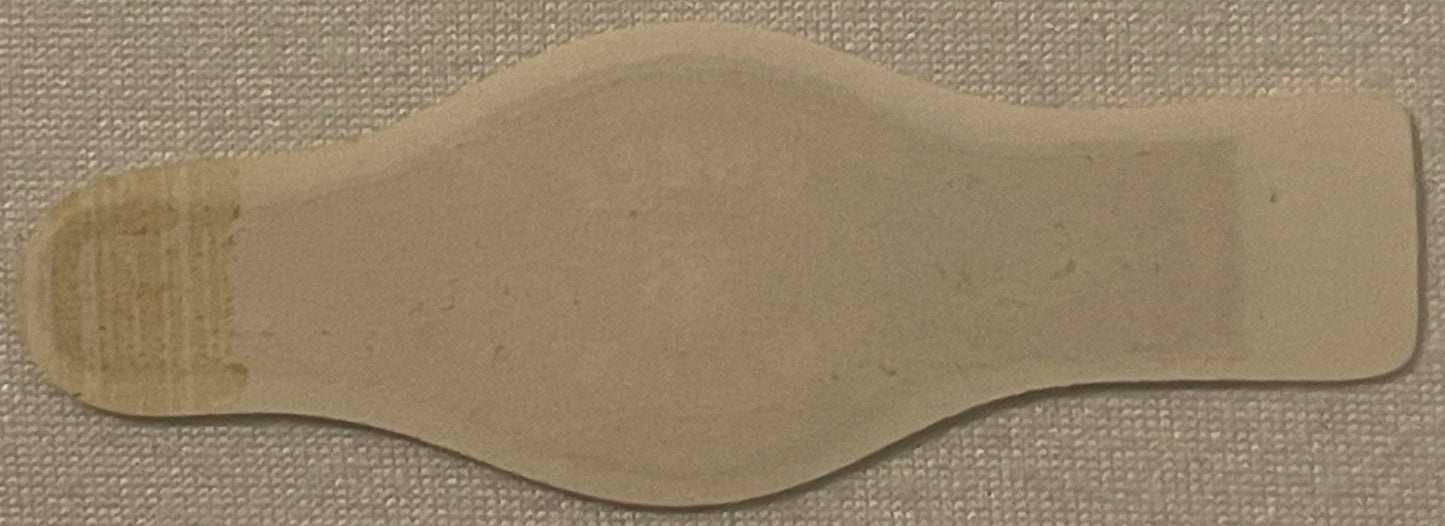
Turn it over and the back is plain cream paper with a small rectangular patch of gum at one end. That gum was meant to be wetted and pressed shut around a cigar. It never was. This band is New Old Stock: printed, stored, and never put on a cigar.

🎩 Baltimore First: Schafer-Pfaff and Uncle Willie

Before it was a Red Lion brand, Uncle Willie belonged to Baltimore. H.C. Pfaff founded a cigar factory in the city in 1890. It changed hands in 1929, and as the Schafer-Pfaff Cigar Co. it ran a manufacturing division at Aliceanna and Wolfe streets in Fells Point, the old waterfront neighborhood. That plant rolled Uncle Willie alongside Fire King, Imperio, Pride of Baltimore, and two brands named for city landmarks, Monument Square and Clifton Park. The company also kept a retail store at Lombard and Light streets, and its manufacturing division was headed by Theodore R. Brockman, whose great-uncle had founded the business.

In 1963 T.E. Brooks & Co. bought Schafer-Pfaff out and shut the Fells Point factory for good. Uncle Willie went up the road to York County, and Uncle Willie Perfecto boxes and five-cigar packs marked T.E. Brooks & Co., Red Lion, PA are its later production.

✍️ The People: Mencken and the Cigar Trade

Mencken grew up inside the business. His father, August Mencken, ran Aug. Mencken & Bro., a Baltimore cigar factory started in the 1870s on a few dollars of capital, with brands such as Havana Rose and La Cubana. The son spent roughly three and a half miserable years working there. When his father died in 1899 he left the factory behind and went into newspapers, and the cigar maker's son became the Sage of Baltimore.

He never lost the habit. He took up cigars at sixteen, at his father's suggestion, and he was rarely photographed without one. His brother August remembered that he chewed more of them than he smoked, and his hay fever kept him off cigars every September. When it came to a brand of his own, he chose a Fells Point nickel cigar, rated it above the advertised brands selling for eight cents, and took it without the band.

🏭 The Company: T.E. Brooks & Co.

Thomas E. Brooks built his firm the way the Red Lion cigar men did, one partnership at a time. In 1900 he joined D.A. Horn, S.S. Sechrist and Fred Smith to form the Porto Rico Cigar Co., which lasted five years. In 1906 he bought out H.L. Haines and F.J. Holtsinger. In 1914 he combined with S.E. Sechrist to form T.E. Brooks & Co., and by 1930 the company was running five Pennsylvania factories. Its brands included Tebson Invincibles, whose name opens with the same three letters as this band's monogram, along with Have A Sweet and Canadian Club.

World War I made the big Red Lion houses. Soldiers smoked more than the benches could turn out, and the town's old cigar hands later remembered the war years as the time Brooks and the other big firms made their money.

🦁 The Town: Red Lion, York County

In 1880 Red Lion had one cigar factory with three or four people in it. By 1886 there were thirty factories in town. By 1927 there were 109, and most of those were probably no more than a man, his wife and a child. That year Red Lion rolled a fifth of all the nickel cigars made in America. York County as a whole turned out 573 million cigars in 1920, twenty percent of every cigar made in the country.

It was hand work, and mostly women's work: women rolled, men bunched the filler, and a fast roller could finish eight or nine hundred cigars in a day. Then the machines arrived. A fully automatic cigar machine made thousands a day where a hand roller made hundreds, and by 1928 a banding machine minded by two workers could put 30,000 bands on cigars in a day, against about 7,000 for a hand bander. The Depression, the rise of the cigarette and the machine undid what the war had built, and the Red Lion strike of 1934 was the hand trade's last stand.

The town has not forgotten. Red Lion still rings in every New Year with a Cigar Rise in Center Square.

🌎 The Impact: The Nickel Cigar

Towns like Red Lion existed to make the five-cent cigar. When the federal government reorganized cigar taxes in 1942, nickel cigars got a class of their own, Class C, for cigars selling for more than 4 cents and not more than 6. Mencken could have smoked anything he liked, and his verdict went to a nickel brand.

The factories that made those cigars are gone. The Fells Point plant closed in 1963, and York County's last cigar factory, Van Slyke and Horton on South Pine Street in Red Lion, has since shut its doors too. What survives of a brand like Uncle Willie is mostly paper: boxes, packs, and bands like this one, which were printed to be torn off and thrown away.

📜 The Lore of the Band

The old story about cigar bands is that they were first wrapped around cigars to keep tobacco stains off gentlemen's gloves. Whatever the truth of that, by the time Uncle Willie reached the counter the band's job was plain: name the brand and carry the maker's mark everywhere the cigar went. Band collectors even have their own name, vitolphilists, from vitola, the cigar maker's word for a cigar's size and shape.

✅ Condition

New Old Stock. Unused, never applied to a cigar, gum patch never wetted. The colors are strong, and the back has the light, even toning of long-stored paper.

🎁 Good For

  • Mencken readers and Baltimore collectors: the brand the Sage of Baltimore named the best nickel cigar going.
  • Red Lion and York County history: a band carrying the monogram of one of the town's big cigar houses.
  • Anyone with a Willie in the family: a small, specific gift for an Uncle Willie, a Grandpa Willie, or the Willie who still keeps a cigar in his shirt pocket.
  • Tobacciana and ephemera frames: flat, bright and small enough to float in a shadow box or slip into an archival sleeve beside boxes and labels.

❓ Questions People Ask

Who made Uncle Willie cigars?

First the Schafer-Pfaff Cigar Co. of Baltimore, at its plant at Aliceanna and Wolfe streets. From 1963, when Brooks bought that firm and closed its factory, T.E. Brooks & Co. of Red Lion, Pennsylvania.

What do the letters T E B on the band stand for?

T.E. Brooks, for Thomas E. Brooks, whose firm owned the Uncle Willie brand after 1963.

How old is this cigar band?

The Brooks monogram places it in 1963 or later, after Brooks took Uncle Willie over, which makes it a 1960s band from the brand's Red Lion years.

Did H.L. Mencken smoke cigars with this band on them?

No. Mencken's Uncle Willies came from Baltimore, unbanded, and he died in 1956, seven years before the brand passed to Red Lion. This is the brand he championed, in the form it took after him.

Has this band ever been used?

No. The gum on the back was never wetted and the band was never wrapped around a cigar. It is New Old Stock.

What is a cigar band collector called?

A vitolphilist, and the hobby itself is called vitolphilia.

Shipping

🚚 Shipping & Handling

  • Shipping costs and timing are calculated at checkout.
  • Items curated and shipped directly by me include U.S. shipping at no additional cost, professionally packed to ensure safe arrival of your artifact.

Items from Vetted Pro Collectors
Shipping for items offered by vetted Pro Collectors is determined at checkout. All Pro Collector listings are reviewed to ensure fair, reasonable shipping practices.

For full details, please refer to our Shipping Policy.

Returns & Exchange

Take your time — you've got a full six months. If a piece isn't right for you, send it back the way it reached you and we're good.

In the first 30 days your money goes straight back the way you paid. After that it's store credit, so you can put it toward something you'd rather have.

Return shipping we sort out between us, case by case. I don't make this difficult.

If something arrives damaged, or it isn't what I said it was, send me a photo within 48 hours and I'll make it right.

Email info@vintageantiquesgifts.com or call 802-356-9872 — that's me answering, not a call center.

The only things I can't take back are custom or special-order pieces and gift cards.

View full details
  • 5 stars: 1 (100%)
  • 4 stars: 0 (0%)
  • 3 stars: 0 (0%)
  • 2 stars: 0 (0%)
  • 1 star: 0 (0%)
m
mrmomofli

This seller is A+! great communication, label exactly as described. Will buy from you again!!

We appreciate it. We cant wait to work with you again!

Preserving History: Authentic Objects Across Eras

— Curated by Travis Weigel