Skip to product information
1 of 8

Vintage and Antique Gifts

Antique 1893 Big Four Railroad $1,000 Gold Bond 🚂 Cleveland Cincinnati Chicago St Louis, Bond Only

Antique 1893 Big Four Railroad $1,000 Gold Bond 🚂 Cleveland Cincinnati Chicago St Louis, Bond Only

Regular price $16.00 USD
Regular price Sale price $16.00 USD
Sale Sold out
Shipping calculated at checkout.

Size: 15" x 10"

🚚 Free US Shipping — ships within one business day. International shipping calculated at checkout.

Style
Quantity

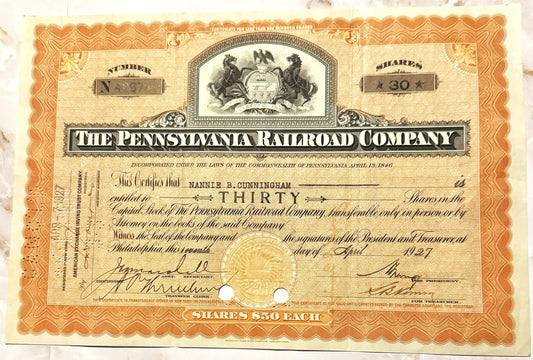
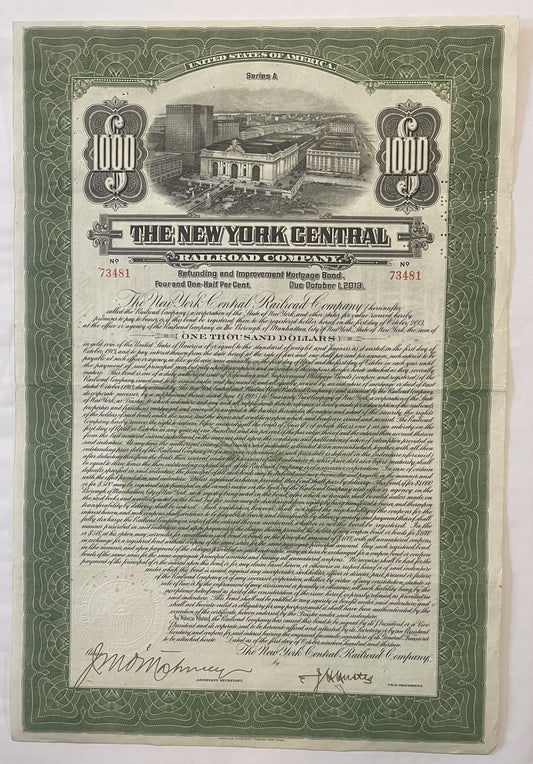
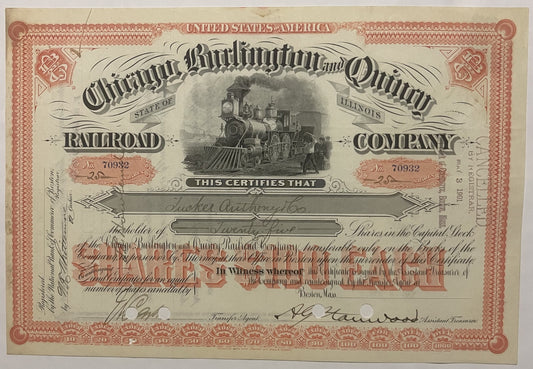
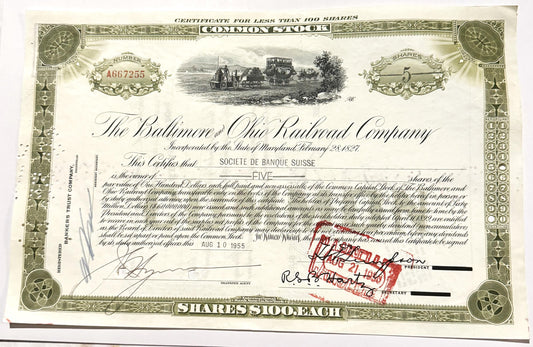
What Was the Big Four Railroad? 🚂 A $1,000 Gold Bond from the "Big Four"

Size: 15" x 10" ~ Punch-cancelled. They vary a little one to the next.

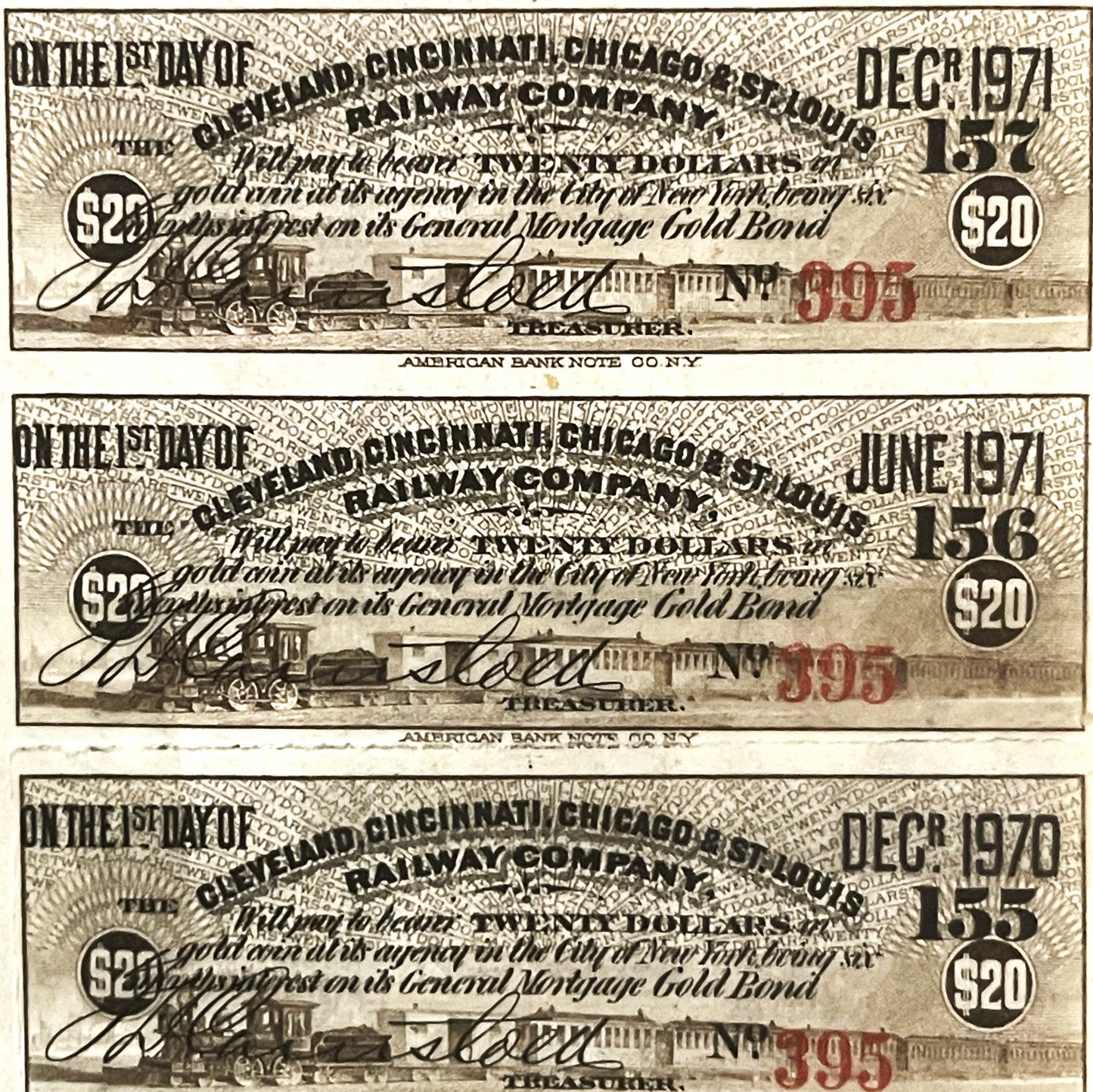
This is an antique General Mortgage 4% Gold Bond for The Cleveland, Cincinnati, Chicago & St. Louis Railway Company, the line everybody just called the "Big Four." It's a $1,000 bond out of an authorized issue of $50,000,000, dated the fifteenth day of May, 1893, with the principal due June 1, 1993 and interest payable every June 1 and December 1 in the City of New York. The American Bank Note Company of New York engraved and printed it, and The Mercantile Trust Company is named as trustee. A hundred-year bond. Somebody in 1893 was thinking a long way ahead. The centerpiece shows two women, one holding a sickle and the other a sheaf of wheat, standing between two steam locomotives pulling passenger cars on facing tracks, all under an arched banner with the railway's name. Down along the bottom border, UNITED STATES and OF AMERICA sit on either side of a little panel that reads GOLD 1000 DOLLARS, and the fine print means it: One Thousand Dollars "in gold coin of the United States of the present standard of weight and fineness." That's a lawyer's mouthful, and I love it. Each one is an issued bond, punch-cancelled at the end of its working life. The listing has two versions: the bond on its own, and the bond with part of its coupon sheet still attached. Each of those little coupons was a promise to pay the bearer $20 in gold, clipped and cashed twice a year.

🌾 "The Reapers"

Collectors know that central scene as "The Reapers," and it comes out of one of the great families of American bank-note engraving. George Frederick Cumming Smillie, born in 1854, started learning the trade at 17 under his uncle, James D. Smillie, at the American Bank Note Company. A Princeton University Library catalog credits the vignette "The Reapers No. 2" to G.F.C. Smillie and James Smillie, engraved in 1874. The American Bank Note Company kept its best vignettes on file and used them for years on bonds and certificates, which is how a scene cut in 1874 ended up on a railroad bond dated 1893. Smillie joined the U.S. Bureau of Engraving and Printing the very next year, in 1894, and spent the rest of his career engraving the country's own money. So the hand that cut these reapers went on to engrave American currency. I think that's a pretty good pedigree for a railroad bond.

🚉 One Railroad, Not Four

Despite the name, the Big Four was one company. It was formed on June 30, 1889, when three lines merged: the Cleveland, Columbus, Cincinnati & Indianapolis (the "Bee Line"), the Cincinnati, Indianapolis, St. Louis & Chicago, and the Indianapolis & St. Louis. The Bee Line was already a Vanderbilt road, so the Big Four was in the New York Central family from the start. Its main lines ran through Ohio, Indiana, Illinois and Michigan, and the bond itself calls the company "a corporation existing under the laws of the States of Ohio and Indiana." But look at the money side: a New York trustee, a New York engraver, and principal and interest payable in gold at the company's agency in the City of New York. Midwestern rails, New York paperwork. Its roots go back a long way. The Mad River & Lake Erie Railroad, chartered by Ohio in January 1832, was the first company incorporated for railroad purposes in the state, and through a string of mergers it ended up in the Big Four.

Melville E. Ingalls ran the Big Four as president from the 1889 merger until 1905, so every bond in this 1893 series was issued on his watch. His skill at running railroads was what caught the Vanderbilts' eye in the first place, and he stayed on as chairman of the board until he retired in 1912. The story goes that in 1901 a prominent Cincinnati architect brought him an elaborate depot design, and Ingalls turned it down flat and sent his own engineers back to the drawing board. That tells you something about how tightly those Gilded Age railroad presidents held the reins.

🏗️ What the Big Four Built

Between 1904 and 1908 the railroad built big locomotive and car shops at Beech Grove, Indiana. Amtrak bought them from the bankrupt Penn Central in 1975, and they're still Amtrak's Beech Grove Shops. At Bellefontaine, Ohio, the Big Four's terminal had the largest roundhouse then in use anywhere between New York City and St. Louis. Folks there were proud of it until Conrail closed the terminal in 1983 and the roundhouse came down. In 1895, two years after this bond was dated, the company picked up the bridge across the Ohio River at Louisville that still carries its name. The Big Four Bridge carried trains until 1969, sat as the "bridge to nowhere" for decades, and reopened for walkers and bikes in 2013 on the Louisville side and in 2014 on the Jeffersonville side. You can walk across it today.

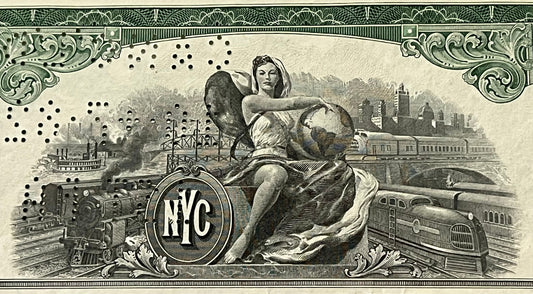
The New York Central took full control in 1906 and ran the Big Four as a separate company until around 1930. In 1930 the Central took a 99-year lease on it. Its later headquarters, the Chesapeake Building on South Meridian Street in Indianapolis, went up in 1929 and has been a Hampton Inn since 1996. The lines went into Penn Central in 1968, then into the government-backed Conrail in 1976, and when Conrail was split up after 1997, CSX and Norfolk Southern took the pieces.

Shipping

🚚 Shipping & Handling

  • Shipping costs and timing are calculated at checkout.
  • Items curated and shipped directly by me include U.S. shipping at no additional cost, professionally packed to ensure safe arrival of your artifact.

Items from Vetted Pro Collectors
Shipping for items offered by vetted Pro Collectors is determined at checkout. All Pro Collector listings are reviewed to ensure fair, reasonable shipping practices.

For full details, please refer to our Shipping Policy.

Returns & Exchange

Take your time — you've got a full six months. If a piece isn't right for you, send it back the way it reached you and we're good.

In the first 30 days your money goes straight back the way you paid. After that it's store credit, so you can put it toward something you'd rather have.

Return shipping we sort out between us, case by case. I don't make this difficult.

If something arrives damaged, or it isn't what I said it was, send me a photo within 48 hours and I'll make it right.

Email info@vintageantiquesgifts.com or call 802-356-9872 — that's me answering, not a call center.

The only things I can't take back are custom or special-order pieces and gift cards.

View full details

Preserving History: Authentic Objects Across Eras

— Curated by Travis Weigel