Skip to product information
1 of 11

Vintage and Antique Gifts

Antique 1913 New York Central Railroad $1,000 Bond 🚂 Payable in Gold Coin, 4.5% Refunding & Improvement Mortgage, Grand Central Terminal

Antique 1913 New York Central Railroad $1,000 Bond 🚂 Payable in Gold Coin, 4.5% Refunding & Improvement Mortgage, Grand Central Terminal

Regular price $22.00 USD
Regular price Sale price $22.00 USD
Sale Sold out
Shipping calculated at checkout.

Size: 15" x 10"

🚚 Free US Shipping — ships within one business day. International shipping calculated at checkout.

Style
Quantity

What Did a 1913 New York Central Bond Promise? 🚂 A Bond That Promised Gold

Size: 15" x 10" ~ Punch-cancelled, with its coupon sheet attached. They vary a little one to the next.

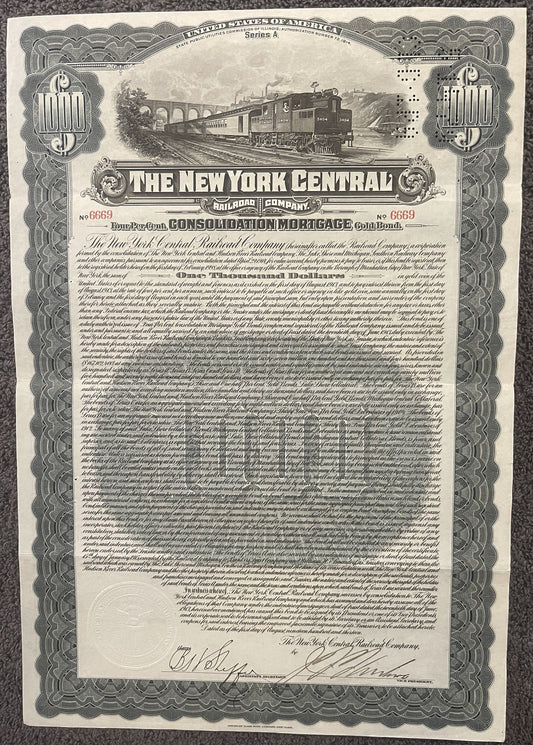
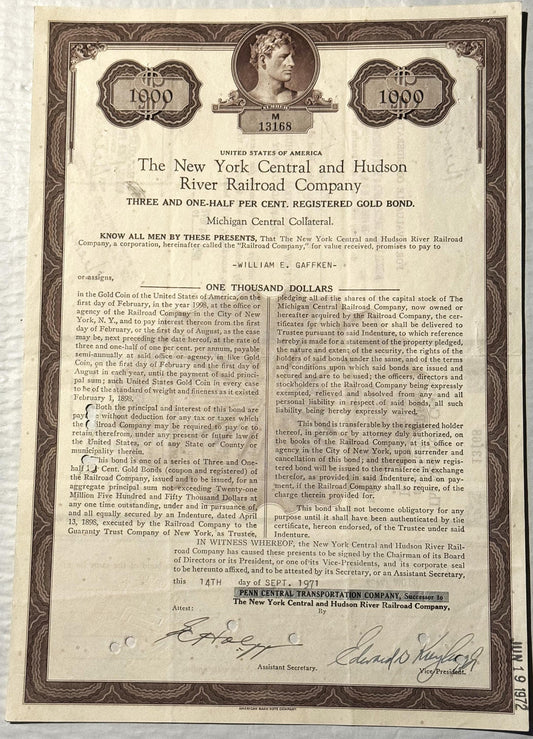
This is a New York Central Railroad Company bond, dated October 1, 1913 — a Refunding and Improvement Mortgage Bond, Series A, in the $1,000 denomination, drawn at four and one-half per cent, and due, right on its own face, October 1, 2013. A full century, printed into the paper itself. When the railroad dated it, Woodrow Wilson was still in his first year in the White House. It's a different animal from the New York Central's blue-gray Consolidation Mortgage bonds with the electric-locomotive vignette that the railroad floated that same year — this one is the Refunding and Improvement series, green ink, Grand Central Terminal in the vignette, and it still carries its coupon sheet. A "refunding and improvement" bond did exactly what the name says: raised fresh money to pay off older, costlier debt and fund new construction, secured against the company's own property under a mortgage held by a trustee.

I like a bond like this precisely because it isn't just old paper — it's a promise, printed out in plain English for anyone to read, and the promise is most of the story.

💰 The Gold Clause

Read the obligation closely and it says the company will pay you back in gold coin "of or equal to the standard of weight and fineness as it existed on the first day of October, 1913." Every coupon on the sheet makes the same promise in its own words: $22.50 in "gold coin of the United States of America." That was completely ordinary to print on a bond in 1913 — the country was on the gold standard, and a "gold clause" was the era's way of guaranteeing an investor against a weaker dollar down the road.

Then the ground shifted under it. On June 5, 1933, deep in the Depression, Congress passed a joint resolution voiding gold-payment clauses in every public and private contract in the country. Bondholders fought it, and on February 18, 1935 the Supreme Court upheld the resolution — by one vote, 5 to 4 — in what's remembered as the Gold Clause Cases. The case that settled it for a private railroad bond just like this one was Norman v. Baltimore & Ohio Railroad Co., brought by a B&O bondholder making the same argument this bond's fine print would have supported. After that ruling, the gold promise printed all over this certificate could no longer be honored in gold at all — it was paid in ordinary dollars, whatever those were worth that year. Every coupon that came due after that was cashed, if it was cashed, under that rule and not the one engraved on it.

🏛️ Grand Central, Brand New

The vignette across the top of the bond, under the lettering UNITED STATES OF AMERICA and Series A, is Grand Central Terminal itself — the stone façade, the statue group on the roofline, cars and buses and a crowd moving through the plaza out front, the rest of midtown rising up behind it. When this bond was dated, the building it's picturing had barely had its ribbon cut. Grand Central opened at 12:01 in the morning on Sunday, February 2, 1913, and more than 150,000 people came through on opening day alone. This bond is dated the very same year. What you're holding is a picture of that terminal at the moment it opened to the public, issued by the railroad that built it, to raise money for the railroad's own improvements.

Reed and Stem worked out its ramps and the way people flowed through it, Warren and Wetmore gave it its Beaux-Arts face, and the Central's own vice president, William J. Wilgus, put the trains on two levels underground. That last part came out of tragedy: after a 1902 collision in the smoky Park Avenue Tunnel, the railroad electrified and roofed over its tracks, and the air rights above them built the Park Avenue we know. From those platforms ran the 20th Century Limited to Chicago, whose passengers walked a crimson carpet to the train - where, the story goes, the "red carpet treatment" comes from - over what the railroad billed as the "Water Level Route - You Can Sleep," up the Hudson and west along the old Erie Canal. It was an old company even then: Erastus Corning stitched about ten small lines together as the New York Central in 1853, and Commodore Vanderbilt took control in 1867 and merged it with his Hudson River Railroad two years later.

🦅 The Seal and the Merger

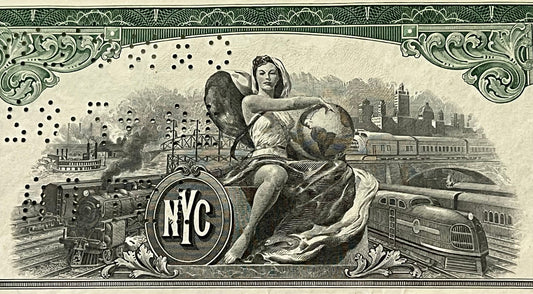
Lower on the certificate is the company's blind-embossed seal — an eagle over a striped shield, ringed with the names of the six states the system ran through: New York, Pennsylvania, Ohio, Indiana, Michigan, Illinois. Around the rim it reads "Consolidated Dec," and that December isn't a guess: on December 22, 1914, the Lake Shore & Michigan Southern Railway was folded into the New York Central Railroad, along with most of the system's other properties (the Boston & Albany, the Michigan Central and the Big Four stayed separate), forming what railroad historians call the second New York Central Railroad. I get a kick out of this part: the consolidation papers were filed that same day in New York, Pennsylvania, Ohio, Indiana and Illinois, and the next day, December 23, in Michigan - the very same six states ringed around this seal. The bond itself is dated October 1, 1913, more than a year before that merger — so what you're holding is a certificate from an October 1913 bond series, printed on paper carrying the seal of the company as it existed after it reorganized fourteen months later. The bond's own fine print tells you how that happened: the mortgage behind it was executed by The New York Central and Hudson River Railroad Company to the Guaranty Trust Company of New York as trustee, and the new New York Central Railroad Company took it over "by a supplement thereto dated June 12, 1915." One document, two dates, one company.

🏦 Trustee, Tax Stamp, and an Empty Ledger

Underneath the main obligation runs the trustee's certificate, countersigned by the Guaranty Trust Company of New York — the independent party that held the mortgage on behalf of every bondholder and vouched that this particular bond belonged to the authorized issue. A line in the margin notes that the federal revenue tax on the issue was paid by stamps affixed to the governing indenture, which is exactly the kind of fine print that makes old bonds worth reading slowly. Down at the bottom sits a blank registration table — date, owner's name, registrar's signature, never filled in — because this was issued as a bearer bond. Whoever held it, owned it; no name ever had to go in that ledger. The whole certificate, coupons included, was engraved by the American Bank Note Company of New York, the same firm that engraved currency and securities for governments and corporations around the world, and it shows in the linework.

💵 The Coupon Sheet

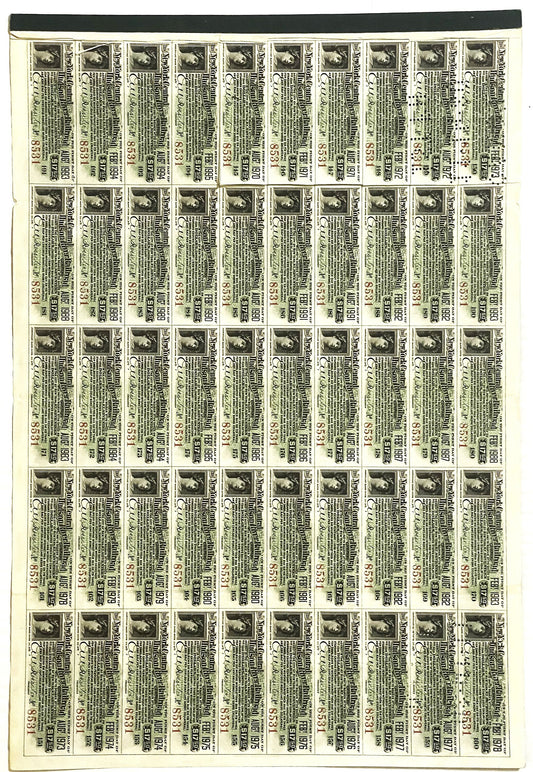
What sets a bond like this apart from one that survives alone is that the coupon sheet is still with it — small engraved promises arranged in a grid, each one good for $22.50 in gold coin, each stamped with its own April or October date and the letter A for the series and carrying its own small portrait of a young woman in a bonnet. A bond that still has its coupons is the complete instrument, not just the pretty half of it. Most surviving railroad bonds were stripped of their coupons decade by decade, one clipping at a time, until only the certificate was left, and a sheet that still hangs on to its coupons survived all that. The railroad itself didn't last as long as its coupons: New York Central merged into Penn Central in 1968, and in 1970 Penn Central collapsed in what was then the largest corporate bankruptcy in American history. Families had counted on those payments, and a bond that still carries its last coupon carries that hope right along with it. Six years later, on April 1, 1976, much of what was left of Penn Central's railroad went into Conrail, the Consolidated Rail Corporation the federal government set up to take over the workable lines of the Northeast's bankrupt railroads. And by the time those later dates came due, the gold clause had been dead for decades regardless — so even a coupon that was cashed was paid in plain dollars, not the gold coin its own engraving promised. Stock and bond certificates can carry financial writings, markings, stamps, hole punches and staples as part of the life of the instrument; that's the paper trail of a bond that did its job, not damage.

🎟️ About the coupons: the count varies from bond to bond, so the one you get may have a few more or a few fewer than pictured. There's a piece of history that goes with them, too. When an interest payment didn't come through, holders often clipped the coupon and taped it right back onto the bond, hoping they could cash it someday, because whole families were counting on that interest. That makes a bond with taped coupons a special find; it tells you about the hard times the people holding it lived through. Any bond in the run may turn up with one taped back on, and some don't.

A hundred and thirteen years is a long time for a sheet of paper to survive with its coupons still on it. This one carries two stories at once: the terminal it pictures, and the gold standard that got legislated out from under the promise printed all over it.

📷 The Grand Central Terminal photos near the end are there for history only and aren't included; you get the bond.

Shipping

🚚 Shipping & Handling

  • Shipping costs and timing are calculated at checkout.
  • Items curated and shipped directly by me include U.S. shipping at no additional cost, professionally packed to ensure safe arrival of your artifact.

Items from Vetted Pro Collectors
Shipping for items offered by vetted Pro Collectors is determined at checkout. All Pro Collector listings are reviewed to ensure fair, reasonable shipping practices.

For full details, please refer to our Shipping Policy.

Returns & Exchange

Take your time — you've got a full six months. If a piece isn't right for you, send it back the way it reached you and we're good.

In the first 30 days your money goes straight back the way you paid. After that it's store credit, so you can put it toward something you'd rather have.

Return shipping we sort out between us, case by case. I don't make this difficult.

If something arrives damaged, or it isn't what I said it was, send me a photo within 48 hours and I'll make it right.

Email info@vintageantiquesgifts.com or call 802-356-9872 — that's me answering, not a call center.

The only things I can't take back are custom or special-order pieces and gift cards.

View full details
  • 5 stars: 6 (100%)
  • 4 stars: 0 (0%)
  • 3 stars: 0 (0%)
  • 2 stars: 0 (0%)
  • 1 star: 0 (0%)
n
n***7 (657)

Package properly arrive timely. Beautiful quality conditions really nice. Got an excellent value from a dollar. I love old stocks, lot of history. Thanks for the beautiful stock. Look forward to doing business again. Highly recommend!

7
7***- (21)

Very detailed listing, item arrived as described, thank you

o
o***i (480)

Such a cool piece of history! Item was just as described. Fast shipping hope to do more business with this Awesome seller A++

J
John (Montvale, US)
New York Central Bond

Great condition , nice pice of history.

t
t***v (425)

Beautiful item...the real deal, packed and shipped beautifully and quickly. Also loved the thank you note from the kids! Really quality merch and transaction.

J
Jonathan

Great people to buy from. Came faster than anticipated and exactly as described.

Rescuing American History Since 2007

— Travis & the Kids