Skip to product information
1 of 5

Vintage and Antique Gifts

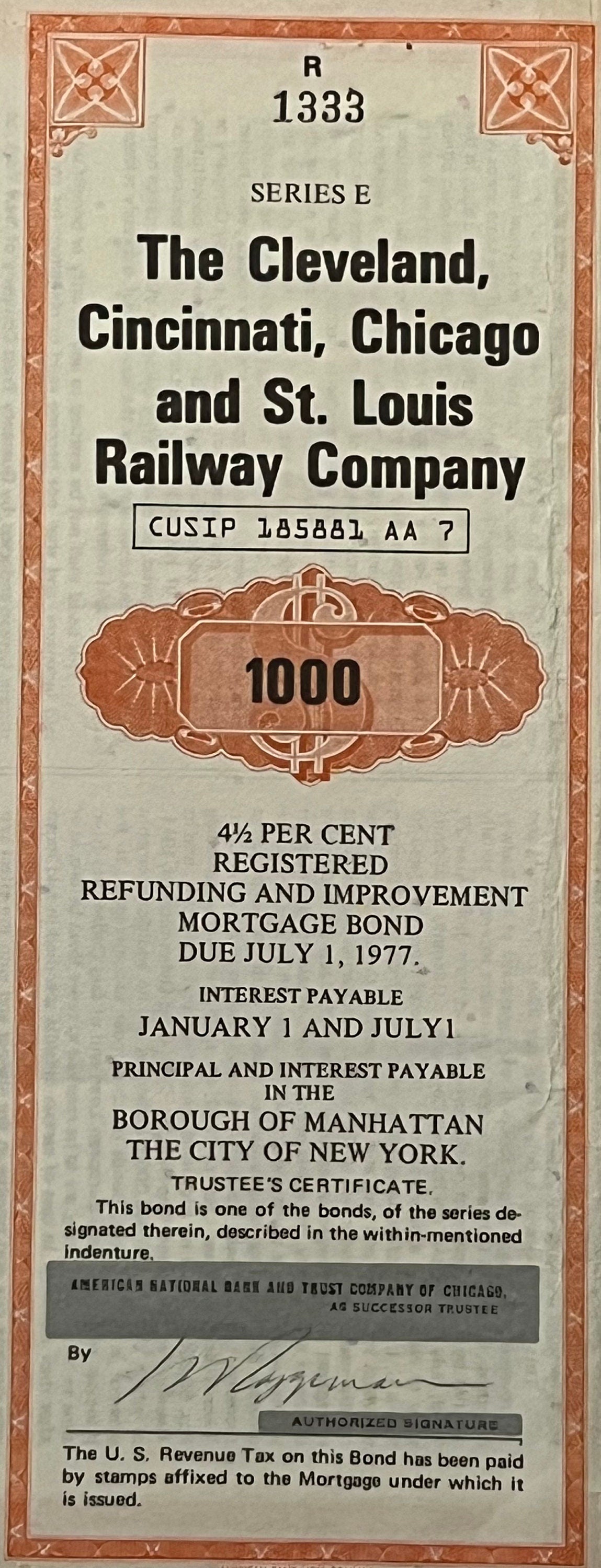
Antique 1927 Big Four Railroad Bond 🚂 Orange, Cleveland Cincinnati Chicago St Louis, $1,000 Mortgage

Antique 1927 Big Four Railroad Bond 🚂 Orange, Cleveland Cincinnati Chicago St Louis, $1,000 Mortgage

Regular price 8.00 USD
Regular price Sale price 8.00 USD
Sale Sold out
Shipping calculated at checkout.
Quantity

🚂 What did a promise look like when it was printed to last fifty years?

Long before "IOU" apps and digital contracts, a company that wanted your trust put its name, its seal, and its signatures on a sheet of heavy paper — engraved it in fine steel lines so nobody could forge it, framed it in bold orange scrollwork so nobody could ignore it, and handed it over as a fifty-year promise. That's exactly what you're holding here: a railroad's word, given in ink and engraving, backed by track and freight and the good name of one of the Midwest's great rail systems. I've handled a lot of old paper in my time, and there's something about a railroad bond — the weight of the stock, the density of the small print, the sheer confidence of the design — that still makes me stop and read every line.

This is a $1,000 Series E Refunding and Improvement Mortgage Bond issued by The Cleveland, Cincinnati, Chicago and St. Louis Railway Company — the line everyone along its route simply called the "Big Four" — printed by the American Bank Note Company, the premier security engraver of its era. The certificate carries a Four and One-Half Per Cent interest rate and a due date of July 1, 1977, and the issue itself is dated the first day of July, 1927, placing its origin firmly in the confident, steam-powered late 1920s. It measures 14 inches by 9.5 inches (about 35.5 x 24 cm), a substantial size that fills a standard mat beautifully. The design is a study in steel-engraved intaglio artistry: a deep orange border of dense, machine-turned linework frames the whole document, matching orange denomination panels bookend the top corners, and at the center sits an engraved vignette of a laurel-crowned classical head in profile — a favorite motif of the era's bank note engravers, meant to evoke the dignity and permanence of Greek and Roman antiquity. Below it, black letterpress text runs the full page: dense legal paragraphs on mortgage indentures, gold-coin payment clauses, and redemption terms, all authorized beneath printed officer signature lines for a Vice-President and an Assistant Secretary. This example is offered as a genuine issued bond — registered to a holder, signed by the railway's officers under an embossed seal, and punch-cancelled when it was surrendered.


🛤️ The Big Four: Four Cities, One Railroad

Here's the thing people get wrong every single time: the "Big Four" wasn't four railroads. It was one railroad named for four cities — Cleveland, Cincinnati, Chicago, and St. Louis — and it came together on June 30, 1889, when the Cleveland, Columbus, Cincinnati and Indianapolis Railway merged with the Cincinnati, Indianapolis, St. Louis and Chicago Railway and the Indianapolis & St. Louis Railway. Collectors and rail historians have long enjoyed pointing out the irony baked right into that name: Indianapolis, the one city that was part of every single predecessor company, never made it into the final title at all. Old-timers along the route liked to say the Big Four "forgot the town that built it," and the joke has outlived the railroad itself.

By the mid-1920s, right around when this bond was issued, the Big Four was no small operation — over 2,300 route-miles and better than 4,600 track-miles of railroad, hauling grain, coal, manufactured goods, and mail alongside passenger trains linking the factories of Cincinnati to the riverfront of St. Louis and the rail yards of Chicago's Loop. In 1895 the line extended its reach further still with the completion of the Big Four Bridge across the Ohio River at Louisville, Kentucky — a structure that would carry freight for decades before its rail days ended and it found new life, much later, as a pedestrian and cycling bridge, one of the more beloved surviving landmarks of the whole system.


🏢 Indianapolis, and a Railroad Owned by the Vanderbilts

Despite "Cleveland" leading its corporate name, the Big Four's true home was Indianapolis, Indiana, where it kept its headquarters in the Chesapeake Building on South Meridian Street. It was there that decisions were made about routes, rates, and — eventually — its own independence. In 1906, the powerful New York Central Railroad, controlled by the Vanderbilt family, acquired the Big Four and began operating it as part of its own network, even while the Big Four continued to exist as its own corporate entity, issuing bonds like this one under its own name straight through the 1920s. That's precisely why a bond dated 1927 still bears the Big Four's name in bold letters at the top — the railroad had become a Vanderbilt property in practice, but it hadn't yet been formally folded into New York Central's corporate structure, something that wouldn't happen until 1930, when the NYC leased the Big Four route outright for 99 years.


🖋️ The Engravers Who Made Money Look Like Art

The name printed discreetly along this certificate's border — American Bank Note Company — belonged to one of the most trusted names in American security printing. The firm traced its roots to 1795 and took its familiar name in 1858, when seven of the country's leading engraving houses merged in the wake of the financial Panic of 1857 to form a single powerhouse headquartered in New York City. For well over a century afterward, American Bank Note engraved currency for the nation's state-chartered banks, U.S. postage stamps, and the ornate stock and bond certificates that companies used to raise the capital that built America's railroads, mills, and utilities. Their engravers popularized classical imagery — gods, goddesses, laurel-crowned heads like the one gracing this very bond — specifically because a hand-cut steel engraving of a finely detailed face was nearly impossible for a forger to reproduce convincingly. Every wavy line in that orange border, every fine crosshatch in the vignette, was there to protect the investor's thousand dollars as much as to please the eye.


📉 From Big Four to Penn Central to Conrail

This bond promised repayment by July 1, 1977 — a fifty-year bet on the future of American railroading. History had other plans. The Big Four's lines were absorbed into the ill-fated Penn Central merger of 1968, which collapsed into one of the largest corporate bankruptcies in American history by 1970. When the smoke cleared, many of the old Big Four's routes were folded into Conrail, the government-backed rescue railroad, in 1976 — the very year before this bond's stated maturity. Bonds of this series that survive today typically carry the cancellation marks and punch holes from that turbulent mid-1970s reorganization era, physical evidence of a fifty-year promise meeting its ending amid one of railroading's most dramatic upheavals. Collectors who study this period will tell you there's a particular poignancy to a 1927 bond due in 1977 — issued in an age when steam still ruled and the Depression hadn't yet arrived, redeemed in an age of bankrupt conglomerates and government bailouts.

🚉 Echoes on the Rails Today

Walk the old Big Four right-of-way today and you'll still find its fingerprints. The sprawling rail yard at Avon, Indiana — still known locally as the Big Four Yards — remains an active freight facility, now run by CSX. Key through-routes the Big Four once proudly operated continue to move freight under Norfolk Southern and CSX Transportation. Lore passed down among railfans holds that engineers on some of these lines still refer to certain sidings and junctions by their old Big Four names, decades after the railroad's own name vanished from a locomotive tender. The company is gone, but the grade, the yards, and — in pieces like this — the paper promises it left behind, remain.


🖼️ Display Ideas

  • 🚂 Frame it solo with a wide mat to let the orange engraved border and the classical vignette take center stage as a piece of graphic art in its own right
  • 🗺️ Pair it with a vintage railroad map of Ohio, Indiana, or Illinois to show the actual routes the Big Four once ran
  • 🏢 Group it with other early 20th-century financial ephemera — stock certificates, ticket stubs, timetables — for a "history of American commerce" wall grouping
  • 📚 Stand it on a library shelf or office credenza in a freestanding frame as a conversation piece for anyone who loves trains or finance history
  • 🛤️ Hang it in a den or hobby room devoted to model railroading, alongside vintage rail photography or a Big Four timetable
  • 🖋️ Showcase it near other American Bank Note Company engravings to highlight the artistry of the printer itself across different companies

🎁 Who Collects These

Scripophily collectors — people who specifically hunt down old stock and bond certificates for their engraving artistry and corporate history — are the natural audience here, and the Big Four name is a recognizable, desirable one within that hobby. Railroad history buffs and model railroaders love adding genuine financial paper from the lines they study to their collections. Indiana and Ohio local historians appreciate a document tied directly to Indianapolis's corporate past. And anyone furnishing an office, library, or study with a nod to industrial-age Americana finds this bond does double duty — a genuine piece of 1920s financial history that also happens to be striking, framable graphic art.


❓ FAQ

What exactly is this document?

It's a $1,000 Series E Refunding and Improvement Mortgage Bond issued by The Cleveland, Cincinnati, Chicago and St. Louis Railway Company (the "Big Four"), engraved and printed by the American Bank Note Company. It represents an actual financial instrument — a fifty-year loan the railroad took from an investor, due July 1, 1977.

Is this a stock certificate or a bond?

A bond. Unlike a stock certificate, which represents ownership in a company, this bond represented a loan to the railroad, secured by a mortgage on its property, paying 4.5% interest until its 1977 due date.

What condition is it in?

This is a genuine issued railroad bond that carries the marks of its own working life. It presents as an excellent example of 1920s American railroad security engraving and financial Americana.

Was the Big Four a real, independent railroad?

Yes, and that's part of what makes it interesting. It operated as its own corporate entity from 1889 onward, even after the New York Central acquired control in 1906 and continued to run it as an affiliated line — which is exactly why the Big Four's own name, rather than New York Central's, appears across this bond.

What happened to the Big Four Railroad?

It was formally leased to the New York Central in 1930, later became part of the 1968 Penn Central merger, and following Penn Central's bankruptcy, its lines were folded into Conrail in 1976. Portions of its original routes remain active today under Norfolk Southern and CSX.

Why does the certificate have such elaborate engraving?

Fine steel engraving with detailed vignettes and dense border patterns was the security technology of its day — the intricate linework made counterfeiting extremely difficult, which is why bond and currency printers like American Bank Note Company invested so heavily in ornate, artistic designs.

What size is it, and how should I frame it?

It measures 14 by 9.5 inches (about 35.5 x 24 cm), fitting comfortably into standard-size mats and frames, whether displayed alone or grouped with other railroad or financial ephemera.

These are issued instruments rather than blanks. Bonds and debentures of this type were registered to a holder, authenticated by the trustee, and punch- or cut-cancelled when they were finally redeemed. Expect financial writings, markings, stamps, hole punches and staple holes as part of the life of the instrument: endorsements and signatures, trustee and registrar stamps, revenue or documentary tax stamps, cancellation punches, staple holes from being bound into a transfer book, pencil ledger notations. That is the paper trail of a security that actually did its job, and it is what separates a document that lived from a blank that never did. No two are alike: holder details, serial numbers, dates, signatures, stamps and punch patterns vary from example to example, so the photographs show the type rather than the exact sheet that ships.

Shipping

🚚 Shipping & Handling

  • Shipping costs and timing are calculated at checkout.
  • Items curated and shipped directly by me include U.S. shipping at no additional cost, professionally packed to ensure safe arrival of your artifact.

Items from Vetted Pro Collectors
Shipping for items offered by vetted Pro Collectors is determined at checkout. All Pro Collector listings are reviewed to ensure fair, reasonable shipping practices.

For full details, please refer to our Shipping Policy.

Returns & Exchange

Take your time — you've got a full six months. If a piece isn't right for you, send it back the way it reached you and we're good.

In the first 30 days your money goes straight back the way you paid. After that it's store credit, so you can put it toward something you'd rather have.

Return shipping we sort out between us, case by case. I don't make this difficult.

If something arrives damaged, or it isn't what I said it was, send me a photo within 48 hours and I'll make it right.

Email info@vintageantiquesgifts.com or call 802-356-9872 — that's me answering, not a call center.

The only things I can't take back are custom or special-order pieces and gift cards.

View full details