Skip to product information
1 of 7

Vintage and Antique Gifts

Vintage 1963 Frisco Railroad $1,000 Gold Bond 🚂 St Louis-San Francisco Second Mortgage

Vintage 1963 Frisco Railroad $1,000 Gold Bond 🚂 St Louis-San Francisco Second Mortgage

Regular price 6.00 USD
Regular price Sale price 6.00 USD
Sale Sold out
Shipping calculated at checkout.
Quantity

Size: 15 x 10 inches

What Does a Railroad's Bankruptcy Comeback Look Like on Paper? 🚂

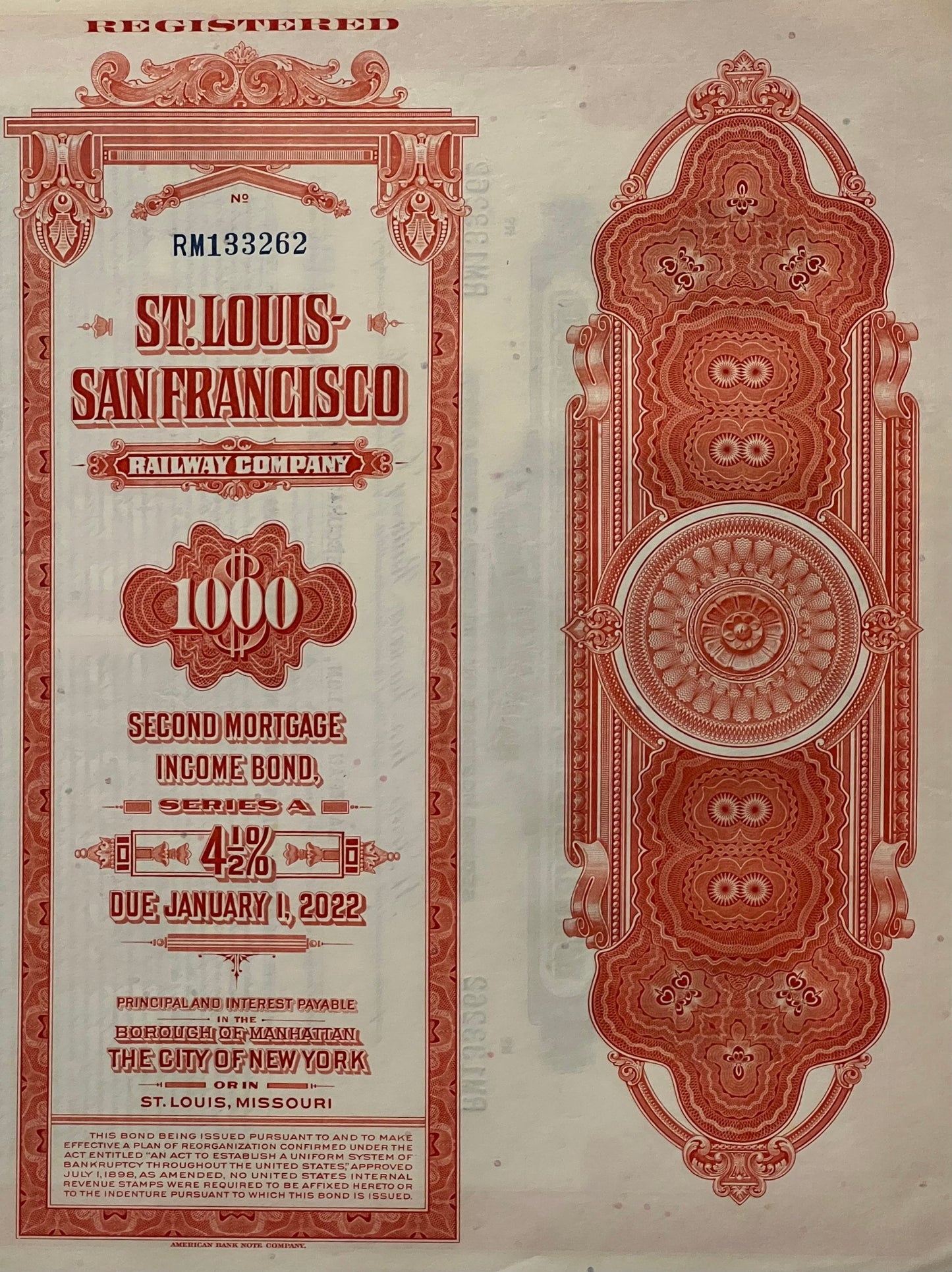
There's a certain kind of magic in holding a piece of paper that outlived the company it promised to pay. This $1,000 Second Mortgage Income Bond from the St. Louis–San Francisco Railway Company — the beloved "Frisco" — is exactly that kind of survivor. Engraved by the American Bank Note Company and dated 1963, it carries a running figure of Mercury, messenger of commerce, sprinting past a steam locomotive, an ocean liner, and a low-flying airliner, all set against a stylized city skyline. It's a small, dense piece of mid-century financial artistry that tells a much bigger story — of a Missouri railroad that failed, and failed again, and kept coming back.

This is a genuine engraved bond certificate of the St. Louis-San Francisco Railway Company, a corporation organized under the laws of the State of Missouri, executed in New York, N.Y. and dated 1963. It's a $1,000 Second Mortgage Income Bond, Series A, paying 4½% interest, due January 1, 2022 — a document that was actually registered, signed, sealed, and put into the stream of Wall Street commerce before eventually being surrendered for transfer, punch-cancelled, and retired from circulation. The design is dense and formal in the way only mid-century American finance could be: a wide orange border framed with scrollwork and rosettes, bold black lettering spelling out ST. LOUIS-SAN FRANCISCO RAILWAY COMPANY across the center, an embossed orange corporate seal reading "St. Louis-San Francisco Railway Company Incorporated 1916 Missouri," and page after page of tightly engraved script laying out the bond's terms, its indenture, and the rights of its holder. Ink date stamps, hand signatures, and a large diagonal "REGISTERED — FRISCO" overprint complete the piece.


🚂 The Frisco: A Railroad That Failed Its Way to Greatness

The St. Louis–San Francisco Railway — everyone just called it the Frisco — never once touched San Francisco. It ran instead through the American heartland: St. Louis to Tulsa to Oklahoma City to Floydada, Texas on one arm, Kansas City to Memphis to Birmingham on the other, meeting at a junction in Springfield, Missouri that became the operational heart of the whole system. At its peak the Frisco and its subsidiaries operated roughly five thousand miles of track across Missouri, Oklahoma, Kansas, Arkansas, Texas, Louisiana, Mississippi, Alabama, and Florida.

What makes the Frisco's story so compelling to rail historians is how many times it had to reinvent itself. The original company traces to 1876, formed from the Missouri and Central Divisions of the Atlantic and Pacific Railroad — one of only two railroads ever federally authorized to build across Indian Territory. It fell into receivership in 1893, re-emerged in 1896 as the St. Louis and San Francisco Railroad Company, expanded aggressively under the leadership of General B.F. Yoakum — who served as general manager, president, and chairman of the board for more than twenty years and doubled the size of the road, pushing it deep into the South — and then collapsed again. Overexpansion combined with catastrophic Mississippi River levee failures that flooded the mainline pushed the company into a second receivership beginning in 1913. In August 1916, it emerged once more, chartered fresh as the St. Louis-San Francisco Railway Company — the exact corporate entity, and the exact year, embossed into the seal on this bond.

The Depression brought a third crisis. Company records show the board resolved to begin reorganization proceedings under the federal Bankruptcy Act in December 1934, and the railroad spent years working through federal receivership before emerging reorganized in the 1940s under new financial footing — the very reorganization that gave rise to securities like this Second Mortgage Income Bond, Series A. Income bonds like this one are a distinctive species of railroad finance: interest was payable only to the extent the company's earnings could support it, a structural feature built for a company working its way back from bankruptcy rather than one flush with cash. The bond's distant January 1, 2022 maturity — a full 75-year term — reflects just how long-term that recovery financing was meant to be.

After that reorganization, the Frisco settled into what railfans still remember as its golden decades: a stable, well-run regional carrier through the 1950s, 60s, and 70s. It finally ended its 104-year corporate life in November 1980, when it was purchased by and folded into the Burlington Northern Railroad. Today's BNSF Railway — one of the largest freight networks in North America — still operates much of the old Frisco mainline.


🏛️ Springfield and St. Louis: The Towns the Frisco Built

Springfield, Missouri was the Frisco's beating mechanical heart. The railroad's repair shops there grew to include a roundhouse capable of holding twelve engines, expanded in 1909 with the West Side Shops, and in 1911 the company built a 37,000-square-foot administrative building at Jefferson and Olive to run its Springfield operations. For generations, the Frisco was one of the city's largest employers, and its fortunes and Springfield's were bound tightly together. Old-timers in the region still recall the Frisco depot's lunchroom — the last one operating anywhere on the line — closing its doors on November 1, 1955, and the last passenger train pulling out of Springfield on December 9, 1967, both quiet markers of the slow national shift away from passenger rail that this very bond's era lived through.

St. Louis, meanwhile, was the Frisco's corporate seat. The Frisco Building at 908 Olive Street housed the company's headquarters and today stands on the National Register of Historic Places — one of the few physical monuments left standing to a company whose paper trail, like this bond, has otherwise scattered into private collections.


🖋️ Mercury, Steam, and Steel: Reading the Engraving

The central vignette on this bond is an allegorical figure of Mercury — winged sandals, winged cap, caduceus raised — sprinting across a scene that layers a locomotive, a great ocean liner, and a propeller airplane against a modern city skyline. It's a design collectors of American railroad and transportation-era financial paper will recognize instantly: the messenger god of commerce bridging every mode of transportation the mid-century American economy depended on, all engraved in the fine crosshatched linework the American Bank Note Company was famous for. The firm behind that engraving traced its own lineage back to 1795, to Robert Scot, the first official engraver of the U.S. Mint, and formally organized as the American Bank Note Company in an 1858 merger of several leading security printers. For decades, the New York Stock Exchange required that all listed certificates be engraved by a "responsible" security printer, and American Bank Note became the industry's dominant name — the company whose engraving work stands behind stock certificates, bonds, and even currency across generations of American finance.

Surrounding that central image, the certificate is a small textbook of financial-document conventions: the "Corporate Trustee's Certificate of Authentication" naming Guaranty Trust Company of New York, the officer signatures attesting the bond on behalf of the Frisco, and the embossed corporate seal bearing the company's Missouri incorporation year. Interestingly, by the time this bond was dated in 1963, the trustee bank named on its face had already changed hands — Guaranty Trust Company of New York had merged into J.P. Morgan back in 1959 to form Morgan Guaranty Trust, even though Guaranty Trust was by far the larger of the two institutions. The engraved plate, cut years earlier for the bond's original indenture, still carried the older name — a small frozen moment of Wall Street history sitting quietly on the paper.


🦝 The Coonskin, the Named Trains, and Frisco Folklore

No telling of the Frisco's story is complete without its logo — a distinctive raccoon-pelt silhouette that became one of American railroading's most recognizable marks. Rail lore holds that the design traces back to a Frisco general manager who bought a raccoon hide for two dollars at a Missouri depot and had a company draftsman turn it into the railroad's herald. That coonskin mark became so tied to the company's identity that a Texas town growing up along the line eventually took the name Frisco, Texas for itself — and the city still uses a version of that same logo today, now under BNSF's stewardship.

Old-timers and rail enthusiasts also remember the named passenger trains that carried the Frisco's reputation across the heartland — the Texas Special, the Meteor, the Firefly, and the Will Rogers among them — trains that, in their day, were the fastest and most comfortable way to travel between St. Louis, Oklahoma, and Texas. Bonds like this one financed exactly that world: the shops, the rolling stock, the rails those named trains ran on, all bundled into a piece of engraved paper meant to reassure a Wall Street investor that the reorganized Frisco was, this time, built to last.


🎁 Who Collects These

Railroad bond and stock certificates sit at a wonderful crossroads of collecting interest. Scripophily collectors — those who focus specifically on historic financial documents — prize Frisco material for its clean engraving, its readable corporate history, and its connection to one of the Midwest's most storied lines. Railfans and model railroaders look for anything bearing the coonskin mark or the Frisco name to display alongside their layouts, photographs, and memorabilia. Missouri and Oklahoma local historians and genealogists often seek these out too, especially those with a family connection to the line — a grandfather or great-uncle who worked the shops in Springfield or rode the Texas Special out of St. Louis. And plenty of buyers simply want a piece of handsome, story-rich vintage paper for a library, home office, or vintage gallery wall — something with real ink, real signatures, and a real company behind it, rather than a modern print.


🖼️ Display Ideas

  • 🖼️ Framed on its own as a statement piece in a home office or library, matted to let the orange border and Mercury vignette breathe
  • 🗺️ Paired with a vintage railroad map of Missouri or Oklahoma showing the old Frisco routes between St. Louis, Springfield, and Tulsa
  • 🚂 Grouped with railroad photographs, timetables, or other Frisco ephemera for a themed rail-history wall
  • 🏢 Displayed alongside other American Bank Note Company engraved certificates to build out a small scripophily collection
  • 🎓 Given as a meaningful gift to a railfan, history enthusiast, or anyone with family ties to the Frisco line
  • 📚 Kept flat in an archival sleeve for collectors who prefer to handle and study the engraving directly

❓ FAQ

Is this a genuine, period document or a reproduction?

This is a genuine engraved bond certificate of the St. Louis-San Francisco Railway Company, executed and dated 1963, printed by the American Bank Note Company — not a modern reprint.

What is a "Second Mortgage Income Bond"?

It's a bond secured by a second-priority mortgage on the railroad's property, with interest payable only from available income — a common structure for railroads emerging from bankruptcy reorganization, designed to protect the company financially while it rebuilt.

Why does the bond say "due January 1, 2022" when it's a 1960s document?

Railroad reorganization bonds of this era were often issued with very long maturities, sometimes 50 to 75 years out, reflecting the long financial runway a recovering railroad needed. The distant due date is a printed feature of the bond series itself, not an error.

Why is it called "St. Louis–San Francisco" if the railroad never reached San Francisco?

The name reflects the company's original westward ambitions from its 1870s founding. The Frisco's actual network stretched through Missouri, Oklahoma, Texas, and the South-Central states — it never built tracks anywhere near California, but the name stuck for the entirety of its history.

Is this bond still redeemable for its face value?

No — like virtually all surviving historic stock and bond certificates, this piece is collected today for its engraving, history, and connection to a defunct railroad rather than for any financial redemption value.

What happened to the Frisco company?

After decades as a stable regional carrier, the St. Louis-San Francisco Railway was purchased by and merged into the Burlington Northern Railroad in November 1980, ending its corporate existence. Much of its trackage is still operated today by BNSF Railway.

Can this be framed?

Yes — the engraved detail, bold lettering, and rich orange border make it a striking piece for framing in a home office, library, or rail-themed display.

These are issued instruments rather than blanks. Bonds and debentures of this type were registered to a holder, authenticated by the trustee, and punch- or cut-cancelled when they were finally redeemed. Expect financial writings, markings, stamps, hole punches and staple holes as part of the life of the instrument: endorsements and signatures, trustee and registrar stamps, revenue or documentary tax stamps, cancellation punches, staple holes from being bound into a transfer book, pencil ledger notations. That is the paper trail of a security that actually did its job, and it is what separates a document that lived from a blank that never did. No two are alike: holder details, serial numbers, dates, signatures, stamps and punch patterns vary from example to example, so the photographs show the type rather than the exact sheet that ships.

Shipping

🚚 Shipping & Handling

  • Shipping costs and timing are calculated at checkout.
  • Items curated and shipped directly by me include U.S. shipping at no additional cost, professionally packed to ensure safe arrival of your artifact.

Items from Vetted Pro Collectors
Shipping for items offered by vetted Pro Collectors is determined at checkout. All Pro Collector listings are reviewed to ensure fair, reasonable shipping practices.

For full details, please refer to our Shipping Policy.

Returns & Exchange

Take your time — you've got a full six months. If a piece isn't right for you, send it back the way it reached you and we're good.

In the first 30 days your money goes straight back the way you paid. After that it's store credit, so you can put it toward something you'd rather have.

Return shipping we sort out between us, case by case. I don't make this difficult.

If something arrives damaged, or it isn't what I said it was, send me a photo within 48 hours and I'll make it right.

Email info@vintageantiquesgifts.com or call 802-356-9872 — that's me answering, not a call center.

The only things I can't take back are custom or special-order pieces and gift cards.

View full details
  • 5 stars: 8 (89%)
  • 4 stars: 0 (0%)
  • 3 stars: 1 (11%)
  • 2 stars: 0 (0%)
  • 1 star: 0 (0%)
o
o***o (854)

These are incredible!!! Love the history provided as well. Such a beautiful piece of ephemeral history. Thanks so much!!! Super fast ship too! A++++

b
b***p (574)

Wonderful to deal with. Will do business with again!!!! A+++++

u
u***u (1550)

AMAZING SELLER!!!! FAST SHIPPING!!!! EBAY FAVORITE SELLER!!!!! 🌟🌟🌟🌟🌟🌟🌟🌟🌟🌟🌟🌟🌟🌟🌟🌟⭐️⭐️⭐️⭐️⭐️⭐️⭐️⭐️⭐️⭐️⭐️⭐️💫💫💫💫💫💫💫

c
c***5 (5)

Item never came. Seller didn’t leave a track number either. Seller did refund my money after 3 weeks. I won’t do business with this company again.

You bought an item and chose USPS First Class, which doesn't have tracking. I offer upgraded methods. USPS is dealing with fires, storms, etc, but I guarantee every delivery. You opened a case with no message you were having an issue. eBay's customer service standards are lower than my own. I told you several times I only have one option in a case: to refund you, and if you close the case, I will refund and resend it. I won't be forced into it and have it not be altruistic. You made that choice.

d
d***o (1655)

Aha! Here at last. Thanks for hanging in there. Loved the extra communication. Call me a satisfied customer!

o
o***o (858)

Fantastic! Thanks so much! These are great.

o
o***o (858)

Whoopwhoop!!! Thank you!

M
Margo

Great item that shipped fast and arrived safely! Thank you!

V
Vale Violet
Great!

Beautiful piece!

Hi there, Vale! We're elated to hear that you appreciate the beauty of your 1963 St. Louis San Francisco Railway Co. Gold Bond Certificate. Thank you so much for taking the time to bless us with a 5-star review! We can't wait to assist you in uncovering more beautiful antique gems in the future!