Skip to product information
1 of 4

Vintage and Antique Gifts

Antique B&O Railroad Stock Certificate 🚂 1930s 1950s Baltimore & Ohio 10 Shares Blue Engraved Tom Thumb Vignette, Monopoly Railroad

Antique B&O Railroad Stock Certificate 🚂 1930s 1950s Baltimore & Ohio 10 Shares Blue Engraved Tom Thumb Vignette, Monopoly Railroad

Regular price $8.00 USD
Regular price Sale price $8.00 USD
Sale Sold out
Shipping calculated at checkout.

Size: 11 1/2" x 7 1/4"

🚚 Free US Shipping — ships within one business day. International shipping calculated at checkout.

Quantity

Remember the B&O on the Monopoly Board? 🚂 The Railroad on the Monopoly Board, on Real Paper

Size: 11 1/2" x 7 1/4"

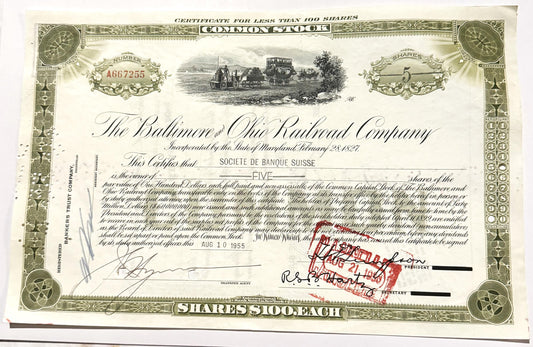
Generations have bought the B&O with colored play money. This is a share of the real one: an original ten-share common stock certificate of the Baltimore and Ohio, printed in deep blue by the International Bank Note Co. of New York and issued across the 1930s to the 1950s, the same years Monopoly went into production and onto family tables. Across the top runs the engraved early-train scene collectors know as the "Old Tom Thumb Train" vignette, a picture of the morning American railroading began.

And the favorite piece of Monopoly trivia: of the four railroads on a board named for the streets of Atlantic City, the real B&O never directly served Atlantic City at all.

📜 What Is Printed on It

  • The issuer in flowing engraved script, The Baltimore and Ohio Railroad Company, with "Incorporated by the State of Maryland, February 28, 1827" beneath it
  • "COMMON STOCK" across the top, a large "10" in each upper corner, and a "SHARES 10" panel beside the vignette
  • TEN shares "of the par value of One Hundred Dollars each, full paid and non-assessable," with "SHARES $100 EACH" in the ribbon along the bottom
  • The printer's imprint at the foot, naming its New York maker
  • An ornate blue border framing a gray engraved vignette
  • Blanks for the owner, the date, the transfer agent and the registrar, completed by typewriter, rubber stamp and pen when each certificate was issued

📌 What You Receive

These blue B&O ten-share certificates come from one group. The typed owner's name, the certificate number, the dates, the stamps, the signatures and the endorsements on the back differ from one certificate to the next, and the photographs show one of them. What stays the same is the certificate itself: the blue ten-share common stock design, the engraved train, the ornate border and the printer's imprint.

🎨 Read the Little Train

The scene comes from the railroad's first steam days. At the left an upright-boilered locomotive puffs along with its engineer standing on the open platform. Behind it rolls a flatcar stacked with barrels, then a double-deck coach packed with passengers at the windows and up on the roof, then an open car with more riders. Beyond the track lie a bay with sailboats, a long arched bridge on the far shore and a line of hills, and a leafy tree and scattered rocks close the picture at the right. All of it is cut in fine engraved line, the banknote printer's craft, which is why the crowd on that coach roof can be picked out figure by figure.

🐎 The Legend of Tom Thumb and the Horse

The engine the vignette is named for belonged to Peter Cooper, the New York inventor and businessman who later founded Cooper Union. In 1830 he put a small coal-burning steam locomotive on the rails of the young Baltimore and Ohio to convince its owners to use steam, improvising the boiler flues from old musket barrels. On August 28, 1830 it carried the B&O's directors in a passenger car out to Ellicott's Mills.

Then comes the story every railroad buff knows. On the trip home, legend has it, Tom Thumb raced a horse-drawn car. The engine pulled ahead until the belt driving its blower slipped off the pulley, the fire lost its draft, and the horse went by to win. The B&O Railroad Museum tells the tale and notes it was never substantiated through documentation. It hardly mattered: the demonstration worked, the railroad committed to steam, and the horse lost the future even if it won the race.

The original engine is long gone. The Tom Thumb that museum shows visitors in Baltimore today is a replica, built to run at the railroad's 1927 Fair of the Iron Horse.

🏛️ Baltimore Starts Something

February 28, 1827, the date engraved on this certificate, is the day Maryland chartered the company. Baltimore businessmen Philip E. Thomas and George Brown were its pioneers, and the plan was bold: a railroad from the port of Baltimore west to the Ohio River, a faster road for Midwestern goods to reach the East Coast than the Erie Canal, which had opened only two years before. On the Fourth of July, 1828, construction began when Charles Carroll of Carrollton, the last living signer of the Declaration of Independence and by then ninety years old, laid the first stone. "I consider this among the most important acts of my life," he said, "second only to my signing the Declaration of Independence, if even it be second to that."

The first section opened on May 24, 1830, and the B&O became the first common carrier railroad in the country, the first American line built to carry anyone's passengers and freight for hire. Every railroad that followed worked from the template Baltimore laid down.

🧾 The Fine Print Remembers a Bankruptcy

Read the small script in the middle of the certificate and the nineteenth century is still talking. It explains that holders of the railroad's preferred stock, "Sixty Million Dollars ($60,000,000)" of it, are entitled under stockholder resolutions adopted April 11, 1899 to a yearly dividend, "non-cumulative," of no more than four per cent, paid before anything can be set apart for the common stock.

That clause is the scar of a collapse. Weakened by the Panic of 1893, the B&O could not meet its obligations and went into receivership in 1896. The reorganization of 1899 created four per cent non-cumulative preferred stock, $40 million at first and later raised to $60 million, the very figure printed here. So the owner of these ten common shares stood behind the preferred holders in line for every dividend, a pecking order written by a bankruptcy and still printed on the paper decades later.

🏦 Uncle Dan and the Depression

Certificates of this design were being issued while Daniel Willard ran the railroad. "Uncle Dan" was president of the B&O from 1910 to 1941 and gave it its reputation as a public-minded, inventive road. The invention showed early: working with Willis Carrier, the B&O air-conditioned the dining car Martha Washington in 1930, and on May 24, 1931 its Columbian became the first fully air-conditioned passenger train in America.

The money was another story. The Great Depression hit the B&O harder than most railroads, and it barely escaped receivership. In 1932, the year Willard made the cover of Time for his part in negotiating railroad wage cuts, the federal Reconstruction Finance Corporation lent the B&O $8 million to repay a debt to the investment bank Kuhn, Loeb and Company. In 1934 Willard negotiated a $900,000 Public Works Administration loan to test lightweight equipment, and the result was the streamlined Royal Blue of 1935, built of aluminum and lightweight steel with air-conditioning and reclining seats. The railroad held on, and its shares kept changing hands.

🧭 Where the B&O Went

By 1962 the railroad was in financial trouble and accepted merger overtures from the Chesapeake and Ohio. In 1973 it became part of the Chessie System, and today the old B&O lines belong to CSX. The name lives on in Baltimore's railroad museum and on the Monopoly board.

✍️ Turn It Over

The back is printed with the transfer form every sale of these shares needed: "For Value received ... hereby sell, assign and transfer unto," a line to print or typewrite the name and address of the assignee, a clause appointing an attorney "to transfer the said stock on the books of the within-named Company," and a notice that the signature must correspond with the name written on the face "in every particular, without alteration or enlargement or any change whatever." Along the foot, in plain capitals: "THIS SPACE MUST NOT BE COVERED IN ANY WAY."

Each certificate in the group was completed differently. On the one photographed, the form carries typed entries, bank stamps and signatures, and punched holes cancel the paper, the record of the day its shares moved on and the certificate was retired.

Take all of that as the normal condition of the type rather than as damage. Financial writings, markings, stamps, hole punches and staple holes are what an issued share collects on its way through a broker, a bank and a transfer desk: pencil ledger notes, rubber stamps, tax stamps, the punch that retired it, the staple that once held it in a transfer book. A sheet without any of them never left the book. Seals belong on that list too: a corporate seal embossed straight into the paper, a wafer seal, and the signature-guarantee patch a bank or broker laid across an endorsement and then signed over the top of.

🖼️ Living With It

  • Frame it face-up with a plain mat so the blue border and the little train lead.
  • A double-sided float frame shows the engraved front and the worked back together.
  • Hang it in a game room beside a vintage Monopoly set, or in an office or study.
  • Give it to a railroad fan, a banker, a history teacher, or a collector of old stocks and bonds.

❓ Questions People Ask

Is this an original certificate? Yes. It is an engraved B&O common stock certificate from the issues of the 1930s through the 1950s, not a reprint.

Will mine have the same name and dates as the photos? No. The typed owner, number, dates, stamps and back endorsements differ from certificate to certificate. The design, the blue color, the vignette and the ten-share denomination are the same.

Why is the B&O on the Monopoly board? The board takes its street names from Atlantic City, New Jersey, and its four railroads are the Reading, the Pennsylvania, the B&O and the Short Line. The railroad itself had no line of its own into the resort town, which is why the question keeps coming up at game night.

Is the train really Tom Thumb? That is the name collectors give the engraving. It shows an early upright-boilered engine hauling freight and passengers, the kind of machine Peter Cooper demonstrated on the B&O in 1830.

Can it be cashed in as stock? It is sold as a historical collectible document, not as an investment.

Condition: an issued working document with the edge wear, soft corner creasing and toning of its age, along with the typed entries, stamps and cancellation marks that come with a certificate that did its job.

Shipping

🚚 Shipping & Handling

  • Shipping costs and timing are calculated at checkout.
  • Items curated and shipped directly by me include U.S. shipping at no additional cost, professionally packed to ensure safe arrival of your artifact.

Items from Vetted Pro Collectors
Shipping for items offered by vetted Pro Collectors is determined at checkout. All Pro Collector listings are reviewed to ensure fair, reasonable shipping practices.

For full details, please refer to our Shipping Policy.

Returns & Exchange

Take your time — you've got a full six months. If a piece isn't right for you, send it back the way it reached you and we're good.

In the first 30 days your money goes straight back the way you paid. After that it's store credit, so you can put it toward something you'd rather have.

Return shipping we sort out between us, case by case. I don't make this difficult.

If something arrives damaged, or it isn't what I said it was, send me a photo within 48 hours and I'll make it right.

Email info@vintageantiquesgifts.com or call 802-356-9872 — that's me answering, not a call center.

The only things I can't take back are custom or special-order pieces and gift cards.

View full details
  • 5 stars: 2 (100%)
  • 4 stars: 0 (0%)
  • 3 stars: 0 (0%)
  • 2 stars: 0 (0%)
  • 1 star: 0 (0%)
a
a***k (233)

Product was received in great condition, within the expected time period, and was exactly as described. Great Seller!

D
David

A wonderful stock certificate. Lots of info on the back. All original. Shipped very fast and very securely. 5 stars all around for this seller and this transaction. Thank you

Preserving History: Authentic Objects Across Eras

— Curated by Travis Weigel