Skip to product information
1 of 3

Vintage and Antique Gifts

Antique B&O Railroad Stock Certificate 🚂 100 Shares 1930s 1950s Baltimore & Ohio Engraved Banknote Vignette

Antique B&O Railroad Stock Certificate 🚂 100 Shares 1930s 1950s Baltimore & Ohio Engraved Banknote Vignette

Regular price $5.50 USD
Regular price Sale price $5.50 USD
Sale Sold out
Shipping calculated at checkout.

Size: 11 1/2" x 7 1/4"

🚚 Free US Shipping — ships within one business day. International shipping calculated at checkout.

Quantity

Remember the B&O Railroad? 🚂 A Hundred-Share Round Lot in the Railroad Everyone Knows From the Board Game

Size: 11 1/2" x 7 1/4"

This is an original common stock certificate of the Baltimore & Ohio Railroad Company — and it is a big one: one hundred shares, a full round lot rather than the small share lots most surviving certificates represent, printed in a warm, displayable brown with the classic Tom Thumb-era train vignette. It is genuine antique scripophily: a real, issued-and-cancelled railroad share.


📌 One Group, Two Decades

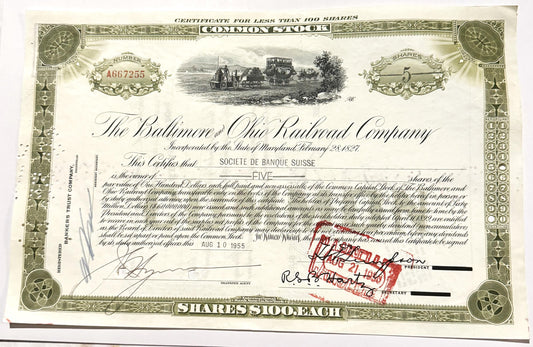
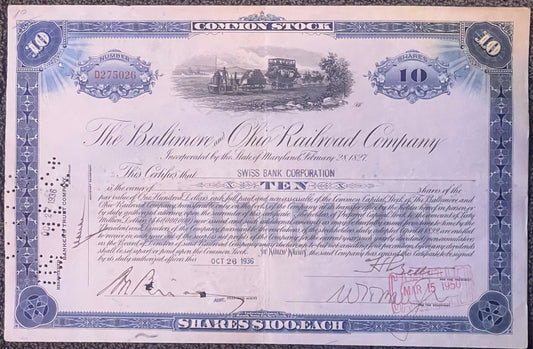
These brown hundred-share B&O certificates came out of a single original group, printed across roughly two decades spanning the 1930s into the 1950s, so the typed date, the serial number, the registered holder and the signatures change from one sheet to the next. The photographs show the type. What does not change is what you are buying: an original engraved Baltimore & Ohio Railroad brown common stock certificate for one hundred (100) shares, printed by the International Bank Note Company, with the same big "100" medallions, the same Tom Thumb-era vignette, and the same brown border and color. Everything below is read off the examples photographed and holds true of the type.


🎩 "B. & O." — the Railroad on the Monopoly Board

Almost everyone has held a little piece of the B&O without ever holding a share of it — because the Baltimore & Ohio is one of the four railroads on the classic Monopoly board, the "B. & O. Railroad" that generations of players have bought, mortgaged and traded across the kitchen table. That fame is not an accident; the game reached for the B&O precisely because it was one of the great, familiar names of American railroading. Here is the real thing behind the game token: an actual, issued share certificate of that very railroad, engraved, signed and cancelled, the genuine article the board-game square only stands in for. For anyone who grew up landing on B. & O., this is a quietly delightful object to own.


💯 A Round Lot — Read the Big Numbers

Where a small certificate whispers, this one announces itself. Because it represents a full hundred shares, the engravers gave it two large ornamental medallions — a bold "100" set into each of the panels that flank the central vignette — and spelled the amount out in engraved capitals, "ONE HUNDRED," across the body. These certificates were printed across roughly two decades, spanning the 1930s into the 1950s — the twilight of the great steam railroads, just before the diesels and then the airlines and interstates remade travel entirely. A hundred-share block of the B&O was a real position in a real railroad, taken through the high-water years of the passenger train.


🎨 The Engraved Vignette — Watch the Double-Deck Coach

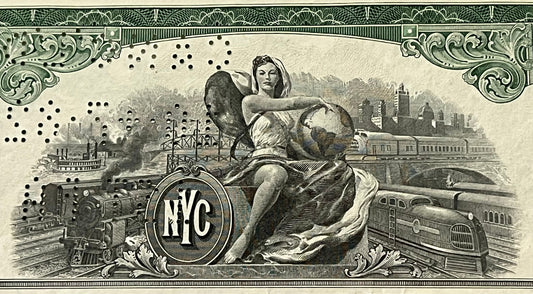
Across the top sits the beautifully engraved tableau of early American steam that these certificates are loved for. A pioneer locomotive of the 1830s leads the way, an engineer standing on its little open platform. But the detail to watch on this certificate is the carriage riding behind: an ornate, open double-deck passenger coach, its riders seated below and more passengers perched along the roof under a canopy, the whole thing looking more like a fine stagecoach set on rails than any modern train car. That is exactly what the earliest passenger railroading looked like — road-carriage bodies mounted on flanged wheels — and the engraver caught it in crisp intaglio line, complete with a sailboat-dotted bay and soft mountains behind. The security printer's imprint sits at the foot of the sheet.

The whole certificate is printed in a warm, rich brown — the border, the twin "100" medallions, the "COMMON STOCK" banner across the top and the "SHARES $100 EACH" ribbon below. Two company officers signed it by hand. It is a handsome, substantial-looking document, designed to convey exactly the permanence and weight that a hundred-share holding was meant to represent.


📜 The Back — a Documented Transfer

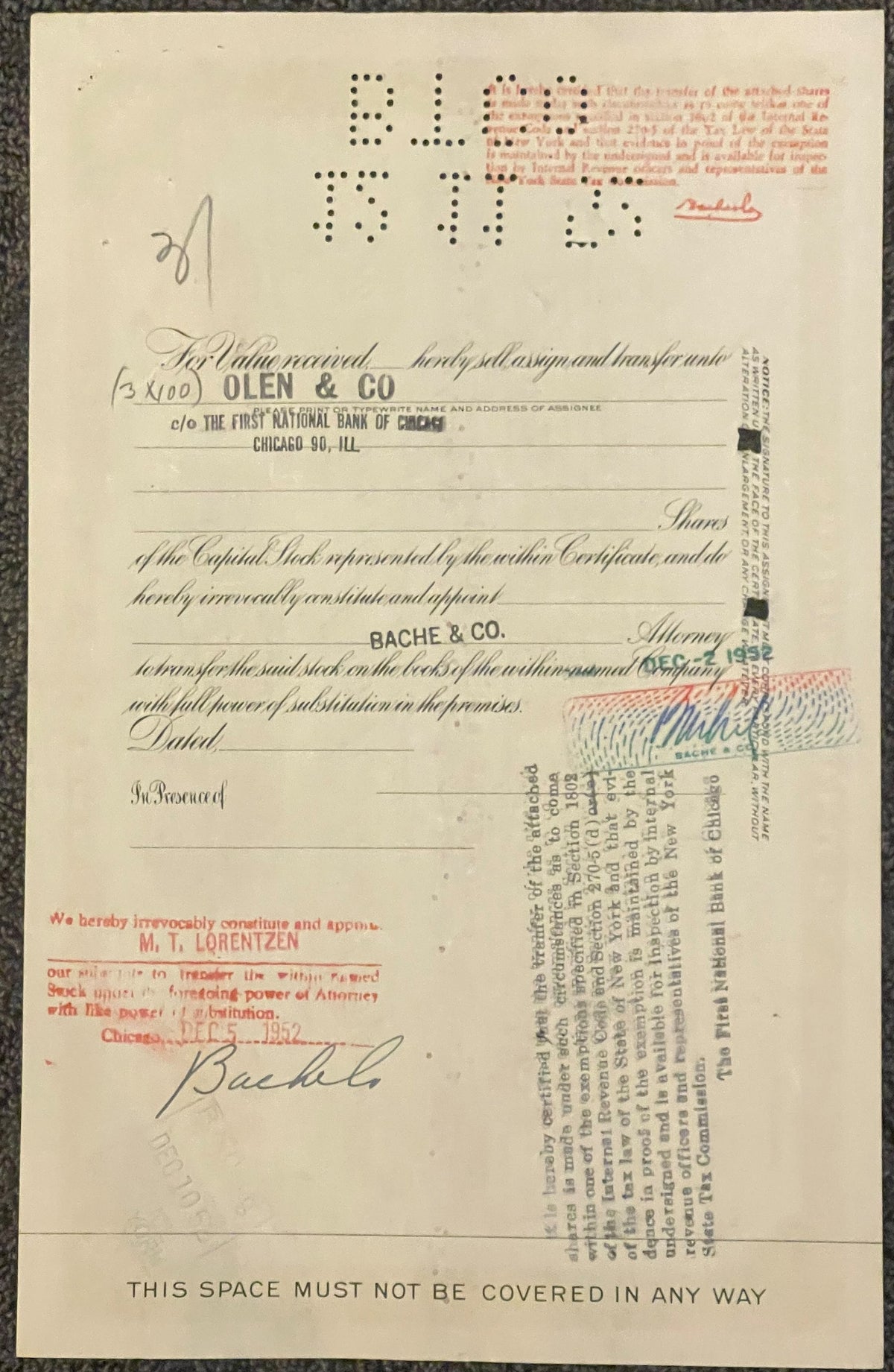
The reverse records the certificate's transfer in ink and rubber stamp, and as with the dates, the exact assignment differs certificate to certificate - each sheet carries its own assignee, attorney's stamp, tax notices and cancellation.

None of that is damage, and I would hate for you to read it that way. A certificate carrying none of them is one that never left the book.

📜 Every one of these certificates had a working life, and it can show. Depending on the sheet, you may find staples or staple holes, cancellation punch holes (often right through the signatures), hand stamps from banks, brokers and transfer agents, real federal or state stock transfer tax stamps, handwriting or a filled-in transfer on the back, papers still attached, seals (a corporate seal pressed into the paper, a foil wafer seal, or a bank's signature-guarantee stamp signed across an endorsement), or a silver strip pasted over an officer's signature with the new officer's signature printed on top. That last one is what collectors call silvering: when the officers changed, the new signature could be pasted right over the old one on certificates already printed. None of that is damage. Each mark is part of the paper's own history, and they vary sheet to sheet, so no two are quite alike.


🔎 What Collectors Look For, and Why This Delivers

Scripophily — the collecting of antique stocks and bonds — rewards a few particular qualities, and this certificate type carries them. It is a blue-chip issuer with instant name recognition, thanks to that Monopoly-board fame. It is a large-denomination hundred-share round lot, more visually impressive than the common single-digit certificates, with those big "100" medallions doing real display work. It has a beautifully engraved period vignette from a respected security printer, and a documented transfer on the back tying the paper to real holders. And it is decorative and historical at once — a warm brown that frames beautifully and a story anyone can follow.


📈 What a Hundred-Share Certificate Actually Is

A stock certificate was, for most of two centuries, the physical proof that you owned a piece of a company — and this one is a substantial piece. It certifies one hundred shares of the common stock of the Baltimore & Ohio Railroad, at a par value of one hundred dollars each, which is why it is called a "round lot": a full, even hundred-share block, the standard unit in which stock was traded, rather than the odd handful most surviving certificates represent. That scale is written all over the design, from the twin "100" medallions to the "ONE HUNDRED" spelled across the body. When the block changed hands, the owner signed the assignment on the back, an attorney was named to record the transfer on the company's books, a bank processed it, and the certificate was cancelled with the punch and perforation you can see on the sheet. That cancellation is the honest mark of a document that finished its working life — and the reason it survived to be collected, filed away rather than redeemed, to surface decades later as a genuine record of who owned the railroads.


🎲 The Four Railroads of the Monopoly Board

The Monopoly connection is worth telling in full, because it is entirely true and it is why these certificates delight people who have never collected anything. The classic American Monopoly board carries four railroads — Reading, Pennsylvania, B. & O., and Short Line — set at the four midpoints of the board, the properties a shrewd player collects to squeeze rent out of every lap. The board is modeled on the streets of Atlantic City, New Jersey, and three of its four railroad squares point to lines that really ran into town in the 1930s - the Reading, the Pennsylvania and, most likely, the Shore Fast Line behind the "Short Line." The Baltimore & Ohio, the "B. & O.," is the odd one out: it never reached Atlantic City, and it made the board anyway. Owning a genuine B&O share certificate is about as close as anyone can come to holding a piece of the Monopoly board in real life — not a game token, but an original document of the actual railroad the square was named for, engraved and signed and cancelled. Hand it to someone beside a Monopoly set and the delight is instant.


🗽 The First American Railroad — and Its Famous First Stone

The Baltimore & Ohio was chartered in 1827 as the first common-carrier railroad in the United States, and its construction began with a ceremony that tied it straight to the nation’s founding: on the Fourth of July, 1828, the first stone was laid by Charles Carroll of Carrollton — the last surviving signer of the Declaration of Independence — who reportedly counted it among the most important acts of his life, second only to signing the Declaration itself. The company Carroll helped inaugurate became an enduring American institution, and this certificate is a genuine share in it.

🌾 Why Baltimore Built It, and Where the Tom Thumb Went

Baltimore in 1830 was a port of about 80,000 people, the second-largest city in the country, and since the 1820s its merchants had been watching New York's Erie Canal pull the western trade north. The railroad was the answer. Its shops went up at Mount Clare, on Baltimore's west side, in March 1829, and the first regular railroad passenger service in the United States started there on May 22, 1830. The first 13 miles of track ran out to Ellicott's Mills - today's Ellicott City - a town Quaker millers from Bucks County, Pennsylvania had founded in 1772 on the Patapsco River, and already one of the big flour-milling places in the country.

That little engine in the vignette is Peter Cooper's Tom Thumb, and on August 28, 1830 it hauled a car of B&O directors out to Ellicott's Mills and back. The railroad was convinced. In 1831 it held an open contest for a working locomotive, with a $4,000 prize, and Phineas Davis's York won it; Davis went on to run the company's shops. Tom Thumb's demonstration settled the question of steam on American rails.

Mount Clare's history carries a harder story too, and I'm glad it's told. The B&O Railroad Museum, which stands on that ground, has documented 24 freedom seekers who used the B&O on the Underground Railroad, at least eight of them through Mount Clare itself, Henry "Box" Brown and William and Ellen Craft among them. The station and shops were named a National Historic Landmark in 1961.

🧭 A Century on the Rails

During the Civil War the B&O's line from Baltimore to the Ohio Valley was a Union lifeline into Washington, which is exactly why Southern raiders, Stonewall Jackson's men among them, kept hitting it. After the war it fought the Pennsylvania Railroad for routes and traffic across the East and the Midwest. It went into receivership in 1896, was reorganized in 1899, and by its 1935 high-water mark it ran about 6,350 miles of track. The Great Depression hit it hard; the federal Reconstruction Finance Corporation lent it $8 million in 1932. In the end it went out by merger, not collapse: the Chesapeake and Ohio took control in 1963, the combined system went into the new CSX Corporation in 1980, and in 1987 the B&O was merged into the C&O for good.

You can still see a piece of it at the ballpark. The railroad's long brick warehouse beside its Camden Station, built between 1898 and 1905 and more than a thousand feet long, is the backdrop behind right field at Oriole Park at Camden Yards, home of the Baltimore Orioles since 1992.

And one bit of B&O lore, told as lore: the old story says Abraham Lincoln wrote the Gettysburg Address on the back of an envelope on the train out of Washington in November 1863. It's a good story; historians will tell you most of the speech was written before he ever got on board. Andrew Carnegie even claimed, years later, that he was the one who handed Lincoln the pencil. Nice try, Andrew: that November he was the Pennsylvania Railroad's young superintendent out in Pittsburgh, nowhere near the train.

Stock certificates themselves go back to the early 1600s and the Dutch East India Company, and for centuries engraved pieces like this one were the official record of who owned a railroad. This one runs 11 1/2 x 7 1/4 inches, about 29.2 x 18.4 cm.

Shipping

🚚 Shipping & Handling

  • Shipping costs and timing are calculated at checkout.
  • Items curated and shipped directly by me include U.S. shipping at no additional cost, professionally packed to ensure safe arrival of your artifact.

Items from Vetted Pro Collectors
Shipping for items offered by vetted Pro Collectors is determined at checkout. All Pro Collector listings are reviewed to ensure fair, reasonable shipping practices.

For full details, please refer to our Shipping Policy.

Returns & Exchange

Take your time — you've got a full six months. If a piece isn't right for you, send it back the way it reached you and we're good.

In the first 30 days your money goes straight back the way you paid. After that it's store credit, so you can put it toward something you'd rather have.

Return shipping we sort out between us, case by case. I don't make this difficult.

If something arrives damaged, or it isn't what I said it was, send me a photo within 48 hours and I'll make it right.

Email info@vintageantiquesgifts.com or call 802-356-9872 — that's me answering, not a call center.

The only things I can't take back are custom or special-order pieces and gift cards.

View full details
  • 5 stars: 1 (100%)
  • 4 stars: 0 (0%)
  • 3 stars: 0 (0%)
  • 2 stars: 0 (0%)
  • 1 star: 0 (0%)
T
The

This was a gift from my brother-in-law, and he loved it.

Rescuing American History Since 2007

— Travis & the Kids