Skip to product information
1 of 6

Vintage and Antique Gifts

Vintage 1950s Studebaker-Packard Stock Certificate 🚗 Blue Beauty, 100 Shares, Detroit Michigan Engraved

Vintage 1950s Studebaker-Packard Stock Certificate 🚗 Blue Beauty, 100 Shares, Detroit Michigan Engraved

Regular price $10.00 USD
Regular price Sale price $10.00 USD
Sale Sold out
Shipping calculated at checkout.

Size: 12" x 8"

🚚 Free US Shipping — ships within one business day. International shipping calculated at checkout.

Quantity

Remember Studebaker-Packard? 🚗 Vintage 1950s Stock Certificate, Blue, 100 Shares, Detroit

Size: 12" x 8"

🚗 A blue engraved Studebaker-Packard certificate for 100 shares, from the Detroit years, when Packard had just bought Studebaker and the two old independents were trying to stand up to the Big Three together. It's American Bank Note Company engraving, and it's a piece of the plan that was supposed to create a fourth big American carmaker.

I've always had a soft spot for this one. Two of the proudest names in American cars, a wagon builder from South Bend and a luxury maker from Detroit, put their names on one piece of paper and swung for the fences. They didn't make it, but what a story they left behind.

🔍 What's On It

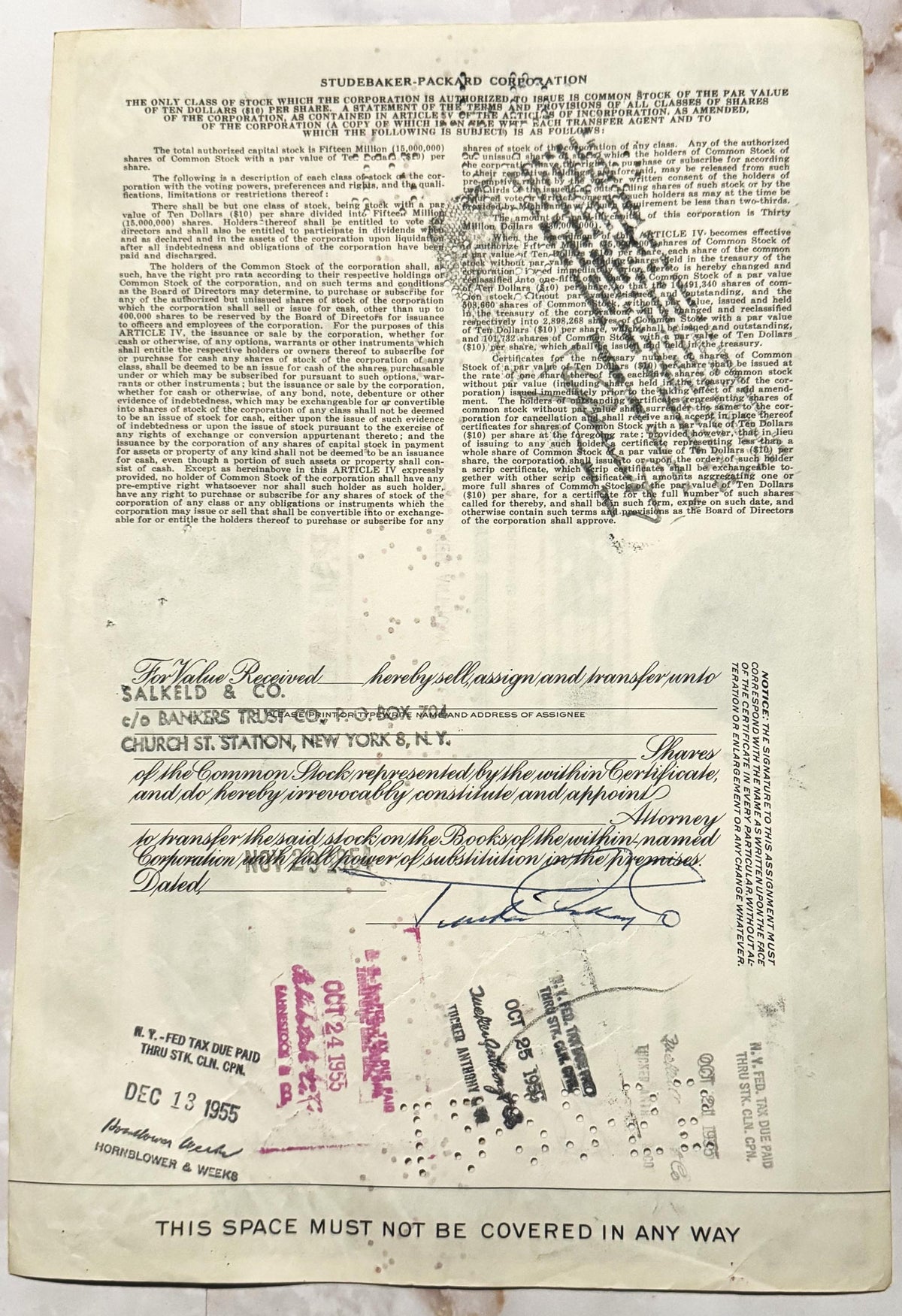
STUDEBAKER-PACKARD CORPORATION, INCORPORATED UNDER THE LAWS OF THE STATE OF MICHIGAN, for ONE HUNDRED fully paid shares of COMMON STOCK, PAR VALUE $10 PER SHARE, with big 100 numerals in the upper corners and an ornate blue border. Up top is the engraved vignette: a seated woman in a flowing cloak between two bare-chested workmen, one with a pickaxe. It reads THIS CERTIFICATE IS TRANSFERABLE EITHER IN NEW YORK CITY OR DETROIT, names the Detroit Trust Company and the City Bank Farmers Trust Company as registrars and Guaranty Trust Co. of New York as a transfer agent, and has a printed corporate seal, facsimile officers' signatures and AMERICAN BANK NOTE COMPANY along the foot. The back has the Article IV text and the assignment form.

Those printed banks date the plate. City Bank Farmers Trust became First National City Trust at the end of January 1959, and Guaranty Trust merged with J.P. Morgan & Co. the same year to form Morgan Guaranty Trust, so these come from 1954 to 1959. Some carry the facsimile signature of James J. Nance, the Packard president who ran the merged company, and later ones carry his successor's.

These are issued certificates, filled in for a holder, countersigned and later punch-cancelled. Each one in the stack is a little different that way.

📜 Every one of these certificates had a working life, and it can show. Depending on the sheet, you may find staples or staple holes, cancellation punch holes (often right through the signatures), hand stamps from banks, brokers and transfer agents, real federal or state stock transfer tax stamps, handwriting or a filled-in transfer on the back, papers still attached, seals (a corporate seal pressed into the paper, a foil wafer seal, or a bank's signature-guarantee stamp signed across an endorsement), or a silver strip pasted over an officer's signature with the new officer's signature printed on top. That last one is what collectors call silvering: when the officers changed, the new signature could be pasted right over the old one on certificates already printed. None of that is damage. Each mark is part of the paper's own history, and they vary sheet to sheet, so no two are quite alike.

🏭 The Merger That Was Supposed to Save Them

In 1954 the Packard Motor Car Company of Detroit bought the Studebaker Corporation of South Bend, Indiana. The bigger plan was for Studebaker-Packard to join Nash-Kelvinator and Hudson in a four-make American Motors Corporation. Then Nash's George W. Mason died suddenly in 1954, George Romney took over, and disputes over sharing parts sank the whole idea.

Nance and Mason had dreamed that plan up together. Nance had been brought over from the appliance maker Hotpoint to run Packard in 1952.

Packard's people also found out Studebaker was in worse shape than they'd been told. Studebaker needed to sell about 282,000 cars a year to break even and sold about 82,000 in 1954. After a terrible 1956, Nance left, Curtiss-Wright took over management, and the car business moved to South Bend, ending production in Detroit, which is why a Detroit certificate like this belongs to those first few years. The Packard name was gone after 1958; the compact Studebaker Lark gave the company one last good year in 1959, its biggest profit ever at about $28.5 million; then the company became the Studebaker Corporation in 1962, South Bend closed in 1963, and the last Studebakers came out of Hamilton, Ontario, in 1966.

A few more bits I love from those years. The last car Packard designed all on its own, a Patrician four-door, rolled off the Conner Avenue line in Detroit on June 25, 1956. The 1957 and 1958 Packards were built by Studebaker in South Bend, and the critics called them "Packardbakers." Curtiss-Wright's Roy T. Hurley came in insisting on big changes, and one of them was getting Studebaker the rights to sell Mercedes-Benz cars in the United States. The Lark sold over 130,000 in its very first year, and it was the work of Harold E. Churchill, who was elected president in 1956 when Nance left. Time magazine called him a "horn-handed engineer": he had come to Studebaker in South Bend in the 1920s as a mechanic with two years at Western Michigan, helped engineer the 1939 Champion and held more than 50 automotive patents. He figured a small company couldn't fight the Big Three model for model, so he built one good, low-priced compact instead, and Time credited him with bringing the company back from the brink of bankruptcy. South Bend built its last car on December 20, 1963, and the very last Studebaker left Hamilton on March 17, 1966.

🛞 Wagons First

Studebaker was a South Bend name long before it built cars. Brothers Henry and Clement Studebaker opened a blacksmith and wagon shop there in 1852, and by the 1880s they were the biggest wagon builders in the world. The Studebaker National Museum in South Bend still keeps the carriage Abraham Lincoln rode to Ford's Theatre. Packard, the other half of this company, sold luxury cars for half a century under the line "Ask the man who owns one."

There were five Studebaker brothers in all: Henry, Clement, John Mohler, Peter and Jacob. My favorite is John Mohler. During the Gold Rush he was out in Placerville, California, building wheelbarrows for the miners, and he came home with $8,000 in his pocket. The Studebakers built wagons for the Union Army in the Civil War, and when the horseless carriage came along they started with electric cars in 1902 and gasoline cars in 1904.

🏁 Packard, "Ask the Man Who Owns One"

Packard started in Warren, Ohio, with James Ward Packard, his brother William Doud Packard and their partner George Lewis Weiss. The story goes that Weiss owned Winton cars, James figured he could build a better one, and when Alexander Winton ignored his suggestions, Winton more or less told him to go build his own car. So he did, and the first Packard ran on November 6, 1899. Henry Bourne Joy, from a wealthy Detroit family, bought one, rounded up investors, and in 1902 it became the Packard Motor Car Company and moved to Detroit, where Albert Kahn's firm designed the big East Grand Boulevard plant. That famous slogan is credited to Packard president James Alvan Macauley. And during World War II, Packard built 55,523 Rolls-Royce Merlin engines, the ones that powered the P-51 Mustang.

🖨️ American Bank Note Company

The printer at the foot of this certificate goes way back. American Bank Note traces its roots to 1795 and Robert Scot, the first official engraver of the U.S. Mint, and it took its name in 1858 when several of the big New York security printers merged. It printed banknotes, postage stamps and stock certificates, including the Demand Notes the Treasury issued during the Civil War, and its printing plant in the South Bronx was finished in 1908. That's why the engraving on these is so fine: it came from a firm that engraved money too.

📏 Details

  • Vintage 1950s Studebaker-Packard Corporation stock certificate, blue, 100 shares, $10 par common
  • Transferable in New York City or Detroit; American Bank Note Company engraving
  • About 12" x 8", issued and cancelled
  • You'll get one certificate like the ones shown; dates, names, signatures and stamps differ from one to the next

🖼️ Frame it for an office, a den or a garage, next to a picture of a Hawk or a Packard Caribbean.

It makes a great gift for a car guy, a Studebaker or Packard club member, anybody from South Bend or Detroit, or someone in finance. There's only a finite supply of these old certificates, nobody is printing engraved paper like this anymore, and once they're gone they will be very difficult to acquire.

Shipping

🚚 Shipping & Handling

  • Shipping costs and timing are calculated at checkout.
  • Items curated and shipped directly by me include U.S. shipping at no additional cost, professionally packed to ensure safe arrival of your artifact.

Items from Vetted Pro Collectors
Shipping for items offered by vetted Pro Collectors is determined at checkout. All Pro Collector listings are reviewed to ensure fair, reasonable shipping practices.

For full details, please refer to our Shipping Policy.

Returns & Exchange

Take your time — you've got a full six months. If a piece isn't right for you, send it back the way it reached you and we're good.

In the first 30 days your money goes straight back the way you paid. After that it's store credit, so you can put it toward something you'd rather have.

Return shipping we sort out between us, case by case. I don't make this difficult.

If something arrives damaged, or it isn't what I said it was, send me a photo within 48 hours and I'll make it right.

Email info@vintageantiquesgifts.com or call 802-356-9872 — that's me answering, not a call center.

The only things I can't take back are custom or special-order pieces and gift cards.

View full details
  • 5 stars: 6 (100%)
  • 4 stars: 0 (0%)
  • 3 stars: 0 (0%)
  • 2 stars: 0 (0%)
  • 1 star: 0 (0%)
2
2***1 (1541)

One of the nicest transactions I have ever had with a vendor

0
0***2 (541)

Excellent. Great seller. Great communication. Everything about this purchase was excellent.

s
s***s (1728)

Quickly sent in very good condition; will be popular with Studebaker Club members here;

l
l***a (569)

Great condition thank you!

i
i***n (27)

The item arrived in perfect condition and was just as described. The seller included a wonderful, personal note signed by him and his family. I love it!

D
David

A rare piece of history. Great for framing. Great value for the money. Shipped very fast and very securely. 5 stars all around for this seller and this transaction. Thank you.

Rescuing American History Since 2007

— Travis & the Kids