
Nice shirt!
Very nice nickel. Charming vender. Fast service. He has other very cool stuff on sale as well.
Very nice labels in excellent condition. Well packaged and arrived timely.
The Cadillac poster was great, very well made and great graphics.
Everything authentic. Nothing reproduced. 🏛️ Vintage and Antique Gifts is a multi-channel...
$0.00 USD
Vintage and Antique Gifts
🚚 Free US Shipping — ships within one business day. International shipping calculated at checkout.
Couldn't load pickup availability
Size: 12" x 8"
There was a time when a share of General Motors lived in a safe deposit box at the bank, in a manila envelope in a roll-top desk drawer, or in a frame on the wall behind the bar in the basement. These are those certificates.
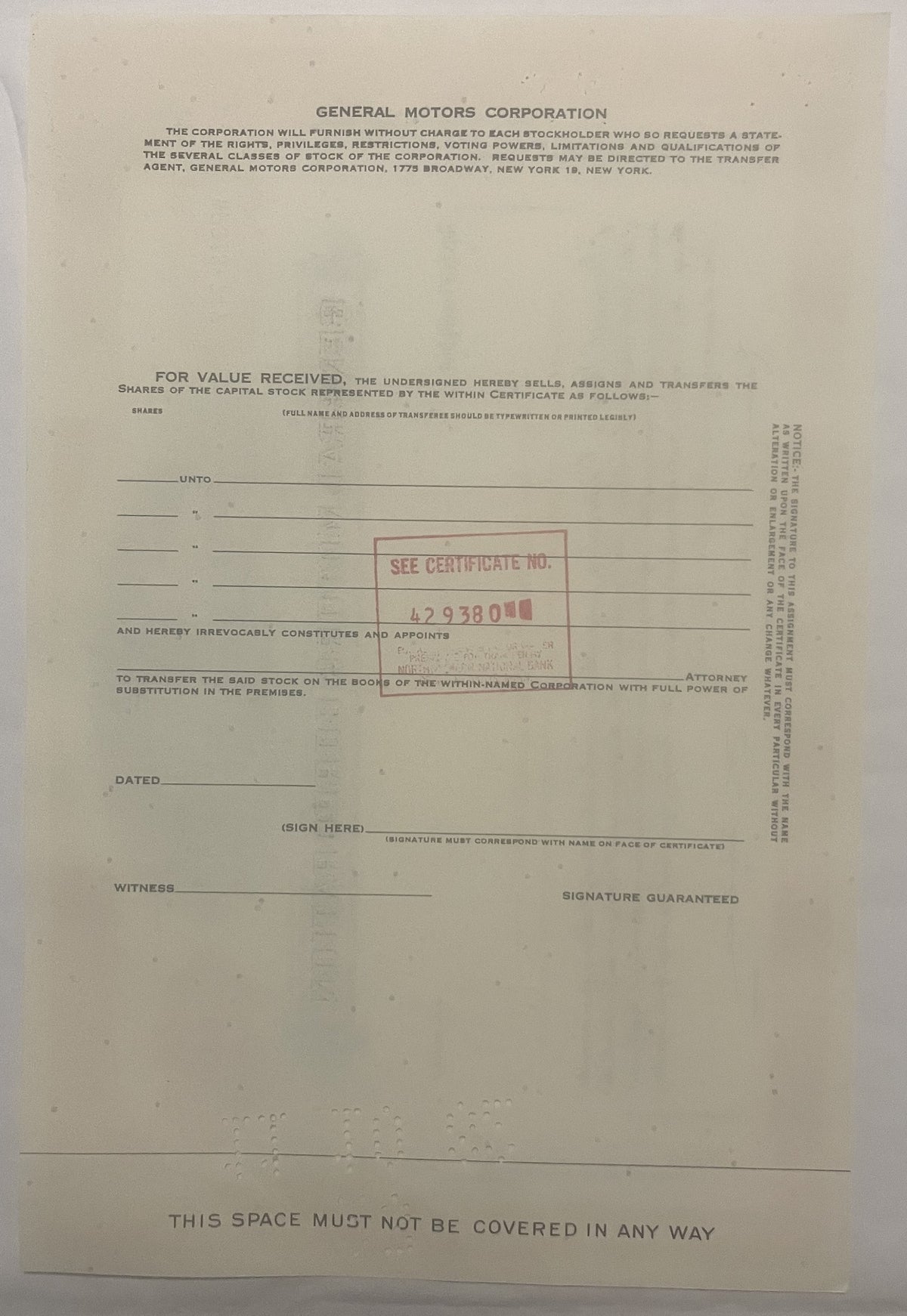
These are engraved General Motors Corporation common stock certificates - real bank-note paper. Most carry the ordinary marks of paper that did real work: a cancellation punch or two, a transfer stamp, here and there a faint pencil note in the margin. They vary a little one to the next. Stock and bond certificates can carry financial writings, markings, stamps, hole punches and staples as part of the life of the instrument. Those marks are the paper trail of a working financial instrument, not flaws - the story of a certificate that actually did its job in the twentieth-century American financial system.
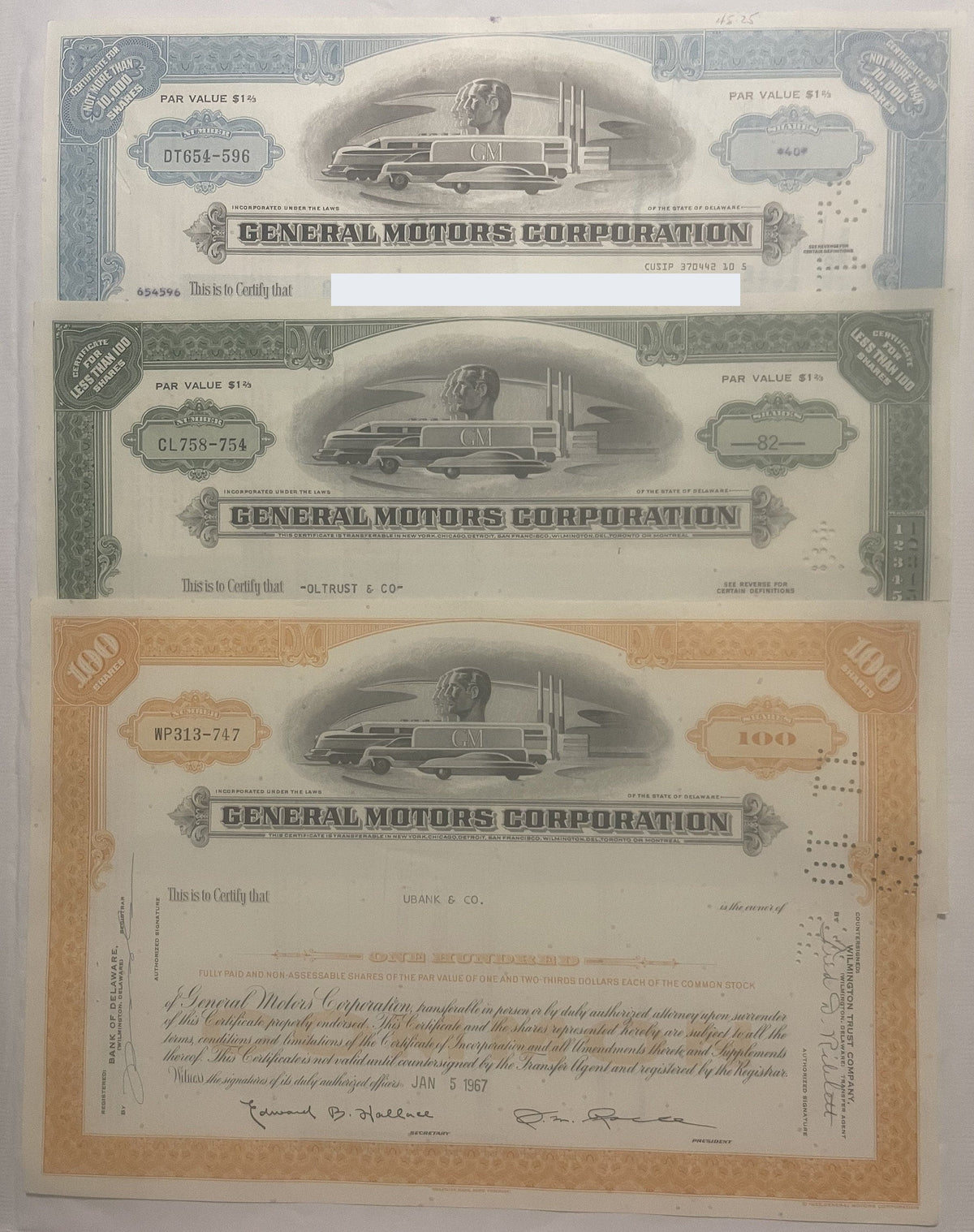
I stock General Motors common stock in three flavors, and each one is its own printed tier, not just a different color of the same thing. Blue is the "CERTIFICATE FOR NOT MORE THAN 10,000 SHARES" printing. Green is the "CERTIFICATE FOR LESS THAN 100 SHARES" printing, with its own tens-and-units punch column down the side. Orange is the flat "100 SHARES" printing - the one that spells ONE HUNDRED across the face. Buy one color, or all three together.
Each color has its own personality on a wall, too. The blue is the classic - crisp blue ink against creamy bank-note paper. The green is quieter and woodsier, with a kind of understated authority; it reads less like a Wall Street trading floor and more like a country club library, and it pairs beautifully with leather, oak, brass and the warm light of a desk lamp in a study or an executive office. The orange is the showstopper of the three. It pops on a wall, it pops in a frame, it pops in a shadow box, and it's the one that pulls the most attention in any display. The set of all three is the one to pick when you want the wall, the shelf or the gift to do the heavy lifting in one move - three frames in a vertical run, three in a horizontal row, or all three layered in a single oversized shadow box. Three matching documents in three colors is what turns a piece of decor into a collection.
Every color shares the same engraved centerpiece: three overlapping male profiles facing forward, a streamlined locomotive, a low teardrop car, and a coach or delivery van stamped with a bold "GM" panel, with factory smokestacks and a curved, saucer-roofed building rising behind them. It's Streamline Moderne down to the bones - the same visual language of speed and industry GM leaned on everywhere in the mid-century. Engraved by the American Bank Note Company, printed light and airy on the blue, deeper and more bookish on the green, boldest on the orange. No embossed seal on any of them - just the engraving, the guilloché borderwork, and the officers' printed signatures.
Look closer and it's a whole transportation trio - car, truck, train, every kind of land transport GM had a hand in, in one composition. The car sits low on rounded teardrop fenders, the kind of concept-car silhouette that defined GM's idea of the road ahead. The three profiles are layered like a futurist motif, eyes fixed on the horizon. The smokestacks stand for the industrial muscle of Detroit - the assembly plants, the foundries, the stamping shops and the body works, all the brick-and-steel architecture of the American manufacturing century - and a set of sweeping arcs pulls the whole scene into one arched horizon. It's a miniature manifesto of mid-century American industrial futurism, small enough to hold in your hand.
Nothing on the certificate says "Futurama" - that's my name for it - but look at the streamlined car, the coach, the locomotive and those forward-facing profiles and you'll see where my head went. GM's actual Futurama was the "Highways and Horizons" ride at the 1939-40 New York World's Fair, designed by Norman Bel Geddes: a scale model of an imagined 1960 America, viewed from moving chair-cars on a conveyor GM called the "carry-go-round" - 552 seats' worth at a time - gliding over automated highways and sweeping motorways while a speaker narrated "Come tour the future with General Motors." About five million people rode it, and every one of them walked out with a little round pin that read "I have seen the future." President Roosevelt sought Bel Geddes out afterward, and Bel Geddes' own book, Magic Motorways, laid out the four principles - safety, comfort, speed, economy - that show up again in the Federal-Aid Highway Act of 1944, the law that eventually gave the country its interstates. GM went back to the Fair in 1964 with Futurama II, on the very same Flushing Meadows grounds in Queens - a swamp and ash dump that had been filled in to build the 1939 Fair - trading highways for lunar colonies and undersea motorways. That's the world this engraving always puts me in mind of.
Futurama was unlike anything Americans had ever experienced. It was the most popular exhibit of the whole Fair - the "number-one hit show" - and when fairgoers were surveyed, GM's pavilion scored 39.4 to second-place Ford's 8.5. The model covered about 35,000 square feet, built in 408 separate sections, and the ride ran a third of a mile over it: 322 moving chair-cars on that carry-go-round, each one wired for sound, gliding above an America twenty years in the future - automated highways, sprawling suburbs, gleaming skyscrapers and multi-lane motorways crossing the continent. The written version of the narration in the souvenir booklet opens just the way the ride did: "Come tour the future with General Motors! A transcontinental flight over America in 1960. What will we see?" Five million people across the 1939 and 1940 seasons found out, and the pin they wore home carried four words that became one of the most famous slogans in the history of American corporate advertising. The Fair's own theme was "The World of Tomorrow," and GM gave it its biggest show.
GM commissioned the dream. Americans came to see it. Washington built it. To my eye the vignette carries the spirit of both Futurama I and Futurama II - the whole mid-century arc of GM's "vision of the future," right down to the jungle highways and undersea hotels of 1964 - and its sleek vehicles, heroic forward-facing profiles, smokestacks and arched horizon are the same design DNA. It's "Highways and Horizons" engraved onto a single piece of bank-note paper: the World of Tomorrow, shrunk down to fit in a frame.
William C. Durant founded General Motors as a New Jersey company in Flint, Michigan, in 1908, lost control of it in 1910, fought his way back in 1916 with financing from Pierre S. du Pont, and was pushed out again in 1920. That 1916 reorganization is also when the company became "General Motors Corporation, incorporated under the laws of the State of Delaware" - the exact line engraved on the certificate face. Charles E. Wilson, GM's president, is the one who told a Senate committee in 1953 that for years he'd thought what was good for the country was good for General Motors, and vice versa - a line that got shortened in the retelling to "what's good for GM is good for America," which he never quite said.
From Durant's start in Flint through the chrome-and-tailfin postwar boom, the muscle-car wars, the energy crisis and the badge-engineering eighties, General Motors was there - sitting in the driveway, idling at the curb, parked at the diner, lined up at the drive-in. Four letters that meant Detroit. In 1955, the year this design was copyrighted, GM was the biggest employer in America, with 576,667 people on the payroll, and its domestic workforce peaked at about 620,000 in 1979. From 1931, when it passed Ford, all the way to 2008, GM sold more cars and trucks every year than any other automaker on earth.
Every big American automaker had its badge. Ford's blue oval went back to the 1927 Model A, and Chrysler took up its five-pointed Pentastar in 1962. GM ran five car divisions under one roof - Chevrolet, Pontiac, Oldsmobile, Buick and Cadillac - plus GMC trucks, and each make had a home plant: Buick and Chevrolet in Flint, Oldsmobile in Lansing, Pontiac in Pontiac and Cadillac in Detroit. Beyond Michigan the assembly lines ran in Janesville, Wisconsin, where GM's 100 millionth vehicle came off the Chevrolet line in April 1967; in Linden, New Jersey, from 1937 to 2005; in North Tarrytown, New York, a Hudson River plant that came to GM along with Chevrolet and ran until 1996; and in Fremont, California, which GM closed in 1982 and reopened with Toyota in 1984 as NUMMI.
Picture the line in those years: the hum, the torque guns, the men in coveralls and the women in the trim shop, the lunch pails and the shift whistle, the smell of fresh paint and cutting oil and coffee in waxed-paper cups, and the pride of stamping a hood with a Chevrolet bowtie, a Cadillac crest or a Buick tri-shield. Those factory smokestacks against the Michigan sky are the same ones I see in this vignette. The work that built the country.
Picture the showroom, too. Polished tile, plate glass, a Chevrolet Impala on a slow-spinning turntable under the lights, a salesman in a short-sleeved white dress shirt with a clip-on tie, coffee on the desk, cigarettes in the ashtray and a wall clock ticking past five. Outside the window, the lot full of trade-ins - Bel Airs, Catalinas, Eighty-Eights, Skylarks, LeSabres - each one headed toward a second life with a new owner and a new story. That's the everyday American world these certificates come from: the postwar boom, the muscle-car years and the long, slow afternoons at the dealership.
And picture the family driveways those cars came home to. The Buick your grandfather drove off the lot in the late fifties. The Chevy Bel Air your dad cruised through high school in. The Oldsmobile Cutlass your uncle parked at every family reunion. The Cadillac your great-grandmother kept under a canvas tarp in the garage for "good." The Pontiac GTO your older brother saved up two summers to buy. A Caprice Classic with the wagon roof rack loaded for vacation, a Cutlass Supreme washed and waxed on a Saturday morning, a pickup with a fresh load of mulch for the flower beds, a Camaro with the hood up while two teenagers argued over the carburetor, a Buick Riviera with the chrome polished to a mirror - and the GMC pickup that hauled lumber, kids, hay, Christmas trees, lake gear and most of the family memories from one decade into the next. GM didn't just build cars. GM built the American century.
These went through different registrars and transfer agents depending on the tier and the year, and the banks on them have their own footnotes. Among them: Bank of Delaware as registrar with Wilmington Trust Company as transfer agent - Wilmington Trust founded in 1903 by T. Coleman du Pont, whose own family's General Motors stake grew so large that the Supreme Court ordered DuPont to divest it; the shares went out to DuPont's shareholders in waves between 1962 and 1965. The Chase Manhattan Bank shows up as registrar too - a bank formed in 1955, the same year this design was copyrighted - with General Motors' own Detroit office standing in as transfer agent. And The Northern Trust Company appears as registrar with Continental Illinois National Bank and Trust Company of Chicago as transfer agent; Continental Illinois is the bank whose 1984 collapse was, for a while, the largest bank failure in U.S. history, and gave the country the phrase "too big to fail." GM's New York transfer office on these is 1775 Broadway - the company's own headquarters building until it moved uptown to the new General Motors Building on Fifth Avenue in 1968.
The design itself dates to 1955 - GM's certificates carried a $5 par value and a different vignette before that year, and this "$1⅔"-par design replaced it. That par value stuck with GM's common stock for decades, right through certificates issued into the 1980s. It didn't survive the 2009 bankruptcy: the old General Motors Corporation became Motors Liquidation Company, and its plan cancelled the old $1⅔ common on March 31, 2011. Holders of the paper got nothing for it. What you're holding isn't a live share anymore - it's what's left of one, and a real piece of the company that sat at number one on the Fortune 500 through the 1960s.
The paper certificate itself went the same way. The Depository Trust Company was set up in 1973 to hold Wall Street's shares on its books instead of in envelopes and vaults, the Direct Registration System arrived in 1996 so a shareholder could own stock with no certificate at all, and by 2008 the New York Stock Exchange required its listed companies to be ready to issue shares without paper. The engraved, numbered, bank-note-printed proof of ownership your grandparents knew quietly disappeared from American life.
Scripophily is the formal name for collecting old stocks and bonds, and it's one of the most underappreciated corners of the collecting world - the sports cards, comic books, coins and vinyl records get the headlines while scripophily quietly keeps building. Inside it, the American "blue chip" industrial certificates of the mid-twentieth century hold a special place. These are the documents that capitalized the country - the papers that financed the assembly lines, the steel mills, the railroads, the refineries, the dealerships, and the dream of a two-car garage in every suburb from Long Island to Long Beach. For my money General Motors sits right at the top of that pile.
A GM certificate was never just a financial instrument - it was a cultural artifact. It was the paper your grandfather pulled out at Thanksgiving to show you what "investing" looked like. It was the document your father slipped into the safe deposit box when you were born, "for college." It was the gift your great-aunt gave at every graduation, every wedding, every milestone - "ten shares of GM, kid, hold onto it."
It's not the dollar value - these shares were cancelled in 2011. What the paper holds is history: a finished, closed chapter of American economic and design life. The era of physical ownership. The era of mailed dividend checks. The era of "I have seen the future," and of GM as the company that, more than any other, defined what it meant to be an American corporation and what it meant to dream up the road ahead. That era ended, but the paper survives, and every time one of these certificates lands on a wall, in a frame, in a shadow box, in a den, a dorm or a lake house, the era lives on a little longer. That's what you're buying: the story, and the Americana - and a small engraved echo of "the World of Tomorrow," riding forward on streamlined wheels.
Nobody is printing these anymore. The old GM common was cancelled in 2011 and the engraved certificate is gone from American life, so once the supply still out there is framed and on collectors' walls, they'll be very difficult to acquire. This is the vintage Americana that doesn't shout for attention. It earns it.
Blue, green and orange are what I carry, but they weren't GM's only colors for this design - the same certificate turns up in gray, pink, purple, peach and gold over the years.
Choose blue, green, orange, or the set of all three - a real engraved piece of General Motors, from the era when a share of stock was something you could actually hold.
Items from Vetted Pro Collectors
Shipping for items offered by vetted Pro Collectors is determined at checkout. All Pro Collector listings are reviewed to ensure fair, reasonable shipping practices.
For full details, please refer to our Shipping Policy.
Take your time — you've got a full six months. If a piece isn't right for you, send it back the way it reached you and we're good.
In the first 30 days your money goes straight back the way you paid. After that it's store credit, so you can put it toward something you'd rather have.
Return shipping we sort out between us, case by case. I don't make this difficult.
If something arrives damaged, or it isn't what I said it was, send me a photo within 48 hours and I'll make it right.
Email info@vintageantiquesgifts.com or call 802-356-9872 — that's me answering, not a call center.
The only things I can't take back are custom or special-order pieces and gift cards.

Items are exactly as advertised. Excellent eBay seller! A++++++++++++++++++++
This one's a bit different than the usual certificates so it's great as a collection piece.. very cool
Hello Vale! Thank you for your fantastic 5-star review on the GM General Motors Stock Certificate! We're overjoyed to know that this unique piece caught your eye and has found a place in your collection. We truly appreciate your support and are excited to serve you with more unique and cool vintage items in the future!
Preserving History: Authentic Objects Across Eras
Nice shirt!
Looks great !
Very nice nickel. Charming vender. Fast service. He has other very cool stuff on sale as well.
Very nice labels in excellent condition. Well packaged and arrived timely.
The Cadillac poster was great, very well made and great graphics.
Nice shirt!
Looks great !
Very nice nickel. Charming vender. Fast service. He has other very cool stuff on sale as well.
Very nice labels in excellent condition. Well packaged and arrived timely.
The Cadillac poster was great, very well made and great graphics.