Skip to product information
1 of 10

Vintage and Antique Gifts

Vintage 1950s-1970s Pan Am Stock Certificate ✈️ Teal, Pan American World Airways, Golden Age Aviation

Vintage 1950s-1970s Pan Am Stock Certificate ✈️ Teal, Pan American World Airways, Golden Age Aviation

Regular price 10.00 USD
Regular price Sale price 10.00 USD
Sale Sold out
Shipping calculated at checkout.
Quantity

✈️ Remember When a Boarding Pass Felt Like an Invitation to the World?

There was a time when the words "Pan Am" didn't just mean an airline — they meant a promise. A promise of white uniform caps and blue globe logos, of Clipper flying boats setting down in Hong Kong harbor, of a stewardess handing you a cocktail somewhere over the mid-Atlantic while the rest of the country was still driving two-lane highways to get anywhere at all. Pan American World Airways was, for the better part of the twentieth century, the closest thing America had to a national airline of legend — and every share of its stock, every certificate like this one, was a small paper piece of that legend, passed from broker to shareholder to safe-deposit box for decades. Holding one now is a little like holding a boarding pass to an era that doesn't exist anymore, and honestly, never quite will again.

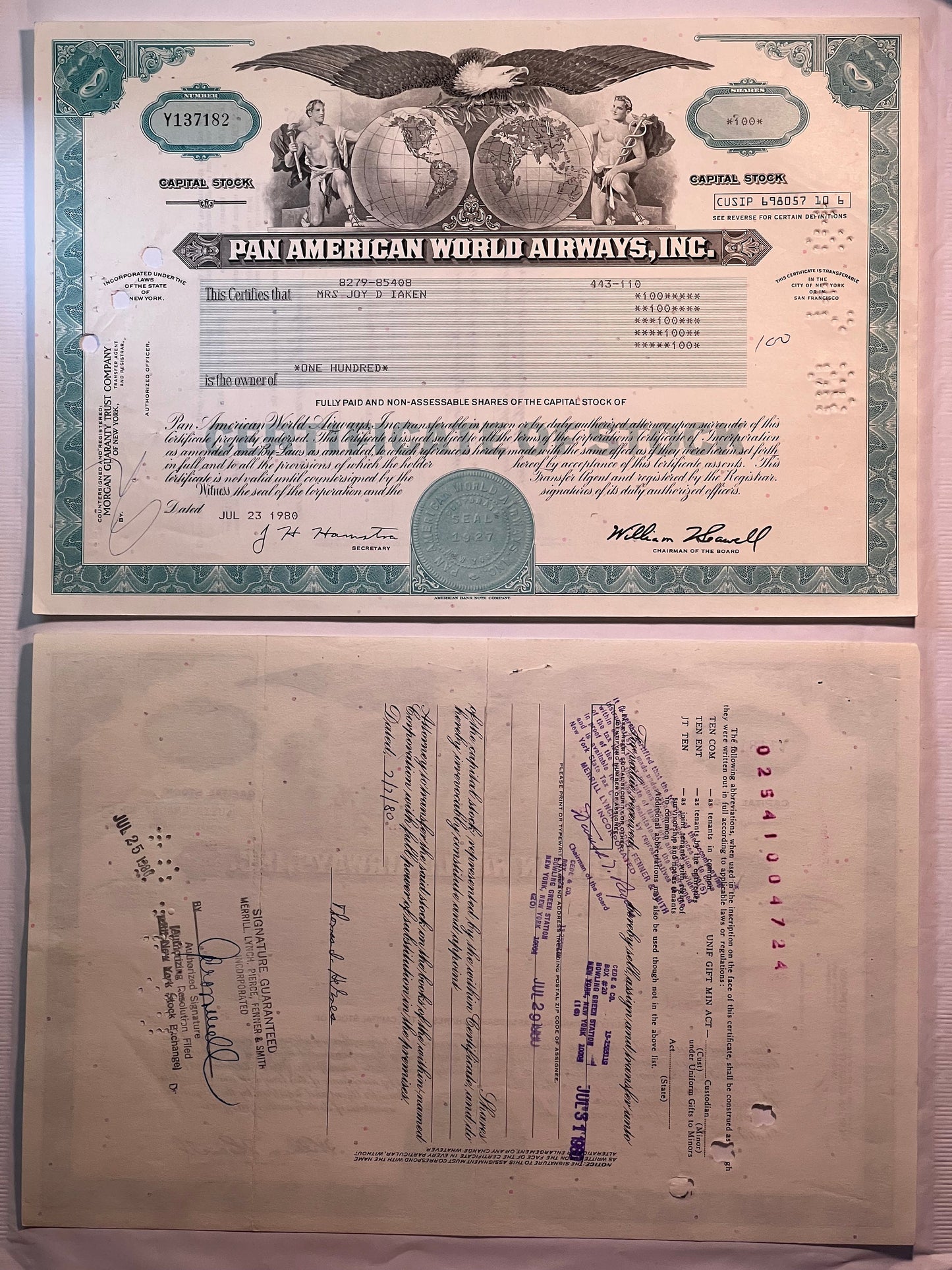
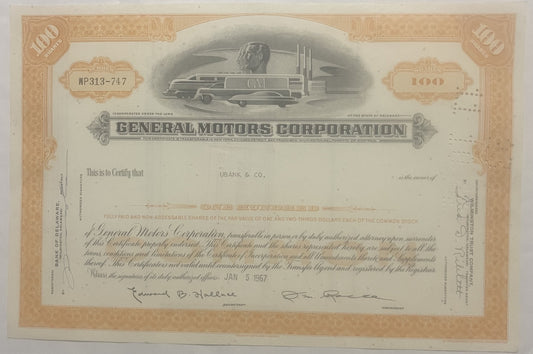
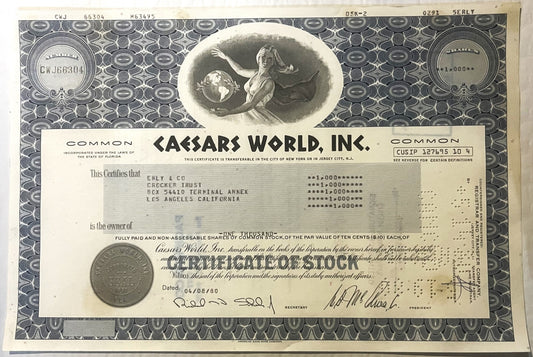
This is an original Pan American World Airways, Inc. capital stock certificate, part of the "teal" issue — printed in soft aqua-blue-green ink on heavy certificate stock, from the mid-twentieth-century decades when Pan Am was at the very height of its power, roughly the 1950s into the 1970s. It measures approximately 12 x 8 inches (30.5 x 20.3 cm), the classic size for American corporate stock certificates of the era, and it's offered here as a genuine issued certificate from the original printing — made out to a holder, ink-signed by the officers and punch-cancelled — which is exactly what makes it a beautifully engraved artifact of one of the most famous companies America ever produced.

Across the top of the certificate spreads a bald eagle, wings fully extended, talons gripping a pair of facing globes — one showing the Americas, the other Africa and Eurasia — flanked on either side by two classically rendered, bare-chested allegorical figures in the grand style of nineteenth- and twentieth-century American banknote engraving.

Below, in bold serif capitals, runs the company's full name: PAN AMERICAN WORLD AIRWAYS, INC., framed in a decorative border alongside fields for share count, certificate number, and a printed CUSIP identifier — with Morgan Guaranty Trust Company of New York appearing in the fine print as the registrar and transfer agent charged with keeping Pan Am's shareholder rolls in order.

It's the kind of document that was built to be handled, filed, and kept — and eighty-some years of American corporate design sensibility went into making sure it looked the part.


🦅 A Closer Look at the Engraving

This vignette — the eagle mantling two hemispheres, flanked by a pair of classical figures — is the work of the American Bank Note Company, the legendary security printer that for generations produced the engraved stocks, bonds, and currency-grade documents for the largest corporations in the country. One of the two figures cradles a caduceus, the winged staff of Mercury, ancient messenger-god of commerce, travel, and communication — a fitting emblem for a company whose entire business was carrying people and messages across oceans that had, until Pan Am came along, taken ships weeks to cross.

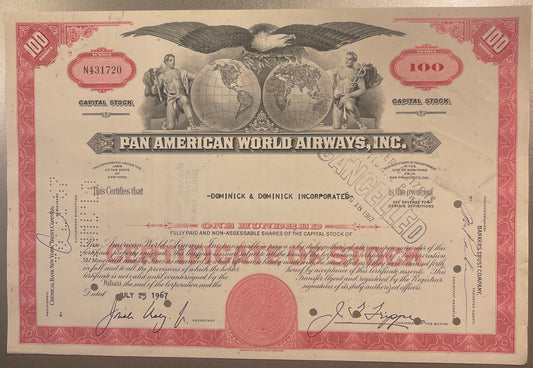
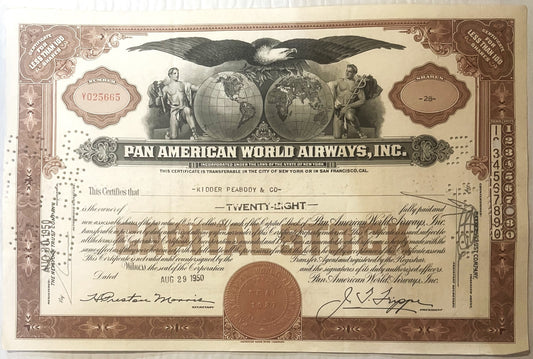
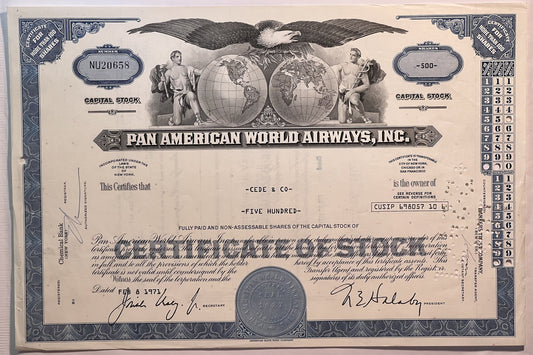
The teal ink itself is part of what makes this issue instantly recognizable to collectors; Pan Am certificates were printed over the decades in several different colorways — red, brown, and this cooler aqua-teal among them — and while dealers today don't agree on an exact year the teal run began or ended, they consistently place it in Pan Am's mid-century heyday.

The engraving work is fine-line steel-plate style, the kind of intaglio printing that gives old stock certificates their slightly raised, tactile quality and their resistance to counterfeiting — a level of craft banks and corporations once insisted on for anything meant to represent real ownership, real money, real trust.


🌎 From a Rented Seaplane in Key West to "The World's Most Experienced Airline"

Pan Am's founding is a genuinely strange and wonderful story, and not the one most people assume. In March of 1927, three U.S. Army Air Corps majors — Henry "Hap" Arnold, Carl Spaatz, and John Jouett — quietly incorporated a shell company called Pan American Airways, partly out of concern that a German-backed airline was gaining too much influence in Latin America. Around the same time, a young, ferociously ambitious former Navy pilot named Juan Trippe was forming his own outfit, the Aviation Corporation of the Americas, with a syndicate of Wall Street financiers behind him. A third rival, Atlantic, Gulf, and Caribbean Airways, entered the picture too — and by 1928 all three had merged, with Trippe's group holding a minority stake but Trippe's vision, ultimately, winning out. The airline's very first flight lifted off on October 19, 1927, from Key West, Florida, to Havana, Cuba — flown, as legend has it among aviation collectors, in a hastily chartered floatplane because Pan Am's own aircraft hadn't arrived in time to meet its airmail contract deadline. From that improvised beginning grew, within a decade, an airline flying to Hong Kong.

The growth from there reads like a highlight reel of aviation's golden century. In 1930 Pan Am absorbed the New York, Rio, and Buenos Aires Line, stitching together the first real air network down the length of South America, and by 1931 the company had renamed itself Pan American Airways Corporation. In 1937, Pan Am struck agreements with Britain and France to begin seaplane service across the Atlantic, flying out of Norfolk, Virginia, by way of Bermuda and the Azores, while on the other side of the globe its Pacific Clipper flying boats were already island-hopping toward Hong Kong.

By 1940 the airline was flying the Boeing 307 Stratoliner — the world's first pressurized airliner — though the coming war would quickly pull it into military service. During World War II, Pan Am pioneered a supply route across Western and Central Africa into Iran, and in early 1942 it became the first airline in history to fly a route circling the entire globe.

In January 1943, President Franklin D. Roosevelt became the first sitting U.S. president to fly abroad, aboard Pan Am's Dixie Clipper — a flight that made front pages everywhere and cemented the airline's reputation as something more than a business: a symbol of American reach.


👨‍✈️ The Men Who Built the Legend

Juan Trippe is the name every Pan Am story returns to — the driving force behind the airline for nearly its entire existence, and the man widely credited as its true founder in spirit if not in original paperwork. He recognized early that the future belonged to jets, ordering Boeing 707s and Douglas DC-8s that put Pan Am's first scheduled jet flight in the air on October 26, 1958. Then, in 1965, Trippe went to his old friend Bill Allen at Boeing with an audacious ask: build something far bigger than the 707. The result was the Boeing 747 — the jumbo jet that redefined air travel for the rest of the century — and Pan Am proudly held the honor of being its first customer. But Trippe's reign wasn't uninterrupted. For roughly two years during the interwar period, stockholder C.V. "Sonny" Whitney managed to wrest the chairmanship away from him — a boardroom coup that old-timers in the stock certificate trade still bring up as one of the great forgotten power struggles of early American aviation, before Trippe reclaimed control and steered the company for decades more.

Trippe also had a knack for recruiting legends. In September 1929, he personally toured Latin America with none other than Charles Lindbergh, who served as a technical adviser during the airline's rapid expansion, using his fame and flying credibility to help secure landing rights across the hemisphere. And in one of aviation history's more delightful footnotes, a young Pan Am Clipper pilot named Gene Roddenberry — who would go on to create Star Trek and, some might say, chart humanity's next great voyage of exploration — survived the crash of the Clipper Eclipse in Syria in 1947. Collectors of aviation memorabilia love to point out that the man who dreamed up starships once flew Pan Am's own "ships of the air."


💫 The Golden Age — and the Long Descent

By the late 1960s, Pan Am was flying under the confident slogan "World's Most Experienced Airline," and the numbers backed the boast: 6.7 million passengers carried in 1966 alone, and by 1968 a fleet of 150 jets serving 86 countries, with the company sitting on roughly a billion dollars in cash reserves. This was the era this certificate belongs to — the years when Pan Am wasn't just an airline but a piece of American self-image, its blue globe logo (which collectors and old employees still fondly nickname "the Blue Meatball") appearing on luggage tags, timetables, and travel posters in every corner of the world. Its planes and routes carried the "Clipper" name in tribute to the great sailing ships of an earlier age of ocean travel, and its pilots' white caps became so iconic that, by some accounts passed down among aviation collectors, Pan Am's globe emblem was once considered the second most recognized corporate trademark on Earth.

The fall, when it came, arrived in stages that anyone who lived through the era remembers. Rising fuel costs through the 1970s, the deregulation of the U.S. airline industry, and a wave of new domestic competition all began chipping away at Pan Am's dominance. Then came December 1988, when Pan Am Flight 103 was destroyed over Lockerbie, Scotland — a tragedy that inflicted damage on the airline's reputation and finances from which it never fully recovered. When Iraq invaded Kuwait in August 1990, triggering the Gulf War, fuel prices spiked and global travel demand collapsed, delivering the final blow to a company already reeling. Pan Am filed for bankruptcy on January 8, 1991; Delta Air Lines purchased its remaining profitable routes and assets; and on December 4, 1991, Pan American World Airways ceased operations entirely — the third major U.S. airline to disappear that same year, following Eastern Air Lines and Midway Airlines into history. It was, by any measure, the end of an era that had begun with three Army majors and a rented floatplane sixty-four years earlier.


🏙️ Not Small-Town Paper — A Skyscraper's Signature

Unlike a lot of vintage stock certificates that trace back to a single mill town or regional railroad, Pan Am was never a local story — it was a global one, headquartered for most of this certificate's era in the landmark Pan Am Building towering over Manhattan's Park Avenue, one of the most recognizable pieces of corporate real estate in the country. Only at the very end, as the company prepared for a final, short-lived relaunch attempt, did it relocate its headquarters south to the Miami area — fittingly, back toward the Caribbean routes where the whole adventure had begun in Key West decades before. There's a nice symmetry to that: an airline that started with a puddle-jump to Havana and ended, in its last days, looking toward Florida once more.


🌟 Why Pan Am Still Matters Today

More than three decades after its final flight, Pan Am remains one of the most collected and romanticized brands in American aviation history — arguably the country's unofficial overseas flag carrier for much of the twentieth century, and the airline credited with pioneering the jet age, the jumbo jet, and computerized reservation systems that every airline still relies on today. Vintage travel posters, luggage stickers, flight bags, and stock certificates like this one continue to circulate among collectors precisely because Pan Am occupies such a singular place in the popular imagination of what flying used to feel like — glamorous, aspirational, and just a little bit dangerous in the best possible sense. A certificate like this isn't just a piece of corporate paperwork; it's a genuine artifact of that golden age, engraved and printed at a moment when air travel itself still felt like the future.


🖼️ Display Ideas

  • 🖼️ Framed alone on a study or home-office wall as a striking piece of mid-century American graphic design
  • ✈️ Paired with a vintage Pan Am travel poster or luggage sticker for an aviation-themed gallery wall
  • 📚 Matted alongside old Clipper route maps or timetables in a den dedicated to golden-age travel
  • 🛋️ Displayed on a bar cart or credenza for a mid-century modern living space with a jet-set sensibility
  • 🎓 Given as a milestone gift for a pilot, retired airline employee, or aviation history enthusiast
  • 💼 Kept in a collector's portfolio alongside other historic American stock and bond certificates

🎁 Who Collects These

Pan Am memorabilia draws a wonderfully wide crowd — aviation history buffs and retired airline crew who lived the golden age firsthand, scripophily collectors who specialize in historic stock and bond certificates as an art form in their own right, mid-century design lovers drawn to the American Bank Note Company's engraving style, and everyday nostalgics who simply remember when flying meant something. It's also a natural gift for anyone with a personal connection to the airline — a family member who flew as crew, a frequent traveler of that era, or a collector already building out a wall of vintage travel ephemera. Because Pan Am's story intersects with so much of twentieth-century history — from Lindbergh to the jet age to the end of an era in 1991 — it appeals as much to history buffs as to aviation die-hards.


❓ FAQ

Is this an original Pan Am stock certificate, or a modern reprint?
This is an original issued certificate from Pan American World Airways, Inc., from the company's mid-twentieth-century printing — not a modern reproduction.

What does the "teal" color refer to?
Pan Am issued its capital stock certificates in several ink colorways over the decades, including red, brown, and this cooler aqua-teal tone — each corresponding to a different printing run rather than a different class of stock.

Is this stock still active or redeemable?
No — Pan American World Airways ceased operations in December 1991, and its stock has no financial value today. Certificates like this one are collected purely as historical and decorative artifacts.

How big is the certificate?
It measures approximately 12 x 8 inches (30.5 x 20.3 cm), the standard size for American corporate stock certificates of its era.

Who engraved and printed it?
The American Bank Note Company, the premier American security printer of the era, engraved the eagle-and-globes vignette and classical figures found on this certificate.

Does it come framed?
It's offered as the certificate itself, ready to be framed or displayed to suit your own space.

Why is Pan Am's globe logo so recognizable?
Collectors and old employees alike often point out that Pan Am's blue globe emblem — nicknamed "the Blue Meatball" — became one of the most widely recognized corporate trademarks in the world during the airline's golden age, a legacy that keeps its memorabilia in steady demand among collectors today.

These are issued instruments rather than blanks. Certificates of this type were filled in for a holder in ink, countersigned by the transfer agent and registered by the registrar, then punch- or cut-cancelled when they were redeemed and retired. Expect financial writings, markings, stamps, hole punches and staple holes as part of the life of the instrument: endorsements and signatures, transfer-agent and registrar stamps, revenue or documentary tax stamps, cancellation punches, staple holes from being bound into a transfer book, pencil ledger notations. That is the paper trail of a security that actually did its job, and it is what separates a document that lived from a blank that never did. No two are alike: holder details, serial numbers, dates, signatures, stamps and punch patterns vary from example to example, so the photographs show the type rather than the exact sheet that ships.

Shipping

🚚 Shipping & Handling

  • Shipping costs and timing are calculated at checkout.
  • Items curated and shipped directly by me include U.S. shipping at no additional cost, professionally packed to ensure safe arrival of your artifact.

Items from Vetted Pro Collectors
Shipping for items offered by vetted Pro Collectors is determined at checkout. All Pro Collector listings are reviewed to ensure fair, reasonable shipping practices.

For full details, please refer to our Shipping Policy.

Returns & Exchange

Take your time — you've got a full six months. If a piece isn't right for you, send it back the way it reached you and we're good.

In the first 30 days your money goes straight back the way you paid. After that it's store credit, so you can put it toward something you'd rather have.

Return shipping we sort out between us, case by case. I don't make this difficult.

If something arrives damaged, or it isn't what I said it was, send me a photo within 48 hours and I'll make it right.

Email info@vintageantiquesgifts.com or call 802-356-9872 — that's me answering, not a call center.

The only things I can't take back are custom or special-order pieces and gift cards.

View full details
  • 5 stars: 2 (100%)
  • 4 stars: 0 (0%)
  • 3 stars: 0 (0%)
  • 2 stars: 0 (0%)
  • 1 star: 0 (0%)
h
h***h (2469)

Very important yes, indeed very important

V
Vale Violet

Like the picture on this one a lot. Everything I got arrived safely and in great condition, great seller, have made a few purchases already! Thanks!

Hello Vale! Thank you for your amazing 5-star review on our Vintage Pan Am Stock Certificate. We're delighted to know you're satisfied with your purchases and our service! Your recurring trust in our shop is sincerely appreciated. Looking forward to offering you more antique and vintage treasures in the future!