Skip to product information
1 of 9

Vintage and Antique Gifts

Vintage 1960s-1970s Pan Am Stock Certificate ✈️ Blue, Pan American World Airways Capital Stock, Golden Age Aviation

Vintage 1960s-1970s Pan Am Stock Certificate ✈️ Blue, Pan American World Airways Capital Stock, Golden Age Aviation

Regular price $9.00 USD
Regular price Sale price $9.00 USD
Sale Sold out
Shipping calculated at checkout.

Size: 12" x 8"

🚚 Free US Shipping — ships within one business day. International shipping calculated at checkout.

Quantity

Could You Really Book a Seat to the Moon on Pan Am? ✈️ A Vintage 1960s-1970s Pan American World Airways Stock Certificate, Blue

Size: 12" x 8"

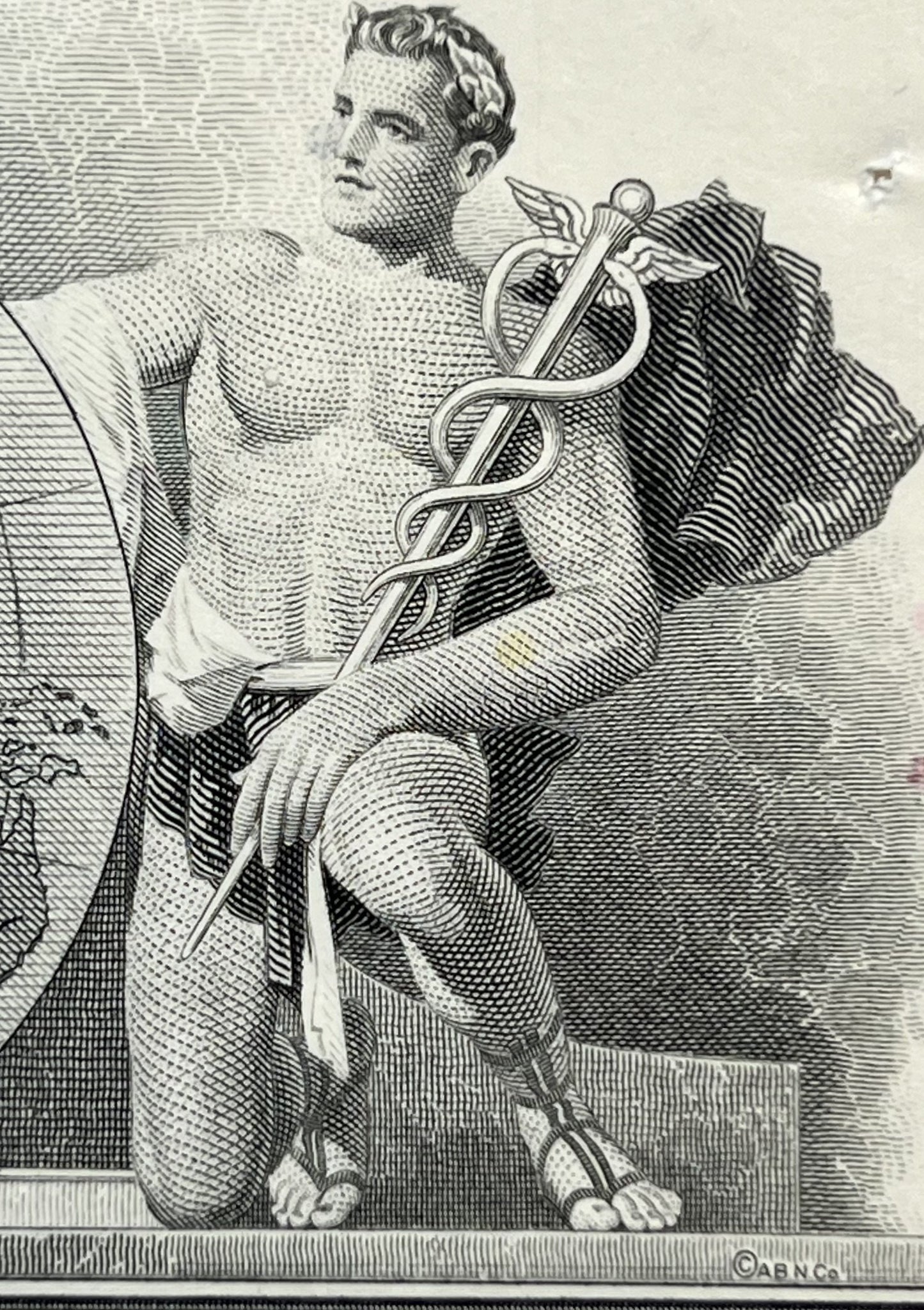
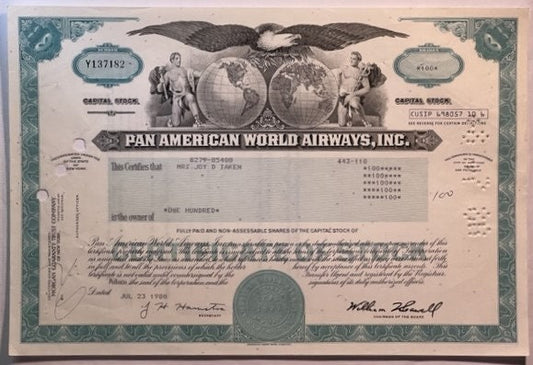
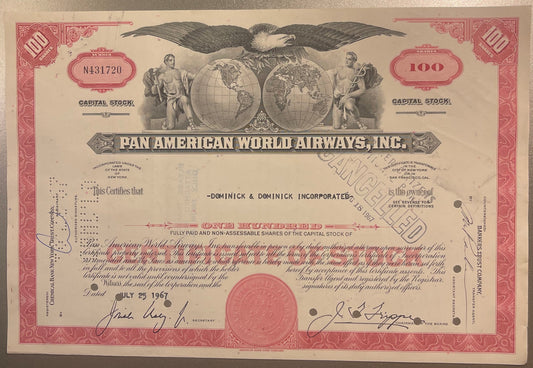
A real, issued capital stock certificate of PAN AMERICAN WORLD AIRWAYS, INC., engraved by the AMERICAN BANK NOTE COMPANY with a blue border: a bald eagle spreading its wings over the two hemispheres, a seated figure with a torch on one side and one with a caduceus on the other. It's the CERTIFICATE FOR MORE THAN 100 SHARES, with CUSIP 698057 10 6, transferable in New York, Chicago or San Francisco, Chemical Bank as registrar, Bankers Trust Company as transfer agent, and the corporate seal dated 1927. They were punch-cancelled when the shares were turned in.

🌙 The First Moon Flights Club

These are the years Pan Am was so sure of the future it started taking names for flights to the Moon. The story goes that it began in 1964, when an Austrian journalist, Gerhard Pistor, walked into a Vienna travel agency and asked to book a seat to the Moon, and the request found its way up to Pan Am, which answered that the first departure was expected around the year 2000. From 1968 to 1971 the airline mailed out free numbered membership cards in its First Moon Flights Club - about 93,000 of them, to members in every state and some ninety countries. The Smithsonian's National Air and Space Museum keeps one. Old-timers recall the airline really was taking names for the Moon.

🖋️ The man who signed this plate

One president whose signature was engraved on these plates was Najeeb Halaby. He was a Navy test pilot and lawyer who ran the Federal Aviation Agency for President Kennedy, joined Pan Am in 1965, became president in 1968, took over as chief executive from Harold Gray in November 1969 and as chairman when Gray retired in 1970, and was pushed out in 1972 when William Seawell took over. His daughter Lisa grew up to be Queen Noor of Jordan. On his watch, on January 22, 1970, Pan Am flew the first Boeing 747 passenger flight, New York to London - old-timers in the business still tell how Juan Trippe leaned on his friend Bill Allen at Boeing to build something bigger than anything that had ever flown.

✈️ Pan Am

The airline began in 1927 - that's the year in the seal - and took the name Pan American World Airways in 1950.

Juan Trippe came at it the long way round. In 1924 he'd put together Colonial Air Transport, an airmail line between New York and Boston, and when its stockholders refused to push it south to Florida and Havana, he walked out. In June 1927 he formed the Aviation Corporation of America. That same spring, in March, Hap Arnold of the Army Air Corps, later the chief of the Army Air Forces in World War II, had set up a company called Pan American Airways, worried that a German-run airline flying in Colombia would spread. Trippe's company, Arnold's Pan American Airways and New York banker Richard Hoyt's Atlantic, Gulf and Caribbean Airways were pooled together under the Pan American name with Trippe in charge, and he led it until 1968. The first Pan Am flight went on October 19, 1927: La Niña, a little Fairchild FC-2 floatplane hired from West Indian Aerial Express and flown by Cy Caldwell, carried the mail from Key West, Florida, to Havana to qualify for the Post Office's Key West-Havana airmail contract.

Then there's Charles Lindbergh. The story goes that after his 1927 solo flight to Paris he had offers pouring in from every corner of industry, and he picked Trippe. By the start of 1929 he had signed on as Pan Am's technical adviser, a public-relations sensation for a young airline. That February he flew a Sikorsky S-38 with the airmail from Miami to Cristóbal in the Panama Canal Zone. Through the 1930s he flew survey routes for the airline, he and his wife Anne going north to Asia and around the Atlantic, and in 1965 he joined Pan Am's board of directors.

The jet age came to Pan Am on the evening of October 26, 1958, when the Boeing 707 Clipper America left New York's Idlewild Airport - JFK today - for Paris Le Bourget with 111 passengers, stopping for fuel at Gander, Newfoundland. BOAC's Comet 4 had crossed three weeks earlier, on October 4, but Clipper America flew the first transatlantic jet service by an American airline.

Pan Am's blue globe, the Blue Meatball, was on tails all over the world, and corporate lore has it that executives up in the Pan Am Building over Grand Central could watch their own jets drawing contrails across the sky. That tower still stands at 200 Park Avenue. MetLife bought it in 1981, the Pan Am letters came down in 1992, and it's the MetLife Building now. The lore goes that for decades an address there was as much a badge of prestige as the airline itself. When the Beatles landed at JFK on February 7, 1964, on Flight 101 from London, they stepped off a Pan Am 707 named Clipper Defiance into a crowd of about 3,000 screaming fans, and the British Invasion had arrived. Even a con man wanted in: between 1964 and 1968 young Frank Abagnale Jr. passed himself off as a Pan Am pilot. Deregulation in 1978, the costly National Airlines buy, selling the Pacific routes to United in 1985, Lockerbie in 1988 and the Gulf War fuel shock of 1990 wore it down; Thomas Plaskett, brought in from American and Continental, couldn't save it. On January 8, 1991, Pan Am filed for Chapter 11 in the federal bankruptcy court in New York. In those last months it moved its headquarters out of the Pan Am Building and down to Miami, back to Florida where it all began. The plan was a smaller Pan Am flying from a Miami hub to the Caribbean and Central and South America, with Delta putting in $100 million for 45 percent of it, and it relaunched on November 1. It ended on December 4, 1991, when Pan Am stopped flying and about 7,500 people lost their jobs in a single day. The very last Pan Am flight anywhere was Flight 436, the Boeing 727 Clipper Goodwill, from Bridgetown, Barbados, into Miami under Captain Mark Pyle. Delta bought the best routes and the Worldport terminal at JFK, and in 1993 the Pan Am name and blue globe were auctioned in bankruptcy court for $1.3 million.

📅 How old are they?

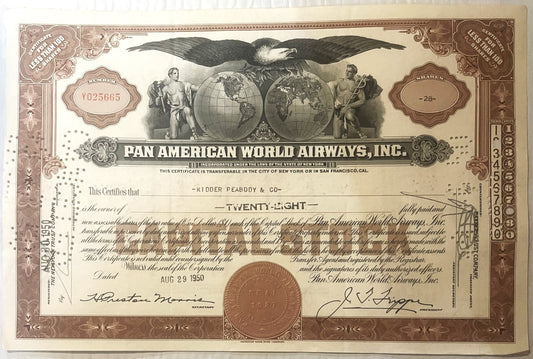
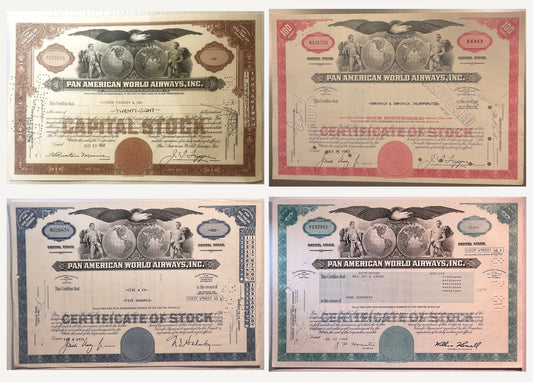
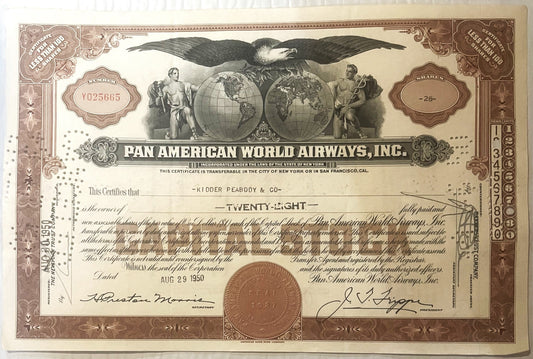
The CUSIP number means 1968 or later, and Chemical Bank only took that name in 1969 - it had been the Chemical Bank New York Trust Company since a 1959 merger. The engraved signatures changed with the men at the top. Juan Trippe retired in May 1968 and Harold Gray followed him as chairman, and another Pan Am certificate, a brown one in the SFO Museum's aviation collection, dated September 30, 1969, carries Gray's signature as Chairman of the Board over the very same pairing as this blue one - Chemical Bank as registrar and Bankers Trust Company countersigning. Then came Halaby's, and from 1972 William Seawell's. That's why the design spans the 1960s and 1970s. Sheets of this design vary, so yours can carry a different signature plate, date, owner and share count than the one in my pictures.

🌍 About these certificates

They're 12 by 8 inches, engraved on heavy certificate paper, with the cancellation punches of real use. Frame one for a pilot, a flight attendant, a space buff, anybody who flew Pan Am, or an office wall. The supply is finite - Pan Am has been gone since 1991, nobody's issuing its stock again, and once these last ones are framed, they'll be very difficult to acquire.

📜 Every one of these certificates had a working life, and it can show. Depending on the sheet, you may find staples or staple holes, cancellation punch holes (often right through the signatures), hand stamps from banks, brokers and transfer agents, real federal or state stock transfer tax stamps, handwriting or a filled-in transfer on the back, papers still attached, seals (a corporate seal pressed into the paper, a foil wafer seal, or a bank's signature-guarantee stamp signed across an endorsement), or a silver strip pasted over an officer's signature with the new officer's signature printed on top. That last one is what collectors call silvering: when the officers changed, the new signature could be pasted right over the old one on certificates already printed. None of that is damage. Each mark is part of the paper's own history, and they vary sheet to sheet, so no two are quite alike.

Shipping

🚚 Shipping & Handling

  • Shipping costs and timing are calculated at checkout.
  • Items curated and shipped directly by me include U.S. shipping at no additional cost, professionally packed to ensure safe arrival of your artifact.

Items from Vetted Pro Collectors
Shipping for items offered by vetted Pro Collectors is determined at checkout. All Pro Collector listings are reviewed to ensure fair, reasonable shipping practices.

For full details, please refer to our Shipping Policy.

Returns & Exchange

Take your time — you've got a full six months. If a piece isn't right for you, send it back the way it reached you and we're good.

In the first 30 days your money goes straight back the way you paid. After that it's store credit, so you can put it toward something you'd rather have.

Return shipping we sort out between us, case by case. I don't make this difficult.

If something arrives damaged, or it isn't what I said it was, send me a photo within 48 hours and I'll make it right.

Email info@vintageantiquesgifts.com or call 802-356-9872 — that's me answering, not a call center.

The only things I can't take back are custom or special-order pieces and gift cards.

View full details
  • 5 stars: 2 (100%)
  • 4 stars: 0 (0%)
  • 3 stars: 0 (0%)
  • 2 stars: 0 (0%)
  • 1 star: 0 (0%)
b
b***m (351)

Great item. Great seller. Great family and business.

2
2***2 (134)

A++++ seller. Answered all messages. Thx again.

Rescuing American History Since 2007

— Travis & the Kids