Skip to product information
1 of 8

Vintage and Antique Gifts

Vintage 1950s 1970s Pan Am Stock Certificate Red Pan American World Airways 100 Shares American Icon 📜

Vintage 1950s 1970s Pan Am Stock Certificate Red Pan American World Airways 100 Shares American Icon 📜

Regular price 13.00 USD
Regular price Sale price 13.00 USD
Sale Sold out
Shipping calculated at checkout.
Quantity

✈️ What Was It Like to Hold a Piece of the Golden Age of Flight? 🌎

There was a time when the name "Pan American World Airways" meant something almost mythical — a blue globe logo painted on the tail of a Boeing Clipper, a stewardess in a crisp navy uniform, a passenger stepping off a gangway in Rio or Rome or Hong Kong, and the quiet understanding that Pan Am had gotten you there first. This engraved capital stock certificate is a genuine surviving piece of that story — not a photograph of it, not a reproduction of it, but an actual financial instrument issued by the airline itself at the height of its power, bearing the same corporate seal, the same eagle, the same globes that once represented one of the most recognized brand names on Earth.

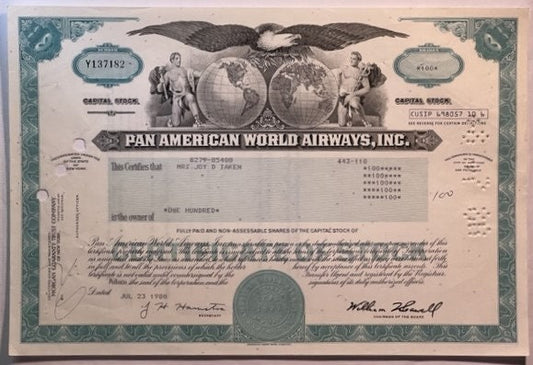
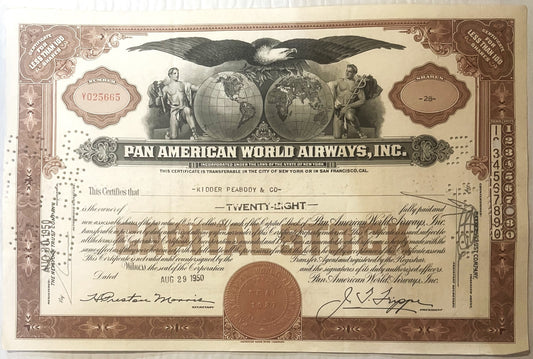
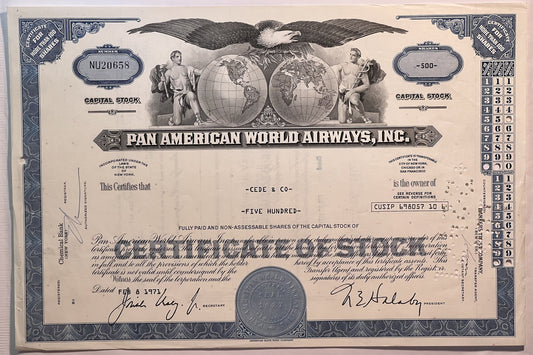
This is an original capital stock certificate issued by Pan American World Airways, Inc., incorporated under the laws of the State of New York, and engraved and printed by the American Bank Note Company of New York City. The certificate is dated 1967 — squarely inside Pan Am's peak jet-age years — and it was issued and later cancelled in the manner typical of shares registered in "street name" to Wall Street brokerage houses, which held such blocks on behalf of clients, a routine and important part of how mid-century American securities changed hands.

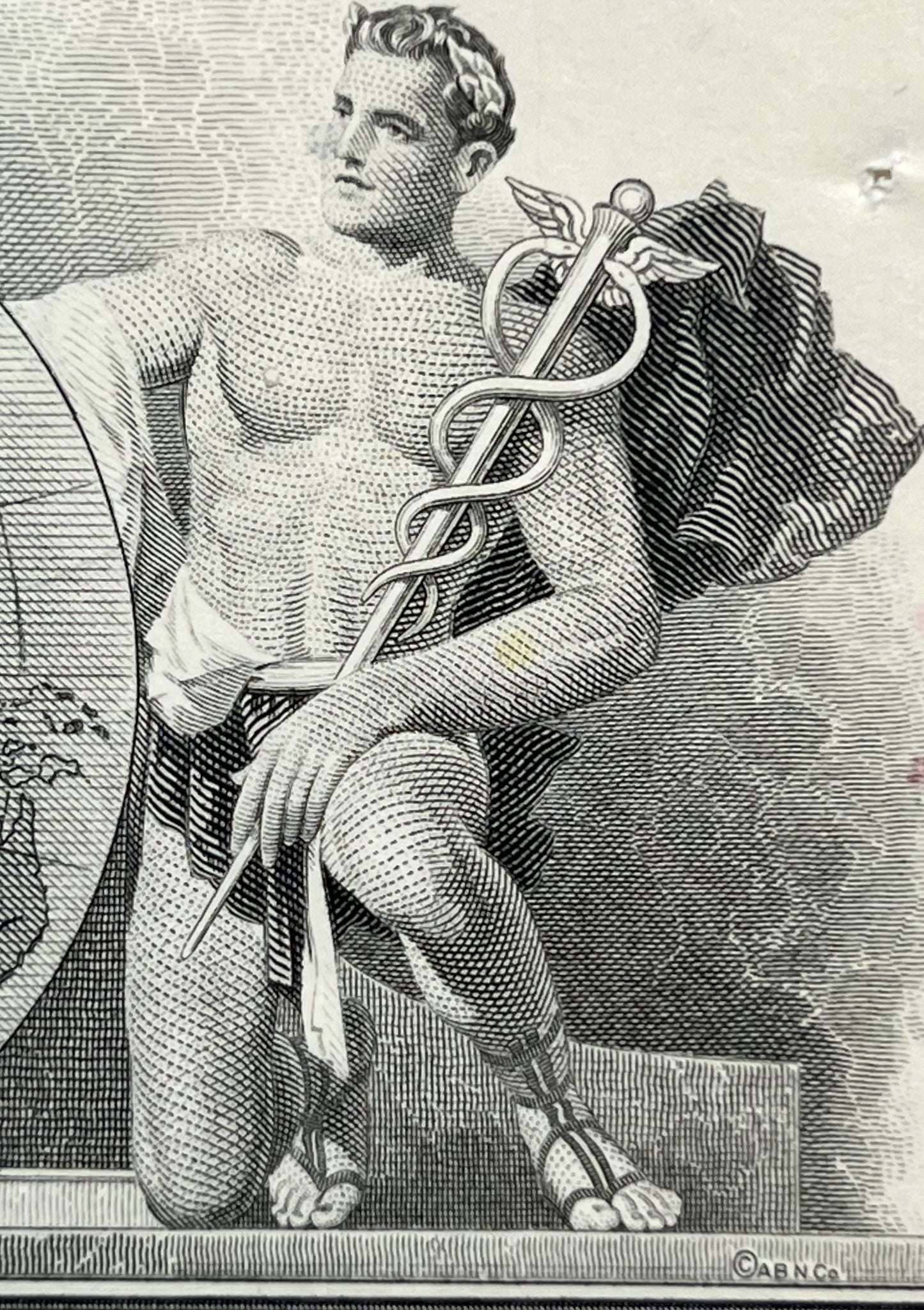
The piece measures 12 x 8 inches, printed on cream stock in rich red and black engraved ink, with the airline's iconic vignette dominating the top third of the certificate: a spread-winged American eagle clutching an olive branch, perched directly atop two facing globes — one showing the Western Hemisphere, the other the Eastern — while two classical, toga-draped male figures flank the globes on either side, one holding a torch, the other holding a caduceus, the ancient winged staff long associated with commerce and safe passage.

Below, in bold engraved lettering banked between ornate scrollwork, runs the name PAN AMERICAN WORLD AIRWAYS, INC. The document carries the printed hallmarks of authenticity expected of a genuine American Bank Note Company security: the fine cross-hatched engraving work, the raised corporate seal reading "SEAL 1927," the registrar's and transfer agent's names, and a bold diagonal CANCELLED stamp — meaning this certificate completed its working life as a real financial document before ever reaching a collector's hands.

The life of a certificate like this can show up on the paper itself, not just in the vignette: things like stamps from a registrar or transfer agent, a punch or cut cancellation, staple holes from a bound ledger, pencil notations, and signatures on the back. That is part of what makes a piece like this worth collecting: it did the job it was printed to do.


🦅 The Artwork Itself — Reading the Eagle, the Globes, and the Two Guardians of Commerce

Every detail on this certificate was engraved for a reason, and the reason was rarely just decoration. American Bank Note Company certificates of this era were governed by New York Stock Exchange security regulations that required a "human figure with visible areas of flesh" to appear somewhere on the design — the logic being that the fine shading of skin, muscle, and the intricate folds of draped cloth were among the hardest details for a counterfeiter to reproduce by hand. That's precisely why so many mid-century stock certificates, this one included, feature classically rendered, robed male figures rather than simple borders or logos alone. Here, the two seated men — one gripping a torch, the other resting a hand on a caduceus — do double duty as both security device and symbolism: figures of enlightenment and commerce presiding over a literal image of the globe Pan Am connected. The two hemispheres beneath the eagle aren't generic decoration either — they are a direct, literal illustration of "World Airways," the very words printed just below them, and a fitting emblem for a company whose route map by the late 1960s touched every inhabited continent but Antarctica.


🌍 Pan American World Airways — The Airline That Invented International Travel

The company's roots go back to March 1927, when Pan American Airways, Incorporated was founded as a shell company by United States Army Air Corps officers Henry "Hap" Arnold, Carl Spaatz, and John Jouett — motivated in part by concern over the growing reach of a German-owned airline operating out of Colombia. Commercial control soon passed to a young former Navy aviator named Juan Terry Trippe, who had already secured a mail contract flying between Key West and Havana. Trippe would go on to run the airline for more than four decades, and it was under his direction that Pan Am became something more than a mail carrier — it became the standard-bearer of American aviation itself.

The airline built its legend on a string of firsts. In 1936 the famous China Clipper flying boat opened the first transpacific passenger route, from San Francisco to Manila. In 1939 the Yankee Clipper carried the first transatlantic passengers, from New York to Lisbon. By 1947 Pan Am had completed the first round-the-world flight, departing New York and returning to New York having circled the globe eastbound. In 1958 the airline introduced the Boeing 707, ushering America into the jet age, and in 1966 — the year before the date printed on this certificate — Pan Am placed a $525 million order that made it the launch customer for the Boeing 747, the aircraft that would define the "jumbo jet" era of air travel.

By the time this certificate was issued, Pan Am was flying under the slogan "The World's Most Experienced Airline," carrying 6.7 million passengers a year, and running roughly 150 jets to 86 countries across an unduplicated route network of over 81,000 miles. Its cash reserves stood near a billion dollars, and its newly opened headquarters, the Pan Am Building in midtown Manhattan, towered over Grand Central Terminal as a physical monument to the airline's confidence. The following year, in 1968, Trippe announced his retirement, handing the reins to former FAA administrator Najeeb Halaby in 1969 — a changing of the guard that marked the beginning of a new chapter for the airline. One figure connected to Pan Am from its earliest days deserves special mention: the famed aviator Charles A. Lindbergh, who served as a technical advisor on Pan Am's Board of Directors for the next forty-five years, lending the airline both engineering insight and a measure of the same aviation glamour that made his own name legendary.

The decades that followed the golden years told a harder story — over-expansion, the economic shocks of the 1970s, and the turbulence of airline deregulation eroded Pan Am's finances. An attempt to gain a foothold in the domestic market through the 1980 acquisition of National Airlines did not reverse the decline, and in 1984 Pan American Airways created a holding company, Pan Am Corporation, to manage what remained of the airline and its other divisions. The tragedy of Pan Am Flight 103, brought down over Lockerbie, Scotland in December 1988 with the loss of 243 passengers and 16 crew, further weakened public confidence in the carrier. After years of asset sales and restructuring attempts, Pan American World Airways ceased operations altogether in December 1991. When it folded, Pan Am's trademark was said to be the second-most recognized in the world — and for many Americans, the airline's closure marked, quite simply, the end of the golden age of air travel.


🏙️ New York and the American Bank Note Company — Printing the Paper of American Finance

Pan Am was headquartered in New York, incorporated under New York law, and financed through New York institutions — and so, fittingly, was the paper this certificate is printed on. The American Bank Note Company traced its lineage back to 1795, to an engraving firm established by Robert Scot, the very first official engraver of the United States Mint. Through a series of nineteenth-century mergers — American Bank Note Co. in 1858, National Bank Note Co. in 1859, and Continental Bank Note Co. in 1863 — the firm consolidated in 1878 and incorporated under its modern name in 1879, making New York City its permanent headquarters.

By the very decade this certificate was issued, American Bank Note's Bronx printing plant, in the Hunts Point section of the city, was operating on a staggering scale — processing more than five million pieces of security paper a day, and printing roughly half of all the securities traded on the New York Stock Exchange. Old-timers in the printing trade have long recalled the sheer density of engraving talent packed into that one Bronx facility, where the same steel dies used for currency, postage stamps, and stock certificates for companies around the world were cut and pressed. That same plant would later find itself in an entirely different kind of history book: it was the target of a 1977 bombing, reportedly chosen because of the Latin American currency it was printing at the time. The building has since been preserved and designated a New York City landmark — a rare acknowledgment of just how central this quiet Bronx printworks was to the paper trail of American capitalism.


💼 Dominick & Dominick — A Wall Street Name Since 1870

The brokerage recorded as owner of this block of Pan Am shares was itself a fixture of American finance well before Pan Am even existed. Dominick & Dominick was founded on June 15, 1870, as Dominick & Dickerman, by William Gayer Dominick and Watson Bradley Dickerman. Following Dickerman's retirement in 1889, the firm took the name it would carry for the rest of the century — Dominick & Dominick.

In 1964, just a few years before this certificate was issued, the firm reorganized from a partnership into a corporation, becoming Dominick & Dominick, Incorporated — the exact legal form printed on this certificate. The firm was in an active period of expansion through the 1960s, notably acquiring the New England firm of Townsend, Dabney & Tyson in 1966, which brought it a major Boston office along with fifteen additional branches across the Northeast, part of a broader push that saw roughly thirty new branch offices open across the country by decade's end.

Brokerages like Dominick & Dominick routinely held large blocks of client shares registered in their own corporate name — exactly the kind of "street name" holding this certificate documents, and a small but genuine window into how mid-century Wall Street actually moved money and shares behind the scenes.


🏛️ Why a Piece Like This Still Matters

Pan Am's corporate records now form a major archival collection at the University of Miami, preserved for historians studying the rise and fall of American commercial aviation, while the American Bank Note Company's engraving dies, printing plates, and photographic archives are held by the Smithsonian's National Museum of American History — a reminder that both halves of this certificate's story, the airline and its printer, were considered significant enough to preserve at the institutional level. For collectors of scripophily — the hobby of collecting historic stock and bond certificates — a Pan Am certificate from this era occupies a special place, uniting a beloved, vanished airline with the engraving craftsmanship of one of America's great security printers, at a moment when both were operating near the peak of their influence.


🖼️ Display Ideas

  • ✈️ Frame it alongside vintage Pan Am travel posters or route maps for an instant mid-century aviation gallery wall
  • 🗽 Pair it with other New York financial ephemera — ticker tape, Wall Street photographs, bank note reproductions — for a Wall Street history corner
  • 🌎 Let the eagle-and-globes vignette be the centerpiece of a world-travel or globe-themed office or study display
  • 📚 Tuck it into a shadow box with a small model airplane or an old Pan Am timetable for a layered conversation piece
  • 🎓 Use it as a teaching artifact for lessons on the history of commercial aviation, engraving, or American finance
  • 🖋️ Display it simply matted and framed, letting the engraved detail of the eagle and the twin hemispheres speak for itself

🎁 Who Collects These

This certificate speaks to several overlapping collecting worlds at once. Scripophily collectors — those who gather historic stock and bond certificates — prize Pan Am shares specifically because the airline no longer exists and its certificates are permanently finite. Aviation history enthusiasts and Pan Am nostalgists seek out anything bearing the airline's name and globe imagery, from timetables and postcards to certificates like this one. Collectors of American Bank Note Company engraving admire the artistry and security-printing craftsmanship on display, independent of the issuing company. And students of Wall Street history find genuine value in a document that ties together a famous airline, a historic security printer, and a real nineteenth-century brokerage house all on a single sheet of engraved paper.


❓ FAQ

Is this a genuine, original Pan Am stock certificate?

Yes. This is an original capital stock certificate issued by Pan American World Airways, Inc., engraved and printed by the American Bank Note Company, carrying the airline's corporate seal, registrar and transfer agent endorsements, and a cancellation stamp marking the end of its working life as a financial document.

What does "CANCELLED" mean on the certificate?

The cancellation stamp indicates the shares were formally retired from active trading — a standard, routine part of how stock certificates were processed when shares were transferred, redeemed, or the underlying stock ledger was updated. It's a normal and expected feature of surviving vintage stock certificates.

Why does the certificate say "SEAL 1927" if it's dated 1967?

The corporate seal engraved on the certificate carries the year Pan American Airways, Incorporated was originally founded, 1927. The certificate itself was printed and issued decades later, in 1967, as the company's later corporate name, Pan American World Airways, Inc., in place since 1950, reflects.

Who was Dominick & Dominick?

Dominick & Dominick, Incorporated was a Wall Street brokerage firm founded in 1870, one of the older continuously operating names in American finance, and the recorded holder of this block of Pan Am shares.

Does this certificate have any monetary value as stock today?

No — Pan American World Airways ceased operations in 1991, so the shares carry no active investment or redemption value. Its worth today is entirely historical and collectible, as an engraved artifact of one of the most storied airlines and one of the great American security printers.

How big is the certificate?

It measures 12 x 8 inches, the standard oversized format used for engraved American stock certificates of this era, making it well suited to framing and display.

Shipping

🚚 Shipping & Handling

  • Shipping costs and timing are calculated at checkout.
  • Items curated and shipped directly by me include U.S. shipping at no additional cost, professionally packed to ensure safe arrival of your artifact.

Items from Vetted Pro Collectors
Shipping for items offered by vetted Pro Collectors is determined at checkout. All Pro Collector listings are reviewed to ensure fair, reasonable shipping practices.

For full details, please refer to our Shipping Policy.

Returns & Exchange

Take your time — you've got a full six months. If a piece isn't right for you, send it back the way it reached you and we're good.

In the first 30 days your money goes straight back the way you paid. After that it's store credit, so you can put it toward something you'd rather have.

Return shipping we sort out between us, case by case. I don't make this difficult.

If something arrives damaged, or it isn't what I said it was, send me a photo within 48 hours and I'll make it right.

Email info@vintageantiquesgifts.com or call 802-356-9872 — that's me answering, not a call center.

The only things I can't take back are custom or special-order pieces and gift cards.

View full details
  • 5 stars: 11 (100%)
  • 4 stars: 0 (0%)
  • 3 stars: 0 (0%)
  • 2 stars: 0 (0%)
  • 1 star: 0 (0%)
6
6***s (4)

It was packaged very well from preventing any type of damage ! I would definitely purchase again .

c
c***u (56)

Very good experience.

m
m***r (38)

Fantastic seller.... well packed, fast shipping, excellent condition and personalized with nice letter and bonus. Highly recommend this seller...best out there. A+++++++

y
y***c (1018)

AAAAA+++++

1
1***z (545)

Great item good communication, quick shipping

u
u***8 (2456)

Great Pan Am Stock Certificate, excellent condition, well packed, quick delivery, Thanks.

7
7***7 (200)

What a great experience!! Unparalleled customer service and support!! One of a kind seller!!!

V
Vale Violet
Highly recommended!

Seller is amazing, appreciate the effort to work with me and make sure I got what I wanted!

Hi Vale! We're thrilled that you're pleased with your vintage Red Pan Am certificate and our service. Our customers mean the world to us, and we always strive to provide an unparalleled shopping experience. We truly appreciate your support and would love to assist you again in the future. Happy shopping!

a
alexajohnl

Such a nice seller and so nicely personalized thank you

Aww, thank you for the kind words.❤️ It makes us smile!

c
cma9942_pfcmtk

Described item arrived on time and in perfect condition.

Thank you so much for your support! We hope to work with you again soon.

t
teddyb123fffvxx

Very nice exactly as described. well wrapped for shipping thanks 👍

Pleasure is all ours! Such a great piece of Americana. We are so glad you like it!