Skip to product information
1 of 3

Vintage and Antique Gifts

Vintage 1980s 🥤 Jolt Cola Lightning Bolt Bottle Cap — Rochester NY Soda Collectible

Vintage 1980s 🥤 Jolt Cola Lightning Bolt Bottle Cap — Rochester NY Soda Collectible

Regular price 12.00 USD
Regular price Sale price 12.00 USD
Sale Sold out
Shipping calculated at checkout.
Quantity

⚡ The Little Map Under the Lightning Bolt: A Jolt Cola Cap That Paid West Virginia's Pop Tax

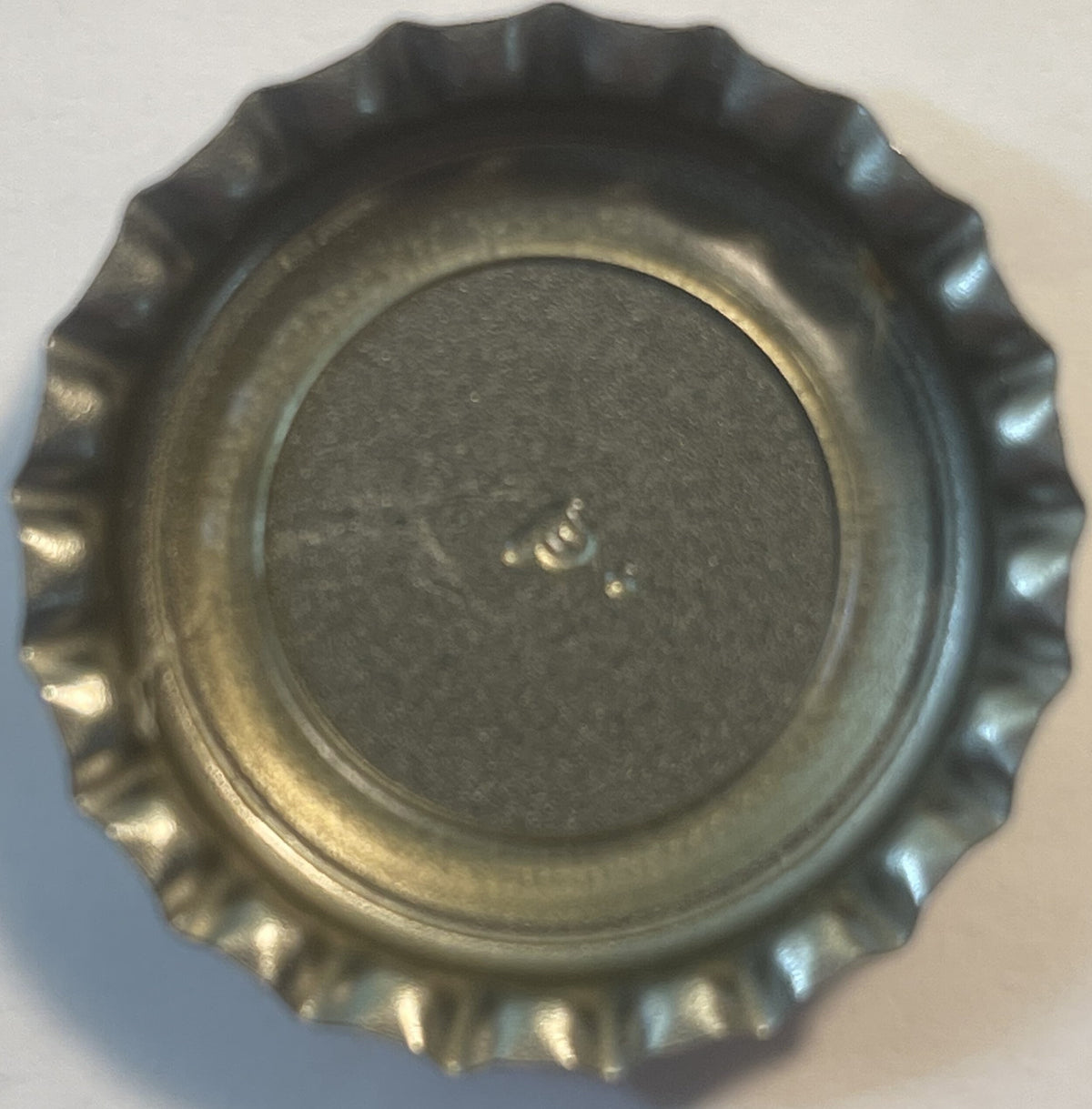
Look just below the JOLT logo. That small outline with a "1" inside it is the shape of West Virginia, and it is not decoration. It is a tax crown: under state law, the mark that proved one cent of West Virginia's soft drink tax had been paid on the bottle this cap was made to seal. That tax started in 1951, paid for the medical school at West Virginia University for seventy-three years, and was repealed in July 2024. The cola printed above it has had just as rough a ride. Jolt, the Rochester, New York soda that bragged about its caffeine at a time when the big brands sold theirs quietly, went through bankruptcy in 2009 and has been revived and shelved more than once since. This crown carries both stories at once.


🔍 What Is Printed on This Crown

This is a litho-printed metal crown cap, the fluted pry-off kind that sealed glass soda bottles. The face is a red-orange field. Across it, the word JOLT runs in chunky white letters outlined and drop-shadowed in dark blue, with a yellow lightning bolt edged in blue tearing through the letters from upper right to lower left.

Three small marks tell you more than the logo does:

  • The circled U above the logo is the kosher symbol of the Orthodox Union, the most widely used kosher certification on American packaged food and drink.
  • The outline of West Virginia with a "1" inside sits below the logo. That is the state tax indicium, and the number is its denomination: one cent.
  • The ® mark after the T shows JOLT as a registered brand name.

The skirt is plain silver metal with its flutes still standing out straight, and the inside shows bare metal around a grey sealing disc. This is new old stock: a crown that was never crimped onto a bottle neck and never met an opener. It dates to the 1980s, the decade The Jolt Company launched its cola.


🏔️ West Virginia's Pop Tax, 1951 to 2024

West Virginians called it the pop tax. The state put an excise tax on soft drinks in 1951 and earmarked the money for WVU's School of Medicine in Morgantown, a dedication that held for the rest of the tax's life. By 2017 it was bringing in about $15 million a year.

The law did not trust a ledger alone. Under the state code, payment of the tax was proven by "the affixing of soft drink tax stamps or tax crowns" to each container, and whoever first owed the tax had twenty-four hours after taking possession of the drinks to put stamps or crowns "of the appropriate denomination" on every bottle. Skipping it was a misdemeanor carrying a fine of $100 to $500, up to six months in jail, or both. For bottles headed to West Virginia shelves, a crown like this one did the job, with the state's outline and the tax amount printed right on the cap where anyone could check it.

When the industry moved to aluminum, the mark moved with it. For years the outline of West Virginia was etched into the tops of soda cans sold there, and later it was often replaced by a small inkjet "WV1" printed on the bottom of the can: the same penny, the same state, in a new format.

The pop tax ended with Senate Bill 533, passed in 2022, which set the tax to expire in 2024 and replaced the medical school's share with $14 million a year from state insurance tax revenue. The last of it was collected at the end of June 2024. A crown like this is now a relic of a seventy-three-year chapter of West Virginia law, as well as of the soda it capped.


🏙️ The Jolt Company of Rochester, New York

Jolt was a father-and-son idea with a contrarian streak. Joseph Rapp had owned a Canada Dry bottling plant for nearly forty years before retiring in 1979. His son, Carl Joseph "C.J." Rapp, who attended McQuaid Jesuit High School in Rochester and studied sociology at SUNY Potsdam, believed Coke and Pepsi had watered soda down until people forgot what it could taste like. At college he had watched students concoct their own drinks to stay awake long enough to finish term papers, pledge fraternities, or cram for exams. Father and son set out to sell those students what they were already trying to make.

They spent six years and tested 114 formulas. The cola that came out of it, introduced in 1985, carried 5.9 milligrams of caffeine per fluid ounce, twice what Coke or Pepsi held and just under the FDA's 6-milligram ceiling for soft drinks, plus about ten teaspoons of real sugar. The slogan said it without apology: "All the sugar and twice the caffeine!" C.J. liked to call it a naughty drink, something slightly forbidden.

Rochester got it first. The regional release came in April 1986, into 26 Wegmans stores, and it moved briskly enough that Jolt signed franchise agreements covering 20 states that same spring and summer. Getting it onto trucks was the hard part: most soda bottlers already had deals with Coca-Cola or Pepsi and would not take on a rival cola, so Jolt leaned heavily on beer distributors instead. Within about a year it was sold in 44 states and Canada. Sales reached roughly $1 million in 1986, fell 44 percent the next year, and settled into about a tenth of one percent of the cola market. In the summer of 1987 the company added Jolt 25, a 25-calorie version sweetened with NutraSweet.


💻 The Legend of the Programmer's Soda

Jolt's market share was tiny; its reputation was not. The drink became the stuff of legend among the people writing the software of the personal computer boom. It earned a cover story in Dr. Dobb's Journal, the programmers' magazine, and Software Development magazine named its annual industry prize the Jolt Award after it. C.J. Rapp took the drink onto Late Night with David Letterman, where Letterman drank it on the air, and onto Good Morning America and CNN.

Hollywood picked up the shorthand. Jolt turned up in Wayne's World in 1992, and in 1993 it was the drink stacked around Dennis Nedry's workstation in Jurassic Park, the programmer who shuts down the park's security. The 1995 film Hackers ran a fake Jolt commercial and treated it as the soft drink of the elite hacker. Cartoons told the same joke from the other side: The Simpsons parodied it as Buzz Cola and Beavis and Butt-Head as Volt Cola. Jolt later appeared on Mystery Science Theater 3000, in the 2010 30 Rock episode "Reaganing," and in the third season of Stranger Things.

The appetite Jolt spotted was real. By 1989 about ten percent of all soda in America was drunk in the morning, and the giants answered with a "Coca-Cola in the morning" campaign and a short-lived Pepsi A.M. Consumer advocates pushed back too: Michael Jacobson of the Center for Science in the Public Interest criticized Jolt's caffeine load. The argument over high-caffeine soft drinks that Jolt stirred up in the 1980s is still running in every energy drink aisle.


🔋 Battery Bottles, Bankruptcy and Revivals

In February 2005 the company, operating as Wet Planet Beverages, relaunched Jolt in a 23.5-ounce resealable aluminum container shaped like an alkaline battery, made by Rexam. The design came from Mason Selkowitz McDermott, Inc. of Penfield, New York, a Rochester suburb, where creative director Brad Schultz shaped it to say "energy" at a glance. The Battery Bottle was striking and expensive to produce, and the Rexam deal behind it contributed to the company's later bankruptcy.

In 2008 C.J. Rapp sold a controlling interest to Emigrant Capital. He was removed as chief executive early in 2009, and late that year the company filed for bankruptcy. The filings were later overturned, and Rapp's lawsuit against Emigrant ran eight years before it settled. The name came back in September 2017 as a Dollar General exclusive in 16-ounce cans at a dollar apiece; in March 2019 its social media went quiet and the stores stopped carrying it. In October 2024 Redcon1 announced a co-branded, sugar-free Jolt energy drink. The sugar-and-caffeine cola from Rochester, sealed in glass under a crown like this one, is the chapter collectors go looking for.


🎁 Who Collects This Cap

  • Bottle cap and crown collectors, especially anyone who chases state tax crowns
  • West Virginia collectors and WVU alumni, for a piece of the pop tax that funded the medical school
  • Rochester and western New York history fans, for a hometown brand that took on Coke and Pepsi
  • Programmers, gamers and Jurassic Park or Hackers fans who remember what Jolt stood for
  • 1980s soda and advertising collectors who want the loud lightning-bolt graphic

❓ Questions People Ask

What does the West Virginia outline with a "1" mean on a Jolt cap?

It is a West Virginia soft drink tax crown. State law accepted tax stamps or tax crowns on each bottle as proof the tax was paid, and the "1" is the amount, one cent. A Jolt bottle sealed with this crown was meant for sale in West Virginia.

Is this cap unused?

Yes. It is new old stock. The flutes are straight and it was never pressed onto a bottle or pried off.

When is this cap from?

It is a 1980s crown. Jolt Cola was introduced in 1985 and reached stores in April 1986, and crowns like this sealed its glass bottles.

Is West Virginia's soda tax still collected?

No. Senate Bill 533 repealed it, and the final collections came in June 2024 after seventy-three years of funding West Virginia University's medical school.

Who made Jolt Cola?

The Jolt Company, Inc. of Rochester, New York, founded by C.J. Rapp with his father Joseph Rapp, a retired Canada Dry bottler. The company later operated as Wet Planet Beverages.

What does the circled U stand for?

The Orthodox Union, whose circled-U symbol certifies a product as kosher.

How much caffeine did Jolt Cola have?

About 5.9 milligrams per fluid ounce, double the caffeine in Coke or Pepsi and just under the FDA's limit of 6 milligrams per ounce for soft drinks.

Shipping

🚚 Shipping & Handling

  • Shipping costs and timing are calculated at checkout.
  • Items curated and shipped directly by me include U.S. shipping at no additional cost, professionally packed to ensure safe arrival of your artifact.

Items from Vetted Pro Collectors
Shipping for items offered by vetted Pro Collectors is determined at checkout. All Pro Collector listings are reviewed to ensure fair, reasonable shipping practices.

For full details, please refer to our Shipping Policy.

Returns & Exchange

Take your time — you've got a full six months. If a piece isn't right for you, send it back the way it reached you and we're good.

In the first 30 days your money goes straight back the way you paid. After that it's store credit, so you can put it toward something you'd rather have.

Return shipping we sort out between us, case by case. I don't make this difficult.

If something arrives damaged, or it isn't what I said it was, send me a photo within 48 hours and I'll make it right.

Email info@vintageantiquesgifts.com or call 802-356-9872 — that's me answering, not a call center.

The only things I can't take back are custom or special-order pieces and gift cards.

View full details
  • 5 stars: 4 (100%)
  • 4 stars: 0 (0%)
  • 3 stars: 0 (0%)
  • 2 stars: 0 (0%)
  • 1 star: 0 (0%)
r
r***i (1550)

Pleasure doing biz.

N
Nicholas A.

Thank you for the care in packaging to keep my caps safe! Very much appreciated!

k
k***p (99)

A+++, great seller

g
g***r (128)

REALLY NICE, A BRAND NEW CAP! And a whiskey brand label in as an extra, too! This is a first class operation and I'm highly recommending it to friends, near and far. It isn't often, if at all, that I see these kinds of genuinely thoughtful, added little touches from a business. A true rarity that means so much. Thank you and I wish you much continued success, you certainly deserve it and so much more!