Skip to product information
1 of 3

Vintage and Antique Gifts

Vintage 1950s Canada Dry Club Soda Cork Bottle Cap 🍾 NOS

Vintage 1950s Canada Dry Club Soda Cork Bottle Cap 🍾 NOS

Regular price $5.50 USD
Regular price Sale price $5.50 USD
Sale Sold out
Shipping calculated at checkout.

Size: 1 1/4"

🚚 Free US Shipping — ships within one business day. International shipping calculated at checkout.

Quantity

Remember Canada Dry Club Soda Caps? 🍾 Vintage 1950s Cork Bottle Cap, NOS

Size: 1 1/4" ~ NOS unused stock, little to no storage wear.

Vintage 1950s Canada Dry Club Soda Cork Bottle Cap 🍾✨

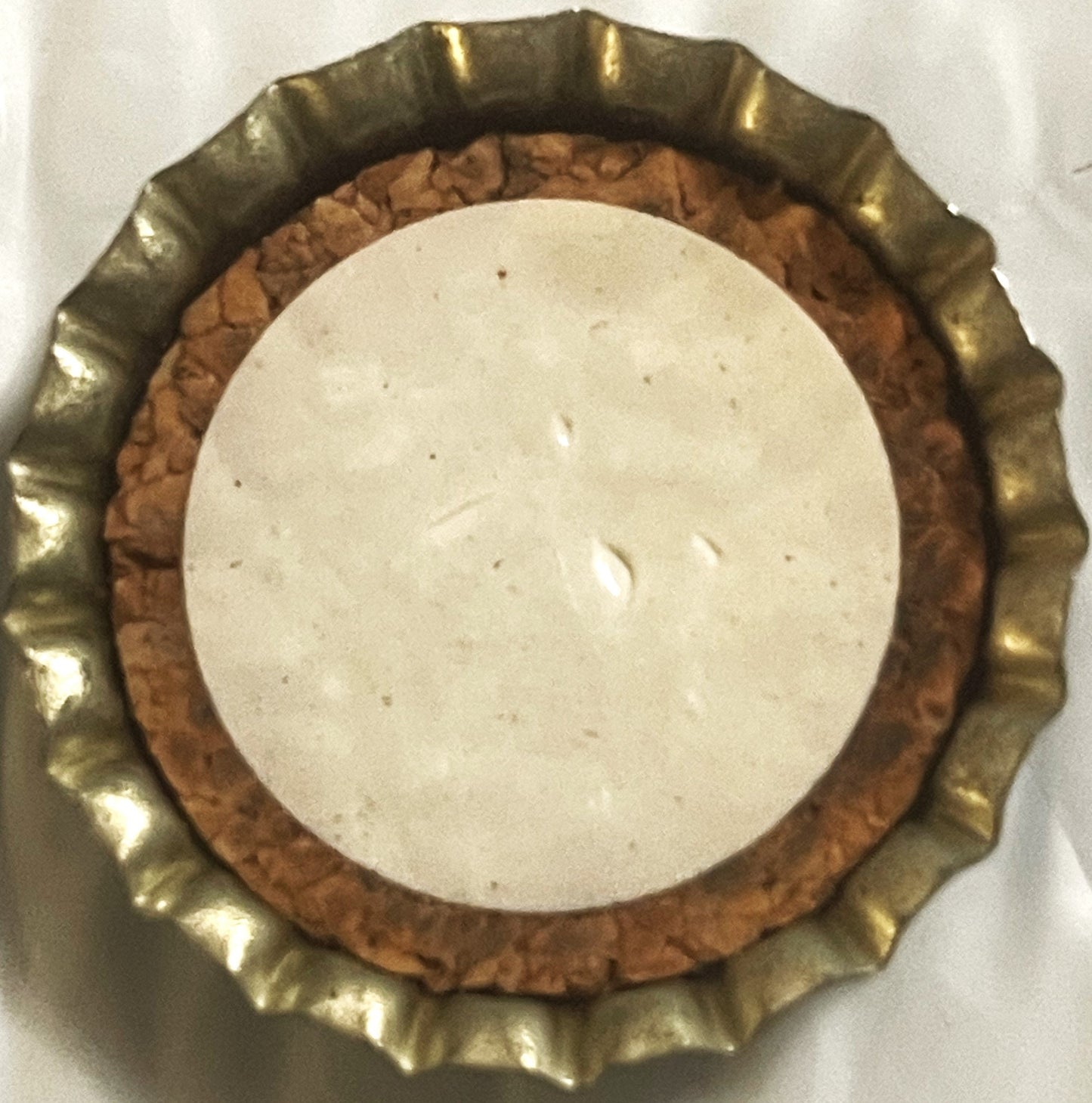
A New Old Stock Canada Dry Club Soda crown, never crimped onto a bottle, so it measures 1 1/4" across like every uncrimped cap. Metallic blue with the famous Canada Dry badge in white: a shield with the map on it, CANADA DRY across the middle and a crown on top, and CLUB SODA in big serif letters underneath. Flip it over and it's the real old-school kind, a composition cork liner with a white disc over it, from the years before plastic linings took over in the 1960s.

There's no bottler's town on this one, just the brand and the flavor, and the cork has never been pressed against a bottle lip. I'm a sucker for these old cork crowns, and this one feels just the way it did coming off the line.

👑 Why there's a crown and a map on it

Canada Dry started with a pharmacist. John J. McLaughlin (1865–1914) was the eldest son of Robert McLaughlin, whose McLaughlin Carriage Company became McLaughlin Motor Car and then General Motors of Canada. John graduated from the Ontario College of Pharmacy in 1885, did postgraduate work in New York and managed one of the biggest pharmacies in Brooklyn, then came home and opened a carbonated water plant in Toronto in 1890. In 1904 he came up with a lighter ginger ale he called "Pale Dry," and "dry" meant not sweet, like a dry wine. The Canada Dry name was registered on January 18, 1907, and his wife Maude gave it the slogan "The Champagne of Ginger Ales."

That same year a map of Canada went on the label, with a beaver. Then the company got a royal appointment to the vice-regal household of the Governor General of Canada, and the beaver made way for the crown. That's the badge on this cap. McLaughlin turned down offer after offer to sell his formula or build a plant in the States, and died at home in Toronto in 1914.

A little more about the man. John James McLaughlin was born near Enniskillen, Ontario, on March 2, 1865. He married Maude Christie in New York in 1890, went to look over the mineral water makers of Europe, and then set up his soda water business in Toronto near City Hall, where he's credited with bringing in the siphon bottle. His company was incorporated as J. J. McLaughlin Limited on October 25, 1905, and when the ginger ale went out in 1906 there were already branch plants in Winnipeg and Edmonton. He died of a heart attack on January 28, 1914, not quite 49, and the Toronto Daily Star called him "one of Toronto's shrewdest businessmen." His brothers George and Sam carried on and backed that first New York plant.

🍸 Prohibition and the mixer years

In 1923 P. D. Saylor and Associates bought the business from the McLaughlin family and formed Canada Dry Ginger Ale, Inc., a public company, with a New York bottling plant already running since 1922. The timing couldn't have been better. During Prohibition, Canada Dry took off as a mixer because it covered the taste of homemade liquor, and by 1930 it was selling ten million bottles a year. Club soda, the plain fizzy water every bartender reaches for, is the mixer on this cap. Later owners ran from Norton Simon in 1964 to Dr Pepper in 1982, Cadbury Schweppes in 1986 and Keurig Dr Pepper since 2008, but the crown and shield never went away.

💧 What Makes It Club Soda

Club soda isn't just plain bubbly water. It's carbonated water with a pinch of minerals added, things like sodium bicarbonate or potassium sulfate, to give it the taste of a natural mineral spring and take the sharp edge off the carbonation. The whole idea goes back to 1767, when Joseph Priestley figured out how to put fizz in water, and in 1783 Johann Jacob Schweppe started bottling it in Geneva. Fun fact: that Schweppes company ended up owning Canada Dry in 1986.

🧢 The Crown Cap and Its Cork

The cap itself has a story. William Painter, a Quaker born in Maryland in 1838, was granted three patents for his crown cork on February 2, 1892, covering the cap, the sealing disk and the cork inside, and he started the Crown Cork & Seal Company in Baltimore to make them. His big idea was that a cap like this could just be levered off with a little opener. For decades every crown had a disk of cork pressed inside, like this one. Starting in the late 1920s, crown makers set a small spot of vinyl or foil in the middle of the cork so the soda touched the spot and not the cork, which kept the taste clean. That's the white disc you see inside this one. The first plastic liners showed up in crowns in 1957, and by around the mid-1960s cork was on its way out, so a cork-and-spot crown like this one is a 1950s piece.

A genuine piece of mid‑century soda history, great for collectors, bar decor 🍺, shadow boxes 🖼️, or vintage advertising displays.

  • 🗓️ Era: 1950s
  • 🏷️ Brand: Canada Dry
  • 🥤 Type: Club Soda cork bottle cap

Shipping

🚚 Shipping & Handling

  • Shipping costs and timing are calculated at checkout.
  • Items curated and shipped directly by me include U.S. shipping at no additional cost, professionally packed to ensure safe arrival of your artifact.

Items from Vetted Pro Collectors
Shipping for items offered by vetted Pro Collectors is determined at checkout. All Pro Collector listings are reviewed to ensure fair, reasonable shipping practices.

For full details, please refer to our Shipping Policy.

Returns & Exchange

Take your time — you've got a full six months. If a piece isn't right for you, send it back the way it reached you and we're good.

In the first 30 days your money goes straight back the way you paid. After that it's store credit, so you can put it toward something you'd rather have.

Return shipping we sort out between us, case by case. I don't make this difficult.

If something arrives damaged, or it isn't what I said it was, send me a photo within 48 hours and I'll make it right.

Email info@vintageantiquesgifts.com or call 802-356-9872 — that's me answering, not a call center.

The only things I can't take back are custom or special-order pieces and gift cards.

View full details
  • 5 stars: 1 (100%)
  • 4 stars: 0 (0%)
  • 3 stars: 0 (0%)
  • 2 stars: 0 (0%)
  • 1 star: 0 (0%)
J
Joshua Jones (Dallas, US)
Everything was perfect!

Fast shipping perfect packaging!

Rescuing American History Since 2007

— Travis & the Kids