Skip to product information
1 of 4

Vintage and Antique Gifts

Vintage 1970s Standard Motor Products Stock Certificate 🔧 NAPA & CARQUEST, New York, Eagle Vignette

Vintage 1970s Standard Motor Products Stock Certificate 🔧 NAPA & CARQUEST, New York, Eagle Vignette

Regular price 9.00 USD
Regular price Sale price 9.00 USD
Sale Sold out
Shipping calculated at checkout.
Quantity

What Does It Mean to Hold a Piece of an American Parts-Maker's Boardroom History? 🦅

There's something about an old stock certificate that a photograph or a company annual report never quite captures — the weight of engraved paper, the eagle with wings thrown wide across the top, the hand-signed flourishes of a Secretary and President who actually ran the place. This one carries all of it: a genuine Class A Capital Stock certificate from Standard Motor Products, Inc., the Long Island City, New York automotive parts maker that's been keeping American cars running for over a century.

This is an original Standard Motor Products, Inc. stock certificate, issued in 1972, measuring 12 x 8 inches. It's presented in blue and cream, engraved and lithographed by the Security-Columbian Banknote Company of New York, one of the recognized names in American security printing.

The centerpiece is a magnificent bald eagle vignette — wings fully spread, head turned in profile, talons resting on a leafy branch — rendered in the fine cross-hatched engraving style that banknote houses used to make counterfeiting difficult and to make a simple piece of paper feel like something worth keeping. Ornamental scrollwork borders frame the certificate on all sides, with decorative medallions in each corner and a lacy, geometric guilloché pattern running the full perimeter — the kind of dense, hypnotic linework that only a trained engraver's hand (or a very precise machine descended from one) could produce.

Just below the eagle, the corporate seal reads "STANDARD MOTOR PRODUCTS, INC. CORPORATE SEAL 1926 NEW YORK," anchoring the whole design to the company's founding charter. This piece is an issued survivor of American corporate financial artistry from an era when even a stock certificate was treated as a small work of art.


🔧 The Company: A Century of Keeping America's Cars Running

Standard Motor Products traces its roots back to 1919, when Elias Fife and Ralph Van Allen opened a small partnership in Manhattan with ten employees, selling replacement parts to repair shops — piston rings, ignition parts, starter and generator brushes, battery cables and clamps. Ignition switch keys, oddly enough, became the company's first runaway bestseller. Van Allen struck out west in 1920 to open a branch in Seattle, and the original partnership dissolved in 1925. Elias Fife carried the business forward alone for a year before formally incorporating it in New York in 1926 — the very date stamped into the corporate seal at the center of this certificate.

By the 1930s, Standard Motor Products had introduced its now-legendary Blue Streak line of premium ignition products, a name that would become a fixture in garages and parts counters across the country for generations. Leadership passed to the next generation in the mid-1940s, when Bernard Fife — the founder's son — and Nathaniel Sills, Elias Fife's son-in-law, took over management of the growing company. It was very much a family enterprise, and it stayed that way: the Fife and Sills families guided Standard Motor Products through decades of expansion, acquisition, and product innovation, right into the era this certificate comes from.

In 1960, Standard Motor Products went public for the first time, offering Class A stock to outside investors at $15 a share and raising nearly $4.5 million. But here's the detail that makes this particular certificate more than just a pretty piece of engraved paper — the company structured that public offering deliberately as a two-tiered stock system. The Fife and Sills families retained a substantial block of the Class A shares and held onto all of the Class B stock, which carried the true voting power. It was a classic founding-family move: raise the capital the business needed to grow, while keeping the steering wheel firmly in family hands. That's exactly why the words "CLASS A CAPITAL STOCK" appear boldly across the face of this certificate — it's a direct artifact of that 1960 decision, still playing out a decade later when this share was issued.

By the time this certificate was dated in 1972, Standard Motor Products was in an active growth phase — that same year the company acquired Universal Automobile Parts Distributors of Miami, folding its warehouse operations into the company's Marathon Parts division, and stood up a new Electronics Engineering group, an early step toward becoming a manufacturer of electronic ignition components as cars themselves were beginning to modernize under the hood. At this point the stock still traded over the counter; Standard Motor Products wouldn't land on the New York Stock Exchange under the ticker SMP until 1977.


🏙️ Long Island City: An Industrial Neighborhood That Built America's Garages

Standard Motor Products moved its headquarters to Long Island City, in the borough of Queens, in 1921 — a neighborhood that, in the first half of the twentieth century, hummed with factories, foundries, and manufacturing plants of every stripe, feeding both New York City's own explosive growth and the broader industrial machine of the American Northeast. Long Island City sat at a crossroads of rail lines and waterfront access, making it an ideal base for a company that needed to ship small, precise automotive parts to repair shops and dealers across the country. Old-timers in the parts trade have long spoken of Standard Motor Products almost as a hometown institution there — a company whose name on a delivery truck or a warehouse sign was as familiar in that stretch of Queens as the elevated subway line running overhead. It's the kind of place-and-company pairing that gets stitched permanently into a neighborhood's own working-class identity.


✍️ The People Behind the Signatures

Every certificate in this series bears the facsimile signatures of the company's Secretary and President — a tradition as old as the corporate stock certificate itself, meant to personally vouch for the shares being genuine. Those roles, at Standard Motor Products, were held by men whose family names run straight through the company's history: Bernard Fife, son of founder Elias Fife, and Nathaniel Sills, Fife's son-in-law, both of whom took the reins of company leadership in the years following World War II. Collectors of vintage stock certificates often note that half the fun is in these signatures — a small, personal trace of the actual people who ran a company, captured in ink at a moment when they signed off on real shares of real ownership. Some collectors spend hours chasing down who signed what and when; it's a rabbit hole all its own, and part of what makes these documents feel less like paper and more like history you can hold.


📜 The Craft of the Security Printer

The name at the bottom of this certificate — Security-Columbian Banknote Company — belongs to a firm with real pedigree in American financial engraving. It was formed in 1957 through the merger of the Security Banknote Company with the Columbian Bank Note Company, itself incorporated in 1904 by C.C. Cheney, a veteran of the earlier Western Bank Note Company. Security printers like this one specialized in exactly the kind of dense, hand-engraved ornamentation seen across this certificate — the guilloché borders, the vignette engraving of the eagle, the fine crosshatched shading — techniques originally developed to make currency and securities extraordinarily difficult to counterfeit, and which had the happy side effect of turning ordinary corporate paperwork into genuinely beautiful printed art. Collectors of "scripophily" — the hobby of collecting stocks and bonds — actively seek out certificates bearing the Security-Columbian imprint specifically because of that engraving quality.


💵 Impact Today: Why These Certificates Still Matter

Standard Motor Products remains a recognizable name in the automotive parts world today, having spent decades supplying parts eventually rebranded under names familiar to anyone who's ever walked into a parts store. Certificates like this one are a physical link back to a time when owning even a small slice of an American manufacturer meant receiving an actual engraved document in the mail — signed, sealed, registered by a named bank, and transferable only "upon surrender of this certificate properly endorsed," in the certificate's own formal language.

Paper stock certificates like this one have become an increasingly scarce category of collectible in their own right. Publicly traded companies overwhelmingly moved to electronic share registration in the decades since, and stacks of certificates like this one were routinely destroyed once electronic record-keeping took over — which means the surviving population continues to shrink as more examples land permanently in museum archives and private collections.

What remains offers a genuinely tactile way to hold a company's history — the eagle, the seal, the ornate borders, the actual ink signatures — in a way no digital shareholder record ever could.


🖼️ Display Ideas

  • 🖼️ Framed on its own in a home office or den, matted to let the blue engraving and the eagle vignette breathe
  • 🦅 Paired with other eagle-themed Americana for a small gallery wall celebrating American symbolism in commercial art
  • 🚗 Displayed in a garage, workshop, or man-cave as a nod to automotive history and the parts trade
  • 📚 Kept in an archival sleeve inside a collector's binder alongside other scripophily and financial ephemera
  • 🎓 Given as a distinctive gift to a car enthusiast, collector, or anyone with ties to Long Island City or Queens history
  • 💼 Set on a desk or credenza as a conversation-starting piece of corporate Americana

🎁 Who Collects These

Stock and bond collecting — scripophily — draws a wide range of enthusiasts: history buffs who love holding a tangible artifact of American industry, automotive collectors who want a piece connected to the parts and brands they grew up with, engraving and printing aficionados who admire the banknote-house craftsmanship, and gift-givers looking for something genuinely unusual for the car lover, the finance professional, or the New York history fan on their list. Because these certificates combine fine engraved artwork with real corporate and family history, they tend to appeal equally to serious collectors and to people simply looking for a striking, story-rich piece of wall décor.


❓ FAQ

Is this a real, issued stock certificate or a reproduction?
This is a genuine, original Standard Motor Products, Inc. stock certificate from the company's Class A Capital Stock issue, engraved and printed by the Security-Columbian Banknote Company. It is a genuine issued certificate).

Does this certificate still represent active, tradable shares?
No — like the vast majority of vintage stock certificates on the collector market, this is held and sold as a historical document and collectible, not as a live financial instrument.

What does the "1926" on the seal mean if the certificate is from 1972?
The 1926 date on the corporate seal marks the year Standard Motor Products, Inc. was formally incorporated in New York. The certificate itself was printed and issued decades later, in 1972, as part of the company's ongoing Class A stock issuance.

Why does it say "Class A Capital Stock" instead of just "stock"?
Standard Motor Products used a two-tiered share structure after going public in 1960 — Class A shares were sold to outside investors, while the founding Fife and Sills families held the Class B shares that carried voting control. This certificate represents that Class A issue.

What is the eagle image at the top meant to represent?
It's a vignette of a bald eagle with spread wings, a common and celebrated motif in American financial engraving of this era, symbolizing strength, stability, and national pride — a favorite subject for banknote and security printers across the country.

What size is the certificate?
It measures 12 x 8 inches (approximately 30.5 x 20.3 cm).

Who printed and registered these certificates?
They were engraved and printed by the Security-Columbian Banknote Company, with Chemical Bank of New York serving as registrar and the Registrar and Transfer Company of New York as transfer agent.

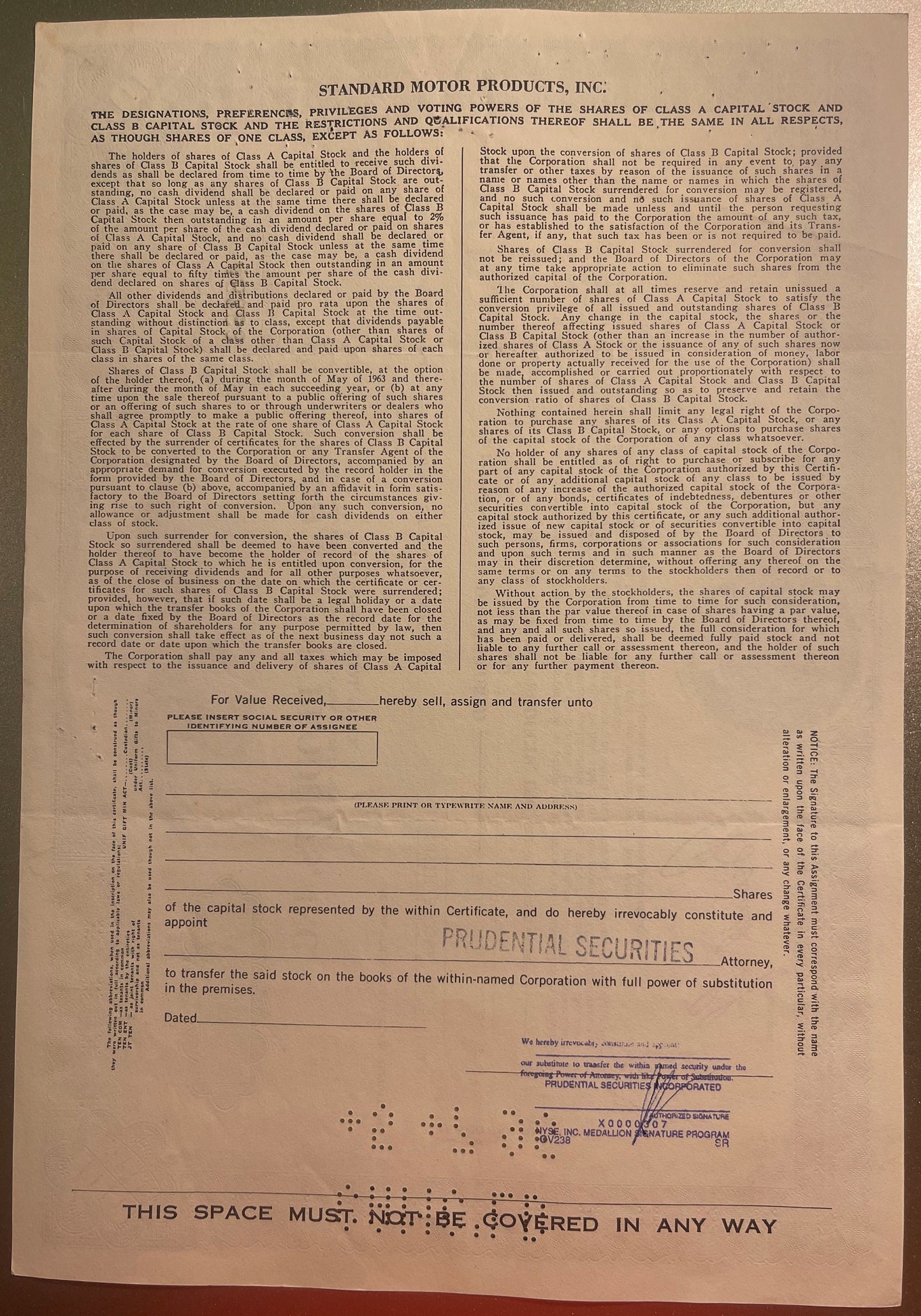
These are issued instruments rather than blanks. Certificates of this type were filled in for a holder in ink, countersigned by the transfer agent and registered by the registrar, then punch- or cut-cancelled when they were redeemed and retired. Expect financial writings, markings, stamps, hole punches and staple holes as part of the life of the instrument: endorsements and signatures, transfer-agent and registrar stamps, revenue or documentary tax stamps, cancellation punches, staple holes from being bound into a transfer book, pencil ledger notations. That is the paper trail of a security that actually did its job, and it is what separates a document that lived from a blank that never did. No two are alike: holder details, serial numbers, dates, signatures, stamps and punch patterns vary from example to example, so the photographs show the type rather than the exact sheet that ships.

Shipping

🚚 Shipping & Handling

  • Shipping costs and timing are calculated at checkout.
  • Items curated and shipped directly by me include U.S. shipping at no additional cost, professionally packed to ensure safe arrival of your artifact.

Items from Vetted Pro Collectors
Shipping for items offered by vetted Pro Collectors is determined at checkout. All Pro Collector listings are reviewed to ensure fair, reasonable shipping practices.

For full details, please refer to our Shipping Policy.

Returns & Exchange

Take your time — you've got a full six months. If a piece isn't right for you, send it back the way it reached you and we're good.

In the first 30 days your money goes straight back the way you paid. After that it's store credit, so you can put it toward something you'd rather have.

Return shipping we sort out between us, case by case. I don't make this difficult.

If something arrives damaged, or it isn't what I said it was, send me a photo within 48 hours and I'll make it right.

Email info@vintageantiquesgifts.com or call 802-356-9872 — that's me answering, not a call center.

The only things I can't take back are custom or special-order pieces and gift cards.

View full details