Skip to product information
1 of 3

Vintage and Antique Gifts

🚘 Vintage GM General Motors Stock Certificate ⭐ Authentic Detroit Americana Document ⭐ Blue Green Orange Combo

🚘 Vintage GM General Motors Stock Certificate ⭐ Authentic Detroit Americana Document ⭐ Blue Green Orange Combo

Regular price 8.00 USD
Regular price Sale price 8.00 USD
Sale Sold out
Shipping calculated at checkout.
Color

Description

🚘 The Stock Certificate That Built America's Driveway

There was a time in this country when owning a piece of General Motors meant something you could hold in your hand. A real document. Engraved. Signed. Serial-numbered. Embossed. Folded into a safe deposit box at the bank, slipped into a manila envelope in a roll-top desk drawer, or proudly framed on the wall behind the bar in the basement. This is one of those documents. An authentic vintage General Motors Corporation common stock certificate — the genuine paper article from the era when shareholders received tangible proof of ownership in the largest, most powerful, most influential automaker in American history.

A Piece of the Company That Built America

General Motors. The four-letter shorthand that meant Detroit. That meant the Buick your grandfather drove off the lot in the late fifties. The Chevy Bel Air your dad cruised through high school in. The Oldsmobile Cutlass your uncle parked at every family reunion. The Cadillac your great-grandmother kept under a canvas tarp in the garage for "good." The Pontiac GTO your older brother saved up two summers to buy. The GMC pickup that hauled lumber, kids, hay, Christmas trees, lake gear, and most of the family memories from one decade into the next.

GM didn't just build cars. GM built the American century. From the time William C. Durant founded the company in 1908 in Flint, Michigan, through the chrome-and-tailfin postwar boom, through the muscle car wars, through the energy crisis, through the badge engineering eighties, through every interstate exit, drive-in movie, suburban commute, and family road trip across the lower forty-eight — General Motors was there. Sitting in the driveway. Idling at the curb. Parked at the diner. Lined up at the drive-in. The blue oval was Ford. The five-pointed star was Chrysler. But GM was the empire — Chevrolet, Cadillac, Buick, Pontiac, Oldsmobile, GMC, all of it — and this certificate is the paper that built it.

🌆 The Futurama Vignette — A Piece of "The World of Tomorrow"

The single most distinctive feature of every GM common stock certificate from this era is its engraved centerpiece — and it's a piece of American design history in its own right. Engraved by the American Bank Note Company in the pure Streamline Moderne / Art Deco style, the vignette is a miniature manifesto of mid-century American industrial futurism. At the front of the scene, a sleek streamlined automobile glides on rounded teardrop fenders, low to the ground, the kind of "concept car" silhouette that defined GM's vision of the road ahead. Beside it, a streamlined coach or truck rolls forward emblazoned with the bold "GM" monogram on its side panel. Behind them, what reads as a streamlined locomotive completes the transportation trio — car, truck, train — every mode of land transport GM and its industrial partners ever touched, captured in a single composition.

Behind the vehicles, three overlapping male profile heads face forward, layered like a futurist motif, eyes fixed on the horizon. To the right, factory smokestacks rise vertically against the sky — the industrial muscle of Detroit, the assembly plants in Flint and Lansing and Tarrytown and Janesville, the smelters and the foundries and the stamping shops and the body works, all the brick-and-steel architecture of the American manufacturing century distilled into three vertical lines reaching up toward a sweeping arched horizon that unifies the whole composition.

🎡 The 1939 World's Fair Connection

This vignette didn't come from nowhere. It came from one of the most influential moments in twentieth-century American design — the 1939 New York World's Fair, and specifically GM's legendary "Highways and Horizons" pavilion at the Fair, which housed the now-famous Futurama exhibit designed by industrial designer Norman Bel Geddes.

Futurama was unlike anything Americans had ever experienced. A 35,738-square-foot scale model of the United States as it might look in 1960 — twenty years into the future from the moment of its construction. Visitors rode in 322 moving chair-cars on a "carry-go-round" that traversed several levels of the pavilion, gliding above a meticulously crafted miniature America of automated highways, vast suburbs, gleaming skyscrapers, and sweeping multi-lane motorways. Each chair-car was equipped with a built-in speaker that narrated the journey: "Come tour the future with General Motors. Take a transcontinental flight over America in 1960. What will we see?"

More than five million people rode Futurama across the 1939 and 1940 seasons of the Fair. It was the single most popular exhibit at the entire Fair, beating out every other corporate, national, and government pavilion by a margin no one had ever seen. Every visitor who exited the ride received a small lapel pin — a simple round button bearing four words that became one of the most famous slogans in the history of American corporate communication: "I have seen the future."

The Streamline Moderne visual language of Futurama — the sleek vehicles, the soaring highways, the modernist heroic profiles facing forward, the bold geometric framing, the industrial smokestacks of the supplier base, the unified arched horizon of the future-city skyline — is the exact same design DNA you're looking at on the face of this certificate. The vignette is GM's twentieth-century visual identity in concentrated form. It is "Highways and Horizons" engraved onto a single piece of bank-note paper. It is the World of Tomorrow, shrunken down to fit in a frame.

President Franklin Roosevelt himself sought out Bel Geddes after Futurama, and the Federal-Aid Highway Act of 1944 — the legislation that ultimately gave birth to the Interstate Highway System — bears unmistakable conceptual similarities to the network of automated motorways Bel Geddes built into the Futurama model. Bel Geddes wrote about his vision in his book Magic Motorways, where he laid out the four principles of highway design that would dominate American road-building for the next half-century: safety, comfort, speed, and economy. GM commissioned the dream. Americans came to see it. Washington built it. And the certificate in your hand is a small engraved artifact of the moment it all began.

GM returned to the World's Fair in 1964 with Futurama II — "The New Futurama" — at the Flushing Meadows fairgrounds. Same pavilion concept, updated visions: undersea motels, lunar colonies, automated jungle highways. The vignette on the stock certificate carries the spirit of both Futurama I and Futurama II — the entire mid-century arc of GM's "vision of the future" branding, captured in a single engraved frame.

🏛️ What You're Looking At

This is an authentic original General Motors Corporation common stock certificate, issued during the 1950s through 1980s window — the precise stretch of years when GM was at its absolute apex, when "What's good for General Motors is good for America" wasn't a punchline, it was just the truth everyone took for granted. Each certificate is printed on the heavy bank-note-quality paper of the era, with the genuine intaglio engraving by the American Bank Note Company, the embossed corporate seal, the authentic signatures of the corporate officers, and the registered serial numbers that made each one a one-of-one document at the moment of its issuance.

Each certificate is incorporated under the laws of the State of Delaware — as GM has been from the very beginning — and carries the legendary par value of one and two-thirds dollars per common share that became the GM standard from the mid-century forward. Down the face you'll find the engraved corporate header, the transfer agent imprint, the registrar countersignature, an issue date drawn from the long 1950s-through-1980s span, and a registered owner name — sometimes a real individual American shareholder, sometimes one of the Wall Street street-name brokerage nominees that anyone who's ever cracked open an old broker statement will recognize on sight.

📋 A Note on the Nature of These Documents

Every authentic vintage stock certificate is its own one-of-a-kind historical artifact. No two are identical. Each piece carries its own unique serial number, its own registered owner, its own issue date, its own pattern of officer signatures from whichever year it left the corporate office, and its own physical character from the decades it spent in safe deposit boxes, broker vaults, family desks, and transfer-agent file drawers.

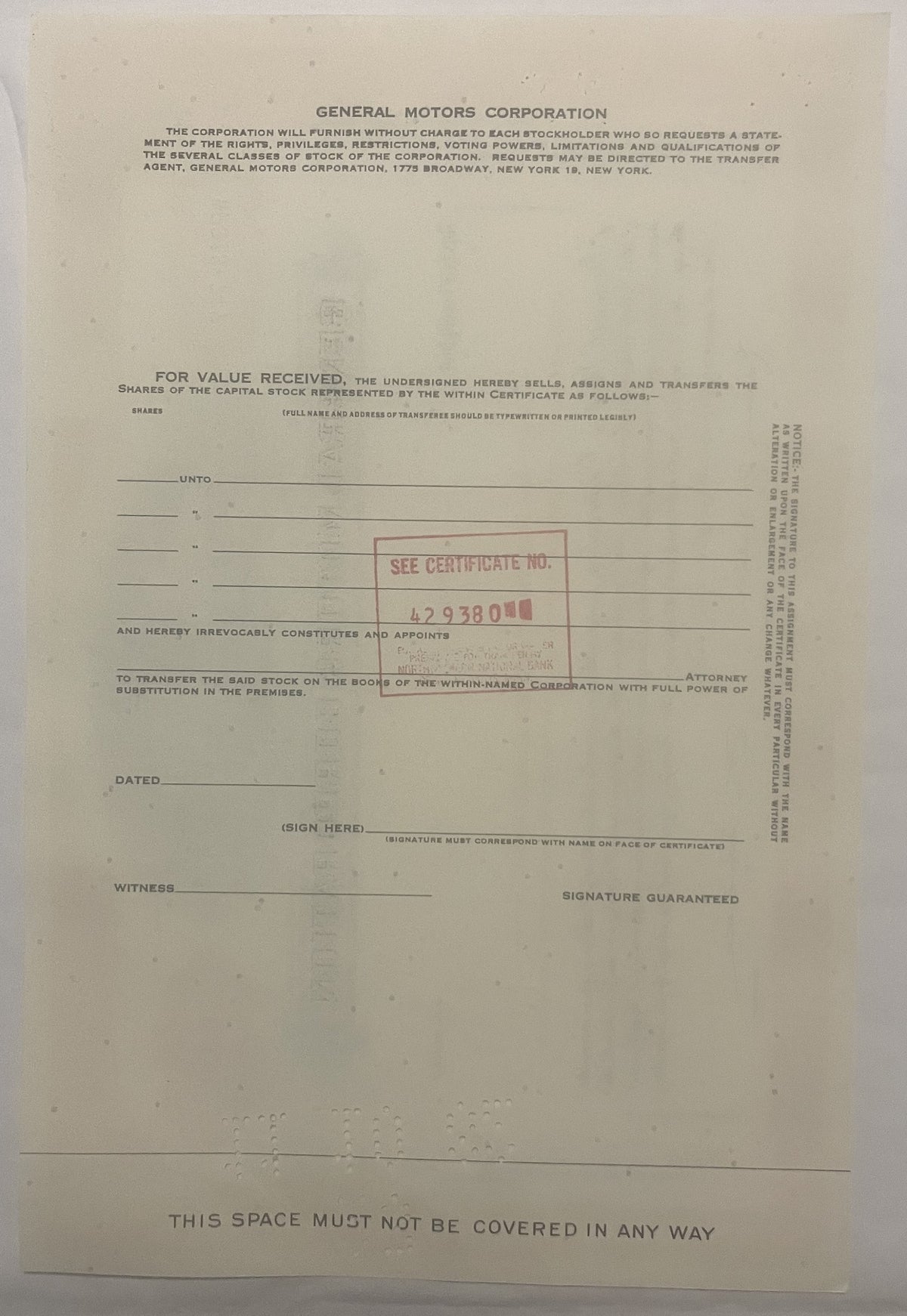
Because these are real, genuine, historically issued shareholder documents — not modern reproductions or new-printed reissues — they may also feature any of the standard hallmarks of a paper share that actually lived through the era of physical stock ownership: financial markings, transfer stamps, cancellation marks, cancellation hole punches, and the occasional remnants of staples. These are the fingerprints of authenticity. They're the marks that prove the certificate is a real document that did real work in the real twentieth-century American financial system — not a freshly minted replica trying to look the part. Collectors and decorators value these character marks for exactly that reason: they're the difference between a print and a piece of history.

🎨 Three Authentic Color Variants — Choose Your Favorite or Collect All Three

🔵 Blue — The classic GM blue certificate. Deep, rich navy-and-cyan tones with the engraved scrollwork running the full width of the document. This is the variant that hung framed in countless dens, offices, basement bars, garages, and home libraries for generations. Crisp blue ink against creamy bank-note paper. The default GM common stock color for many issue runs. Typically the under-hundred-share denomination.

🟢 Green — The forest-green issue. A deeper, woodsier, more sober variant with a presence that reads less like Wall Street and more like a country club library. The green pairs beautifully with leather, oak, brass, and the kind of warm desk-lamp lighting you'd find in a study or an executive office. Collectors love the green for its understated authority. Typically the under-hundred-share denomination.

🟠 Orange — The hundred-share certificate. The bold, sunset-orange variant that signaled a heavier holding. Where the blue and green were typically issued in the under-hundred-share denomination, the orange carries the "100 shares" mark and the corresponding visual weight. It pops on a wall. It pops in a frame. It pops in a shadow box. It's the showstopper of the three, and the one that pulls the most attention in any display.

🎨 The Combo Set — All three colors together. The complete collector trio. Blue, green, and orange — the full GM common stock color story side by side. This is the variant you choose when you want the wall, the shelf, or the gift to do the heavy lifting all in one move. Three frames in a vertical run, three frames in a horizontal row, three certificates layered in a single oversized shadow box — the visual rhythm of three matching documents in three different colors is what separates a piece of decor from a collection.

🏆 Why Collectors Care About Vintage Stock Certificates

The world of scripophily — the formal name for the hobby of collecting historic stocks and bonds — is one of the most underappreciated corners of the collecting universe. While the sports card market, the comic book market, the coin market, and the vinyl record market get most of the headlines, scripophily has been quietly building for over half a century. And inside scripophily, the American "blue chip" industrial certificates of the mid-twentieth century occupy a special place. These are the documents that capitalized the country. These are the papers that financed the assembly lines, the steel mills, the railroads, the refineries, the dealerships, and the dream of a two-car garage in every suburb from Long Island to Long Beach.

General Motors sits at the absolute top of the scripophily food chain for American industrials. The reason is simple: GM was the largest publicly traded corporation in the world for most of the postwar period. More households owned GM stock than owned any other single security. The certificate in your hand wasn't just a financial instrument — it was a cultural artifact. It was the paper your grandfather pulled out at Thanksgiving to show you what "investing" looked like. It was the document your father slipped into the safe deposit box when you were born, "for college." It was the gift your great-aunt gave at every graduation, every wedding, every milestone — "ten shares of GM, kid, hold onto it."

When stock ownership went fully electronic in the early 2000s, the paper certificate was effectively retired. The Direct Registration System took over. Brokerages stopped issuing paper. The Depository Trust Company swallowed the float. And just like that, an entire visual tradition — the engraved, signed, sealed, numbered, hand-printed proof of ownership — vanished from American life. Every certificate that survives from the pre-electronic era is finite, historical, irreplaceable. The American Bank Note Company that engraved them is no longer producing share certificates. The dies are gone. The presses are quiet. The era is gone.

What's left is the paper. And the paper is what you're buying.

🏎️ The Era These Certificates Come From

Picture the showroom floor. Polished tile. Plate glass. A Chevrolet Impala on a slow-spinning turntable under the showroom lights. A salesman in a short-sleeved white dress shirt with a clip-on tie. Coffee on the desk. Cigarettes in the ashtray. A wall clock ticking past five. Outside the window, the parking lot is full of trade-ins — Bel Airs, Catalinas, Eighty-Eights, Skylarks, Le Sabres — each one heading toward a second life with a new owner and a new story. This is the world the certificate comes from. The everyday American world of the postwar boom and the muscle car years and the long, slow afternoons at the dealership.

Picture the assembly line. Flint. Lansing. Pontiac. Detroit. Janesville. Linden. Tarrytown. Fremont. The hum of the line. The torque guns. The conveyor. The men in coveralls. The women in the trim shop. The lunch pails. The shift whistle. The smell of fresh paint and cutting oil and coffee in waxed paper cups. The pride of stamping a hood with a Chevrolet bowtie or a Cadillac crest or a Buick tri-shield. The factory smokestacks reaching up against the Michigan sky — the same smokestacks engraved into the certificate vignette. This is the world the certificate comes from. The work that built the country.

Picture the family driveway. A Caprice Classic with the wagon roof rack loaded for vacation. A Cutlass Supreme washed and waxed on a Saturday morning. A pickup with a fresh load of mulch for the flower beds. A Camaro with the hood up while two teenagers argued over the carburetor. A Buick Riviera with the chrome polished to a mirror.

🎁 Gift Ideas That Actually Land

🛠️ For the gearhead — Frame it. Hang it in the garage above the workbench, in the man cave next to the Snap-On calendar, in the basement bar between the neon signs. Pair it with a die-cast scale model of a '67 Camaro or a '59 Cadillac and you've got a gift that reads "I see who you are and I see what you love."

📈 For the finance professional — A vintage GM certificate on an office wall is shorthand for "I understand markets, I respect history, and I know where the modern financial system came from." Investment bankers, financial advisors, accountants, traders, brokers, retirement planners, fund managers — this is the gift that nails it.

🎓 For the new graduate — Give the kid heading off into the working world a piece of the corporation that defined American capitalism for a hundred years. Frame it with a card. Write on the back: "Your first piece of American industry. Hold onto it."

👴 For the retiree — Especially the one who worked at a GM plant, a GM dealership, a GM supplier, or anywhere along the long, vast GM supply chain. This certificate is a piece of the company they spent their working life inside. It belongs on their wall.

🎡 For the design and architecture lover — The Futurama / World's Fair / Bel Geddes connection makes this a piece of mid-century American design history. Anyone who loves Streamline Moderne, Art Deco, industrial design, or twentieth-century futurism will recognize the vignette on sight.

🏫 For the dorm room or first apartment — Genuine vintage Americana for a kid who's tired of mass-produced wall art. A real engraved document, a real piece of the twentieth century, for less than the cost of a poster.

🖼️ Display Ideas

🪟 Single frame — An eight-by-ten or eleven-by-fourteen wood frame with an off-white mat will let the certificate breathe. Linen-textured mat board adds a museum-grade touch. Black or walnut frames pop the colors. Brass picture lights overhead turn the whole thing into a focal point.

🧱 Gallery wall — Anchor a gallery wall in the office, library, study, or basement bar. Mix the GM certificate with a vintage map, a black-and-white photograph, a piece of railroad memorabilia, a vintage license plate, or a framed advertisement from the same era. Bonus points for pairing with a vintage 1939 World's Fair poster, a Trylon-and-Perisphere print, or a Norman Bel Geddes book cover.

🗂️ Shadow box — Layer the certificate with a vintage GM key fob, a hood ornament, a dealer brochure, or a small die-cast model. The dimensional display turns the piece into an installation.

🪟 Triptych — The combo set in three matching frames, hung vertically or horizontally, makes a statement piece. Three colors, one story, one wall.

🧰 Garage/man cave — A real engraved GM stock certificate above the toolbox or behind the bar is the move.

📚 Office or library — Pair with leather chairs, a banker's lamp, brass accents, and dark wood. The certificate looks like it's been there for fifty years because, well, it has.

🚘 The American Story, In Paper Form

There's a reason the engraved stock certificate has become one of the most quietly powerful collectibles of the American twentieth century. It's not the dollar value. The shares themselves are long since electronically registered through the modern system, and the paper document no longer represents an equity claim. What the paper represents is history. A finished, closed, complete chapter of American economic and design life. The era of physical ownership. The era of mailed dividend checks. The era of "I have seen the future." The era of GM as the company that, more than any other, defined what it meant to be an American corporation and what it meant to dream up the road ahead.

That era ended. But the paper survives. And every time one of these certificates lands on a wall, in a frame, in a shadow box, on a desk, in a den, in an office, in a garage, in a study, in a library, in a child's bedroom, in a dorm room, in a first apartment, in a retirement condo, in a lake house, in a hunting cabin, in a bar, in a barbershop, in a diner, in a museum, in a school — every time one of these certificates is preserved and displayed, the era lives on a little longer.

That's what you're buying. The paper. The history. The era. The story. The Americana. And a small engraved echo of "the World of Tomorrow," riding forward on streamlined wheels.

🛍️ Add to Cart

Choose your color — Blue, Green, Orange, or the full Combo Set of all three — and bring home an authentic engraved piece of the company that built America's driveway, America's interstate, America's middle class, and America's twentieth century. This is the vintage Americana that doesn't shout for attention. It earns it.

🚘 General Motors. Vintage stock certificate. Authentic. Engraved. Genuine. Yours.

Shipping

🚚 Shipping & Handling

  • Shipping costs and timing are calculated at checkout.
  • Items curated and shipped directly by me include U.S. shipping at no additional cost, professionally packed to ensure safe arrival of your artifact.

Items from Vetted Pro Collectors
Shipping for items offered by vetted Pro Collectors is determined at checkout. All Pro Collector listings are reviewed to ensure fair, reasonable shipping practices.

For full details, please refer to our Shipping Policy.

Returns & Exchange

Product Page Return Policy

  • 60-Day Returns – Items must be in original condition.
  • Refunds – Issued after inspection (excluding shipping costs).
  • Return Shipping – Customer is responsible unless item is damaged or incorrect.
  • Damaged/Incorrect Items – Contact us within 48 hours for a replacement or refund.
  • Easy Returns – Email info@vintageantiquesgifts.com or call 802-356-9872 to initiate a return.

For full details, visit our Refund Policy.

View full details