Skip to product information
1 of 6

Vintage and Antique Gifts

Vintage 1960s Atlantic Richfield Stock Certificate ⛽ Brown ARCO Oil Americana

Vintage 1960s Atlantic Richfield Stock Certificate ⛽ Brown ARCO Oil Americana

Regular price $5.50 USD
Regular price Sale price $5.50 USD
Sale Sold out
Shipping calculated at checkout.

Size: 12" x 8"

🚚 Free US Shipping — ships within one business day. International shipping calculated at checkout.

Quantity

Remember ARCO Gas? ⛽ Vintage 1960s Atlantic Richfield Stock Certificate, Brown

Size: 12" x 8" ~ Little to no storage wear.

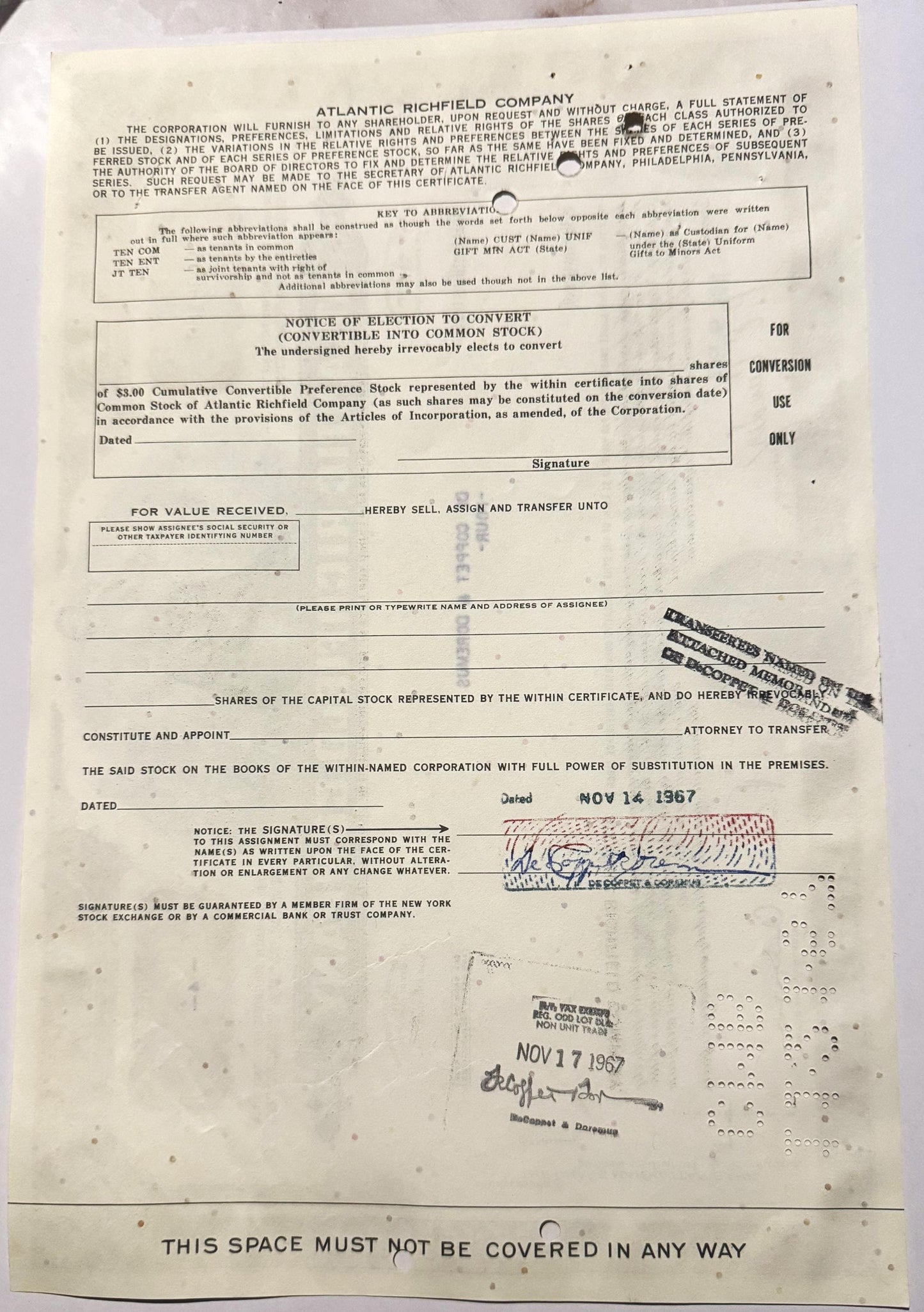
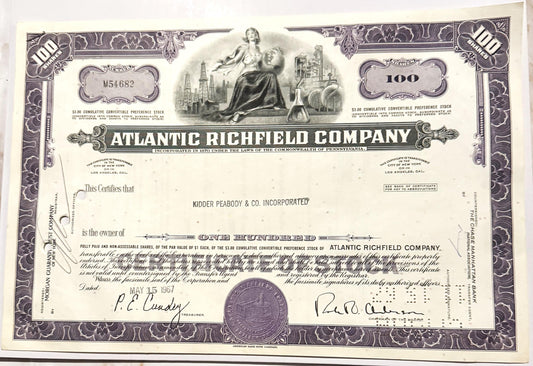
⛽ This vintage 1960s Atlantic Richfield Company stock certificate in warm brown is another great piece of oil-and-gas Americana from the ARCO era. It's the $3.00 Cumulative Convertible Preference Stock, for less than 100 shares, engraved and printed by the American Bank Note Company, and it carries the brand-new Atlantic Richfield name over a company history that goes all the way back to 1870.

Like everything I keep, these live in the dark at under 40% relative humidity and a steady 72°F, climate controlled, so any age they show, they had before they came to me.

🏷️ What's Printed on It

  • ATLANTIC RICHFIELD COMPANY
  • INCORPORATED IN 1870 UNDER THE LAWS OF THE COMMONWEALTH OF PENNSYLVANIA
  • CERTIFICATE FOR LESS THAN 100 SHARES
  • $3.00 CUMULATIVE CONVERTIBLE PREFERENCE STOCK (CONVERTIBLE INTO COMMON STOCK; SUBORDINATE AS TO DIVIDENDS AND ASSETS TO PREFERRED STOCK), par value $1
  • THIS CERTIFICATE IS TRANSFERABLE IN THE CITY OF NEW YORK OR IN LOS ANGELES, CAL.
  • Morgan Guaranty Trust Company, registrar; The Chase Manhattan Bank, transfer agent
  • The company seal, Philadelphia; AMERICAN BANK NOTE COMPANY at the foot

🛢️ One Certificate, Two Coasts

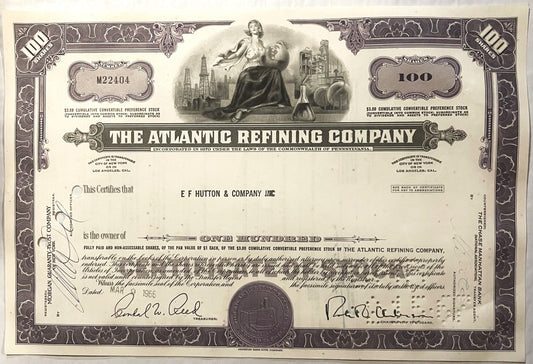
That transfer line, New York or Los Angeles, is the whole merger in one sentence. Atlantic Refining was a Philadelphia company with roots in the Atlantic Petroleum Storage Company of 1866. It spent years inside Rockefeller's Standard Oil trust from 1874 and went its own way when the trust was broken up in 1911. Richfield Oil was a Los Angeles company that opened its first gas station in 1917, at Slauson and Central. On January 3, 1966 Richfield was merged into Atlantic, and that May the company took the name Atlantic Richfield. ARCO is just the two names run together.

This preference stock came out of that merger. Richfield's biggest shareholders, Sinclair and Cities Service among them, came out of the deal holding $3.00 Cumulative Convertible Preference Stock, which is why a company incorporated in Pennsylvania made it transferable in Los Angeles. There was a courtroom story behind it too: the government had sued Richfield, Cities Service and Sinclair on antitrust grounds in 1962, and when that case was dismissed after the merger, Sinclair and Cities Service had to sell off their preference stock within seven years. The headquarters stayed in New York City until 1971 and then moved to Los Angeles, so the two cities on this certificate were the company's two homes.

📈 What Came Next

Atlantic Richfield and Humble Oil, the company that became Exxon, found the Prudhoe Bay oil field in Alaska in 1968, the biggest oil field in North America. In 1969 Sinclair itself was merged in, and the company spent about $60 million putting three gas station brands under the one ARCO name. It merged with Anaconda Copper in 1977, and in 2000 BP bought the whole company for $26.8 billion.

You can still fill up at an ARCO. BP sold the brand to Tesoro in 2012, Tesoro was later folded into Marathon Petroleum, and today Marathon owns the name across most of the United States and Mexico while BP keeps an exclusive license for Northern California, Oregon and Washington.

🏦 The two banks on the face

The registrar and the transfer agent printed on the face are a little Wall Street history lesson of their own, and they ended up in the same family. Morgan Guaranty Trust Company was brand new in the 1960s, formed in 1959 when the Guaranty Trust Company of New York merged with J.P. Morgan & Co. Guaranty Trust was nearly four times the size of Morgan, but the Morgan men took over running the combined bank.

The Chase Manhattan Bank was only a few years older, born in 1955 when Chase National Bank and the Bank of the Manhattan Company came together. The Manhattan Company goes all the way back to September 1, 1799, when Aaron Burr founded it at 40 Wall Street, officially to bring clean water into New York City from the Bronx River, though it was really set up to be a bank. Chase National was founded in 1877 by John Thompson, who named it for Salmon P. Chase, Lincoln's Treasury Secretary, a man who had died four years earlier and had nothing to do with the bank. In December 2000 Chase Manhattan bought J.P. Morgan & Co., and the registrar and transfer agent on this certificate became one company, JPMorgan Chase.

📄 What You Receive

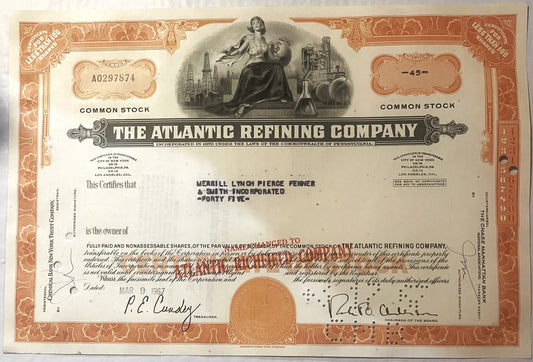
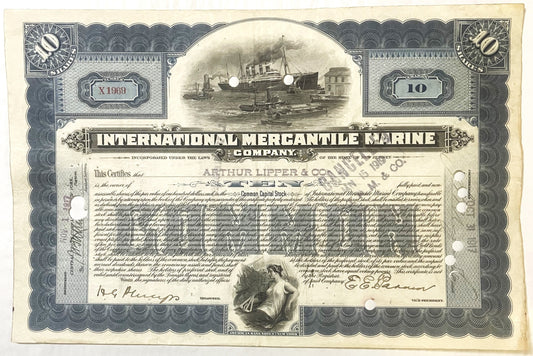
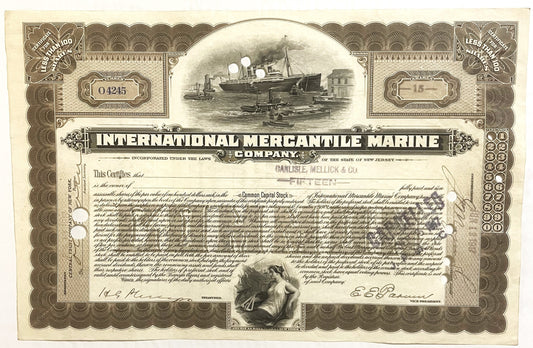
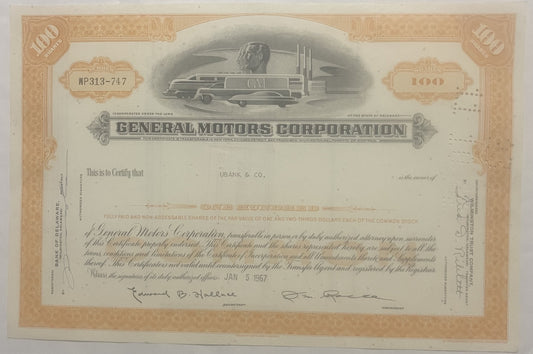
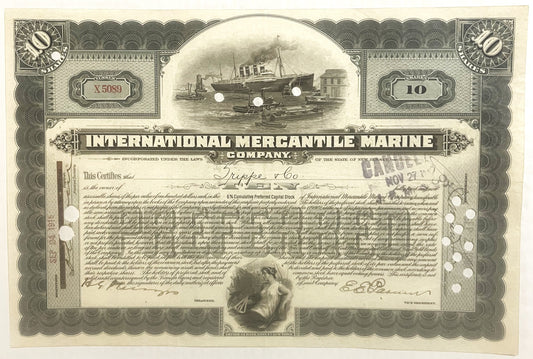
Each one was filled in for a holder in ink, countersigned by the transfer agent and registered by the registrar, then punch- or cut-cancelled when it was redeemed and retired. Holder details, serial numbers, dates, signatures, stamps and punch patterns vary from example to example, so the photographs show the type rather than the exact sheet that ships.

📜 Every one of these certificates had a working life, and it can show. Depending on the sheet, you may find staples or staple holes, cancellation punch holes (often right through the signatures), hand stamps from banks, brokers and transfer agents, real federal or state stock transfer tax stamps, handwriting or a filled-in transfer on the back, papers still attached, seals (a corporate seal pressed into the paper, a foil wafer seal, or a bank's signature-guarantee stamp signed across an endorsement), or a silver strip pasted over an officer's signature with the new officer's signature printed on top. That last one is what collectors call silvering: when the officers changed, the new signature could be pasted right over the old one on certificates already printed. None of that is damage. Each mark is part of the paper's own history, and they vary sheet to sheet, so no two are quite alike.

🏡 Display

Printed on heavy bank-note paper, stiffer than a dollar bill, it frames up beautifully in an office, den, bar or garage, and it's a great gift for anybody in oil and gas or anybody who remembers filling up at an ARCO. Paper share certificates are a thing of the past, and once these last ones are gone, they'll be very difficult to acquire.

Shipping

🚚 Shipping & Handling

  • Shipping costs and timing are calculated at checkout.
  • Items curated and shipped directly by me include U.S. shipping at no additional cost, professionally packed to ensure safe arrival of your artifact.

Items from Vetted Pro Collectors
Shipping for items offered by vetted Pro Collectors is determined at checkout. All Pro Collector listings are reviewed to ensure fair, reasonable shipping practices.

For full details, please refer to our Shipping Policy.

Returns & Exchange

Take your time — you've got a full six months. If a piece isn't right for you, send it back the way it reached you and we're good.

In the first 30 days your money goes straight back the way you paid. After that it's store credit, so you can put it toward something you'd rather have.

Return shipping we sort out between us, case by case. I don't make this difficult.

If something arrives damaged, or it isn't what I said it was, send me a photo within 48 hours and I'll make it right.

Email info@vintageantiquesgifts.com or call 802-356-9872 — that's me answering, not a call center.

The only things I can't take back are custom or special-order pieces and gift cards.

View full details

Rescuing American History Since 2007

— Travis & the Kids