Skip to product information
1 of 4

Vintage and Antique Gifts

Vintage 1960s - 1970s American Brands Inc Stock Certificate 📜 with Native American Art, Tobacco Americana

Vintage 1960s - 1970s American Brands Inc Stock Certificate 📜 with Native American Art, Tobacco Americana

Regular price $5.50 USD
Regular price Sale price $5.50 USD
Sale Sold out
Shipping calculated at checkout.

Size: 12" x 8"

🚚 Free US Shipping — ships within one business day. International shipping calculated at checkout.

Quantity

How Did American Tobacco End Up With No Tobacco at All? 🪶 A Vintage 1960s-1970s American Brands, Inc. Stock Certificate, Chief Powhatan Vignette, American Bank Note Company

Size: 12" x 8" ~ Little to no storage wear.

🦅 Ever Held a Piece of Paper That Watched an Entire American Industry Reinvent Itself?

There's a particular kind of magic in a stock certificate - it's not a photograph, not a newspaper clipping, but an actual working financial instrument, engraved and signed and dated, that once sat in a real person's lockbox or safe deposit drawer as proof of ownership in a real American company. This one carries something extra: a Native American chief in a full feathered headdress, framed by the same guilloche borderwork security printers used to stop counterfeiters cold. It's the kind of image that shows up on currency and old bonds and precious little else - and here it sits on a piece of corporate Americana from a company that spent the better part of a century reinventing what "tobacco company" even meant.

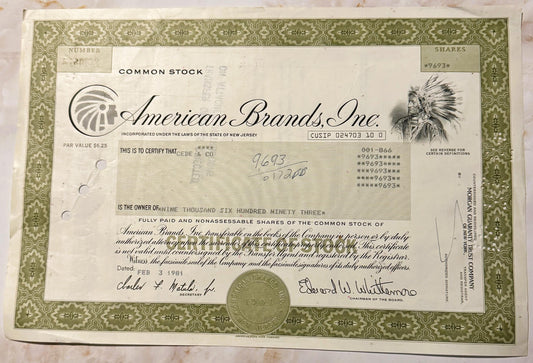
A real, issued COMMON STOCK certificate of American Brands, Inc., INCORPORATED UNDER THE LAWS OF THE STATE OF NEW JERSEY, with a par value of $6.25 a share, engraved by the AMERICAN BANK NOTE COMPANY. The border is orange, CERTIFICATE OF STOCK is overprinted across the face in the same orange, 100 SHARES sits in both top corners, and the company name is set in big engraved script beside a round monogram. The picture is a chief in a full feathered war bonnet, in fine black engraving. Each one was typed in, signed, stamped and punch-cancelled.

That orange is a warm guilloche border wrapped around a cream-white field, and the whole sheet is printed on the heavy, engraved paper of mid-century security documents. The old American Tobacco name doesn't appear anywhere on it - just American Brands, Inc., and the chief it inherited.

📅 1960s-1970s

The name American Brands only goes back to July 1, 1969, so none of these are earlier than that, and the run of this orange chief certificate carries on from there into the 1970s. The one you get will carry its own date, number, owner, share count and stamps, and may look a little different from the one in my pictures.

Certificates of this type were filled in for a holder in ink, countersigned by the transfer agent and registered by the registrar, then punch- or cut-cancelled when they were redeemed and retired. On the sheet in my photos, First National City Bank signs as registrar and Morgan Guaranty Trust Company of New York as transfer agent - two heavyweight New York names of the day, the forerunners of banks still around now - though a run this long can carry other agents on other sheets.

📜 Every one of these certificates had a working life, and it can show. Depending on the sheet, you may find staples or staple holes, cancellation punch holes (often right through the signatures), hand stamps from banks, brokers and transfer agents, real federal or state stock transfer tax stamps, handwriting or a filled-in transfer on the back, papers still attached, seals (a corporate seal pressed into the paper, a foil wafer seal, or a bank's signature-guarantee stamp signed across an endorsement), or a silver strip pasted over an officer's signature with the new officer's signature printed on top. That last one is what collectors call silvering: when the officers changed, the new signature could be pasted right over the old one on certificates already printed. None of that is damage. Each mark is part of the paper's own history, and they vary sheet to sheet, so no two are quite alike.

🪶 Keeper of the leaf

The chief didn't start out on American Brands paper. Collectors know him as Chief Powhatan, Keeper of the Leaf, and the story in the trade is that he came over from the old American Tobacco Company's own certificates, engraved by the same American Bank Note Company. It's a fitting choice for a tobacco company. Powhatan was the paramount chief of the Virginia tribes when the English landed at Jamestown, and it was in his country that John Rolfe raised the tobacco that saved the colony - and in 1614 Rolfe married Powhatan's daughter, Pocahontas.

Engraved chiefs were a favorite of American security printers from the late 1800s on, turning up on currency, bonds and stock certificates as a kind of shorthand for American identity - dignity, gravity, the frontier spirit repackaged as financial trust. The engraver took real care with this one: the furrows of the face and the feathers of the war bonnet trailing down past the shoulder are all built from fine cross-hatched lines that only a bank-note engraver could cut.

🚬 Buck Duke's trust

The company behind this certificate was the American Tobacco Company, which James Buchanan Duke put together in 1890 out of five rival cigarette makers, including Allen & Ginter, Goodwin & Company and Kinney Brothers. Buck Duke ended up with something like 90 percent of the American cigarette business, and in 1911 the Supreme Court broke the trust into sixteen companies. That 1911 ruling leaned on the brand-new "rule of reason" in antitrust law. Duke put his money into hydroelectric power in the Carolinas and a family foundation, and that fortune is where Duke University got its name.

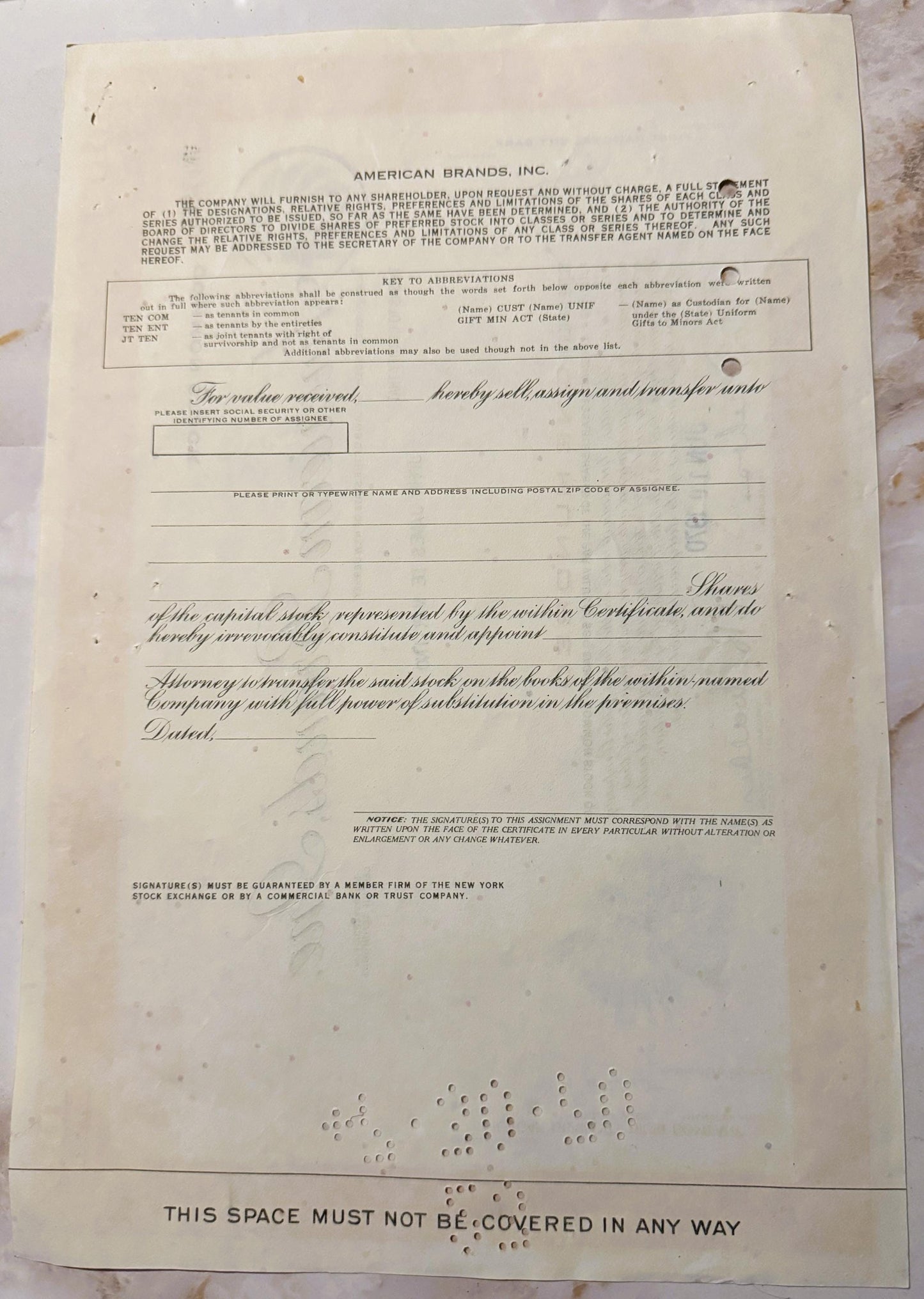
The American Tobacco that came out of the break-up had Lucky Strike, and it kept selling cigarettes for decades. The Lucky Strike blend was perfected by Charles A. Penn of Reidsville, North Carolina, American Tobacco's vice president for manufacturing from 1916, who enlarged his father's old factory in Reidsville to turn them out - the town took the nickname "Lucky City." But by the 1960s, with the Surgeon General's report on smoking and the warning labels, the company was quietly buying everything else it could: Sunshine Biscuits, the Jim Beam bourbon distillery, Duffy-Mott, Gallaher in Britain. On July 1, 1969 it took Tobacco out of its own name and became American Brands - the name on this certificate. Swingline staplers came along in 1970, Titleist's maker Acushnet in 1976. The leadership wanted out from under the word "tobacco" itself, and that put a five-and-dime desk staple in the same family as pipe tobacco and bourbon - the James B. Beam Distilling Company, to give the distillery its full name.

🍾 What became of it

In 1994 American Brands sold the American Tobacco Company itself to British American Tobacco, so the company that started as the biggest tobacco trust in history ended up with no tobacco at all. The price was reported at about a billion dollars, and the old brands went into BAT's American arm, Brown & Williamson. In 1997 it renamed itself Fortune Brands, in 2011 it split apart, and the bourbon end, Beam, went to Suntory of Japan in 2014. The 2011 split made two companies, Fortune Brands Home & Security and Beam Inc. There hasn't been an American Brands, Inc. since 1997.

🖨️ The engravers

American Bank Note goes back to an engraving shop of 1795 founded by Robert Scot, the first chief engraver of the U.S. Mint, and grew by swallowing its rivals - seven security printers joined up in 1858, National and Continental came in 1879, United Bank Note in 1911 - until it was the biggest maker of money paper in the world. Its 1908 headquarters and plant in New York are city landmarks now. The raised intaglio lines you can feel on this certificate were the whole point: stock had to look like money, so nobody could fake it.

The par value printed on it, $6.25 a share, is its own little piece of old-school finance - a nominal value a company set on its books, quite apart from whatever the stock actually traded for on the floor. And it isn't good as stock today: American Brands is long gone and paper shares were replaced by electronic records years ago, so this is collected for its history and its engraving.

📈 A vanishing kind of paper

Paper stock certificates like this one are a vanishing category of Americana. The very first stock certificate is said to have been issued by the Dutch East India Company in 1606, and the tradition ran for about four hundred years before big American companies moved their shareholders onto electronic book-entry records. The Walt Disney Company's 2013 decision to stop issuing paper certificates is often cited as the end of that chapter for the major American names. A certificate like this - engraved, signed, dated and issued into a real shareholder's transaction - comes from the years when owning a piece of a company meant holding an actual piece of engraved paper, not a line item in a brokerage account.

🪶 About these

They're 12 by 8 inches, engraved on heavy paper. A fine one for a cigar room, a bourbon shelf, a Virginia history wall, or anybody who grew up around tobacco barns in the Carolinas. The supply is finite - nobody's issuing American Brands stock again, and once these last ones are framed, they'll be very difficult to acquire.

  • 🖋️ Framed alone under glass in a home office or den, letting the orange border and the chief carry the whole wall
  • 📚 Paired with other tobacco-era or Americana ephemera in a "Wall Street history" grouping
  • 🎩 Matted alongside vintage cigarette tins or tobacco advertising for a themed corner
  • 🏛️ Set near business or finance books as a conversation piece of corporate history
  • 🖼️ Rotated with other old stock and bond certificates for a changing "history of American industry" display

Scripophily - the collecting of old stock and bond certificates - draws a particular crowd: history buffs who want a piece of a story like American Tobacco's breakup and reinvention, engraving fans drawn to the American Bank Note Company's work, Americana collectors after the Native American vignettes so common on old security paper, and gift-givers looking for a birthday, retirement or Wall Street present with a real story behind it. It's also a natural for anyone who loves the five-and-dime feel of old American advertising and finance, where even a stock certificate was made to be looked at, not just filed away.

Shipping

🚚 Shipping & Handling

  • Shipping costs and timing are calculated at checkout.
  • Items curated and shipped directly by me include U.S. shipping at no additional cost, professionally packed to ensure safe arrival of your artifact.

Items from Vetted Pro Collectors
Shipping for items offered by vetted Pro Collectors is determined at checkout. All Pro Collector listings are reviewed to ensure fair, reasonable shipping practices.

For full details, please refer to our Shipping Policy.

Returns & Exchange

Take your time — you've got a full six months. If a piece isn't right for you, send it back the way it reached you and we're good.

In the first 30 days your money goes straight back the way you paid. After that it's store credit, so you can put it toward something you'd rather have.

Return shipping we sort out between us, case by case. I don't make this difficult.

If something arrives damaged, or it isn't what I said it was, send me a photo within 48 hours and I'll make it right.

Email info@vintageantiquesgifts.com or call 802-356-9872 — that's me answering, not a call center.

The only things I can't take back are custom or special-order pieces and gift cards.

View full details
  • 5 stars: 1 (100%)
  • 4 stars: 0 (0%)
  • 3 stars: 0 (0%)
  • 2 stars: 0 (0%)
  • 1 star: 0 (0%)
a
a***a (391)

Hi it’s me again I received my antique 1960s 1970s stock certificate in great condition and right on time very fast shipping service I very much appreciate the opportunity of doing my business with you and your family stay safe and healthy thanks again 👍

Rescuing American History Since 2007

— Travis & the Kids