Skip to product information
1 of 6

Vintage and Antique Gifts

Vintage 1960s Atlantic Richfield Company Stock Certificate ⛽ ARCO Oil Americana

Vintage 1960s Atlantic Richfield Company Stock Certificate ⛽ ARCO Oil Americana

Regular price $5.50 USD
Regular price Sale price $5.50 USD
Sale Sold out
Shipping calculated at checkout.

Size: 12" x 8"

🚚 Free US Shipping — ships within one business day. International shipping calculated at checkout.

Quantity

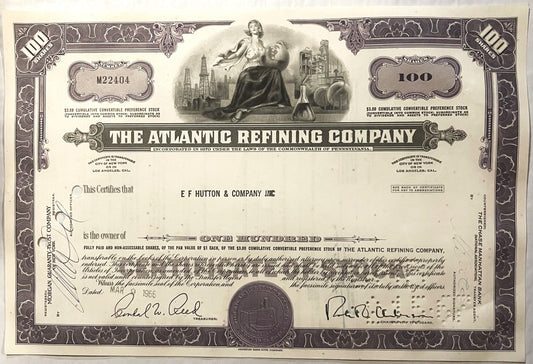
How Did Atlantic and Richfield Become One Oil Company? ⛽ A Vintage 1960s Atlantic Richfield Company (ARCO) Preference Stock Certificate, Violet, American Bank Note Company

Size: 12" x 8" ~ Little to no storage wear.

Ever hold a piece of paper that once carried a stake in an oil empire stretching from the Alaskan tundra to the refineries of Philadelphia? An old stock certificate is a little engraved time capsule, printed with the same care and craftsmanship once reserved for paper money. Long before "ARCO" meant a red-diamond sign glowing over a highway off-ramp, it meant a bold new American oil giant, born of a handshake between two very different companies - one rooted in the old refineries of the East, the other in the wildcat oil fields of California.

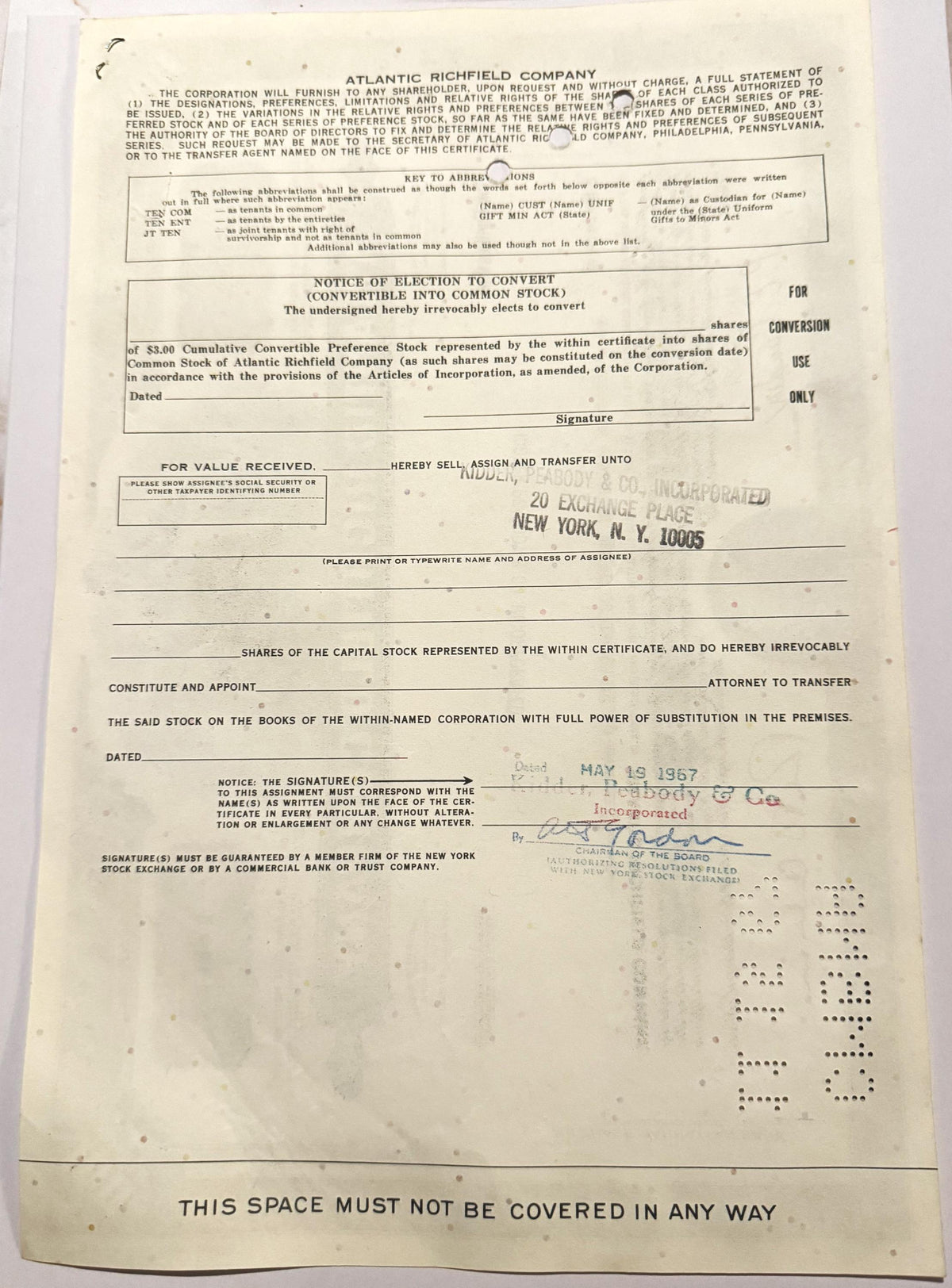
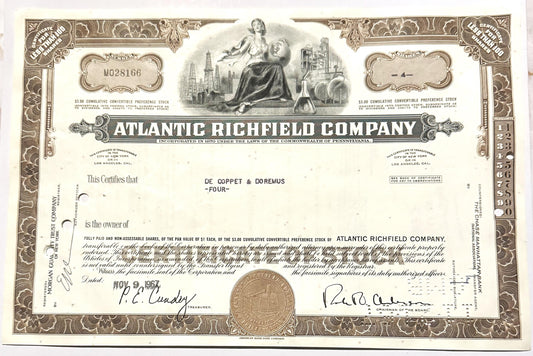
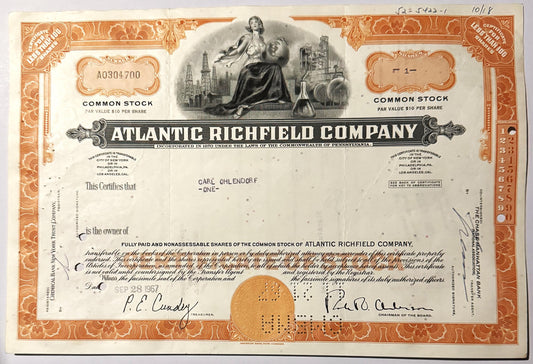
A real, issued certificate of the ATLANTIC RICHFIELD COMPANY for its $3.00 CUMULATIVE CONVERTIBLE PREFERENCE STOCK, engraved by the AMERICAN BANK NOTE COMPANY with a violet border and a black vignette: a seated woman with her hand on a globe, oil derricks rising behind her on one side and a refinery's towers and tanks on the other, a laboratory flask at her feet. 100 SHARES sits in both upper corners, ONE HUNDRED across the face, and the fine print says it's CONVERTIBLE INTO COMMON STOCK - in plain English, it paid three dollars a year on each one-dollar-par share, ahead of the common stock though behind the company's preferred (it says so right in print: SUBORDINATE AS TO DIVIDENDS AND ASSETS TO PREFERRED STOCK), and the owner could swap it for common whenever that looked like the better deal. The registrar is Morgan Guaranty Trust Company of New York and the transfer agent The Chase Manhattan Bank (National Association), and it's TRANSFERABLE IN THE CITY OF NEW YORK OR IN LOS ANGELES, CAL. - which is the whole story of this company in one line. Each one was filled in, signed, stamped and punch-cancelled. Ornate scrollwork fills the corners, and ATLANTIC RICHFIELD COMPANY stretches across the center in bank-note lettering, with the incorporation line running just beneath it.

📅 The 1960s

It says INCORPORATED IN 1870 UNDER THE LAWS OF THE COMMONWEALTH OF PENNSYLVANIA, but don't let that fool you. 1870 is the charter of Atlantic Refining, the older half. The Atlantic Richfield Company itself only came into being with the merger of January 1966, and it ran as an independent American oil company from 1966 to 2000, so none of these are earlier than that. The one you get will carry its own date, number, owner and stamps, and may look a little different from the one in my pictures.

🛢️ The Philadelphia half

Atlantic goes back to the very start of the oil business. Charles Lockhart and William Frew had come to the Pennsylvania oil country to drill in 1859, the year Colonel Drake's well came in at Titusville - what old-timers in the oil patch still call Drake's Folly - and with William G. Warden they built the Atlantic refinery in Philadelphia in the 1860s, one of the very first oil refineries in the United States. Old-timers in the Pennsylvania oil country used to swear that half the fortunes made in those early boom years were as much luck as engineering - wildcatters striking gushers on land they'd bought for a song, and refiners like Atlantic racing to keep up with the flood of crude.

Then came Rockefeller. In 1874 Atlantic's owners quietly sold out to John D. Rockefeller's Standard Oil and kept right on running under their own name - Atlantic kept its own name and its own people, hiding in plain sight inside the largest industrial trust in American history. Ida Tarbell, who exposed the whole business in 1904, wrote that the deal was kept so secret that Rockefeller later swore under oath it had never happened, and that men in these arrangements were cautioned not to tell their wives. When the Supreme Court broke up Standard Oil in 1911, Atlantic walked back out on its own, in Philadelphia.

🌴 The California half

On the other coast, a very different oil story was unfolding. Richfield Oil came up out of the California oil boom - the gushers of Signal Hill, Kern County and the Los Angeles basin that turned sleepy towns into boomtowns almost overnight - opened its first service station in Los Angeles in 1917, went through receivership in the Depression, and came out of it with an eye on Alaska. In July 1957 a Richfield crew brought in the Swanson River well on the Kenai Peninsula, Alaska's first big commercial oil field, and Richfield sat on millions of acres of Alaska leases. Atlantic had refineries and filling stations back east, and a Justice Department suit had been hanging over Richfield since 1962. The story goes that Atlantic's chairman, Robert O. Anderson, worked out the merger on a fishing trip with Richfield's chairman, Charles S. Jones. In January 1966 the two became the Atlantic Richfield Company - a true coast-to-coast oil concern, uniting nearly a century of Pennsylvania refining heritage with California's wildcatting spirit.

❄️ Prudhoe Bay

Anderson ran the new company - that is his signature printed on the CHAIRMAN OF THE BOARD line of every one of these - and he is remembered in the oil business as one of its sharpest operators, the man people in the business credit with turning the newly merged company into a genuine industry powerhouse rather than a shotgun marriage of convenience. Under Anderson's leadership, on March 12, 1968, ARCO and Exxon struck oil at Prudhoe Bay on Alaska's North Slope, the biggest oil field ever found in North America. Old roughnecks who worked those early Alaska rigs told stories for decades afterward of drilling in temperatures that could freeze skin in minutes, of ice roads built fresh each winter just to move equipment across the tundra, and of caribou herds wandering past drilling pads as if the whole operation were just another feature of the landscape. Then came the Trans-Alaska Pipeline, built through the mid-1970s, nearly 800 miles of it, which old pipeline hands still talk about with a mix of pride and disbelief that it was ever finished at all.

ARCO's growth didn't stop with oil. It took in Sinclair Oil in 1969, bringing in Sinclair's refining and petrochemical operations, and Anaconda Copper in 1977, briefly turning an oil company into a hard-rock mining concern as well. It moved into ARCO Plaza in Los Angeles in 1972 - twin 52-story towers that were, for about a year, the tallest twin towers in the world, until New York finished the World Trade Center - wrapped in the same red-diamond ARCO Spark that the Bauhaus artist Herbert Bayer designed in 1966 - the logo that lit up gas station signs across the West.

🏙️ Philadelphia, Los Angeles, and the refineries between

It's worth pausing on just how unusual ARCO's geography was. Most oil giants of the era were rooted in one region - Texas, Oklahoma, the Gulf Coast. ARCO instead straddled the entire country, with Atlantic Refining's century-old Philadelphia refining on one end and Richfield's California production and marketing network on the other. Collectors of oil-industry paper often point to that as part of what makes ARCO certificates so interesting - one company that touched Atlantic's old Point Breeze refinery in South Philadelphia and the pumpjacks of the San Joaquin Valley in the very same breath.

🌎 What happened to ARCO

By the late 1990s, the independent ARCO that Anderson built had become an acquisition target itself. BP Amoco announced its purchase of the Atlantic Richfield Company in 1999, and the deal closed in April 2000 for $26.8 billion - the end of 34 years of ARCO as a stand-alone company. Yet the name never disappeared from American roads. Today the ARCO gasoline brand is owned by Marathon Petroleum, while BP keeps the rights to the ARCO name in Northern California, Oregon and Washington, and Marathon runs it everywhere else it flies, into Mexico. A strange kind of immortality for a corporate name that started life on paper very much like this - an engraved promise of ownership in a company that no longer exists as it once did, but whose sign you might still drive past on the way to work.

🖋️ The engraver's art behind the vignette

The American Bank Note Company imprint connects this certificate to a printing tradition that predates the automobile itself - one of the most storied security printers in American history, the firm entrusted with engraving currency, bonds and railroad shares for well over a century. Security engravers worked in a craft nearly extinct today, cutting reversed images into steel plates by hand, one fine line at a time; collectors like to say a single vignette like this woman, her globe and her refinery could take a skilled engraver weeks. Scripophily collectors (the hobby of collecting old stock and bond certificates) call these draped figures "Spirit of Industry" muses - women resting a hand on a globe, flanked by symbols of the industry the company stood for - and you'll find them on energy, rail and manufacturing certificates all through the mid-20th century, small works of American commercial art in their own right.

⛽ About these

They're 12 by 8 inches (about 30.5 x 20.3 cm), engraved on heavy paper. These are issued instruments rather than blanks: filled in for a holder in ink, countersigned by the transfer agent and registered by the registrar, then punch- or cut-cancelled when they were redeemed and retired. No two are alike: holder details, numbers, dates, signatures, stamps and punch patterns vary from one to the next, so the photographs show the type rather than the exact sheet that ships. Like most certificates from companies that later merged or were bought out, it holds no financial redemption value today - it's collected as a piece of financial and industrial Americana, not as a security.

📜 Every one of these certificates had a working life, and it can show. Depending on the sheet, you may find staples or staple holes, cancellation punch holes (often right through the signatures), hand stamps from banks, brokers and transfer agents, real federal or state stock transfer tax stamps, handwriting or a filled-in transfer on the back, papers still attached, seals (a corporate seal pressed into the paper, a foil wafer seal, or a bank's signature-guarantee stamp signed across an endorsement), or a silver strip pasted over an officer's signature with the new officer's signature printed on top. That last one is what collectors call silvering: when the officers changed, the new signature could be pasted right over the old one on certificates already printed. None of that is damage. Each mark is part of the paper's own history, and they vary sheet to sheet, so no two are quite alike.

Frame one for a petroleum geologist, an Alaska hand, a retiring engineer, a Wall Street history buff, anybody who worked for ARCO, Atlantic or Richfield, or a wall of old gas-station signs. A few ways to show it off:

  • ⛽ Frame it alongside vintage gas station photography or old oil-can labels for a "history of American energy" wall
  • 🗺️ Pair it with a map of the Trans-Alaska Pipeline or the California oil fields to anchor the geography behind the company
  • 🏛️ Group it with other scripophily - old railroad bonds, mining shares, insurance certificates - for a "paper history" wall
  • 🛢️ Set it in a shadow box with a small model oil derrick or an old tool for a garage or den display
  • 🎓 Use it as a teaching piece for anyone curious about how mergers, stock ownership and the American oil boom actually worked on paper

Scripophily collectors are the most natural home for a piece like this, but oil and energy history fans, especially the ones drawn to the Alaska pipeline era or the golden age of California crude, go after them as a link to the companies they've read about. And plenty of buyers simply want a striking piece of engraved Americana for the wall - something with real weight and real history behind the ink. The supply is finite - the Atlantic Richfield Company has been gone since 2000, nobody's issuing its stock again, and once these last ones are framed, they'll be very difficult to acquire.

Shipping

🚚 Shipping & Handling

  • Shipping costs and timing are calculated at checkout.
  • Items curated and shipped directly by me include U.S. shipping at no additional cost, professionally packed to ensure safe arrival of your artifact.

Items from Vetted Pro Collectors
Shipping for items offered by vetted Pro Collectors is determined at checkout. All Pro Collector listings are reviewed to ensure fair, reasonable shipping practices.

For full details, please refer to our Shipping Policy.

Returns & Exchange

Take your time — you've got a full six months. If a piece isn't right for you, send it back the way it reached you and we're good.

In the first 30 days your money goes straight back the way you paid. After that it's store credit, so you can put it toward something you'd rather have.

Return shipping we sort out between us, case by case. I don't make this difficult.

If something arrives damaged, or it isn't what I said it was, send me a photo within 48 hours and I'll make it right.

Email info@vintageantiquesgifts.com or call 802-356-9872 — that's me answering, not a call center.

The only things I can't take back are custom or special-order pieces and gift cards.

View full details
  • 5 stars: 3 (100%)
  • 4 stars: 0 (0%)
  • 3 stars: 0 (0%)
  • 2 stars: 0 (0%)
  • 1 star: 0 (0%)
u
u***a (7)

Received in excellent condition

v
v***a (39)

👍🏻👍🏻👍🏻👍🏻

_
_***2 (7)

Great item. great service. Would definitely use again!

Rescuing American History Since 2007

— Travis & the Kids