Skip to product information
1 of 3

Vintage and Antique Gifts

Vintage 1940s-1950s Monmouth Park Jockey Club Stock Certificate 🐎 Jersey Shore Horse Racing Wall Art

Vintage 1940s-1950s Monmouth Park Jockey Club Stock Certificate 🐎 Jersey Shore Horse Racing Wall Art

Regular price $8.00 USD
Regular price Sale price $8.00 USD
Sale Sold out
Shipping calculated at checkout.

Size: 12" x 8"

🚚 Free US Shipping — ships within one business day. International shipping calculated at checkout.

Quantity

Who Brought Horse Racing Back to Monmouth Park? 🐎 A Vintage 1940s-1950s Monmouth Park Jockey Club Common Stock Voting Trust Certificate

Size: 12" x 8" ~ Little to no storage wear.

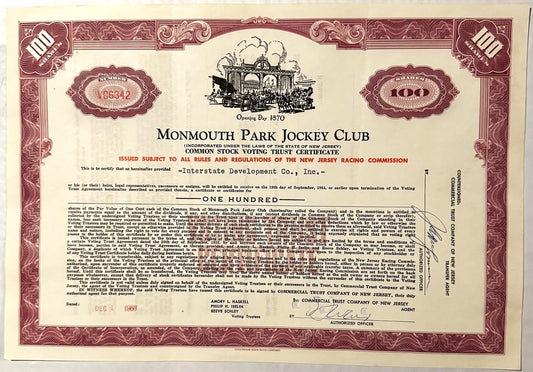
The answer is printed right on the face of this certificate. Racing came back to the Shore in 1946, after a 53-year hiatus, and the two men who led the comeback, Amory L. Haskell and Philip H. Iselin, are among the five voting trustees named on it. Yes, that Haskell - the man Monmouth's big summer race is named for. If you've ever stood at the rail at Monmouth on a July afternoon, that's the reason to own one. I love that it isn't something made about the comeback after the fact; it's the Monmouth Park Jockey Club's own paper from its very first decade. Hang it over the bar, in the den or at the Shore house, and every horseplayer who walks past will stop to read the names.

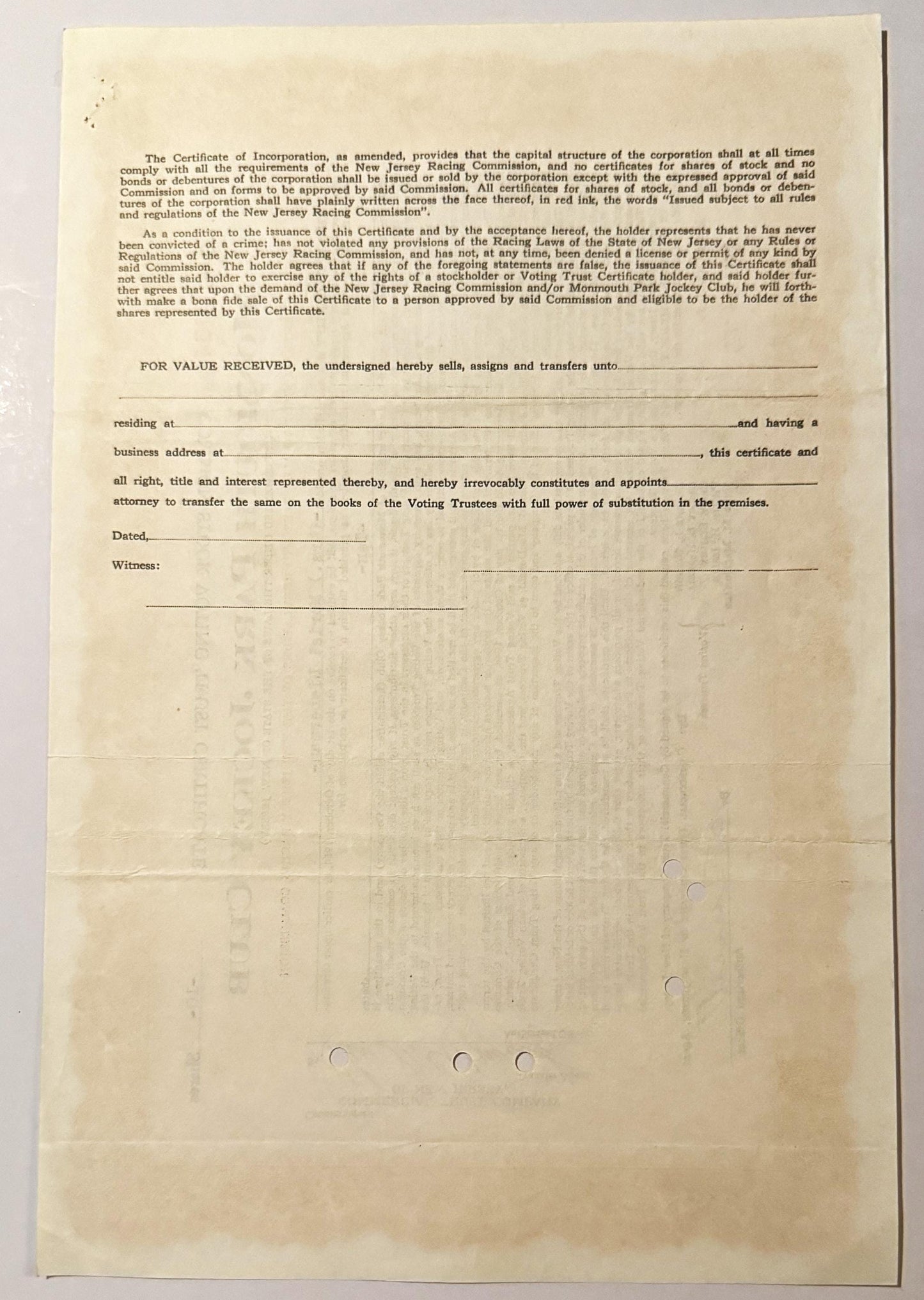
A real, issued COMMON STOCK VOTING TRUST CERTIFICATE of the MONMOUTH PARK JOCKEY CLUB, INCORPORATED UNDER THE LAWS OF THE STATE OF NEW JERSEY, in an orange border, printed by HAMILTON BANK NOTE, NEW YORK. It's ISSUED SUBJECT TO ALL RULES AND REGULATIONS OF THE NEW JERSEY RACING COMMISSION, dated at Jersey City, and the printed voting trustees are EUGENE L. NORTON, AMORY L. HASKELL, REEVE SCHLEY, PHILIP H. ISELIN and JOHN M. MacDONALD, with the Commercial Trust Company of New Jersey as agent. The text refers to a Voting Trust Agreement of October 1, 1944, running to October 1, 1954. Each one was typed in, signed and punch-cancelled, with the terms printed on the back.

The shares behind it are spelled out as "of the Par Value of One Cent each of the Common Stock," and that red line about the Racing Commission isn't decoration. Flip it over and the back spells it out: the club's charter said every share certificate had to have those words written across the face in red ink, and no stock could be sold at all without the Commission's say-so. Then comes my favorite part. By taking the certificate, the holder swore he had never been convicted of a crime, never broken New Jersey's racing laws, and never been turned down for a license by the Commission, and he agreed that if the Commission or the club ever demanded it, he'd sell to somebody they approved. That's how seriously they took keeping racing clean when it came back to New Jersey.

🏇 A track that came back from the dead

Horse racing at Monmouth goes back to 1870, when the first Monmouth Park opened near Long Branch on the Jersey Shore and drew the summer crowd from New York and Philadelphia, back when a seaside race meeting was the height of the social season, in the golden years of American Thoroughbred racing after the Civil War. Then New Jersey outlawed betting in the anti-gambling politics of the 1890s, and in 1893 the racing stopped. For more than fifty years there was no Monmouth Park at all, until New Jersey voters approved pari-mutuel betting in 1939. When the founders brought it back they reached for the old name on purpose, so a certificate from the postwar club is a link in a chain that runs back to the 1870s, carrying seventy-odd years of Jersey Shore racing lore on one orange-bordered sheet.

That first track opened on July 30, 1870, and folks called it the "Newmarket of America" after the famous English racing town. It struggled at first, and in 1878 a group of wealthy sportsmen, David D. Withers, George L. Lorillard, James Gordon Bennett Jr. and George P. Wetmore, bought it, fixed it up and reopened it in 1882. A brand new track went up right beside the old one in 1890, but the betting ban was already coming. It became law in 1894, and that May the township seized the grandstand for back taxes and sold it at auction on May 7. The vote that finally brought racing back was a special election on June 20, 1939.

In 1944 a group of investors headed by Amory L. Haskell and Philip H. Iselin formed the Monmouth Park Jockey Club to bring it back, with Reeve Schley, John MacDonald, Joseph M. Roebling, Townsend B. Martin and James Cox Brady among them, and the new track in Oceanport opened on June 19, 1946, after a 53-year gap - nearly nineteen thousand fans poured in that first afternoon, and the grandstands, barns and track were paid for by selling stock to the people who believed in it. Haskell had done a big share of the lobbying to make betting legal again, and Iselin chaired the construction committee that built the new plant. Four of the five trustees printed on this certificate are that founding group, and the October 1, 1944 trust agreement is the year the club was formed - so this paper comes from the club's first decade. The fifth trustee, Eugene L. Norton, was right there with them: when the Daily Racing Form reported in June 1951 that the club's whole sixteen-man board had been re-elected for another year at Oceanport, all five trustees on this certificate were on it.

🏆 The Haskell

Amory Haskell's name lives on in the Haskell, Monmouth's biggest race of the summer, which regularly brings Kentucky Derby winners to the Shore every July. War Emblem won it in 2002, the same year he took the Kentucky Derby and the Preakness. Philip Iselin got a stakes race of his own on the Monmouth calendar and went on to run the New York Jets. A voting trust like this one kept the voting control of the new club in the hands of the founders while the shareholders put up the money, which is why their names are printed right on the face. The certificate says it in plain words: "no voting right passes to the holder of this certificate."

Haskell was born in Manhattan in November 1893. His father, Jonathan Amory Haskell, was a vice president of both General Motors and du Pont and ran du Pont's smokeless powder division, so the papers called him the "powder magnate." Amory was the first and only president the Jockey Club had in his lifetime, and he died on April 12, 1966, at 72. In 1968 the track named a race for him, and today the Haskell is a Grade I race at a mile and an eighth. American Pharoah won it in 2015, his first start after winning the Triple Crown.

Iselin was a Port Washington, New York boy, born September 1, 1902, who made his money as a New York women's apparel manufacturer. He was the club's treasurer from the start, took over as president in 1968, and he sat on the board that bought the New York Titans in 1963 and renamed them the Jets. He became the Jets' president in 1968, the year of their Super Bowl III season, and he was still running the team when he died in December 1976.

🌊 Monmouth today

Monmouth Park is still running at Oceanport and still pulls the summer crowd down the Garden State Parkway. The Jockey Club these men built ran the track for some forty years, until the New Jersey Sports and Exposition Authority bought it from the club in 1985-86 - and the state still keeps the old corporate name, Monmouth Park Jockey Club, the same name printed across the top of this certificate. This certificate is from the years right after it came back.

🐎 About these

The one you get will carry its own number, owner, share count and typed date, and may look a little different from the one in my pictures. Frame one for a horseplayer, a Jersey Shore house or anybody who's spent a summer afternoon at Monmouth. The supply is finite - the 1944 voting trust ended long ago, nobody's issuing these again, and once these last ones are framed, they'll be very difficult to acquire.

What you get: one of these voting trust certificates, like the ones pictured, about 12" x 8", little to no storage wear. Date: 1940s-1950s - the voting trust printed on it ran from October 1, 1944 to October 1, 1954. Printer: HAMILTON BANK NOTE, NEW YORK, on the bottom margin. Front and back are both in the pictures, so you can read every line for yourself.

📜 Every one of these certificates had a working life, and it can show. Depending on the sheet, you may find staples or staple holes, cancellation punch holes (often right through the signatures), hand stamps from banks, brokers and transfer agents, real federal or state stock transfer tax stamps, handwriting or a filled-in transfer on the back, papers still attached, seals (a corporate seal pressed into the paper, a foil wafer seal, or a bank's signature-guarantee stamp signed across an endorsement), or a silver strip pasted over an officer's signature with the new officer's signature printed on top. That last one is what collectors call silvering: when the officers changed, the new signature could be pasted right over the old one on certificates already printed. None of that is damage. Each mark is part of the paper's own history, and they vary sheet to sheet, so no two are quite alike.

So that's the piece: the club's own paper, the Haskell name right on its face, and the story of the summer the horses came home to the Jersey Shore, all in one frame. Any questions, just ask - I'm happy to help.

Shipping

🚚 Shipping & Handling

  • Shipping costs and timing are calculated at checkout.
  • Items curated and shipped directly by me include U.S. shipping at no additional cost, professionally packed to ensure safe arrival of your artifact.

Items from Vetted Pro Collectors
Shipping for items offered by vetted Pro Collectors is determined at checkout. All Pro Collector listings are reviewed to ensure fair, reasonable shipping practices.

For full details, please refer to our Shipping Policy.

Returns & Exchange

Take your time — you've got a full six months. If a piece isn't right for you, send it back the way it reached you and we're good.

In the first 30 days your money goes straight back the way you paid. After that it's store credit, so you can put it toward something you'd rather have.

Return shipping we sort out between us, case by case. I don't make this difficult.

If something arrives damaged, or it isn't what I said it was, send me a photo within 48 hours and I'll make it right.

Email info@vintageantiquesgifts.com or call 802-356-9872 — that's me answering, not a call center.

The only things I can't take back are custom or special-order pieces and gift cards.

View full details

Rescuing American History Since 2007

— Travis & the Kids