Skip to product information
1 of 6

Vintage and Antique Gifts

Vintage 1980s San Juan Racing Stock Certificate Coca Cola of New York 1978 Takeover Bid El Comandante Puerto Rico 📜

Vintage 1980s San Juan Racing Stock Certificate Coca Cola of New York 1978 Takeover Bid El Comandante Puerto Rico 📜

Regular price 8.00 USD
Regular price Sale price 8.00 USD
Sale Sold out
Shipping calculated at checkout.
Quantity

🐎 What does a Caribbean racetrack have to do with the birth of New York disco radio?

It sounds like a trivia question with no real answer — until you hold a piece of paper like this one. Long before "Disco 92" ever hit the New York airwaves, and long before a horse named Waiter ever thundered down a dusty Puerto Rican track and set off a racing mania across the island, a company called San Juan Racing Association, Inc. was quietly building one of the more unusual little empires in mid-century American business: a thoroughbred racetrack monopoly in Puerto Rico that also, almost improbably, owned a stable of U.S. mainland radio stations. This certificate is a genuine surviving share of that company, and the engraving on its face — a classical reclining figure holding a sundial while a jockey drives a numbered racehorse past in the background — was commissioned to make sure investors understood that this was no small-time operation.

This is a common stock certificate issued by San Juan Racing Association, Inc., a corporation organized under the laws of the Commonwealth of Puerto Rico, engraved and printed by the Security-Columbian Banknote Company of New York, N.Y. Certificates of this series carry a printed issue date in 1982, near the end of the company's public life.

Each measures 12 x 8 inches, printed in blue and black intaglio banknote-style engraving on cream/tan stock. Across the top, twin panels announce the share denomination in bold lettering framed by dense blue guilloche work — the wave-upon-wave geometric engraving that banknote printers relied on precisely because it was so difficult to hand-forge.

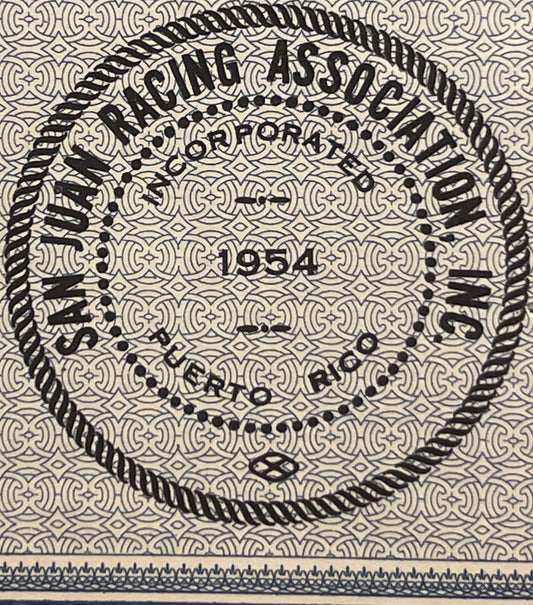
Lower left carries an embossed corporate seal bearing the company name and the year 1954 worked into its border. Lower right is the showpiece: a bare-chested, classically draped male figure reclining against a pedestal, one arm resting easy, the other cradling a sundial disc tilted toward the light, with a jockey in racing silks driving a horse numbered "7" past in tight crosshatched engraving behind him, and a stylized Art Deco numeral motif with a hint of palm trees anchoring the corner.

Two officer signature lines run beneath the certifying text, and the document names The Chase Manhattan Bank as registrar and the Registrar and Transfer Company of Jersey City, N.J., as transfer agent.

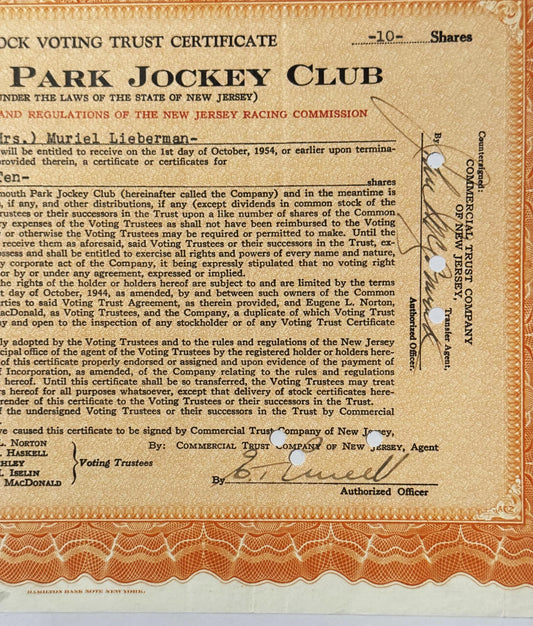
This kind of certificate can collect a paper trail the way any real financial document does: things like hole punches or cut cancellations, staple holes, stamped endorsements from a registrar or transfer agent, revenue stamps, and pencil notations left by a clerk. It is history on the page, not a condition problem, the kind of detail that separates a real financial artifact from a print.


🏇 The company: a racetrack monopoly that also ran the radio

San Juan Racing Association was, at its core, the company that owned Puerto Rico's only thoroughbred racetrack — a genuine legal monopoly on the sport in the commonwealth. But it diversified in a way that still surprises people who dig into it: alongside the racetrack, SJRA held real broadcasting interests on the U.S. mainland, including radio stations such as WKTU in New York, WYSP in Philadelphia, WJMD in Washington, WQAL in Cleveland, WKLS in Atlanta, and KRLY in Houston. In Philadelphia radio history, "SJR" is remembered as shorthand for "San Juan Racing" — the parent company behind the call-letter change that created WYSP.

The New York station's story is the one people still tell today. In the mid-1970s, the San Juan Racing Association's FM outlet at 92.3 in New York flipped from a soft-rock format to become "Mellow 92," then in 1978 abruptly switched over to a disco-based top-40 sound as "Disco 92" — and within months, WKTU was the number-one station in New York City, riding the same wave that filled dance floors across the country. It's a strange and wonderful footnote: a company best known in Puerto Rico for horses and a betting window helped light up one of the most famous radio call signs of the disco era.

The company's reach went further still. According to the obituary of its founding president, San Juan Racing Association also held interests in Madison Square Garden, Roosevelt Raceway, and Shenandoah Downs — a genuine cross-industry sporting and entertainment portfolio built out of a single Caribbean racetrack license. Financial reporting from the late 1970s described the company as cash-rich, drawing meaningful interest income on its investments even in years when the track itself faced operating headwinds.


🌴 The track: El Comandante and the horse that started a mania

Puerto Rico racing history holds that a horse named Waiter — the island's first Triple Crown winner — set off such enthusiasm for the sport that the existing small courses simply couldn't handle the crowds anymore, and El Comandante Race Track was born out of that demand. The original El Comandante operated in Carolina, just outside San Juan, from 1957 until it was replaced in 1976 by a new facility built at Canóvanas, which opened its gates on Halloween of that year. That newer track went by "El Nuevo Comandante" for its first three decades and is known today as Hipódromo Camarero — still the only thoroughbred track on the island, a roughly one-mile course a short drive east of San Juan proper.

The company's founding president, Hyman N. Glickstein, is on record as having helped found San Juan Racing Association in the 1950s and led it as president and board chairman for nearly 35 years, only stepping back when the racing operation was ultimately sold off. That sale, and the broader winding-down of the company's assets, took place across the 1980s — which places a certificate dated 1982 right at the tail end of the enterprise's public existence, issued as the company was already moving toward the exit.


🖋️ The engraver: Security-Columbian Banknote Company

The firm named on this certificate was a serious player in American financial printing, not a minor jobbing shop. The Columbian Bank Note Company traced back to 1904, founded by a former president of the Western Bank Note Company, and in 1957 merged with the Security Banknote Company to form Security-Columbian — for decades a genuine rival to the American Bank Note Company in the printing of stock certificates, bonds, debentures, and corporate securities. Late in its history, the firm (by then reorganized as U.S. Banknote Corporation) moved to acquire American Bank Note itself, in what stood as the largest consolidation in the American banknote-printing industry in over a century. That lineage is worth knowing when you look at the density of the guilloche borders and the fine crosshatched shading in the allegorical figure here — this was engraving done by people whose entire trade depended on making a piece of paper both beautiful and nearly impossible to counterfeit.


👤 The people behind the signatures

The president's signature on certificates of this series belongs to Hyman N. Glickstein, a Manhattan-born, Columbia-educated lawyer who was active in New York City politics in his younger years before turning to business in the 1950s. He co-founded San Juan Racing Association and stayed at its helm for the better part of thirty-five years, guiding it through the racetrack's growth, the radio acquisitions, and finally its 1980s sale. The secretary's signature belongs to Robert A. Phelps, named on the certificate itself as the company's corporate secretary.


🎨 Reading the artwork

It's easy to look at the sundial-holding figure and the racing scene behind him and see exactly what the engraver intended: an allegory of time itself standing beside the raw motion of a horse race, as though the whole business of racing came down to that one tension — the clock against the finish line. The stylized numeral motif tucked into the corner alongside a hint of palm trees reads, at least to my eye, like a small wink toward luck and the tropical home of the track itself, though that's my own read on it rather than anything documented. What is certain is the craft: this was Art Deco commercial engraving at a genuinely high level, applied to a document whose only real audience was meant to be a broker's file drawer.


📻 Impact today

El Comandante's successor track, Hipódromo Camarero, still runs thoroughbred racing in Canóvanas today, carrying forward the sport that this company built its name on. WKTU, born under this company's ownership, remains a recognizable New York call sign decades after its disco-era heyday. And Security-Columbian's engraving lineage lives on in the broader history of American banknote and security printing that it helped shape through its later mergers. For collectors, a certificate like this one sits at a genuinely rare crossroads — Puerto Rican sporting history, American radio history, and the vanishing art of hand-engraved financial paper, all on one sheet.


🖼️ Display Ideas

  • 🖼️ Frame it alongside other horse-racing memorabilia for a den or home bar with a sporting theme
  • 🌴 Pair it with vintage Puerto Rico or Caribbean travel ephemera for a tropical-history vignette
  • 📻 Group it with old radio or broadcasting memorabilia to tell the WKTU/disco-era story visually
  • 💼 Mat and frame it as a conversation piece for a home office or finance-themed collection
  • 🏛️ Set it beside other Art Deco engraved ephemera to spotlight the allegorical figure and guilloche work
  • 🎁 Give it as a gift to a horse racing fan, a radio history buff, or a scripophily collector

🎁 Who Collects These

Scripophily collectors — people who collect old stock and bond certificates for their artwork and history rather than any financial value — are the natural audience here, and this one offers an unusually rich story for the category: a Puerto Rico racetrack monopoly, a piece of New York radio history, and a well-documented engraving house all on a single sheet. Horse racing enthusiasts and Puerto Rico history buffs will find plenty to love in the El Comandante connection, while fans of classic American radio will appreciate the tie to WKTU's disco-era rise. Collectors of Art Deco commercial engraving and banknote-style printing will find the allegorical sundial figure and guilloche borderwork a strong example of the genre.


❓ FAQ

Is this a real, genuine stock certificate?
Yes — it's a certificate for common stock of San Juan Racing Association, Inc., engraved and printed by the Security-Columbian Banknote Company.

What company is this stock from, and what did it do?
San Juan Racing Association, Inc. was a Puerto Rico corporation best known as the parent company of the El Comandante racetrack, and it also held U.S. radio broadcasting interests, including the station that became New York's WKTU.

How old is this certificate?
Certificates in this series carry a printed issue date in 1982.

What does the 1954 date on the seal mean?
That year appears in the border of the embossed corporate seal, marking an early charter/incorporation reference for the company — it is not the date this certificate itself was printed or issued, which is 1982.

Who printed and engraved it?
The Security-Columbian Banknote Company of New York, N.Y., a firm formed from the 1957 merger of the Security Banknote Company and the Columbian Bank Note Company, historically a major competitor to the American Bank Note Company.

What does the artwork on the certificate show?
A reclining classical male figure holding a sundial, with a jockey riding a numbered racehorse in the background, alongside a stylized Art Deco numeral motif and a hint of palm trees, framed by blue guilloche borderwork.

Does the racetrack this company owned still exist?
Yes — its successor, Hipódromo Camarero in Canóvanas, Puerto Rico, still operates as the island's thoroughbred racetrack today.

Shipping

🚚 Shipping & Handling

  • Shipping costs and timing are calculated at checkout.
  • Items curated and shipped directly by me include U.S. shipping at no additional cost, professionally packed to ensure safe arrival of your artifact.

Items from Vetted Pro Collectors
Shipping for items offered by vetted Pro Collectors is determined at checkout. All Pro Collector listings are reviewed to ensure fair, reasonable shipping practices.

For full details, please refer to our Shipping Policy.

Returns & Exchange

Take your time — you've got a full six months. If a piece isn't right for you, send it back the way it reached you and we're good.

In the first 30 days your money goes straight back the way you paid. After that it's store credit, so you can put it toward something you'd rather have.

Return shipping we sort out between us, case by case. I don't make this difficult.

If something arrives damaged, or it isn't what I said it was, send me a photo within 48 hours and I'll make it right.

Email info@vintageantiquesgifts.com or call 802-356-9872 — that's me answering, not a call center.

The only things I can't take back are custom or special-order pieces and gift cards.

View full details