
Skip to product information
1 of 4

Vintage and Antique Gifts

๐Ÿ‡ Vintage San Juan Racing Association Stock Certificate 1960s Coca-Cola Horse Racing Puerto Rico El Comandante Scripophily

๐Ÿ‡ Vintage San Juan Racing Association Stock Certificate 1960s Coca-Cola Horse Racing Puerto Rico El Comandante Scripophily

Regular price 12.00 USD
Regular price Sale price 12.00 USD
Sale Sold out
Shipping calculated at checkout.

Description

๐Ÿ‡ The Most Improbable Empire in American Sports History

There is a story hiding inside this stock certificate that most people will never hear โ€” and it begins not in a boardroom on Wall Street, not in a glass tower in Midtown Manhattan, but at a racetrack on a Caribbean island, on an afternoon when a horse named Waiter ran circles around everything Puerto Rico thought it knew about speed.

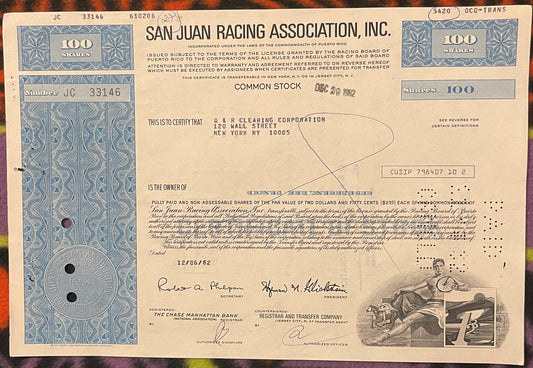
This is a genuine vintage common stock certificate of San Juan Racing Association, Inc. โ€” a company incorporated under the laws of the Commonwealth of Puerto Rico in 1954, authorized for two million shares of common stock, and destined to become one of the most quietly extraordinary corporate stories of the twentieth century. What started as a racing operation on a tropical island ended, a quarter-century later, with a $66 million acquisition offer from a subsidiary of one of the most recognizable brands in the history of American commerce โ€” while simultaneously owning the second-most-listened-to radio station in New York City during the absolute peak of the disco era.

The paper you are looking at is your share of that story.

๐ŸŽ A Horse Named Waiter and the Birth of El Comandante

The San Juan Racing Association was brought into being by a very simple and very powerful force: an island of racing fans who could not get enough of their sport. Puerto Rico's love for thoroughbred horse racing predated the Association itself by decades, and the horse that drove it to a fever pitch was a Puerto Rican Triple Crown winner named Waiter.

By the time Waiter was four years old, his reputation had spread to every corner of the island. Thousands of spectators rushed to every race he ran, packing the small courses beyond their capacity, pressed against fences, climbing anything they could find for a view of the track. Fans were turned away at the gates. The existing racecourses were simply too small, too modest, too limited for the crowds that Waiter and Puerto Rico's passion for racing had created. The need for something larger โ€” something worthy of the island's racing culture โ€” became impossible to ignore.

San Juan Racing Association answered that need. The company was incorporated in 1954 with the purpose of giving Puerto Rican horse racing a home worthy of the sport. After years of operation, the company built the crown jewel of its assets: the New El Comandante Race Track in Canovanas, Puerto Rico. Completed in 1977, El Comandante was not simply a replacement for what came before โ€” it was the only thoroughbred racetrack in Puerto Rico, operating under an exclusive franchise for off-track betting throughout the commonwealth. El Comandante was quite literally the only game on the island for anyone who loved the sport.

๐Ÿ“ป From the Track to the Airwaves โ€” How a Puerto Rican Horse Track Built a Radio Empire

This is where the story takes its most extraordinary turn. The same company that built and operated Puerto Rico's only racetrack also, quietly and systematically, assembled one of the most remarkable radio station portfolios in American broadcasting history.

Through its broadcasting operations, San Juan Racing built a group of stations spanning the major markets of the United States โ€” WKLA-FM in Atlanta, WIMI-FM in Miami, WQAL-FM in Cleveland, WYSP-FM in Philadelphia, WRLY-FM in Houston, two stations in Washington D.C., and the crown jewel of the entire operation: WJIT-AM and WKTU-FM in New York City. By 1978, this radio group had become the biggest money maker in the entire San Juan Racing portfolio, earning $2.6 million pretax. The racetrack that inspired the company's founding had become the secondary business to the broadcasting empire built around it.

And then there was WKTU.

๐Ÿ•บ WKTU โ€” The Disco Station That Became the Sound of New York

In the late 1970s, the American radio landscape was being remade by a force nobody had seen coming: disco music. The pulsing, euphoric sound that had risen from the underground clubs of New York had broken into the mainstream with a velocity that no programming director could have predicted. The station that caught that wave perfectly โ€” not just caught it, but rode it to the very top โ€” was WKTU-FM, owned by San Juan Racing Association, Inc., a Puerto Rican horse racing company.

Not even in the top ten stations in New York City just two years before, WKTU jumped to number two in the entire New York market after switching to a format of 24-hour disco music. In a city of millions, in the most competitive radio market in America, a station owned by a Caribbean racetrack company became the second most-listened-to radio station in the country's greatest media market.

That is not a footnote. That is a headline.

While horses ran at El Comandante and crowds cheered in Canovanas, the same company's signal was filling the dance floors of Manhattan, pouring out of taxicab radios in the Bronx, echoing through apartment buildings in Brooklyn, and carrying the sound of the decade across five boroughs. A Puerto Rican horse racing company owned the soundtrack of New York City's disco era.

๐Ÿฅค The Coca-Cola Offer โ€” $66 Million and the End of an Era

On December 8, 1978, the Washington Post reported a story that captured exactly how far San Juan Racing Association had traveled from its origins as a Caribbean horse track.

Larry Israel, heading the new broadcasting subsidiary of Coca-Cola of New York โ€” a regional franchise bottler of one of the most iconic brands in the history of American commerce โ€” had approached San Juan Racing with an acquisition offer. The terms were $17.50 in cash and $2.50 in short-term notes per share for the company's 3.3 million shares outstanding. Total value: $66 million.

At the time of the offer, San Juan Racing's stock was trading at approximately $14 per share. The offer represented a premium of more than forty percent over market โ€” the kind of premium a buyer pays when they recognize that what they are acquiring is worth substantially more than the market has priced it.

The company's directors confirmed their interest. They had been with San Juan Racing since shortly after the company was formed, and one director told the Washington Post the larger shareholders "are not getting any younger and would just as soon be in a more liquid position." The prior year, San Juan Racing had reported earnings of $1.8 million on revenues of $38.3 million โ€” a genuine operating business with real assets, real earnings, and real history behind every dollar.

โš–๏ธ Drama at the Track โ€” The Jockeys' Strike of 1978

The story of San Juan Racing is not purely a tale of boardrooms and broadcasting deals. It is also the story of horses and the people who rode them, and the tensions that inevitably arose at a racetrack where professional athletes rode dangerous animals for wages set by others.

In January of 1978, the jockeys at El Comandante began pushing for an increase in their share of the purse under a compensation structure in place since 1974. When negotiations stalled, matters came to a head on the night of April 28, 1978 โ€” a scheduled evening of racing at which every single jockey at the track refused to ride. San Juan Racing went to court. The United States Court of Appeals for the First Circuit ultimately upheld an injunction requiring the jockeys to return to work, finding that their collective refusal constituted an illegal concerted action under antitrust law. The incident is a footnote in legal history and a chapter in racing history โ€” and it happened at the very track whose company issued this certificate.

๐Ÿ“œ The History of the Stock Certificate โ€” Four Centuries of Paper Finance

The document you are looking at is part of one of the longest traditions in the history of commerce. The first stock certificate in recorded history was issued in 1606 by the Dutch East India Company, which pioneered the concept of selling shares of corporate ownership to the public. That single innovation, now more than four hundred years old, is the direct ancestor of every certificate ever printed โ€” including the one in your hands.

For the next four centuries, the physical stock certificate was the tangible embodiment of corporate ownership. The Walt Disney Company issued one of the very last physical stock certificates from a major corporation in 2013 โ€” a final farewell to four hundred years of paper and ink. From that point forward, ownership existed only as an entry in a digital ledger, abstract and invisible, stripped of every physical quality that made the certificate a document worth keeping. What remains of the physical certificate era is finite, fixed, and irreplaceable.

๐Ÿ–จ๏ธ Built to Last โ€” The Craft of the Certificate

These certificates were not printed on ordinary paper. They were produced on heavy certificate stock โ€” denser, more archival, and more durable than virtually anything produced commercially in their era โ€” printed with security inks and engraved with fine-line patterns designed to defeat any attempt at reproduction. The Security-Columbian Bank Note Company, the printer of these certificates, was among the most technically sophisticated printing operations of its time, producing work that was as secure as currency and as precise as fine art.

More than half a century later, the paper retains its weight and substance, the colors remain vivid, and the engraving holds its precision. These documents were built to outlast the companies that issued them โ€” and they have.

โœ๏ธ The Authenticity Marks โ€” Reading the Certificate's History

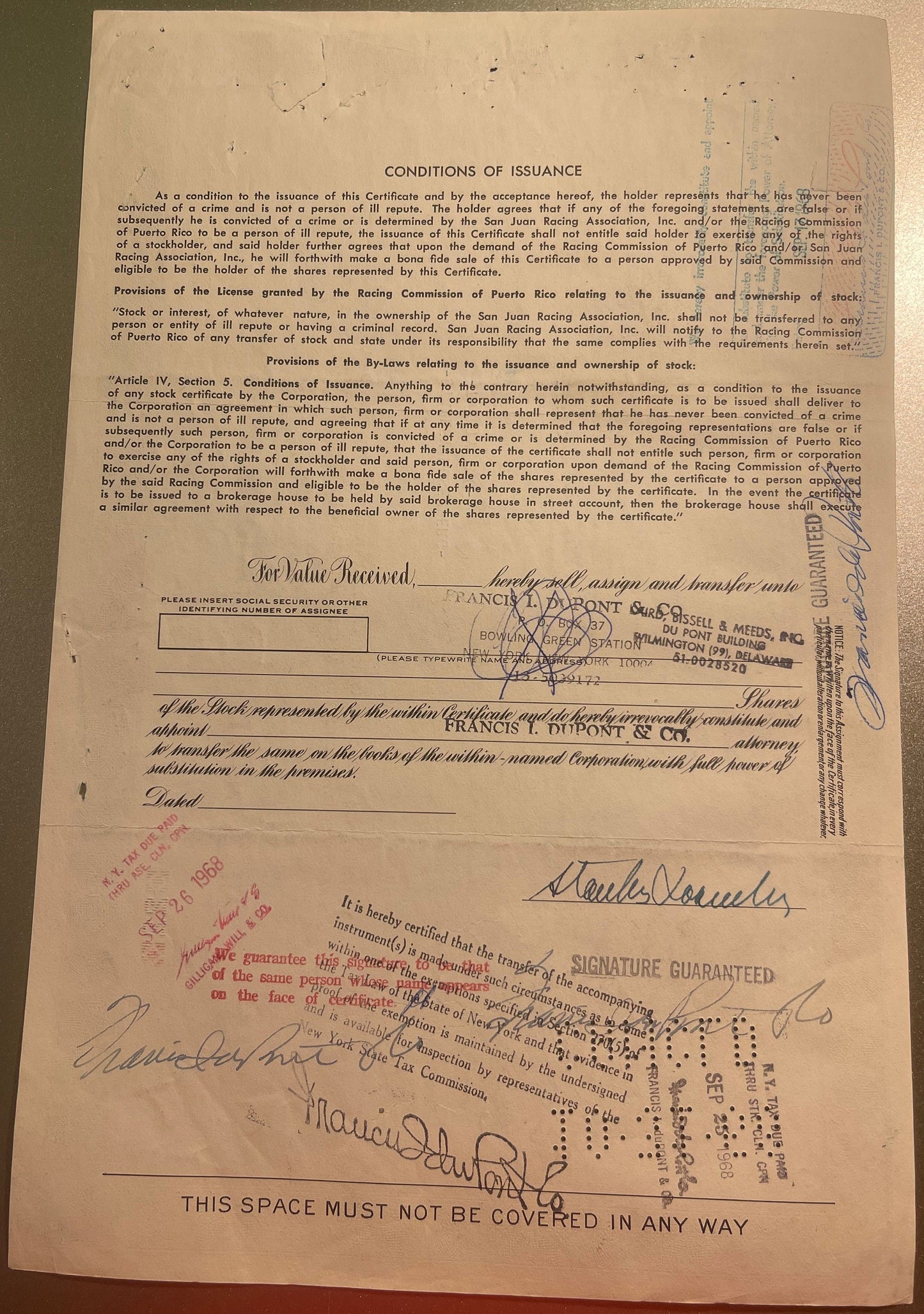
The cancellation perforations present on these certificates are the authentic fingerprints of their time in the American securities market. When shares were formally transferred or retired, they were marked through the official transfer agent process โ€” the perforation pattern being the standard mid-century method of cancellation. In scripophily, these marks are documentation, not damage. They are the physical evidence that this paper moved through the machinery of American finance โ€” processed by registrars and transfer agents whose job was to maintain the integrity of the capital markets. A cancelled certificate is a certificate that was real.

๐Ÿ” What You Are Receiving

Each certificate is an original issued common stock certificate of San Juan Racing Association, Inc., from the 1960s. Certificates are original vintage pieces and will vary in specific date of issue and other individual details โ€” consistent with the nature of a large issued stock series. Each measures approximately 12" x 8" and is printed on heavy certificate paper stock consistent with mid-century American securities production. The cancellation marks present on each certificate are authentic marks of the transfer process.

๐Ÿ–ผ๏ธ Displaying Your Certificate

A document of this size frames beautifully in a standard 12" x 14" or similar frame. Under glass, the colors hold and the engraved borders catch light in ways no printed reproduction can replicate. For a home office, a study, a sports room, a den, or a bar wall โ€” a framed San Juan Racing stock certificate is a piece of American business history, Puerto Rican sporting history, broadcasting history, and mid-century financial craft in a single displayable document.

๐Ÿ›๏ธ Why Collectors Treasure Vintage Stock Certificates

Scripophily โ€” the collecting of antique stocks, bonds, and financial documents โ€” is one of the most deeply historical fields in existence. Every document is a primary source: an original artifact from the age of paper finance, issued by a real company, transferred through real hands, processed through real markets. The supply of these documents is permanently fixed โ€” no new ones are being issued, and the pool shrinks each year as pieces enter permanent institutional collections. For the collector of scripophily, horse racing memorabilia, Coca-Cola history, broadcasting history, or twentieth-century Americana, this certificate is a crossover piece that speaks across interests. It is also simply a beautiful document โ€” worthy of framing, displaying, and passing down.

๐Ÿ›๏ธ Add a vintage San Juan Racing Association stock certificate to your collection and own a genuine piece of one of the most improbable corporate stories in twentieth-century American history โ€” the Puerto Rican horse track that owned the disco capital of New York City and attracted a $66 million offer from Coca-Cola, printed on the heavy paper stock that outlasted the era that created it.

Shipping

๐Ÿšš Shipping & Handling

  • Shipping costs and timing are calculated at checkout.
  • Items curated and shipped directly by me include U.S. shipping at no additional cost, professionally packed to ensure safe arrival of your artifact.

Items from Vetted Pro Collectors
Shipping for items offered by vetted Pro Collectors is determined at checkout. All Pro Collector listings are reviewed to ensure fair, reasonable shipping practices.

For full details, please refer to our Shipping Policy.

Returns & Exchange

Product Page Return Policy

  • 60-Day Returns โ€“ Items must be in original condition.
  • Refunds โ€“ Issued after inspection (excluding shipping costs).
  • Return Shipping โ€“ Customer is responsible unless item is damaged or incorrect.
  • Damaged/Incorrect Items โ€“ Contact us within 48 hours for a replacement or refund.
  • Easy Returns โ€“ Email info@vintageantiquesgifts.com or call 802-356-9872 to initiate a return.

For full details, visit our Refund Policy.

View full details