Skip to product information
1 of 4

Vintage and Antique Gifts

Vintage 1980s Standard Federal Bank Stock Certificate 🏦 Detroit / Troy Michigan, Common Stock Scripophily

Vintage 1980s Standard Federal Bank Stock Certificate 🏦 Detroit / Troy Michigan, Common Stock Scripophily

Regular price 9.00 USD
Regular price Sale price 9.00 USD
Sale Sold out
Shipping calculated at checkout.
Quantity

Ever Wonder What It Felt Like to Own a Piece of Your Neighborhood Bank? 🏦

There was a time when a stock certificate wasn't a line of code in a brokerage app — it was a document you could hold up to the light, feel the engraved lines rise under your thumb, and frame on a wall like a diploma. Before electronic trading swallowed up the paper trail, a share of stock arrived on heavy cream paper, wrapped in a guilloche border, watched over by an allegorical figure who'd been engraved onto currency plates and bond certificates alike. This is one of those documents — a genuine piece of Michigan banking history, printed for the exact moment a hometown savings institution stepped onto the New York Stock Exchange for the very first time.

This is an original Standard Federal Bank Common Stock certificate, issued by the Troy, Michigan-based federal savings bank as part of its historic 1987 conversion from a member-owned mutual association to a publicly traded stock company. It measures a substantial 12 x 8 inches (approximately 30.5 x 20.3 cm) — a true large-format certificate meant to be seen, not tucked in a drawer. Engraved and printed by the Security-Columbian United States Banknote Company, it's rendered in blue and black on cream stock, framed by a dense blue guilloche border of the kind reserved for currency and negotiable securities, with a $1.00 par value per common share and CUSIP 853389 10 4 identifying the issue. Certificates in this conversion series carry the printed date of January 28, 1987 — the day Standard Federal officially began trading as a public company — countersigned by the Registrar and Transfer Company of New Jersey, acting as transfer agent. This piece is offered as exactly what it is: a genuine issued certificate from the original printing, registered to a holder, countersigned by the transfer agent and cancelled when it was surrendered.


🖋️ The Engraver's Art: A Goddess of Commerce in the Lower Corner

Look closely at the lower left of the certificate and you'll find her: a seated allegorical female figure, robed in classical drapery, one hand resting on a rolled document, the other holding a pen or stylus, her gaze lifted upward with the calm confidence of an ideal rather than a person. This kind of vignette was standard practice among the great security engravers of the era — banknote companies kept stables of stock figures representing Liberty, Commerce, Industry, and Justice, and dropped them into whatever certificate needed a touch of gravity.

She's rendered in the same fine cross-hatched, stippled engraving technique used on paper currency: intaglio printing, where the plate is cut in reverse and the ink is forced up out of recessed lines under enormous pressure, giving the finished print its characteristic raised, tactile quality. Alongside her sits the bank's own embossed corporate seal, reading STANDARD FEDERAL BANK TROY MICHIGAN — a blind-stamped detail that was a bank's own guarantee stamped directly into the paper fiber.

Security printers like Security-Columbian United States Banknote Company built their reputations on exactly this kind of ornamental engraving — geometric guilloche borders too intricate to hand-copy, allegorical vignettes too detailed to forge, and lettering cut with the precision of a die-stamp. It's the same visual language you'd find on a Series 1935 silver certificate or a 19th-century railroad bond, applied here to a distinctly late-20th-century Michigan financial institution.


🏛️ From a Detroit Basement to a Billion-Dollar Institution

Standard Federal Bank's story begins on April 25, 1893, when it was chartered as the Standard Savings and Loan Association, taking over the charter of the older Workman's Savings and Loan Association. Its very first offices sat in the basement of the old McGraw Building, at the corner of Griswold and Lafayette in downtown Detroit — a fitting beginning for an institution that, in the words of the old-timers who worked there, always thought of itself as being in the basement of the community, holding up the floors above. In those early decades it operated as a true mutual: depositors were members, not shareholders, and the institution belonged, in a real and legal sense, to the community whose savings it held.

The bank weathered the hardest test any Depression-era financial institution could face — it is remembered as one of the few Detroit fiscal institutions that avoided closure during the notorious "Bank Holiday" of 1933, when banks across the country shuttered their doors under federal order. It kept growing through the postwar boom, opening a suburban branch in 1948 and converting to a federal charter in 1950 as Standard Federal Savings and Loan.

The 1970s and early 1980s brought a wave of consolidation. Standard Federal absorbed Wayne Federal Savings in 1975, merged with First Federal Savings of Niles in 1980, and in 1981 alone added both Landmark Savings and Loan and First Savings Association of Dowagiac to its ranks. In 1982 the bank took a hard hit — a loss of $331.6 million, driven largely by a strategic sale of $1 billion in low-yielding loans as it repositioned for the future. Rather than retreat, Standard Federal doubled down, adopting a wholesale banking strategy and, in 1983, completing the largest merger in its history: four Indiana thrifts joining the fold simultaneously, planting the Standard Federal name firmly across the Michigan-Indiana border.


📈 January 28, 1987: The Day a Mutual Became a Public Company

Every certificate in this issue carries the same date for a very deliberate reason. On August 28, 1986, Standard Federal's board of directors adopted a formal Plan of Conversion, laying out the path from a member-owned mutual association to a publicly traded, shareholder-owned stock company. Five months later, on January 28, 1987, that conversion became reality, and Standard Federal shares began trading on the New York Stock Exchange for the very first time. Financial historians of the thrift industry have noted it as one of the largest stock conversions by dollar amount in the industry's history — a genuinely significant moment, not just for one Michigan bank, but for the broader story of how America's savings and loan institutions reorganized themselves in the 1980s. At the close of 1986, on the eve of this conversion, Standard Federal operated 83 offices across 16 counties in Michigan and Indiana. Every certificate bearing this date represents a shareholder's stake purchased at that historic threshold — the moment depositors' institution became investors' company.


🏙️ A Detroit Company That Grew Up in Troy

Standard Federal's headquarters made the classic postwar migration from the center city to the suburbs. As the institution grew past $1 billion in total assets, it moved its headquarters in 1973 from downtown Detroit to Big Beaver Road in Troy, Michigan — a stretch of suburban Detroit that, through the '70s and '80s, was rapidly becoming a corridor of corporate headquarters and corporate campuses, a suburban answer to the older downtown financial district. The original Detroit building the company left behind — completed in 1930 — still stands today as a recognized contributor to Detroit's Financial Historic District, listed on the National Register in 2009. Troy became Standard Federal's home for the balance of its independent existence, and it's the address stamped in the corporate seal on every certificate of this issue: not a Detroit bank anymore, but a Troy, Michigan institution with deep Detroit roots.


🤝 A Century of Trust, and the People Who Built It

Local legend among longtime Standard Federal employees held that the culture of the place was, in equal parts, a bank and something closer to a neighborhood institution — a place where lifelong tellers knew customers' names and family histories, carried over from the days when a "share" in the association wasn't a stock ticker but a passbook.

Collectors and Michigan banking-history buffs have long noted that Standard Federal's growth into the largest thrift in the Midwest — and, for a time, the largest bank in Michigan by branch count — traces directly back to that mutual-era culture of steady, conservative lending married to an appetite for careful, well-timed acquisition.

By its hundredth year, in 1993, the institution had grown to roughly $10 billion in assets, the seventh-largest thrift in the country, with over 150 banking centers and 200 ATMs stretching across southern Michigan, northern Indiana, and northwestern Ohio — its bread-and-butter business remaining exactly what it had always been: single-family home mortgage lending, closing billions of dollars in home loans in a single year.

The bank also put real dollars behind community reinvestment, including federal financing secured in 1990 to help fund affordable-housing projects in South Bend, Indiana, and Detroit — a continuation, in spirit, of the same community-first mission the mutual association had carried since its 1893 founding.


🔗 The Impact Today: What Became of Standard Federal

Standard Federal never failed — it was absorbed, piece by corporate piece, into an ever-larger banking world. In 2001, Netherlands-based ABN AMRO merged Michigan National Bank into Standard Federal, and the combined company took on Michigan National's national bank charter, becoming Standard Federal Bank, N.A. — and, for a time, Michigan's largest bank by branch count, with more than a thousand ATMs and over $23 billion in deposits by 2005. In 2005, ABN AMRO renamed the bank LaSalle Bank Midwest, N.A. Two years later, ABN AMRO sold its LaSalle Bank Corporation, Standard Federal's parent, to Bank of America in a deal worth $21 billion. The purchase closed in October 2007, and by May 5, 2008, every remaining branch had been rebranded Bank of America — bringing the curtain down on a name that had stood in Detroit and Troy for 115 years. A certificate like this one is a direct physical link back to the exact turning point in that story: the day a hometown mutual association chose to become a public company and, in doing so, set itself on the path toward becoming a Midwest banking giant.


🖼️ Display Ideas

  • 🖼️ Framed on its own with a wide cream or navy mat to let the guilloche border and the seated allegorical figure breathe
  • 🏦 Grouped in a gallery wall alongside other Michigan financial and railroad ephemera for a themed "vintage Detroit business" corner
  • 📚 Displayed flat under glass on a desk or credenza in a home office or den, especially for collectors of finance and banking history
  • 🎓 Given as a milestone gift to a banker, financial advisor, or Michigan native marking a career or retirement
  • 🕰️ Paired with a period photograph of downtown Detroit or the old Financial District for a mini history exhibit

🎁 Who Collects These

Scripophily — the collecting of antique stock and bond certificates — draws a wide range of enthusiasts: Michigan and Detroit-area history buffs tracking the region's financial evolution; collectors of engraved security printing who prize the artistry of banknote-company vignettes and guilloche work; former Standard Federal employees, customers, or shareholders looking to reconnect with an institution that shaped their working lives; and banking-industry historians documenting the wave of 1980s thrift conversions to stock ownership. It also appeals simply to anyone drawn to beautifully engraved paper Americana — the kind of finely printed ephemera that increasingly exists nowhere else but in collections like this one.


❓ FAQ

Is this a real stock certificate, or a reproduction?

This is a genuine issued certificate from the original 1980s printing — not a reprint or facsimile.

What does the January 28, 1987 date on the certificate mean?

That date marks the day Standard Federal Bank converted from a mutual savings association to a publicly traded stock company and began trading on the New York Stock Exchange — certificates from this conversion issue carry that printed date.

Who printed this certificate?

The Security-Columbian United States Banknote Company, a security printer specializing in the engraved intaglio work used on currency, bonds, and stock certificates of the era.

What happened to Standard Federal Bank?

It grew into one of the Midwest's largest thrifts before being absorbed through mergers — first into LaSalle Bank Midwest, then acquired by Bank of America, with all branches rebranded by 2008.

What is the par value and CUSIP of this stock?

Common shares carried a $1.00 par value, and the issue is identified by CUSIP 853389 10 4.

What size is the certificate?

It measures 12 x 8 inches, a large-format certificate suited to framing and display.

Does the certificate still hold any monetary or trading value as stock?

No — Standard Federal Bank's corporate charter is no longer active following its mergers, so this certificate's value today is as a historical and collectible document rather than a negotiable security.

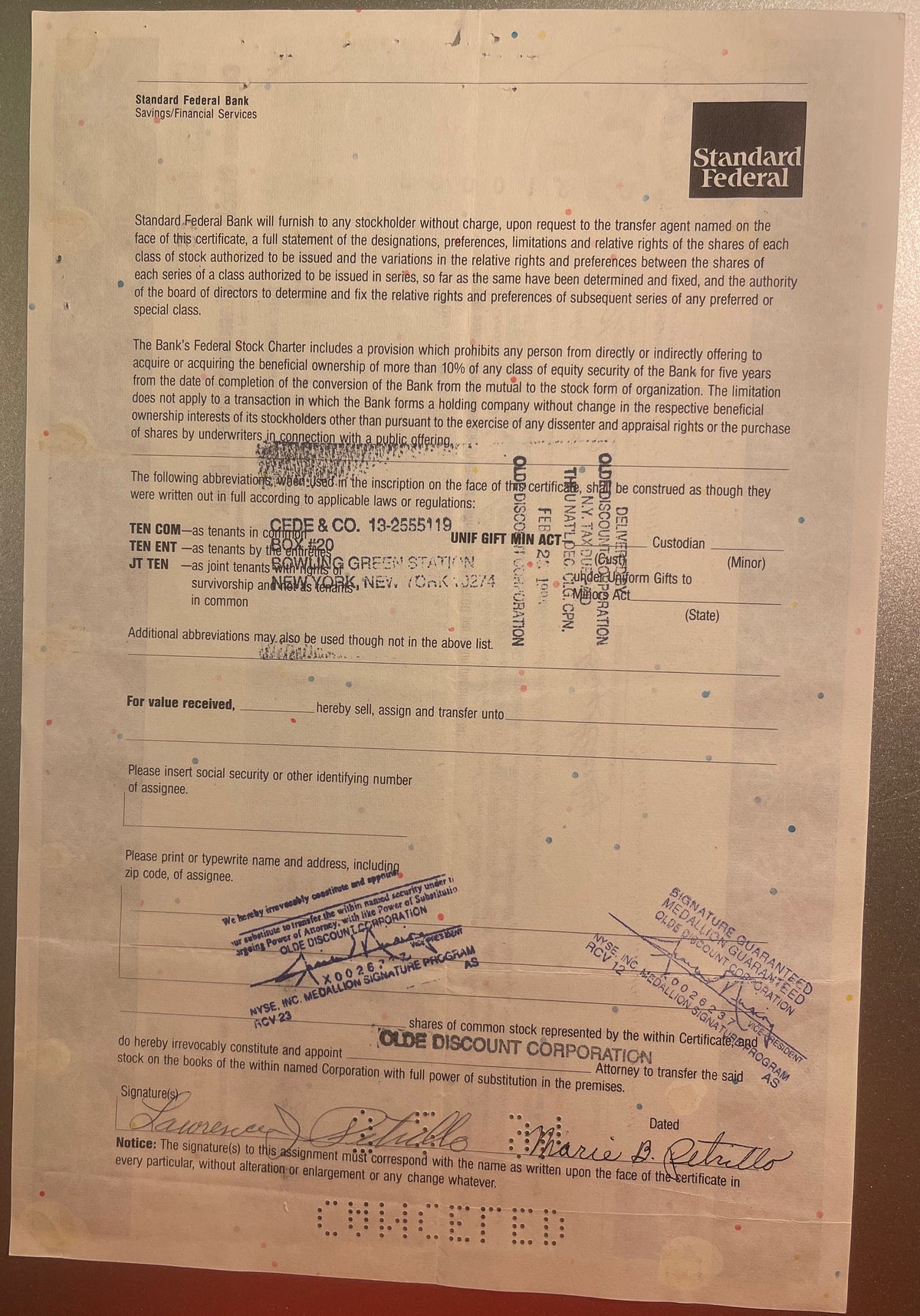
These are issued instruments rather than blanks. Certificates of this type were filled in for a holder in ink, countersigned by the transfer agent and registered by the registrar, then punch- or cut-cancelled when they were redeemed and retired. Expect financial writings, markings, stamps, hole punches and staple holes as part of the life of the instrument: endorsements and signatures, transfer-agent and registrar stamps, revenue or documentary tax stamps, cancellation punches, staple holes from being bound into a transfer book, pencil ledger notations. That is the paper trail of a security that actually did its job, and it is what separates a document that lived from a blank that never did. No two are alike: holder details, serial numbers, dates, signatures, stamps and punch patterns vary from example to example, so the photographs show the type rather than the exact sheet that ships.

Shipping

🚚 Shipping & Handling

  • Shipping costs and timing are calculated at checkout.
  • Items curated and shipped directly by me include U.S. shipping at no additional cost, professionally packed to ensure safe arrival of your artifact.

Items from Vetted Pro Collectors
Shipping for items offered by vetted Pro Collectors is determined at checkout. All Pro Collector listings are reviewed to ensure fair, reasonable shipping practices.

For full details, please refer to our Shipping Policy.

Returns & Exchange

Take your time — you've got a full six months. If a piece isn't right for you, send it back the way it reached you and we're good.

In the first 30 days your money goes straight back the way you paid. After that it's store credit, so you can put it toward something you'd rather have.

Return shipping we sort out between us, case by case. I don't make this difficult.

If something arrives damaged, or it isn't what I said it was, send me a photo within 48 hours and I'll make it right.

Email info@vintageantiquesgifts.com or call 802-356-9872 — that's me answering, not a call center.

The only things I can't take back are custom or special-order pieces and gift cards.

View full details
  • 5 stars: 1 (100%)
  • 4 stars: 0 (0%)
  • 3 stars: 0 (0%)
  • 2 stars: 0 (0%)
  • 1 star: 0 (0%)
a
a***a (391)

Hi again I received my order in great condition and appreciate your support and fast response I like the quality the value very much appearance thank you keep up the great work stay safe and healthy my friends I’ll be back 👍