Skip to product information
1 of 11

Curated Gift Sets

Antique 1910s-1920s Titanic Owner International Mercantile Marine Common and Preferred Stock Certificate 🚢 Set of 2

Antique 1910s-1920s Titanic Owner International Mercantile Marine Common and Preferred Stock Certificate 🚢 Set of 2

Regular price $22.00 USD
Regular price Sale price $22.00 USD
Sale Sold out
Shipping calculated at checkout.

Size: 12" x 8"

Quantity

🚢 Who Actually Owned the Titanic? Antique International Mercantile Marine Common and Preferred Stock Certificates, Together

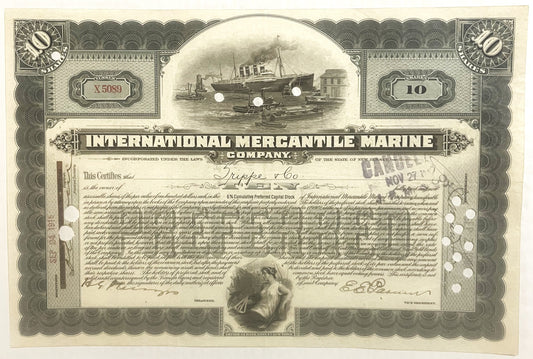
Size: Common 12" x 8", Preferred 12" x 8" ~ Each sheet was issued, registered and formally cancelled when it was retired. They vary a little one to the next.

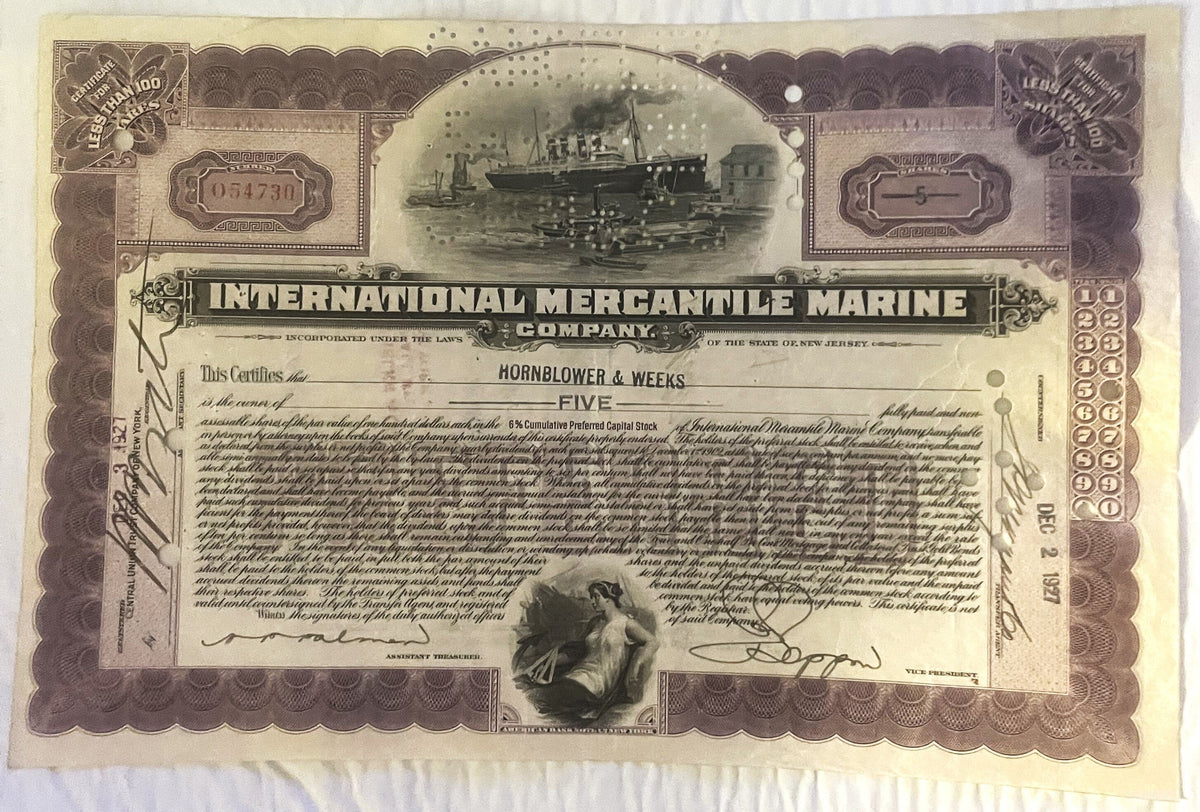
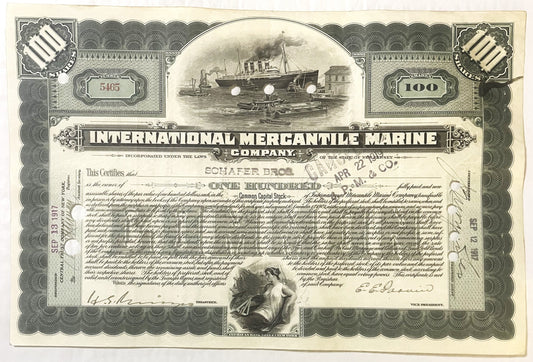
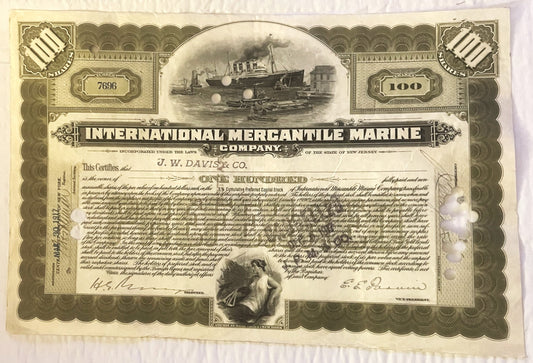
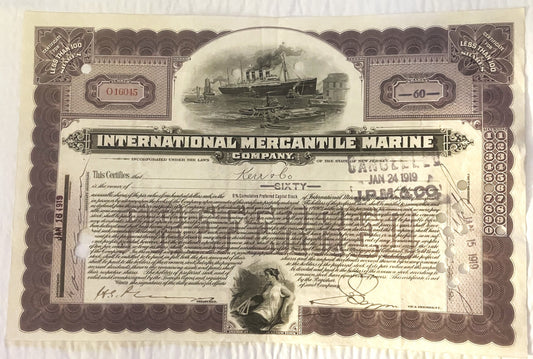
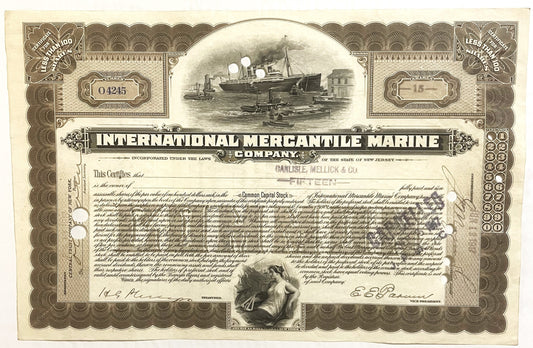
There's a particular kind of goosebump that comes from holding a stock certificate and realizing the company printed across the top owned the RMS Titanic, through its White Star Line. Few pieces make people go quiet the way these do. This set puts both classes of that ownership in front of you: the green 100-share Common Capital Stock and the plum-purple 6% Cumulative Preferred of the International Mercantile Marine Company. Two kinds of owner, one shipping trust, and one very bad night in April.

🏦 J.P. Morgan's Shipping Trust

In the spring of 1902, J. Pierpont Morgan announced in London that he was consolidating the major transatlantic steamship lines into a single combine, and bankrolling it himself. International Mercantile Marine was incorporated in New Jersey on October 1, 1902, capitalized at $120 million, with Clement Griscom, Bernard N. Baker, J. Bruce Ismay and John Ellerman as founders. In its first year it took in White Star, the American Line, the Dominion Line, the Atlantic Transport Line and the Leyland Line, added Red Star, and made working deals with the two big German lines. Newspapers called it simply "the Shipping Trust."

New Jersey was no accident. Its corporation law let one company own the stock of others, and the muckraker Lincoln Steffens was sore enough about it to call New Jersey "the traitor state" in McClure's in 1905. It suited Morgan perfectly: as an American he couldn't simply own British ships, but he could own the companies that owned them.

🛳️ White Star, and the Real Titanic Connection

White Star answered Cunard's speed queens, Lusitania and Mauretania, with scale instead of speed, a trio of ships authorized in 1908 and built at Lord Pirrie's Harland & Wolff in Belfast: Olympic, Titanic and Britannic. When Titanic went down on her first crossing the night of April 14-15, 1912, she flew the British flag and White Star's colors and was registered at Liverpool, but follow the ownership up to IMM and she was, for all practical purposes, American-owned. That ownership is what these two certificates carry.

She had left Southampton on April 10, and White Star's Pier 59 at the new Chelsea Piers on the Hudson was expecting her on the morning of the 17th. She never made it. The Carpathia brought Titanic's lifeboats in to Pier 59 instead, then went back down the river to Cunard's Pier 54 to land the survivors.

⚓ The Men Who Ran It

The story goes that J.P. Morgan himself had a private suite booked for the maiden voyage and cancelled at the last minute, staying on at Aix-les-Bains instead. He died in Rome the next spring. J. Bruce Ismay, who had been running both IMM and White Star since 1904, was aboard and survived by boarding a lifeboat, with "women and children first" hanging over his name for decades. He stepped down in 1913.

In New York, IMM vice president Philip A. S. Franklin faced the reporters and the families outside the White Star offices. "There is no danger that Titanic will sink," he told them at first. Once the truth came through he said, "I thought her unsinkable, and I based my opinion on the best expert advice. I do not understand it." That second line gets me every time. Franklin became president himself in 1916 and held the job for twenty years.

💵 Common and Preferred: What Each One Actually Bought

This is why I wanted both in one frame. The preferred promised six percent a year, cumulative, ahead of the common, on a par value of one hundred dollars a share. The common's own printed text talks about those preferred dividends, because that's who stood in front of it in line.

And how did the front of the line do? IMM defaulted on its bonds in late 1914 and went into what the financial press called a "friendly" receivership in 1915, with wartime demand for any hull that floated bringing it back by 1916. The preferred paid its six percent from 1917 through 1923, and then not again. By 1928, Time magazine reported IMM owed preferred holders about $40.5 million in unpaid back dividends. That is what "Cumulative" meant in practice for whoever held one of these.

In 1926 IMM sold White Star to Britain's Royal Mail Steam Packet Company under Lord Kylsant for a reported seven million pounds. It merged with the Roosevelt Steamship Company in 1931, took the name United States Lines in 1943, and that successor went bankrupt in 1986.

🔍 Read the Paper

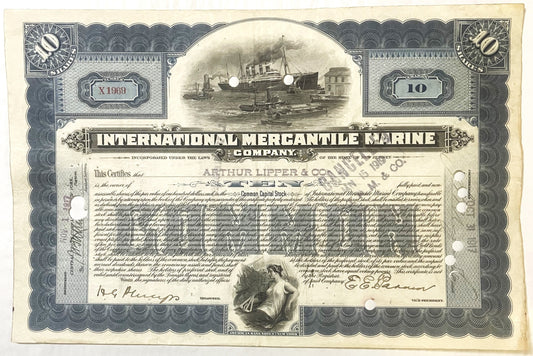
Both were engraved by the American Bank Note Company of New York, and both carry the same top scene: a four-funnel liner under heavy smoke, working past a harbor building with tugs and barges crowding the water. The certificate never names her, and that same engraving appears on an IMM stock trust certificate from December 1902, so she was on IMM's paper years before Titanic was ordered. Lower down a robed woman sits with dividers and a set-square, ship's rigging behind her. The green one has a big COMMON across the body, the purple one a big PREFERRED.

Then look for the cancellations. Across my stack you'll see plain round punch holes, a perforated pattern through the vignette, or an ink stamp reading J.P.M. & CO. That's J.P. Morgan & Co. the firm, not the man, who was gone by then. The registrar changes too, from the Central Trust Company of New York to the Central Union Trust Company, a name that bank used from 1918 to 1929, and that line runs on through Manufacturers Hanover to today's JPMorgan Chase.

🖼️ About These Two

These are antique 1910s-1920s sheets, each drawn from my stack, and each carries its own holder, registration and cancellation, so yours will differ from the ones in my pictures. There is no new press run coming. When the last of these are hanging in collections and galleries, they will be very hard to track down for sale.

Shipping

🚚 Shipping & Handling

  • Shipping costs and timing are calculated at checkout.
  • Items curated and shipped directly by me include U.S. shipping at no additional cost, professionally packed to ensure safe arrival of your artifact.

Items from Vetted Pro Collectors
Shipping for items offered by vetted Pro Collectors is determined at checkout. All Pro Collector listings are reviewed to ensure fair, reasonable shipping practices.

For full details, please refer to our Shipping Policy.

Returns & Exchange

Take your time — you've got a full six months. If a piece isn't right for you, send it back the way it reached you and we're good.

In the first 30 days your money goes straight back the way you paid. After that it's store credit, so you can put it toward something you'd rather have.

Return shipping we sort out between us, case by case. I don't make this difficult.

If something arrives damaged, or it isn't what I said it was, send me a photo within 48 hours and I'll make it right.

Email info@vintageantiquesgifts.com or call 802-356-9872 — that's me answering, not a call center.

The only things I can't take back are custom or special-order pieces and gift cards.

View full details

Preserving History: Authentic Objects Across Eras

— Curated by Travis Weigel