




Skip to product information
1 of 3

Vintage and Antique Gifts

Vintage 1990s Peak Technologies Group Stock Certificate Dot Com Crash Victim Delaware Scripophily 📜

Vintage 1990s Peak Technologies Group Stock Certificate Dot Com Crash Victim Delaware Scripophily 📜

Regular price 5.50 USD
Regular price Sale price 5.50 USD
Sale Sold out
Shipping calculated at checkout.
Quantity

What Does a Certificate Do When the Company It Represents Simply... Disappears? 📈

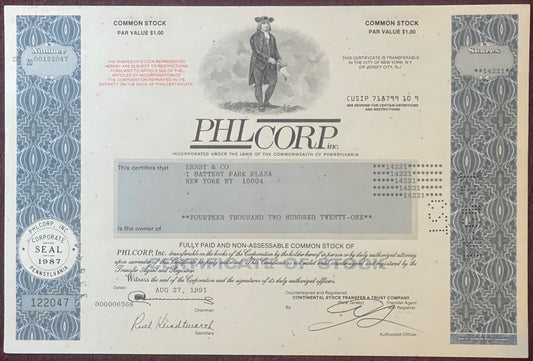
There's a particular kind of quiet electricity in holding a piece of paper that once represented real ownership in a real company — a company that rose, ran its course, and vanished into a larger corporate structure long before most people ever had reason to learn its name. This is a common stock certificate issued by The Peak Technologies Group, Inc., a Delaware corporation, printed for the company by the Banknote Corporation of America using the engraved intaglio process that America's great security printers relied on for anything meant to represent value — money, bonds, and stock. The certificate measures 12 x 8 inches, the classic oblong format used across twentieth-century American stock issues, and it's a genuinely striking example of early-1990s corporate design pressed into the old engraving traditions of Wall Street paper.

The artwork rewards a slow look. Along the top edge runs a hand-engraved band of scrollwork and acanthus leaves in deep blue, arcing gracefully across the certificate and terminating in ornate cartouche medallions at each corner — the kind of dense, lathe-and-hand engraving that security printers used precisely because it was so difficult to counterfeit.

Below that, the company's name appears in bold black lettering — THE PEAK TECHNOLOGIES GROUP, INC. — with a striking red line running through it: a jagged, cresting stroke that climbs into a sharp peak right through the letter A, an unmistakable visual pun that reads simultaneously as a mountain summit and an EKG pulse.

It's a clever, confident piece of early-1990s corporate branding, rendered here in the formal register of an engraved stock certificate rather than a marketing brochure — a combination you don't see often. A round embossed seal near the signature lines reads "SEAL 1989 DELAWARE," confirming the company's year of incorporation as a Delaware entity, and the certificate carries its own CUSIP identifier, 704683 10 1, the standardized code that let this issue be tracked through the American clearing system.

The whole composition sits on cream stock, framed in the same blue guilloche border, with black-inked legal boilerplate specifying $.01 par value common shares, countersigned by the Registrar and Transfer Company as transfer agent and registrar.

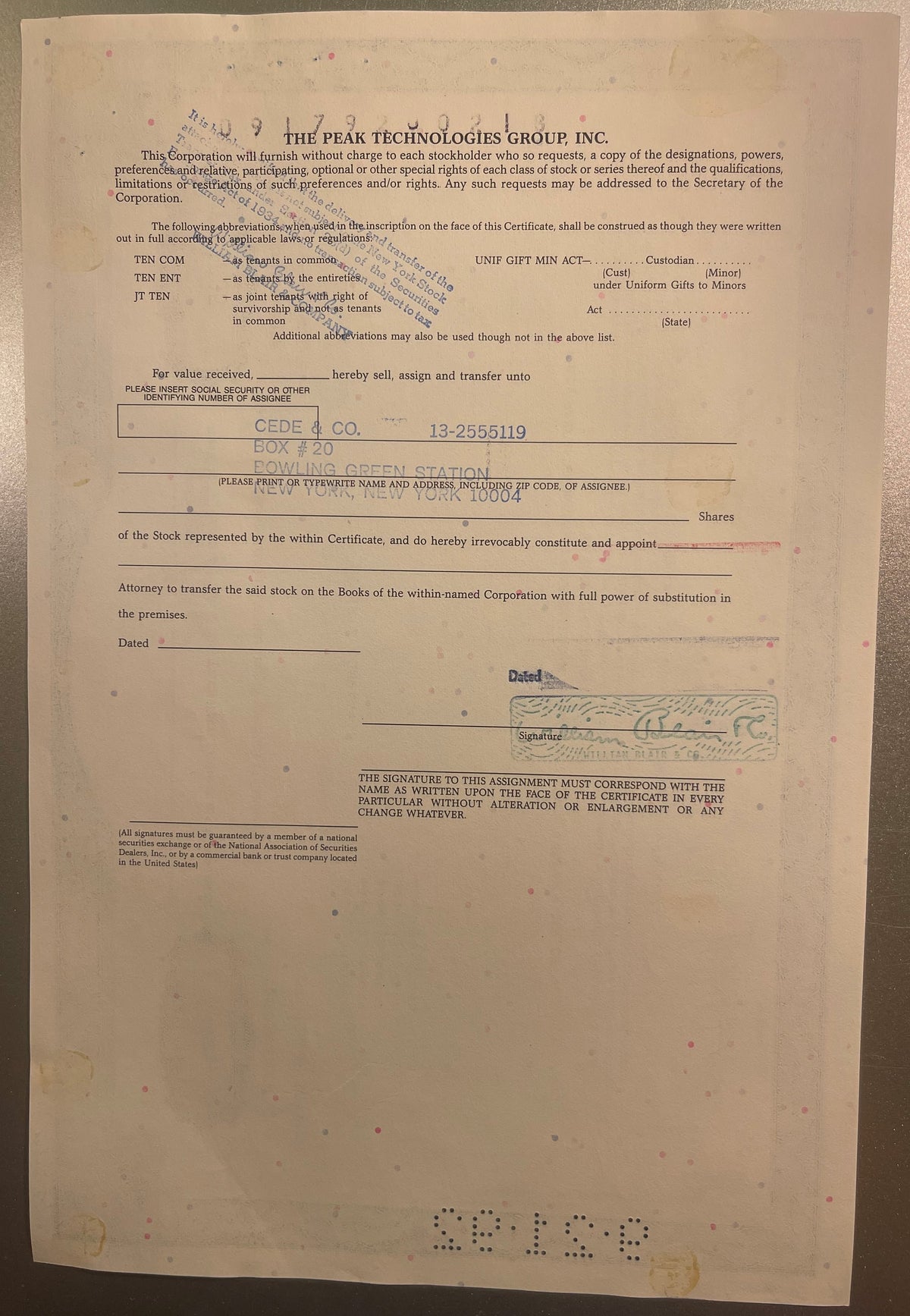
An issued or allotted certificate like this moves through registrars, transfer agents and stock books, and those stops can leave a mark: things like endorsement signatures, transfer-agent stamps, revenue stamps, cancellation punches, staple holes, or pencil ledger notes. None of that is damage — it is the certificate's own record of the hands and offices it passed through.


🏔️ The Company Behind the Peak: A Fast Rise, and an Absorption

The Peak Technologies Group was never a household name, and that's exactly what makes it interesting. As the story has been passed down among those who researched the company in its own time, Peak was built as a Delaware holding company through a strategy of acquisition — assembling smaller operating businesses under one corporate roof rather than growing organically from a single storefront or factory floor. It was, by account, a behind-the-scenes infrastructure player of the kind that rarely makes headlines but quietly supports the operational plumbing of larger industries — the sort of company whose work shows up in how goods get tracked, counted, and moved, rather than in a product on a store shelf. The company took its shares public in the summer of 1992, which lines up precisely with the printed date on certificates from this issue. For a company that had only been incorporated in Delaware a few years earlier, going public in 1992 marked its arrival as a genuine, if brief, Wall Street story.

The chapter didn't run long. As the record has been passed down, Peak Technologies was eventually absorbed into Moore Corporation — at the time one of the largest business-forms and printing conglomerates in North America — in a deal reported at roughly $210 million in 1997. That's the natural arc of so many roll-up companies from this era: built by acquisition, taken public at a moment of momentum, and eventually folded into something larger within just a handful of years. It's precisely this kind of compressed corporate lifespan that makes certificates like this one so appealing to collectors of scripophily — the hobby of collecting antique stock and bond certificates — because the paper survives long after the company's own name has faded from memory. A certificate like this becomes, in effect, the last physical proof that a company like Peak Technologies ever existed as an independent, publicly traded entity at all.


🖋️ The Craft of the Certificate: Security Printing as an American Art Form

Certificates in this issue were engraved and printed by the Banknote Corporation of America, a firm working squarely within the tradition of American security printing — the same engraving discipline used historically for currency, bonds, and negotiable instruments. Intaglio engraving, the process at work here, presses ink into recessed lines cut directly into a printing plate, producing the crisp, raised, almost three-dimensional linework you can see in the scrollwork border and the lettering of the company name. It's a slower, costlier process than ordinary lithography, and it was chosen specifically because fine engraved detail is exceptionally hard to reproduce or forge — which is exactly why stock certificates, like paper currency, carried this kind of ornamentation well into the late twentieth century, long after cheaper printing methods existed for nearly everything else. The red spot-color accent running through the logo and the deep blue of the border are printed in addition to the black engraving work, giving the certificate a layered, almost currency-like richness that plain black-and-white stock paper never had.


🏦 Registrar, Transfer Agent, and the Machinery of Stock Ownership

Every certificate in this issue was countersigned by the Registrar and Transfer Company, acting as transfer agent and registrar — the institution responsible for maintaining the official record of who owned Peak Technologies stock and processing any transfer of ownership from one holder to another. This is the quiet bureaucratic backbone behind every stock certificate ever issued: a company doesn't just print shares and hand them out, it relies on an independent registrar to keep the ledger straight, guaranteeing that the number of shares in circulation matches what the corporate charter allows and that ownership records stay accurate as certificates changed hands.

Institutional holders and brokerage firms were common names to appear in the ownership line of certificates from issues like this one — a reflection of how much early-1990s trading ran through brokerage houses acting on behalf of clients rather than individuals holding paper directly in their own names. It's a detail that grounds this certificate firmly in the mechanics of how Wall Street actually functioned in the years just before stock ownership shifted almost entirely into electronic, "dematerialized" book-entry form.


💾 Why Paper Certificates Like This One Matter Today

Somewhere in the years following this certificate's printing, the entire practice of issuing physical stock certificates began to fade. Publicly traded companies moved toward electronic, book-entry ownership recorded through clearing corporations rather than printed paper handed to shareholders. That shift means certificates like this one — engraved, sealed, signed, and countersigned in the old formal tradition — represent something that companies essentially stopped producing. Every one of these documents is a snapshot of a specific corporate moment: a Delaware charter, a CUSIP number, a par value, an officer's signature, all frozen on paper the way they never are in a modern brokerage statement. That's the appeal for collectors: this isn't a reproduction of financial history, it's an actual artifact from the machinery of how a real, once-publicly-traded American company recorded ownership of itself.


🖼️ Display Ideas

  • 🖇️ Framed alongside other 1990s scripophily pieces to build a visual timeline of a single decade's corporate design language
  • 💼 Displayed in a home office or study as a conversation-starting piece of forgotten Wall Street history
  • 📊 Paired with a modern brokerage statement to illustrate just how far stock ownership has changed in a single generation
  • 🎓 Used as a teaching piece for finance or business history students studying roll-up companies, IPOs, and corporate acquisitions
  • 🖼️ Matted with the engraved border facing outward to spotlight the intaglio scrollwork as standalone graphic art
  • 🎁 Given as a gift to anyone who collects, worked in, or has a personal connection to the printing, finance, or supply-chain industries

🎁 Who Collects These

Scripophily draws a genuinely wide range of collectors: business historians tracing the arc of American holding companies and mergers, graphic design enthusiasts drawn to the engraved lettering and logo work of a specific decade, finance professionals who appreciate a tangible artifact from the mechanics of stock ownership before everything went electronic, and gift-givers looking for something with real historical weight for someone tied to Delaware corporate law, Chicago finance, or the printing and security-document trade. It also appeals simply to anyone who likes objects with a good story attached — a company that rose, went public, and disappeared into a larger name within just a handful of years, leaving behind engraved paper as its only remaining physical trace.


❓ FAQ

  • Is this certificate still worth money as a stock? No — Peak Technologies Group was absorbed into a larger corporation, and shares from this issue no longer represent active, tradable equity. Its value today is as a historical and collectible document, not as a financial instrument.
  • What is a CUSIP number and why does it matter here? CUSIP 704683 10 1 is the unique identifier assigned to this specific stock issue, used to track it through American clearing and settlement systems during the years it traded.
  • What does "$.01 par value" mean? Par value is a nominal figure set by the corporate charter, largely a legal and accounting formality — it has no bearing on the certificate's collectible or historical value.
  • Why does the logo look like a heartbeat? The red line through the company name is a deliberate visual pun — a cresting EKG-style pulse forming a mountain peak through the letter A, tying the graphic directly to the company's name.
  • What was Banknote Corporation of America's role? They were the security printer responsible for engraving and producing this certificate, working in the same intaglio engraving tradition long used for currency and bonds.
  • What happened to The Peak Technologies Group? By historical account, the company was built through acquisition, taken public in 1992, and later absorbed into Moore Corporation in a 1997 deal — bringing its brief run as an independent public company to a close.
  • Is this a good piece for someone who isn't a finance collector? Absolutely — its engraved artwork, bold logo, and formal Wall Street presentation make it an appealing display piece on its visual merits alone, independent of any interest in corporate history.

Shipping

🚚 Shipping & Handling

  • Shipping costs and timing are calculated at checkout.
  • Items curated and shipped directly by me include U.S. shipping at no additional cost, professionally packed to ensure safe arrival of your artifact.

Items from Vetted Pro Collectors
Shipping for items offered by vetted Pro Collectors is determined at checkout. All Pro Collector listings are reviewed to ensure fair, reasonable shipping practices.

For full details, please refer to our Shipping Policy.

Returns & Exchange

Take your time — you've got a full six months. If a piece isn't right for you, send it back the way it reached you and we're good.

In the first 30 days your money goes straight back the way you paid. After that it's store credit, so you can put it toward something you'd rather have.

Return shipping we sort out between us, case by case. I don't make this difficult.

If something arrives damaged, or it isn't what I said it was, send me a photo within 48 hours and I'll make it right.

Email info@vintageantiquesgifts.com or call 802-356-9872 — that's me answering, not a call center.

The only things I can't take back are custom or special-order pieces and gift cards.

View full details
  • 5 stars: 1 (100%)
  • 4 stars: 0 (0%)
  • 3 stars: 0 (0%)
  • 2 stars: 0 (0%)
  • 1 star: 0 (0%)
L
Louis

Fantastic item, great condition, as advertised! thank you for the surprise gift, You guys are awesome!

Thank you so much for the kind words and for taking the time to leave a review! We are thrilled to hear that you are happy with your vintage stock certificate and that it arrived in great condition. It was our pleasure to include a surprise gift for you as a thank you for your support. You are awesome too! Thanks again and have a fantastic day!