Skip to product information
1 of 5

Vintage and Antique Gifts

Vintage 1960s Pan American Sulphur Stock Certificate 📜 from Delaware

Vintage 1960s Pan American Sulphur Stock Certificate 📜 from Delaware

Regular price $5.50 USD
Regular price Sale price $5.50 USD
Sale Sold out
Shipping calculated at checkout.

Size: 12" x 8"

🚚 Free US Shipping — ships within one business day. International shipping calculated at checkout.

Quantity

What Was Pan American Sulphur? 🌋 Pan American Sulphur Company, Capital Stock, Delaware, Green

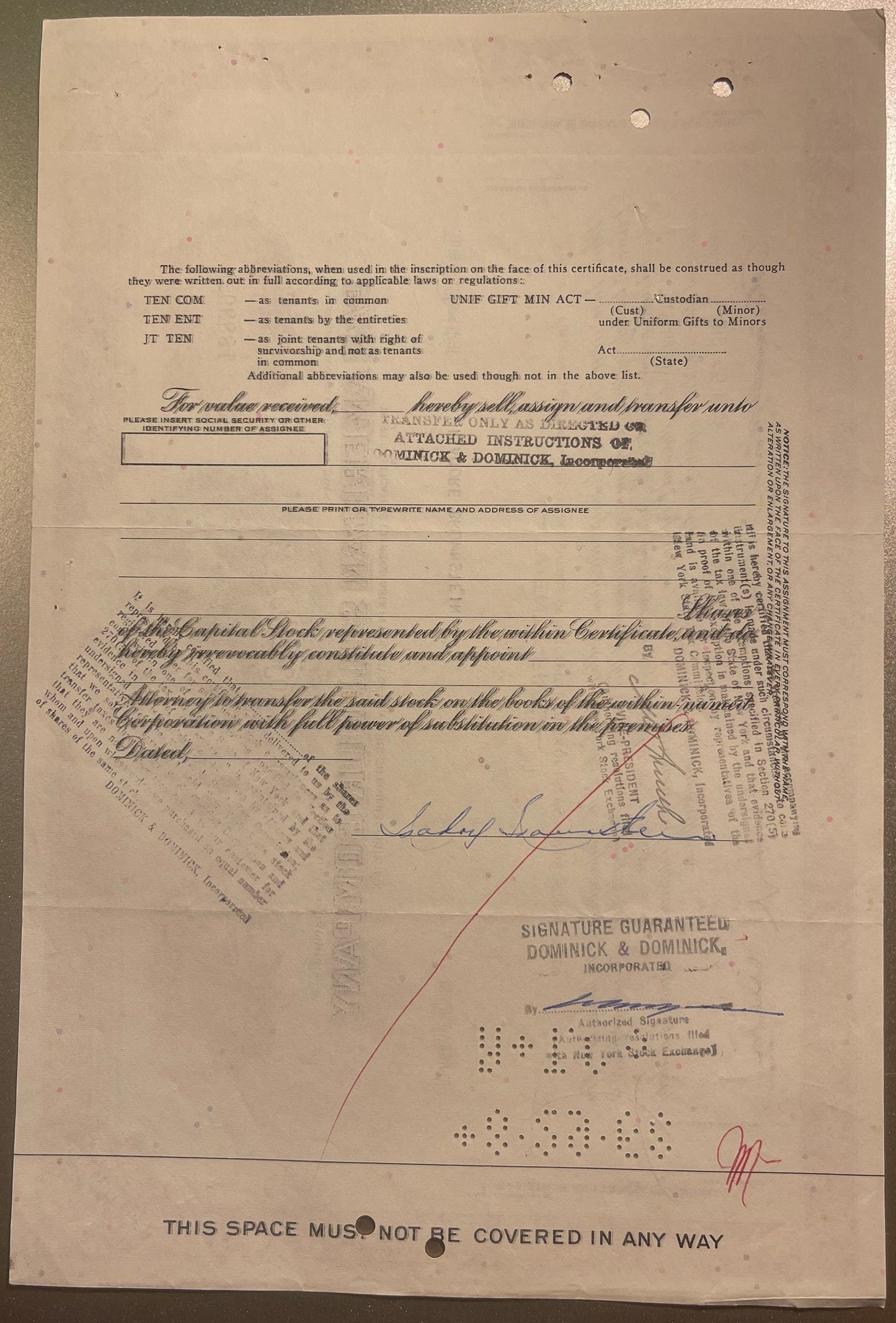
Size: 12" x 8" ~ Issued and cancelled. They vary a little one to the next.

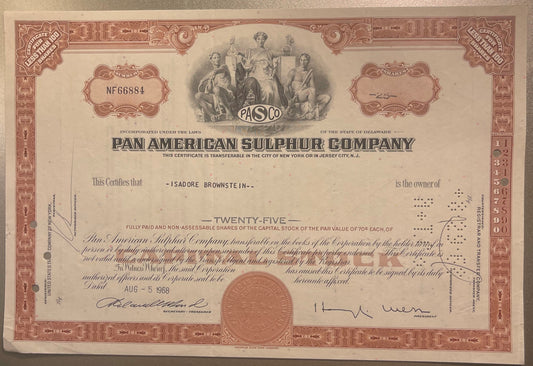
Vintage Pan American Sulphur Company Stock Certificate Delaware 1960s Green. It's engraved and printed by the American Bank Note Company, and the vignette up top is one of the best I've seen on a mining certificate: a crowned classical woman seated among laboratory flasks and retorts, flanked by two powerful seated men, one with a sledgehammer, over an oval monogram reading PASCo, the nickname the company went by.

🏷️ Every Word That Matters

  • PAN AMERICAN SULPHUR COMPANY
  • INCORPORATED UNDER THE LAWS OF THE STATE OF DELAWARE
  • CAPITAL STOCK, PAR VALUE OF 70¢ EACH, 100 SHARES in the corner panels
  • THIS CERTIFICATE IS TRANSFERABLE IN THE CITY OF NEW YORK OR IN JERSEY CITY, N.J.
  • REGISTERED: UNITED STATES TRUST COMPANY OF NEW YORK, REGISTRAR
  • The seal: PAN AMERICAN SULPHUR COMPANY, CORPORATE, SEAL, 1947, DELAWARE
  • The facsimile signature of the SECRETARY-TREASURER
  • AMERICAN BANK NOTE COMPANY, the printer

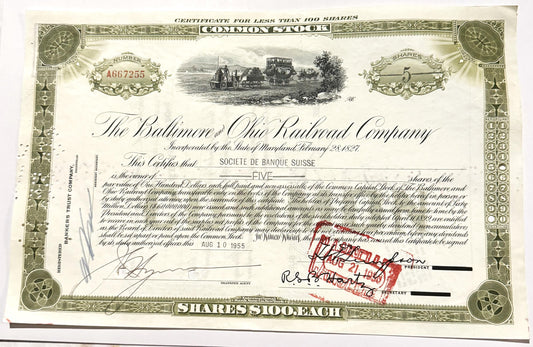
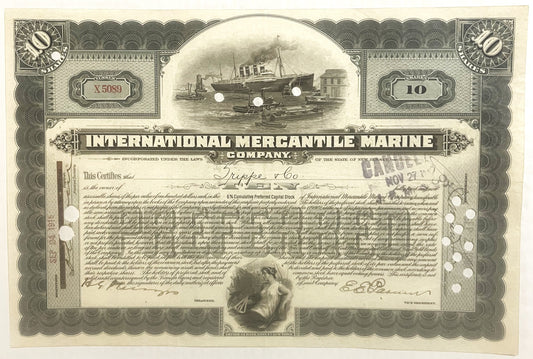
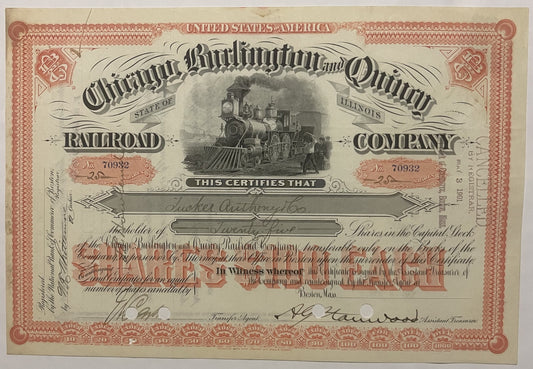
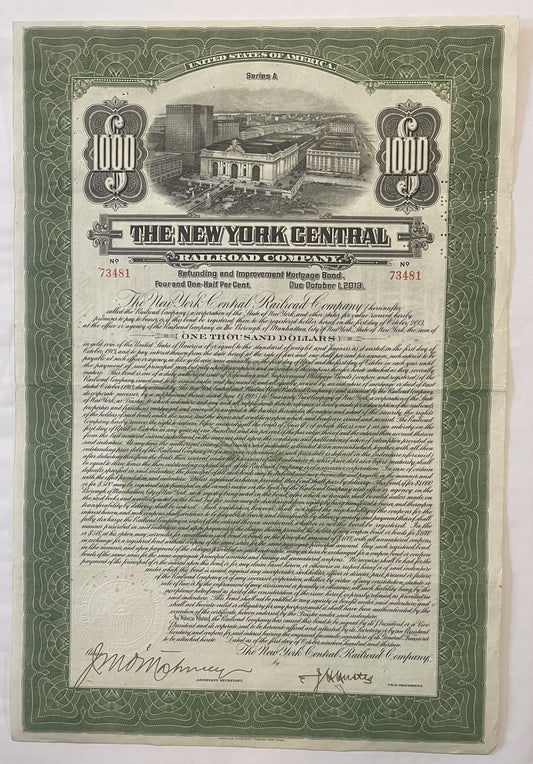
These are real issued certificates. Any certificate in the stack can carry endorsements or signatures on the back, a transfer-agent or registrar stamp, a punch or cut cancellation, a staple hole from a bound stock book, or a pencil ledger notation. Those are marks of real use, not damage, the record of an instrument that actually moved through the financial system.

🤠 The Little Mothers Club

Now for the story, and it's a good one. As early as 1902 sulphur was known to lie under Mexico's Isthmus of Tehuantepec, but it only mattered as a sign of oil. Then General Alfredo Breceda, a hero of the Mexican Revolution, and his engineer partner dug through Mexico's geological archives, rediscovered the Tehuantepec reserves, and in 1942 secured their first sulphur concessions on the Isthmus. Hunting for money, they found three wildcatter brothers named Brady, and through them a clique of independent Texas oil millionaires that Fortune magazine called the Little Mothers Club.

In April of 1947, Pan American Sulphur Company was incorporated to exploit the discovery of the Tehuantepec reserves in Mexico. The original investment and formation made by the Little Mothers Club, a group of Texas oil millionaires including Roland S. Bond, Buddy Fogelson, and Guy I. Warren, was $310,000. Fogelson co-founded the company on April 17, 1947 to develop a big sulphur mine at Jáltipan, Veracruz, and two years later he married the movie star Greer Garson. Roland S. Bond, a Dallas oilman who was also vice president of the Dallas Symphony Orchestra, was the company's vice president and secretary-treasurer by the early 1950s.

⛏️ Sulphur from the Jungle

They soon found sulphur on the nearby land too and got those rights in 1950. The Korean War put sulphur in much more demand, and the company wanted to sell out and take its profit, but it couldn't get Freeport Sulphur or Texas Gulf Sulphur to buy. So PASCO stayed, borrowed $3,664,000 from the Export-Import Bank in 1952 and later another $750,000, and sold new stock through the Wall Street house of Kuhn, Loeb & Co. in 1953 and 1955. Actually, being turned down was probably the best thing that ever happened to PASCO.

The field was perfect for the Frasch process, where superheated water is pumped down to melt the sulphur and compressed air forces it up to the surface. It lay close to the surface, a river ran through the concession for water, a Pemex refinery nearby supplied fuel oil, and there was an old railway and a port 26 miles away. Production at the Jáltipan dome got going in 1954. By 1958 the company was earning $3.5 million a year, in 1960 the Jáltipan dome produced more than a million long tons, and by the late 1960s PASCO was producing 75 percent of all of Mexico's sulphur, with loading docks that could handle 24,000 tons a day.

Then came 1967, the year Mexico brought its Frasch sulphur into Mexican hands. PASCO's stockholders approved an offer from the Mexican government and private Mexican investors to buy 66 percent of the Mexican operating company, Azufrera Panamericana, Mexico's largest Frasch sulphur producer, and PASCO kept the other 34 percent. Azufrera Panamericana was still running Frasch production at Jáltipan in the 1980s.

🖼️ Display

It's a handsome certificate to frame in an office or a den, and a great gift for anybody in mining, chemicals or oil and gas, or anybody with Texas or Mexico roots.

Shipping

🚚 Shipping & Handling

  • Shipping costs and timing are calculated at checkout.
  • Items curated and shipped directly by me include U.S. shipping at no additional cost, professionally packed to ensure safe arrival of your artifact.

Items from Vetted Pro Collectors
Shipping for items offered by vetted Pro Collectors is determined at checkout. All Pro Collector listings are reviewed to ensure fair, reasonable shipping practices.

For full details, please refer to our Shipping Policy.

Returns & Exchange

Take your time — you've got a full six months. If a piece isn't right for you, send it back the way it reached you and we're good.

In the first 30 days your money goes straight back the way you paid. After that it's store credit, so you can put it toward something you'd rather have.

Return shipping we sort out between us, case by case. I don't make this difficult.

If something arrives damaged, or it isn't what I said it was, send me a photo within 48 hours and I'll make it right.

Email info@vintageantiquesgifts.com or call 802-356-9872 — that's me answering, not a call center.

The only things I can't take back are custom or special-order pieces and gift cards.

View full details

Preserving History: Authentic Objects Across Eras

— Curated by Travis Weigel