Skip to product information
1 of 5

Vintage and Antique Gifts

Vintage 1960s Pan American Sulphur Co. Stock Certificate ⛏️ Brown, Delaware PASCO Mexico Mining Share

Vintage 1960s Pan American Sulphur Co. Stock Certificate ⛏️ Brown, Delaware PASCO Mexico Mining Share

Regular price 7.00 USD
Regular price Sale price 7.00 USD
Sale Sold out
Shipping calculated at checkout.
Quantity

What Was a New York Bank Note Engraver Doing Drawing Greek Gods for a Mexican Sulfur Mine? 🌋

I've handled a lot of old paper in my time — railroad bonds, mining shares, oil scrip from every corner of Texas — but there's something about a stock certificate that quietly tells the story of two entirely different worlds colliding on one sheet of engraved paper. On one side, you've got a Delaware-chartered company pulling raw sulfur out of a volcanic dome in southern Mexico. On the other, you've got a Manhattan security-printing house so busy in its era that it was cranking out millions of engraved documents a day. Somehow, both worlds meet in the middle of this certificate, framed by a laurel-crowned goddess and two bare-chested attendants who look like they wandered in from a temple frieze. That contrast — hard industrial reality dressed up in classical allegory — is exactly why pieces like this still stop collectors in their tracks.


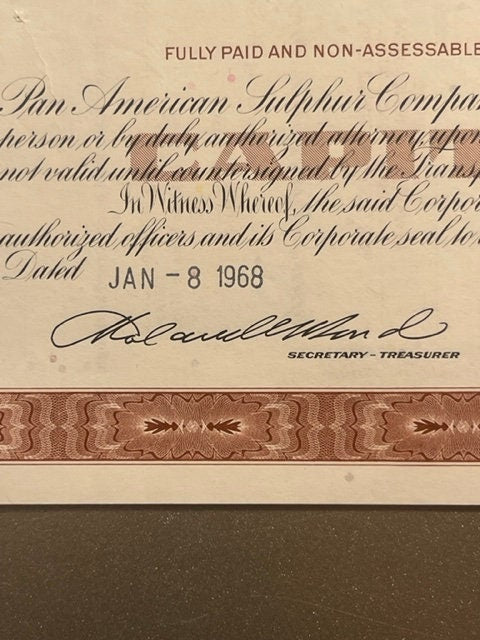
This is a capital stock certificate for the Pan American Sulphur Company, known to shareholders and traders by its shorthand brand name, PASCO — the monogram stamped proudly inside an oval medallion at the base of the certificate's central artwork. The company was incorporated under the laws of the State of Delaware, with its shares transferable in New York City and Jersey City, New Jersey, though its actual business — mining elemental sulfur — was carried out entirely in Mexico. This particular printing dates to 1968, a period when PASCO had grown into one of the more prominent international sulfur producers of its day.

The certificate was engraved and printed by the American Bank Note Company of New York, one of the most storied names in American security printing, and it shows. The design runs in rich brown and black engraved ink against warm cream stock, bordered top and bottom with the swirling scrollwork and guilloché patterning that ABNCo used across its bond and stock work to defeat counterfeiters.

Center stage sits the vignette that makes this piece: a seated, laurel-wreathed allegorical woman — part goddess, part guardian of industry — gripping an ornate hilted sword in one hand while resting the other on a pedestal topped with a round-bellied chemical flask. Flanking her, two reclining, laurel-crowned men rest against the same pedestals, one gripping a wooden staff, surrounded by small glass vessels, gears, and a scientific-looking apparatus that nod toward the chemistry of sulfur extraction.

Below them, the PASCO monogram sits inside its own oval cartouche, and the corners of the certificate carry the printed classification "CERTIFICATE FOR LESS THAN 100 SHARES," with the par value of the capital stock printed at 70 cents per share. The whole design measures 12 x 8 inches, a broad, document-sized sheet meant to be handled, signed, and filed, not folded into a pocket.

This example is a genuine issued certificate that worked as an investment document and was punch-cancelled at the end of it, and it stands today as a genuinely excellent example of mid-century American financial engraving and the visual language Wall Street used to sell trust on paper.


🔥 The Mexican Sulfur Rush and the "Little Mothers Club"

Every mining company has an origin story, but PASCO's is one of the better ones in Texas business lore. In 1947, a handful of Dallas oilmen — Roland S. Bond, Buddy Fogelson, and Guy I. Warren among them — pooled together a modest $310,000 to chase a discovery of sulfur reserves near the Tehuantepec region of Veracruz, Mexico. Collectors and historians researching the company have passed down the nickname given to this founding group: the "Little Mothers Club," a wry bit of Dallas oil-patch humor for a circle of wealthy Texas wildcatters nursing a brand-new venture through its infancy. It's the kind of detail that never made it into a corporate prospectus, but it's exactly the kind of lore that gives an old stock certificate its personality — a reminder that behind every engraved allegory of trust and industry sits a group of real people making a real gamble.

That gamble very nearly didn't pay off in the way anyone expected. The original mineral rights, tied to what was known as the Breceda concession, didn't actually cover where the richest sulfur deposits turned out to lie. The founders had to scramble to secure the adjacent rights before anyone else caught on. Then came a stroke of geopolitical luck: the outbreak of the Korean War drove sulfur demand sharply upward, and with prices climbing, the young company's owners figured the smart move was to sell out while the getting was good. They shopped the operation to the two giants of the American sulfur trade — Freeport Sulphur and Texas Gulf Sulphur — and, as the story goes, neither one would bite.

Old-timers in the industry have long said that PASCO's single luckiest break was being turned down. Locked out of a quick sale, the founders had no choice but to build the business themselves — and build it they did, at the Jáltipan sulfur dome in Veracruz, using the Frasch process, the same hot-water extraction method that had made American Gulf Coast sulfur mining possible decades earlier. What began as a consolation-prize operation grew, over the following years, into one of North America's most productive and profitable sulfur mines.


🏛️ From Wildcatters to Wall Street

Building a Mexican sulfur mine from a Dallas oilman's pocket change took real capital, and PASCO went looking for it in all the right places. In 1952, the company secured a loan of $3,664,000 from the U.S. Export-Import Bank, followed later by an additional $750,000 line of credit — federal financing that reflected sulfur's strategic importance to American industry in the postwar decades, where it fed everything from fertilizer to rubber vulcanization to chemical manufacturing. To fund further expansion, PASCO turned to Wall Street proper, arranging sales of new stock through the investment banking house of Kuhn, Loeb & Co. in both 1953 and 1955 — a pedigree that placed a scrappy Dallas-born mining venture squarely among the era's blue-chip financial circles.

By the 1960s, Pan American Sulphur had grown into a genuinely international operation, its output moving through European and North American markets alongside the American majors it had once tried, and failed, to sell itself to. It's a satisfying twist of business history: the company Freeport and Texas Gulf Sulphur passed over became, within a decade, a serious competitor in the same trade.


🎨 The Art of Trust: American Bank Note Company

The engraving on this certificate carries its own deep well of history, quite separate from PASCO itself. The American Bank Note Company traces its roots to 1795 in New York, printing bank notes and stamps for individual states and private banks back when American currency wasn't yet standardized. The modern firm took shape in 1858, when engraver Nathaniel Jocelyn negotiated a merger bringing together several rival printing and engraving houses — including partners Moseley I. Danforth and Tracy Edson — into a single, unified American Bank Note Company.

By the era this certificate was printed, ABNCo's main plant was one of the busiest security-printing operations in the country, reportedly processing more than five million pieces of paper daily and printing roughly half of all securities traded on the New York Stock Exchange. The company had also become the go-to engraver for currency across Latin America, producing bank notes for Mexico, Brazil, Costa Rica, Ecuador, Haiti, and Cuba — a fitting pedigree for a certificate representing a Mexican mining operation.

The allegorical figures gracing the top of this certificate weren't a stylistic whim, either. Stock exchange listing rules of the era required certificates to carry an image of a human figure with visible skin — reasoning that the human form, with its subtle shading and proportion, was the hardest thing for a counterfeiter to reproduce convincingly by hand. That single regulatory quirk is why so much mid-century American financial engraving looks like it wandered out of a classical sculpture gallery: draped goddesses, laurel-crowned attendants, bare shoulders and forearms rendered in fine engraved line work, all doing quiet security work behind their beauty. Collectors of this era's "vignette" certificates often note that the imagery reads as pure Americana romance today, even though it began life as an anti-fraud measure.


🤝 Presidents at the Table

Few sulfur companies ever rose to the level of international diplomacy, but PASCO did. Records of talks between President Lyndon B. Johnson and Mexican President Gustavo Díaz Ordaz show the two heads of state directly discussing Pan American Sulphur Company — specifically, a dispute between PASCO and the Mexican government over how large the country's sulfur reserves actually were. The estimate mattered enormously, because it directly determined how much sulfur Mexico would permit the company to export north of the border. President Johnson reportedly proposed splitting the difference between the competing figures and asked Mexico to allow increased exports; President Díaz Ordaz pushed back, suggesting the company had misrepresented Mexico's position abroad, while noting that PASCO hadn't even managed to export its full existing quota the year before.

It's a remarkable footnote for a mining company whose stock now trades hands quietly among paper-collectibles enthusiasts: for a moment in the 1960s, the humble mineral behind matchsticks, fertilizer, and vulcanized rubber was a genuine bargaining chip between two national presidents.


👤 The Man at the Head of the Table

Steering PASCO through much of its growth was its chairman of the board, J.R. (Jubal Richard) Parten, a name well known in Texas business and civic circles well beyond sulfur mining. Parten served on the Board of Directors of the Federal Reserve Bank of Dallas beginning in 1944, rising to chairman of that board from 1947 to 1954 — a period that placed him at the center of Texas banking policy during the postwar economic boom. He was equally influential in Texas higher education: appointed to the University of Texas Board of Regents in 1935 by Governor James Allred, Parten went on to chair that board from 1939 to 1941. Under his leadership, Pan American Sulphur developed the Jáltipan mine into what many in the industry considered one of the most profitable sulfur operations in North America — a legacy that quietly rode along on every share certificate the company issued, this one included.


📉 The Final Chapter

Pan American Sulphur Company's independent corporate life came to a close with its liquidation in 1976, closing the book on a three-decade run that had carried it from a $310,000 gamble by a handful of Dallas oilmen to a genuine player in international sulfur markets, complete with Wall Street financing and a seat at the table in presidential-level trade discussions. Whatever became of the sulfur business afterward, the company that issued this certificate — the Delaware-chartered Pan American Sulphur Company that mined the Jáltipan dome — belongs to a distinctly postwar chapter of American resource capitalism, one where Texas oil money, Mexican mineral rights, and New York banking all converged on a single engraved sheet of stock paper.


💼 Why This Piece Matters Today

Stock and bond certificates like this one occupy a wonderful, slightly overlooked corner of collecting — scripophily, as the hobby is formally known — where the appeal isn't a coupon's face value but the layered history behind it: the engraving house, the industry, the era, and the people who built the company whose name is inked across the top. This certificate captures all of it in one frame. It's a genuine artifact of mid-century American Bank Note Company craftsmanship, a document tied to a real and colorful Texas-to-Mexico business story, and a small paper witness to a moment when a sulfur mine's export quota was worth discussing at the presidential level. For collectors of Americana, Texana, mining history, or fine engraved ephemera, it offers a lot of story packed into a single framed sheet.


🖼️ Display Ideas

  • 🖼️ Framed as a study in classical allegory — a simple black or dark wood frame lets the engraved goddess-and-attendants vignette read almost like a miniature sculpture relief on the wall.
  • 📚 Paired with a Texana or oil-boom bookshelf — set alongside other Dallas or Texas business history pieces to tell the "Little Mothers Club" story in your own collection.
  • 🏦 Grouped with other scripophily — displayed alongside railroad bonds or mining shares from the same American Bank Note Company era for a themed wall of engraved financial history.
  • 🧪 Highlighted for its chemistry imagery — the small flasks and apparatus in the vignette make it a fun conversation piece in a home office, lab, or science-minded study.
  • 🎓 Used as a teaching artifact — a hands-on example for anyone studying mid-century American finance, Mexican-American trade relations, or the history of security engraving.

🎁 Who Collects These

Scripophily collectors — those who gather old stock and bond certificates purely for their history and artistry — are the natural home for this piece, especially anyone building out a run of American Bank Note Company engravings or tracking Delaware-chartered mining and resource companies of the mid-20th century. Texana and Texas business-history collectors gravitate toward it for the Dallas oilman origin story and the J.R. Parten connection to Texas banking and the University of Texas. Mining history enthusiasts appreciate it as a rare paper artifact of the sulfur trade specifically, a mineral that rarely gets its own collectible spotlight compared to oil, silver, or gold. And collectors of classical or allegorical engraved art simply enjoy it as a striking piece of printed design, independent of the underlying business.


❓ FAQ

Is this an original certificate, or a reproduction?
This is a genuine issued certificate from the original 1960s printing run by the American Bank Note Company — completed in ink, countersigned and cancelled.

What did Pan American Sulphur Company actually do?
PASCO mined elemental sulfur in Mexico, most notably at the Jáltipan dome in Veracruz, using the Frasch hot-water extraction process, and grew into a major international supplier of sulfur to North American and European markets.

Who is the figure shown in the certificate's artwork?
The central image is an allegorical vignette — a laurel-crowned female figure flanked by two attendants — a common design device on mid-century American stock certificates, chosen partly because engraved human figures were considered especially difficult for counterfeiters to reproduce.

Does this certificate still hold any monetary or shareholder value?
No — Pan American Sulphur Company was liquidated in 1976, so certificates like this one hold collectible and historical value only, not any active financial claim.

Why was this company incorporated in Delaware if it mined in Mexico?
It was common practice for American-founded mining ventures operating abroad to incorporate in Delaware for its favorable corporate law, while conducting all physical operations — in this case, sulfur extraction — in the country where the mineral rights were held.

Who printed this certificate, and why does the engraving look so ornate?
It was engraved by the American Bank Note Company of New York, a security printer whose elaborate scrollwork, guilloché borders, and allegorical figures were standard practice across the financial industry to deter forgery while projecting a sense of institutional trust.

What size is the certificate?
It measures 12 x 8 inches (about 30.5 x 20.3 cm), the broad document format typical of mid-century American capital stock certificates.

These are issued instruments rather than blanks. Certificates of this type were filled in for a holder in ink, countersigned by the transfer agent and registered by the registrar, then punch- or cut-cancelled when they were redeemed and retired. Expect financial writings, markings, stamps, hole punches and staple holes as part of the life of the instrument: endorsements and signatures, transfer-agent and registrar stamps, revenue or documentary tax stamps, cancellation punches, staple holes from being bound into a transfer book, pencil ledger notations. That is the paper trail of a security that actually did its job, and it is what separates a document that lived from a blank that never did. No two are alike: holder details, serial numbers, dates, signatures, stamps and punch patterns vary from example to example, so the photographs show the type rather than the exact sheet that ships.

Shipping

🚚 Shipping & Handling

  • Shipping costs and timing are calculated at checkout.
  • Items curated and shipped directly by me include U.S. shipping at no additional cost, professionally packed to ensure safe arrival of your artifact.

Items from Vetted Pro Collectors
Shipping for items offered by vetted Pro Collectors is determined at checkout. All Pro Collector listings are reviewed to ensure fair, reasonable shipping practices.

For full details, please refer to our Shipping Policy.

Returns & Exchange

Take your time — you've got a full six months. If a piece isn't right for you, send it back the way it reached you and we're good.

In the first 30 days your money goes straight back the way you paid. After that it's store credit, so you can put it toward something you'd rather have.

Return shipping we sort out between us, case by case. I don't make this difficult.

If something arrives damaged, or it isn't what I said it was, send me a photo within 48 hours and I'll make it right.

Email info@vintageantiquesgifts.com or call 802-356-9872 — that's me answering, not a call center.

The only things I can't take back are custom or special-order pieces and gift cards.

View full details
  • 5 stars: 1 (100%)
  • 4 stars: 0 (0%)
  • 3 stars: 0 (0%)
  • 2 stars: 0 (0%)
  • 1 star: 0 (0%)
a
a***a (391)

Hi my friends I received my order right on time as always I thank you for your service with my order and great condition I’m very grateful to you and your family team keep up the great service and work take care and stay healthy 👍