


Skip to product information
1 of 3

Vintage and Antique Gifts

Vintage 1990s Peekskill Financial Stock Certificate Baltimore Ravens and Buffalo Bills Sponsor NY NJ Eagle Vignette Scripophily 📜

Vintage 1990s Peekskill Financial Stock Certificate Baltimore Ravens and Buffalo Bills Sponsor NY NJ Eagle Vignette Scripophily 📜

Regular price 10.00 USD
Regular price Sale price 10.00 USD
Sale Sold out
Shipping calculated at checkout.
Quantity

What does a small savings bank in the Hudson Valley have to do with the Baltimore Ravens' stadium? 🦅

Stay with me on that one — it's a real thread, and it runs straight through this certificate. There's something wonderful about holding a piece of paper that represents nothing but a promise — a fraction of ownership in a company that once had officers, a mailroom, a board meeting calendar, a stock ticker symbol people watched — and that now exists only in framed pieces like this one. This is that kind of piece: quiet, dignified, and carrying a lot more history than its size lets on.

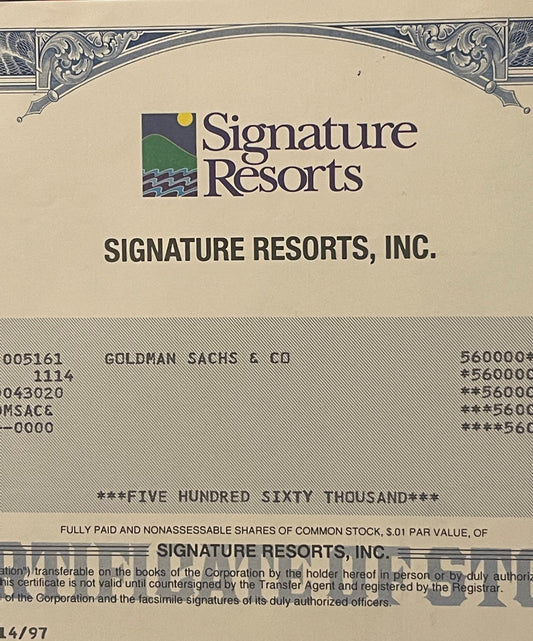
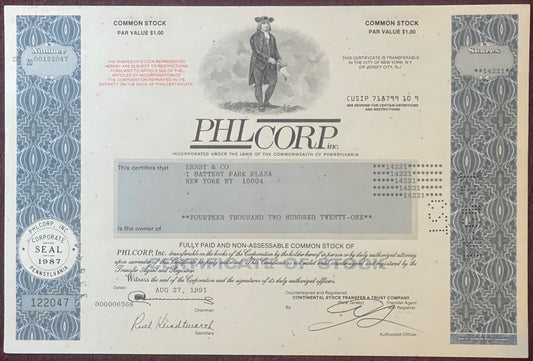
This is a Peekskill Financial Corporation common stock certificate, issued by a Delaware-incorporated savings-and-loan holding company headquartered in Peekskill, New York, in the mid-1990s. The certificate measures 12 x 8 inches (about 30.5 x 20 cm) — a full, substantial sheet, printed the way serious securities were always printed: an engraved bald eagle vignette perched wings-spread at the top center, rendered in fine crosshatched linework with a soft blue-gray wash behind it; an ornate blue guilloché border running the full perimeter with lacy scrollwork medallions in the corners; and bold black lettering announcing PEEKSKILL FINANCIAL CORPORATION beneath the eagle, with the Delaware incorporation line stated just below in smaller type. The overall palette is that classic trio of cream stock, deep engraved blue, and crisp black — the look of American finance paper at its most formal. This example is a genuine issued certificate that went into a real trading portfolio and was punch-cancelled on its way back out, a survivor from the company's original share issuance.


🏦 Peekskill Financial Corporation — A Bank Built to Go Public

Peekskill Financial Corporation came into being in the fall of 1995 for one specific purpose: to serve as the holding company for First Federal Savings Bank of Peekskill as that bank converted from a mutual savings institution — owned, in effect, by its depositors — into a stock savings bank owned by shareholders. That conversion became effective at the very end of December 1995, and the corporation sold just over 4.09 million shares of common stock at $10 apiece to fund it. Shares carried a par value of a single penny — the number you'll find printed right on the face of this certificate — with the $10 offering price reflecting the real value investors placed on the underlying bank.

The new company wasted no time acting like a proper public corporation. It listed on the Nasdaq National Market under the ticker PEEK, and within its first year as a public company the board had already declared its first cash dividend and won regulatory clearance to buy back a slice of its own outstanding shares in the open market — the kind of confident, shareholder-friendly moves a young thrift holding company makes when its books are in good order. By the spring of 1996, Peekskill Financial was carrying nearly $194 million in assets and close to $60 million in stockholders' equity, a solid, well-capitalized community bank by any measure.

Behind it stood First Federal Savings Bank, operating three full-service branches serving northern Westchester and Putnam Counties out of its main office on Park Street in Peekskill — a genuinely local institution, the kind that knew its depositors by name and financed the mortgages, small businesses, and family savings of the Hudson Valley towns around it.


🌊 Peekskill, New York — River Town, Bank Town

Peekskill sits right on the east bank of the Hudson River, a working river town with a long identity as a manufacturing and shipping community long before it became a bedroom community for commuters heading south into Westchester and the city beyond. It's the kind of town where a hometown savings bank mattered — the institution that held the mortgage on the house, financed the shop downtown, and put its name on the local ballfield. First Federal Savings Bank was that institution for Peekskill for generations, which is exactly why its conversion to a publicly traded company in the winter of 1995–96 was, in its own modest way, a local event: depositors becoming shareholders, a hometown mutual becoming a company with a ticker symbol and a board answerable to Wall Street rather than only to its own passbook holders.


✒️ The Signatures — And the People Behind Them

Every certificate like this one carries the facsimile signatures of a President/Secretary and a Chairman of the Board/CEO — the two officers whose word bound the company to its shareholders. The verified Chairman and Chief Executive Officer of Peekskill Financial Corporation was Eldorus Maynard, whose signature appears on certificates from this issue alongside the corporate seal, dated 1995, marking the company's Delaware charter.

There's a whole subculture among stock and bond collectors built entirely around chasing down who these signatures belonged to — cross-referencing old proxy statements and newspaper archives to figure out whether a name on a hundred-year-old railroad bond belonged to somebody who mattered. It's slow, patient work, and it can turn an already handsome certificate into something with real documented provenance. Not every collector goes down that road — plenty of us are perfectly happy simply admiring the engraving and the history baked into the company itself — but it's part of what makes this whole category of collectible endlessly interesting: you genuinely never know whose name you're holding until somebody looks.


🔗 A Short Public Life, and a Long Corporate Trail Afterward

Peekskill Financial Corporation's run as an independent public company lasted only about four years. In February of 2000, the company agreed to be acquired by Sound Federal Bancorp, in a cash deal that valued Peekskill's shares well above their book value — a strong outcome for the shareholders who'd held on since the 1995–96 conversion. By that summer, First Federal Savings Bank had been formally merged into Sound Federal Savings, and the Peekskill name as an independent banking entity came to a close.

The trail didn't stop there. As best I've been able to trace it, Sound Federal was in time folded into Hudson City Bancorp — at the time the largest savings bank headquartered in New Jersey and one of the older thrift institutions in the country, an outfit that famously weathered the mid-2000s housing boom and bust far better than most of its peers and was singled out by Forbes as one of the best-run banks of 2007. Hudson City Bancorp itself was later absorbed into M&T Bank — a Fortune 500-adjacent regional banking giant whose name now sits on the stadium where the Baltimore Ravens play and who carries the title of official bank of the Buffalo Bills. It's a genuinely remarkable chain to trace back: a three-branch Hudson River thrift, converted to stock form on a winter afternoon in 1995, its lineage eventually folded into an institution sponsoring NFL stadiums. Only a handful of comparable Peekskill Financial certificates are known to collectors and dealers who specialize in this corner of American financial history, which is part of what makes turning one up worth pausing over.


🖨️ The Printer — Security-Columbian, United States Banknote Company

The imprint at the base of the certificate reads Security-Columbian, United States Banknote Company — a name with real weight in the security-printing trade. It traces back to the Columbian Bank Note Company, incorporated in 1904, which merged in 1957 with the Security Banknote Company to form Security-Columbian. By the time certificates like this one were being engraved, the firm sat within a much larger consolidation of the American banknote industry, one that eventually folded into the U.S. Banknote Corporation and, further back still, traces its engraving lineage all the way to Murray, Draper, Fairman & Company — an engraving house founded in 1795 by Robert Scot, the very first official engraver of the United States Mint. That's the pedigree behind the fine crosshatched eagle and the lacework border on this certificate: two centuries of American security-engraving craft distilled onto a single sheet of stock paper.


📜 Stock Certificates as Vanishing Americana

It's worth pausing on what this object actually is in the larger sweep of financial history. The very first stock certificate on record was issued clear back in 1606, by the Dutch East India Company — the instrument that essentially invented the modern public corporation. Paper certificates like this one carried that same basic idea forward for centuries, right up until 2013, when the Walt Disney Company issued what's regarded as one of the last physical paper stock certificates from a major American corporation before electronic share registration took over almost entirely. Everything printed in between those two dates — including this Peekskill Financial certificate from the 1990s — belongs to a genuinely finite category: nobody is minting new ones of these. They were printed on heavy, durable stock, closer in feel to currency paper than to ordinary letterhead, precisely so they'd hold up as legal instruments of ownership rather than fade like an everyday document.


🖼️ Display Ideas

  • 🦅 Frame it solo and let that engraved eagle be the whole show above a desk or home office
  • 🏦 Pair it with other Hudson Valley or New York banking ephemera for a themed regional wall
  • 💼 Hang it in a finance office, brokerage, or accountant's waiting room as genuine conversation-starting Americana
  • 🎓 Give it as a gift to a Westchester or Hudson Valley native with local roots worth honoring
  • 📚 Set it into a small collector's portfolio alongside other 1990s bank-conversion certificates
  • 🖋️ Display it near a magnifying glass so guests can appreciate the engraving detail up close

🎁 Who Collects These

Scripophily collectors — the folks who specifically hunt vintage stock and bond certificates — make up the core audience here, and Hudson Valley bank conversions of this era are a niche within that niche worth knowing. Beyond them, this piece speaks to local Westchester and Putnam County history buffs, anyone building out a collection of Americana tied to banking and Wall Street, admirers of engraved security printing and the old banknote houses, and gift-givers looking for something with a genuine, traceable corporate story rather than a generic decorative print.


❓ FAQ

Is this a real, issued stock certificate or a reproduction?
This is a genuine issued certificate from Peekskill Financial Corporation's original issue, printed by the Security-Columbian, United States Banknote Company.

What company is Peekskill Financial Corporation, and does it still exist?
It was the Delaware holding company for First Federal Savings Bank of Peekskill, New York. It traded publicly on Nasdaq under the symbol PEEK before being acquired by Sound Federal Bancorp in 2000, with its corporate lineage eventually flowing into M&T Bank.

Is this certificate still an active, tradable share?
No — Peekskill Financial Corporation was acquired and dissolved as an independent public company years ago, so this certificate now functions purely as a historical and decorative collectible, not a live security.

What size is the certificate?
It measures 12 x 8 inches (about 30.5 x 20 cm), a full formal certificate size that displays beautifully framed.

What condition is it in?
It is an issued example from the company's original run, presenting the engraving, lettering and border artwork exactly as struck by the printer.

Whose signatures appear on the certificate?
Certificates in this series carry the facsimile signatures of the company's President/Secretary and its Chairman and CEO, Eldorus Maynard, alongside the corporation's 1995 Delaware corporate seal.

Why do collectors value old stock certificates like this one?
They're a genuinely finite category of American financial history — engraved on durable security paper by the great banknote houses, tied to real, traceable companies, and no longer being issued in physical form the way they once were for nearly four centuries.

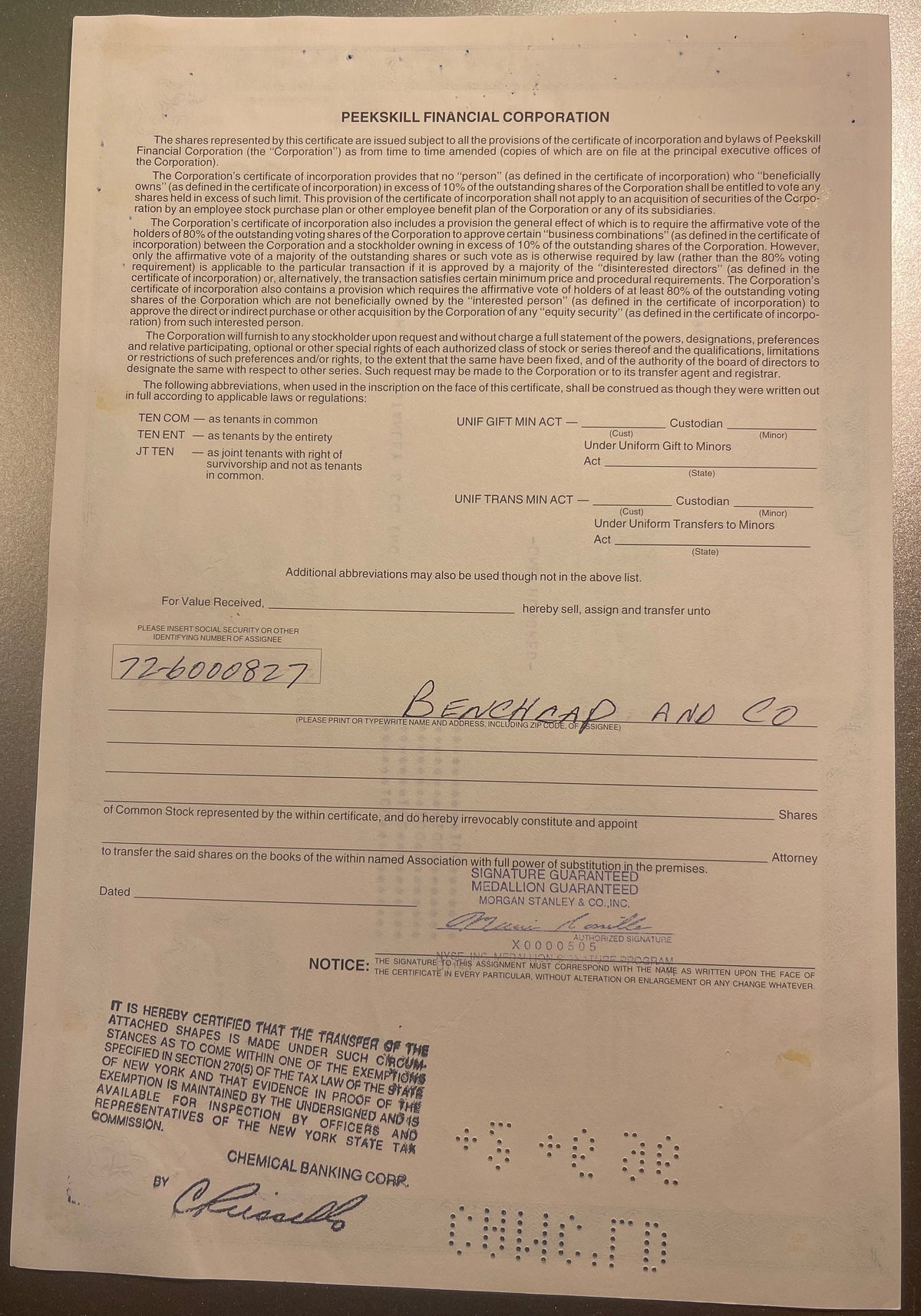
These are issued instruments rather than blanks. Certificates of this type were filled in for a holder in ink, countersigned by the transfer agent and registered by the registrar, then punch- or cut-cancelled when they were redeemed and retired. Expect financial writings, markings, stamps, hole punches and staple holes as part of the life of the instrument: endorsements and signatures, transfer-agent and registrar stamps, revenue or documentary tax stamps, cancellation punches, staple holes from being bound into a transfer book, pencil ledger notations. That is the paper trail of a security that actually did its job, and it is what separates a document that lived from a blank that never did. No two are alike: holder details, serial numbers, dates, signatures, stamps and punch patterns vary from example to example, so the photographs show the type rather than the exact sheet that ships.

Shipping

🚚 Shipping & Handling

  • Shipping costs and timing are calculated at checkout.
  • Items curated and shipped directly by me include U.S. shipping at no additional cost, professionally packed to ensure safe arrival of your artifact.

Items from Vetted Pro Collectors
Shipping for items offered by vetted Pro Collectors is determined at checkout. All Pro Collector listings are reviewed to ensure fair, reasonable shipping practices.

For full details, please refer to our Shipping Policy.

Returns & Exchange

Take your time — you've got a full six months. If a piece isn't right for you, send it back the way it reached you and we're good.

In the first 30 days your money goes straight back the way you paid. After that it's store credit, so you can put it toward something you'd rather have.

Return shipping we sort out between us, case by case. I don't make this difficult.

If something arrives damaged, or it isn't what I said it was, send me a photo within 48 hours and I'll make it right.

Email info@vintageantiquesgifts.com or call 802-356-9872 — that's me answering, not a call center.

The only things I can't take back are custom or special-order pieces and gift cards.

View full details