Skip to product information
1 of 8

Vintage and Antique Gifts

Vintage South Carolina Gamecocks Decal 🐓 1960s NOS Great Western Enterprises Water-Transfer Sticker

Vintage South Carolina Gamecocks Decal 🐓 1960s NOS Great Western Enterprises Water-Transfer Sticker

Regular price 7.00 USD
Regular price Sale price 7.00 USD
Sale Sold out
Shipping calculated at checkout.
Quantity

🐓 Ever Wonder What It Looked Like When Fan Loyalty Rode Around on the Back Bumper Instead of a T-Shirt?

Long before licensed apparel walls and stadium superstores, showing your colors meant a little envelope from a mail-order house, a sink full of water, and thirty careful seconds with a water-slide decal. This one never got that soak. It's a South Carolina Gamecocks decal that has sat, untouched and unapplied, since the day it left the printer — a genuine piece of mid-century Americana that somehow skipped the car window, the toolbox lid, and the notebook cover it was made for, and came straight to us instead.

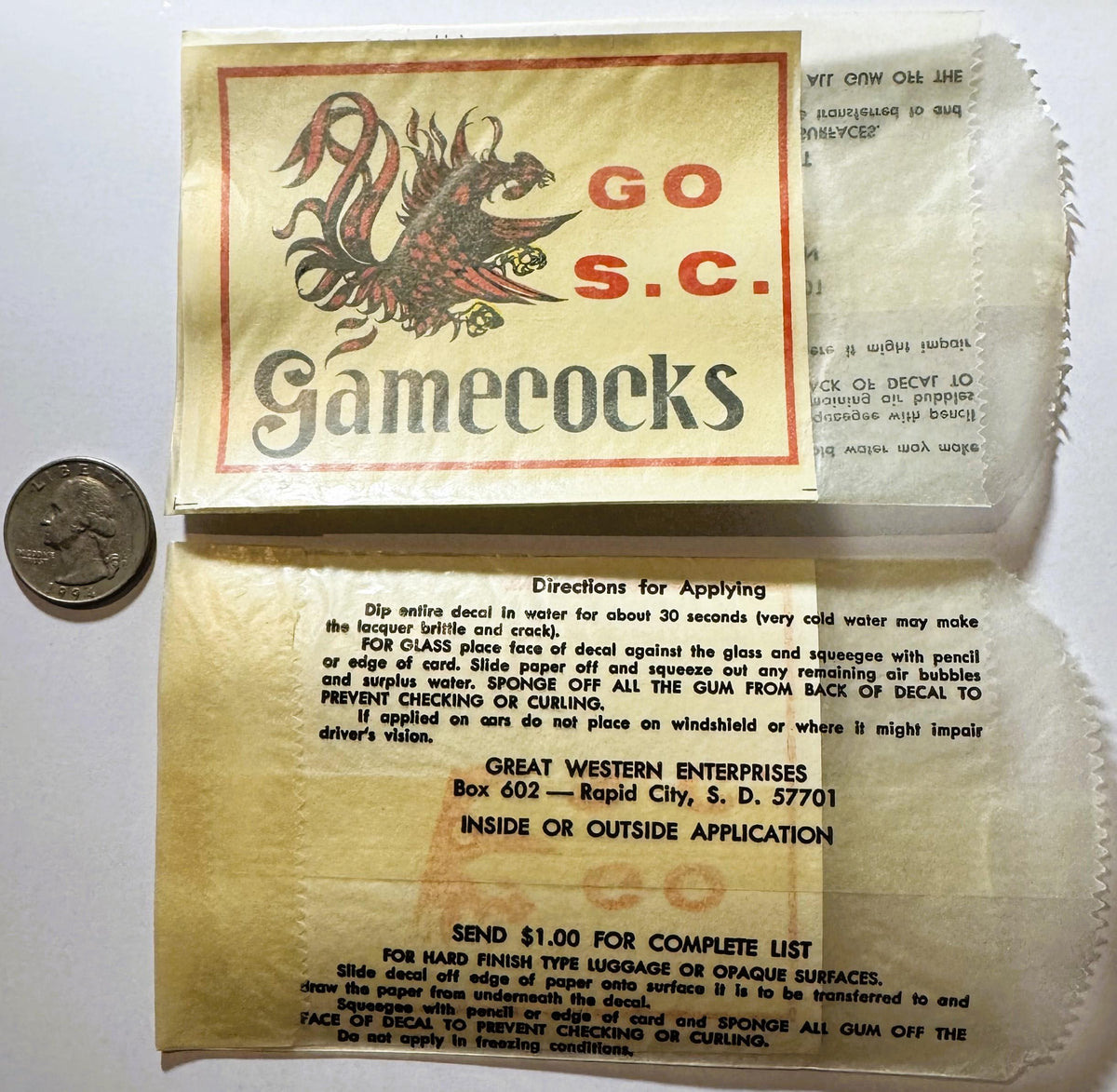
This is an original New Old Stock (NOS) water-transfer decal produced by Great Western Enterprises, a mail-order novelty outfit that operated out of a post office box in Rapid City, South Dakota (Box 602, ZIP 57701 — printed right on the instruction sheet that still travels with it). The artwork is bold and unmistakably mid-century: a fierce, wind-swept fighting gamecock rendered in black and garnet red with touches of yellow at the talons, wings flared and tail feathers curling like flame, set inside a thin red-bordered frame against a warm gold field. To the right, in stacked block capitals, it reads "GO S.C." in red, and below the bird, in a heavy Gothic-style script, the word "Gamecocks" anchors the whole design. It measures 4 x 3 inches, exactly as a decal of this kind would have been sized for a car window, a suitcase, or a schoolbook cover, and it survives complete with its original glassine sleeve and folded paper instruction sheet — the very pieces most owners tore off and tossed the day they bought one.


🏛️ The Legend Behind the Gamecock

Old-timers around Columbia will tell you the nickname didn't come from a marketing meeting — it came from a battlefield. The story handed down for generations holds that Revolutionary War general Thomas Sumter earned the name "The Fighting Gamecock" from his own adversaries, the British, who found him impossible to run off no matter how many times they thought they'd beaten him. Legend says it was the British officer Banastre Tarleton himself who likened Sumter's relentless, scrappy style to a fighting cock that simply would not stay down. Whether or not the exact words were ever spoken quite that way, the nickname stuck to Sumter, and generations later it stuck to the university's teams — a direct thread from a Revolutionary War swamp campaign to a decal meant for a 1960s station wagon window.

It's worth noting, too, that the artwork itself leans into that old fighting-bird tradition. Gamecocks — the actual breed — were bred for centuries purely for combat, prized for aggression, quick feet, and sharp spurs, and you can see that spirit in the decal's design: wings thrown back, neck stretched forward, every line drawn to look like a bird mid-strike rather than a tame mascot standing for a photo.


🖨️ A Mail-Order Novelty Empire Out of the Black Hills

Rapid City wasn't a college town or a print-industry hub — it was (and still is) the gateway to Mount Rushmore and the Black Hills, a place travelers passed through by the carload every summer. Companies like Great Western Enterprises built modest little mail-order businesses right there, selling not just to tourists passing through but to fans and travelers all over the country who wrote away for a decal to bring a piece of home, or a piece of team spirit, along with them. The instruction sheet tucked with this piece makes the business model plain: buyers were invited to "SEND $1.00 FOR COMPLETE LIST" of everything the company offered — suggesting Great Western Enterprises wasn't a one-team operation but ran a whole mail-order catalog of decals covering colleges, states, and Americana designs, sold sight-unseen to fans far from any campus bookstore.

Sharp-eyed collectors have noticed something else worth passing along: the five-digit ZIP code printed right on that instruction sheet, 57701, is a numbering system the U.S. Postal Service didn't introduce until 1963. That small detail places the printing of this decal sometime after that point — a real clue straight from the item itself, and one that fits comfortably with the broader collector consensus placing pieces like this in the 1960s stretching into the 1970s, the true golden age of the campus water-slide decal.

🏈 Gamecocks, Tigers, and a Rivalry That Never Cooled

For a long run through the middle of the twentieth century, the University of South Carolina's teams wore garnet and black as members of the Atlantic Coast Conference, a chapter of Gamecock athletic history that closed when the school moved on to the Southeastern Conference in the early 1970s. A decal like this one belongs squarely to that ACC-era chapter, back when Palmetto State bragging rights were fought out inside a conference the Gamecocks would soon leave behind.

And bragging rights, in South Carolina, has always meant one thing above all: Clemson. Collectors working this same corner of decal history often turn up a companion piece from the same golden age — the Gamecock shown squaring off against, and getting the better of, the Clemson Tiger — proof that the in-state rivalry was baked into fan merchandise from the very start. A decal wasn't just team pride; in South Carolina, it was a small declaration in an argument that's been running for well over a century.


📬 The Golden Age of the Water-Slide Decal

The instruction sheet that comes with this decal is a small time capsule in itself, walking the buyer through dipping the decal in water "for about 30 seconds," squeegeeing out air bubbles with a pencil or the edge of a card, and — a detail that says a lot about the era — a specific warning not to place it on a windshield where it "might impair driver's vision." That single line tells you exactly how these things were used: stuck right on the family car for the world to see. The sheet also notes the decal was built for "INSIDE OR OUTSIDE APPLICATION," meaning it could go on glass, on hard-finish luggage, on lockers, or toolboxes — anywhere a fan wanted to make a statement.

This was the era when firms like Angelus Pacific and Impko were turning out cartoon mascots and campus pride graphics by the millions, sold through gas stations, five-and-dime counters, sporting goods shops, and mail-order catalogs just like Great Western's. It was a business built on impulse and immediacy — a decal bought on a Friday was almost always applied by Saturday's game, which is exactly why so few unused examples like this one made it through the decades still sealed in their original sleeve.


🖼️ Display Ideas

  • 🚗 Frame it alongside its original sleeve and instruction sheet as a little shadow box of mid-century fan culture
  • 🏈 Add it to a Gamecock memorabilia case or trophy shelf as the earliest piece in the collection's timeline
  • 📚 Feature it in a scrapbook or archive of South Carolina Gamecock athletic history
  • 🎨 Lay it flat under glass on a desk or side table where the gold and garnet catch the light
  • 🎁 Give it to a Gamecock alum or lifelong fan as a piece of the team's story they've likely never seen before
  • 🏛️ Pair it with other Rapid City or Black Hills mail-order ephemera for a themed collection of vintage Americana novelty items

🎁 Who Collects These

This piece draws interest from several directions at once: University of South Carolina alumni and lifelong Gamecock fans building out a personal collection of team history, vintage decal and ephemera collectors chasing surviving examples from the golden age of water-slide graphics, Americana and advertising-art collectors drawn to the bold mid-century mascot illustration style, and regional history buffs interested in Rapid City, South Dakota's small but colorful role in the mail-order novelty trade. It's also a natural fit for anyone assembling a collection around Southern college football rivalries, since it sits right at the start of the long-running Gamecocks-Tigers story.


❓ FAQ

What does NOS mean, and why does it matter here?

NOS stands for New Old Stock — meaning this decal was never sold to a final user, never applied, and has simply sat in inventory since it was originally produced. It comes complete with its original sleeve and instruction sheet, which is unusual, since most decals of this kind were bought and applied almost immediately, with the packaging thrown away.

What size is the decal?

It measures 4 x 3 inches, sized for the kind of everyday surfaces it was made for — car windows, lockers, luggage, and toolboxes.

Can a vintage water-slide decal like this still be applied today?

The original instructions describe soaking it in water to loosen the backing paper before applying it to glass or a hard, opaque surface. Given its unused, sleeve-preserved condition, many collectors prefer to keep it as-is and display it rather than apply it, but the original directions are included for reference.

Who made this decal, and where did it come from?

It was produced by Great Western Enterprises, a mail-order novelty company based out of a Rapid City, South Dakota post office box, part of the small mail-order decal trade that sold college and regional pride graphics by catalog across the country.

How old is this decal?

The five-digit ZIP code printed on the instruction sheet places its printing after 1963, and the design, printing style, and collector consensus place it generally within the 1960s to 1970s — the peak years of the campus water-slide decal trade.

Is this an officially licensed University of South Carolina product?

This is a vintage fan novelty item from the era before modern collegiate licensing programs existed, sold independently through mail-order and retail novelty channels rather than through the university itself.

Why does the gamecock look so fierce compared to today's mascot art?

The design reflects the actual gamecock breed's fighting reputation and Thomas Sumter's own "Fighting Gamecock" legend, leaning into motion and aggression rather than a friendly cartoon — very much in keeping with the bold, dramatic mascot art style of its era.

Shipping

🚚 Shipping & Handling

  • Shipping costs and timing are calculated at checkout.
  • Items curated and shipped directly by me include U.S. shipping at no additional cost, professionally packed to ensure safe arrival of your artifact.

Items from Vetted Pro Collectors
Shipping for items offered by vetted Pro Collectors is determined at checkout. All Pro Collector listings are reviewed to ensure fair, reasonable shipping practices.

For full details, please refer to our Shipping Policy.

Returns & Exchange

Take your time — you've got a full six months. If a piece isn't right for you, send it back the way it reached you and we're good.

In the first 30 days your money goes straight back the way you paid. After that it's store credit, so you can put it toward something you'd rather have.

Return shipping we sort out between us, case by case. I don't make this difficult.

If something arrives damaged, or it isn't what I said it was, send me a photo within 48 hours and I'll make it right.

Email info@vintageantiquesgifts.com or call 802-356-9872 — that's me answering, not a call center.

The only things I can't take back are custom or special-order pieces and gift cards.

View full details
  • 5 stars: 1 (100%)
  • 4 stars: 0 (0%)
  • 3 stars: 0 (0%)
  • 2 stars: 0 (0%)
  • 1 star: 0 (0%)
s
s***s (1305)

Great to deal with.