Skip to product information
1 of 4

Vintage and Antique Gifts

Vintage Mid Century 1960s Embroidered Tiger Patch 🐯 – NOS Stylized Face Design (Yellow Black)

Vintage Mid Century 1960s Embroidered Tiger Patch 🐯 – NOS Stylized Face Design (Yellow Black)

Regular price $5.50 USD
Regular price Sale price $5.50 USD
Sale Sold out
Shipping calculated at checkout.

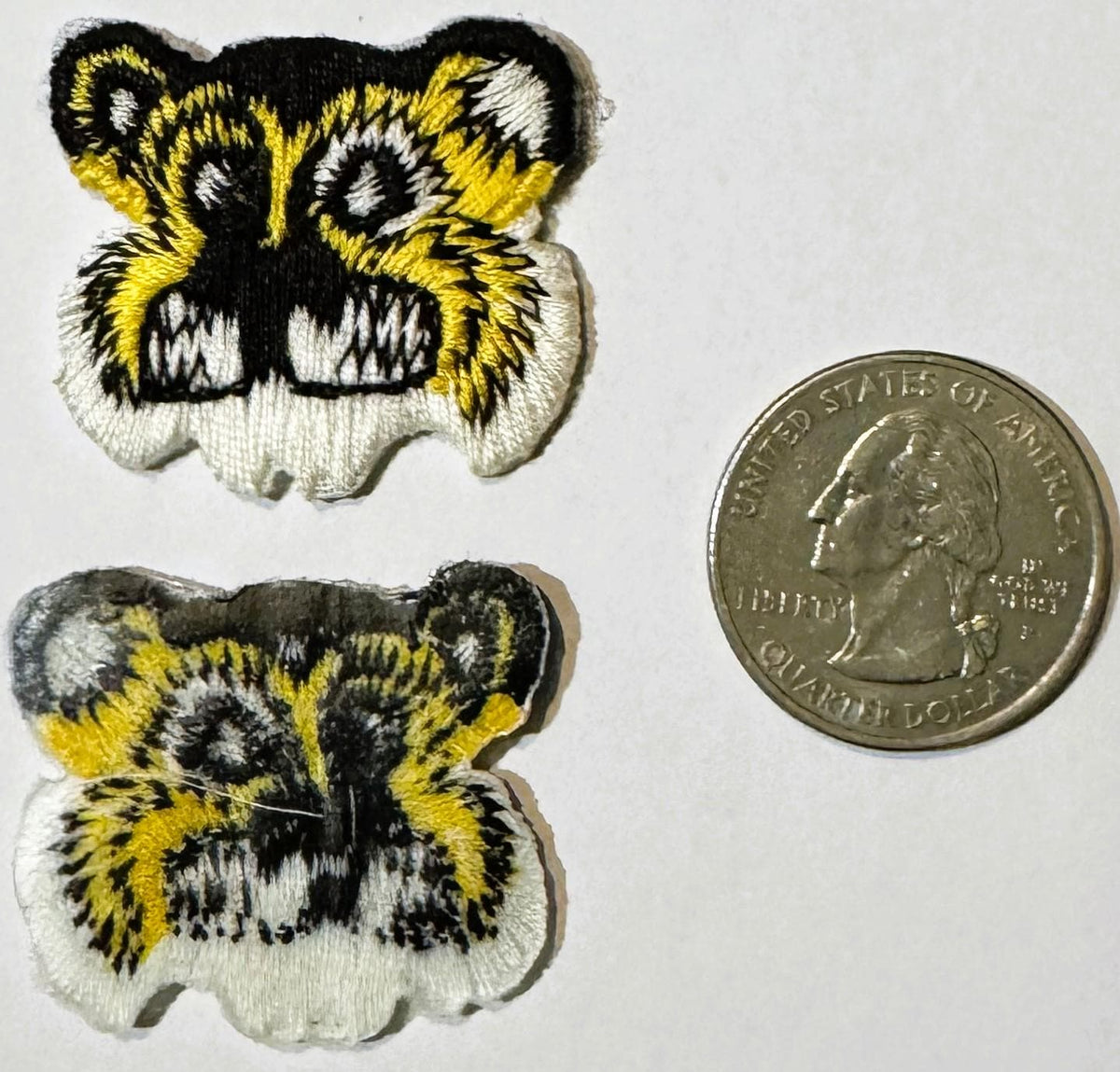
Size: 1 1/4" x 1 1/4"

🚚 Free US Shipping — ships within one business day. International shipping calculated at checkout.

Quantity

Remember Tiger Fever? 🐯 Vintage 1960s Embroidered Tiger Patch, NOS 1¼"

Size: 1 1/4" x 1 1/4"

In the 1960s, America had tiger fever. Drivers were told to put a tiger in their tank and hung striped tails off their gas caps. Triumph's Tiger was the motorcycle to be seen on. Tony the Tiger was on the breakfast table, and "Tiger Force" was the name a hand-picked unit of American paratroopers carried into Vietnam.

Somewhere in all of that, somebody ran off little tiger faces like this one by the bag — no brand, no lettering, so they could be sold to anyone who wanted a tiger on a jacket, a cap or a riding vest. Nobody wrote down who made them. These never got sewn on.

🐯 What This Is

A small embroidered tiger-face emblem, roughly 1 1/4" across. The face is worked in three threads: hot yellow for the fur, dense black for the stripes, muzzle and outline, and bright white for the teeth, the eyes and the ruff under the chin.

It is a stylized tiger, not a naturalistic one — symmetrical, front-facing, stripes simplified into flame-shaped spikes, teeth drawn as a hard white block. A mark, not a portrait, drawn to survive being shrunk.

✂️ Cut To The Tiger — No Border

There is no merrowed edge. No rolled overlock stitch running round the outside. The emblem is embroidered solid onto a backing cloth and then cut to the silhouette, so the outline follows the ears, the cheek tufts and the ruff. You can see the pale backing as a narrow margin at the edge in the photographs.

That borderless, cut-edge machine embroidery is a different route from the merrowed shield sold on a card. It is how emblems were made to be applied — bought by the dozen or the bag and sewn onto something else. Collectors of 1960s and 1970s patches know the look well; it is the same cut-edge style as the tiger patches made in Korea and Vietnam for American units in those years.

And with no border eating the outer millimetre, every bit of the 1 1/4" is tiger.

📅 How Old It Is

Mid-century — the 1960s.

This tiger came in a single find of unused patches, all new old stock, none ever sewn. The pieces in that find that date themselves run from 1950s–60s felt-ground state and youth-baseball emblems to a Bundy Corporation company patch that cannot be older than 1967, the year that company took that name. The tiger's cut-edge construction sits comfortably in the middle of those same years. There is no printed date on it, so that is as tight as the evidence goes.

⛽ "Put A Tiger In Your Tank"

The line was written in April 1959 by Emery T. Smyth, a copywriter in the Chicago office of the agency Needham, Louis & Brorby, for the Oklahoma Oil Company — a Midwestern arm of Humble Oil, part of the old Standard Oil family that sold its gasoline as Esso, Enco and Humble depending on where you lived. In May 1964 the cartoon tiger went national. Its most famous giveaway was a striped tiger tail to hang off the car; one account credits the tails to an independent marketing man, Joseph L. Heimbold, and puts sales at a quarter of a million.

By 1964 tigers were so thick on the ground in American advertising that Time magazine called it "The Year of the Tiger." A small tiger face on a jacket in those years did not need explaining.

🏍️ The Tiger On Two Wheels

For riders, "Tiger" meant Triumph. Edward Turner designed the Tiger 100 in 1939 as a sports machine for enthusiasts — the "100" was its claimed top speed in miles an hour. German bombs destroyed the Triumph works in Coventry in 1940, production came back in 1946, and the Tiger 100 stayed in the range until 1973. In 1954 a 650 joined it, the Tiger 110, with the same promise built into the name.

Tiger emblems went where the riders went — onto jackets, vests and the backs of denim — alongside shop names, club marks and whatever else a rider thought belonged there.

🥣 The Tiger At Breakfast

In 1952 Kellogg's of Battle Creek, Michigan launched Sugar Frosted Flakes and needed a face for the box. Art director Eugene Kolkey at the Leo Burnett agency designed a tiger, named him Tony after a Burnett ad man called Raymond Anthony Wells, and had illustrator Martin Provensen draw the finished art. The story goes that Tony was up against Katy the Kangaroo, Elmo the Elephant and Newt the Gnu. Within a year the others were gone and the tiger had the job for good — which is how a generation of baby boomers grew up with a tiger at the table.

🪖 Tiger Force

In November 1965, Major David Hackworth formed a platoon-sized long-range reconnaissance unit of about 45 paratroopers inside the 101st Airborne Division to, in his words, "out-guerrilla the guerrillas." They called it Tiger Force, and it became one of the most decorated — and hardest-hit — small units of the war. Tiger emblems made in-country and in Korea came home on the uniforms and jackets of the men who served there.

🏫 Why An Unlettered Tiger Sold To Everybody

A tiger is a mascot animal. Schools, teams, clubs, fuel brands, cereal boxes and army units all used one, and a small tiger face with no lettering on it belongs to all of them and none of them. That is deliberate. An emblem with no name could go on a school jacket in Ohio, a riding vest in California or a GI's souvenir jacket, and it is why a design like this ran and ran.

✅ Condition

New old stock. Unused, never sewn to anything. The yellow is still hot, the black is dense and unfaded, the white has not yellowed. The embroidery is tight across the whole face with the stitch direction intact, and the cut edge is clean.

🖼️ What People Do With These

  • Sewn to a denim jacket, riding vest, cap or battle jacket, where a small emblem fills a gap a big patch cannot
  • Grouped with other small emblems on one panel — animals, marks and mascots read well in a grid
  • Framed as a graphic object in its own right; at this size it works like a printer's ornament
  • Given to someone whose team, school or town is the Tigers — or who rides a Triumph Tiger
  • Used in visible mending, where a small dense emblem covers a hole without announcing itself as a patch

🐯 About these

The supply is finite - once these last unused 1960s tiger patches are gone, they'll be very difficult to acquire.

Shipping

🚚 Shipping & Handling

  • Shipping costs and timing are calculated at checkout.
  • Items curated and shipped directly by me include U.S. shipping at no additional cost, professionally packed to ensure safe arrival of your artifact.

Items from Vetted Pro Collectors
Shipping for items offered by vetted Pro Collectors is determined at checkout. All Pro Collector listings are reviewed to ensure fair, reasonable shipping practices.

For full details, please refer to our Shipping Policy.

Returns & Exchange

Take your time — you've got a full six months. If a piece isn't right for you, send it back the way it reached you and we're good.

In the first 30 days your money goes straight back the way you paid. After that it's store credit, so you can put it toward something you'd rather have.

Return shipping we sort out between us, case by case. I don't make this difficult.

If something arrives damaged, or it isn't what I said it was, send me a photo within 48 hours and I'll make it right.

Email info@vintageantiquesgifts.com or call 802-356-9872 — that's me answering, not a call center.

The only things I can't take back are custom or special-order pieces and gift cards.

View full details

Preserving History: Authentic Objects Across Eras

— Curated by Travis Weigel