Skip to product information
1 of 5

Vintage and Antique Gifts

Vintage 1987 Max Headroom Coca-Cola Bumper Sticker 🥤 "Don't Say the P Word" NOS Chrysalis Catch the Wave Cola Wars Ad

Vintage 1987 Max Headroom Coca-Cola Bumper Sticker 🥤 "Don't Say the P Word" NOS Chrysalis Catch the Wave Cola Wars Ad

Regular price $10.00 USD
Regular price Sale price $10.00 USD
Sale Sold out
Shipping calculated at checkout.

Size: 11" x 3"

🚚 Free US Shipping — ships within one business day. International shipping calculated at checkout.

Quantity

Remember When a Stuttering TV Head Told America Not to Say Pepsi? 🥤 A Vintage 1987 Max Headroom Coca-Cola Bumper Sticker, Catch the Wave

Size: 11" x 3" ~ NOS unused stock, little to no storage wear.

There was a strange, wonderful moment in the late 1980s when the most famous face on American television wasn't a person at all - it was a jittery, stammering, sunglasses-wearing "computer" host named Max Headroom, and Coca-Cola had paid him a small fortune to pitch soda. If you were flipping channels back then, you knew the drill: the picture would glitch, that fractured electronic voice would stutter to life, and somewhere between the static and the sarcasm the word "Coke" would land. This strip of hazard-striped sticker is a piece of that campaign, never applied and never faded on a bumper - a reminder of what happens when Madison Avenue tries to out-cool a cartoon robot.

Yellow-and-black hazard stripes, Max Headroom's slicked-back head and white shades on the left, and in big red letters DON'T SAY THE 'P' WORD. - with Catch the wave. Coke® in the corner and ©1987 Chrysalis Visual Programming Ltd. in the fine print. The P word is Pepsi, of course; it's the cola wars on a bumper. The backing has never been peeled, so none of these ever rode on a car.

It's the long, narrow bumper-strip format, made to run across a car's back end, and none of these ever rode around on somebody's Buick. Max is a black-and-white portrait on the left; the red block letters sit on a clean white field; and the yellow-and-black diagonal stripe around the whole thing is the caution-tape look straight off a construction barricade - a clever bit of design mischief, since the message inside is itself a kind of warning label. It's advertising as an inside joke, gift-wrapped in road-crew colors. That ©1987 Chrysalis line printed right on it is what dates it.

🌊 Catch the wave

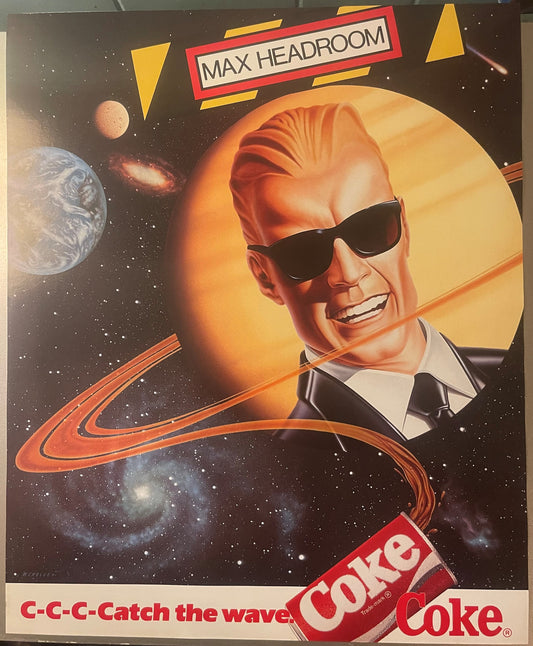
By the mid-'80s Coke and Pepsi were at each other's throats. In April 1985 Coca-Cola changed its formula - New Coke - and the country revolted; 79 days later the old recipe was back as Coca-Cola Classic. After that, Coke went looking for some cool. In April 1986 it signed Max Headroom - the deal was reported at around $4 million - for the Catch the Wave ads, and within a month something like three out of four American teenagers could tell you who he was. The ads leaned right into his stutter - "C-c-catch the wave!" - and on April 20, 1987 Newsweek put him on its cover under the headline "Mad About M-M-Max." This sticker comes from that campaign, at the height of it.

You have to remember how personal the rivalry had gotten. This was the era of the Pepsi Challenge, the blind taste test that made the soft-drink fight national news. When Coke changed the formula, loyal drinkers organized protests, hoarded cases of the old stuff and flooded the company's phone lines, and New Coke limped on afterwards in a much smaller role. So Coke bet that a sharp-tongued, sarcastic pitchman could give the brand a jolt of futuristic cool and a sense of humor about itself. A reported $4 million was enormous money for a fictional character's endorsement, and the commercials became genuine events. The "P word" gag fits right in - a not-so-subtle jab at Pepsi, the rival the sticker never names.

The TV spots weren't the whole of it, either. A June 1987 Christian Science Monitor piece on Max's licensing listed Coke's other Max promotions - a Max watch, Max face masks and "off-the-wall" ceiling clocks - and called him the hottest television pitchman in a long time. His American licensing agency, Taft/Hamilton, had signed nearly three dozen licensees, with about 150 Max Headroom products on the way, from teacups and T-shirts to skateboards.

📺 Twenty minutes into the future

Max started in Britain in 1985, in a Channel 4 TV film, Max Headroom: 20 Minutes into the Future, made by Chrysalis Visual Programming - the company on this sticker - and created by George Stone, Annabel Jankel and Rocky Morton. In the story, reporter Edison Carter crashes into a car-park barrier, and the last thing he saw was the sign on it, MAX. HEADROOM - which is where the name came from. The film aired on April 4, 1985, and two days later Channel 4 handed him his own music-video show, The Max Headroom Show, billed as the first computer-generated TV presenter. Everybody assumed he was computer-generated, but there was no computer on earth in 1985 that could do that: it was actor Matt Frewer in prosthetic makeup, a foam-latex and fiberglass suit and contact lenses, shot against a moving background, with the stutter added in editing. The pilot still won a BAFTA for its graphics in 1986, with nothing computer-made in it but some simple lines behind him.

Here's how the story goes in the film itself. The screenplay was by Steve Roberts, from a story by Stone, Morton and Jankel. Carter, fleeing the parking garage on a motorcycle, hits the barrier - the sign reads MAX. HEADROOM 2.3 M, a height-clearance warning - and while he's out cold his mind and memories are copied into a computer, and the copy takes the name off the sign. I love that a warning meant to stop anything too tall from getting through became the name of a character who couldn't stop talking. His world was a near-future run by a TV company called Network 23 - a satire of television itself - which made him a strange, knowing choice to turn around and sell soda on actual television. And Frewer's timing did as much as the editing: that jerky, broken-record cadence is why Max felt alive rather than mechanical, glitchy rather than robotic.

He got everywhere after that. The Art of Noise put him on their single "Paranoimia," a No. 12 hit in Britain that made the American top 40. In 1987 Cinemax ran his show over here and ABC launched a Max Headroom drama with Frewer playing both Max and Edison Carter - it lasted two seasons. And Chrysalis licensed his face out on both sides of the Atlantic, from a British Christmas annual to Coke stickers like this one, with its copyright in the corner.

That name in the corner wasn't a print shop or an ad agency. Chrysalis was the production company that made Max and held the rights to him, and its line on a Coca-Cola sticker shows you the licensing chain in one glance: Chrysalis owned the character, and Coke paid to borrow him. In June 1987 Chrysalis filed to register MAX HEADROOM in the United States for photographic prints, video tapes, computer games and motion picture film. The same application claimed "advertising services for others," too, with a first use dated March 13, 1986, a few weeks before the Coke deal.

📡 The night Max hijacked Chicago

And here's the strangest Max Headroom story of all, from the same year as this sticker. On November 22, 1987, somebody wearing a Max Headroom mask broke into the broadcast signals of two Chicago TV stations, WGN during the sports news and WTTW during an episode of Doctor Who, with buzzing, nonsense and a can of Pepsi. Nobody was ever caught, and it's still one of the great unsolved mysteries of television.

🔁 He never really went away

Max keeps coming back. Frewer played him again, aged and creaky, in Channel 4's digital switchover ads in 2007 and 2008; in 2015 he turned up in the movie Pixels, this time truly computer-generated from a capture of Frewer's face; and in 2022 AMC announced a new Max Headroom series with Frewer returning. The Coke stickers belong to the first run, though - 1987, the year he was everywhere.

It's easy to forget how strange it was to build a national soft-drink campaign around a "computer-generated" character before most people had a home computer worth mentioning. Max showed up just as ordinary Americans were first hearing words like "digital" and "cyberspace" without quite knowing what they meant, and Coke hired a satire of television to sell a product sold almost entirely through television.

🖼️ Display ideas

  • 🚗 Framed flat behind glass with other vintage Coca-Cola advertising for a soda-fountain wall
  • 📺 With other 1980s pop-culture and TV memorabilia for a "birth of the digital age" display
  • 🥤 Next to other Coke pieces from the same years, so they tell the New Coke and Catch the Wave story together
  • 🛠️ In a garage or workshop, where the hazard-stripe border makes a fun visual pun
  • 🎞️ Near a vintage television or retro electronics, a nod to Max's broadcast-satire roots
  • 🎨 Matted and framed on its own as a piece of 1980s graphic design - the color-blocking holds up all by itself

🎁 Who goes for these

Coca-Cola collectors want it as a piece of the brand's most talked-about advertising decade. Pop-culture and TV people want it for Max, one of the most original characters '80s television ever turned out. Advertising and graphic-design collectors like the hazard-stripe layout and bold primary colors as a snapshot of the period's design language. And plenty of folks are chasing a very particular memory - the stuttering face on the screen, the "Catch the Wave" line, and the feeling that the future had shown up a little early and was in on the joke.

🥤 About these

Every one I have is about 11 by 3 inches, still on its backing. Frame it with Coke memorabilia, put it in an '80s room, or give it to the friend who still quotes Max. The supply is finite - Coke isn't printing Max Headroom stickers again, and once these last unused ones are gone, they'll be very difficult to acquire.

Shipping

🚚 Shipping & Handling

  • Shipping costs and timing are calculated at checkout.
  • Items curated and shipped directly by me include U.S. shipping at no additional cost, professionally packed to ensure safe arrival of your artifact.

Items from Vetted Pro Collectors
Shipping for items offered by vetted Pro Collectors is determined at checkout. All Pro Collector listings are reviewed to ensure fair, reasonable shipping practices.

For full details, please refer to our Shipping Policy.

Returns & Exchange

Take your time — you've got a full six months. If a piece isn't right for you, send it back the way it reached you and we're good.

In the first 30 days your money goes straight back the way you paid. After that it's store credit, so you can put it toward something you'd rather have.

Return shipping we sort out between us, case by case. I don't make this difficult.

If something arrives damaged, or it isn't what I said it was, send me a photo within 48 hours and I'll make it right.

Email info@vintageantiquesgifts.com or call 802-356-9872 — that's me answering, not a call center.

The only things I can't take back are custom or special-order pieces and gift cards.

View full details

Rescuing American History Since 2007

— Travis & the Kids