Skip to product information
1 of 7

Vintage and Antique Gifts

Vintage 1960s New York Central Railroad Stock Certificate 🚂 100 Shares Blue, Vanderbilt Portrait, Delaware Seal, Engraved Scripophily, USA Icon

Vintage 1960s New York Central Railroad Stock Certificate 🚂 100 Shares Blue, Vanderbilt Portrait, Delaware Seal, Engraved Scripophily, USA Icon

Regular price $7.00 USD
Regular price Sale price $7.00 USD
Sale Sold out
Shipping calculated at checkout.

Size: 12" x 8"

🚚 Free US Shipping — ships within one business day. International shipping calculated at checkout.

Quantity

Why Was the New York Central Called the Water Level Route? 🚂 A Vintage 1960s New York Central Railroad Stock Certificate, Blue, American Bank Note Company

Size: 12" x 8" ~ Little to no storage wear.

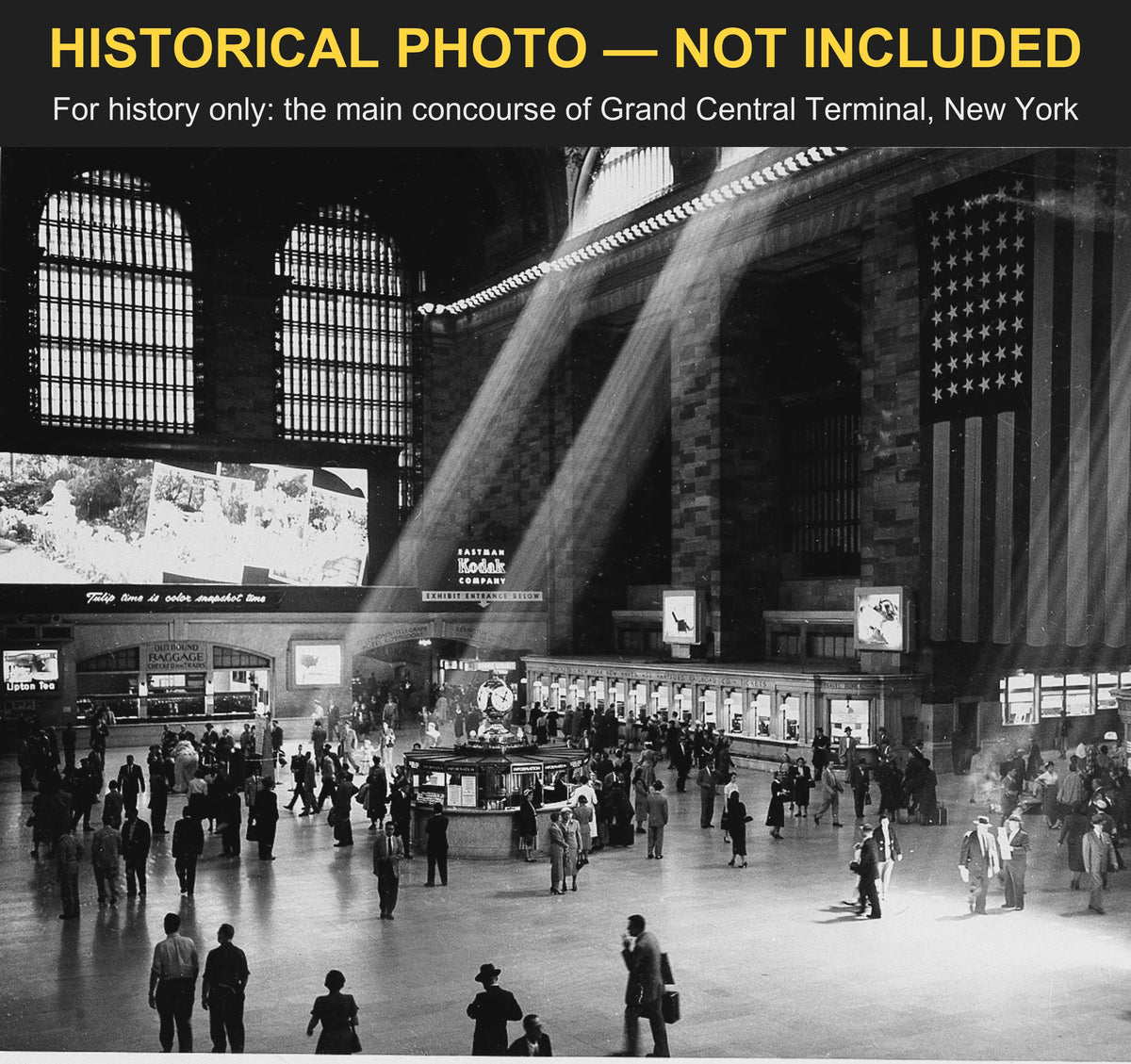
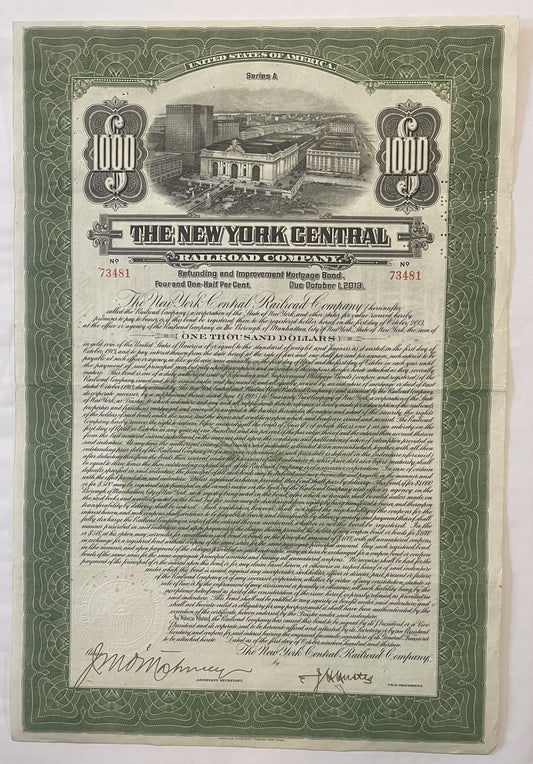
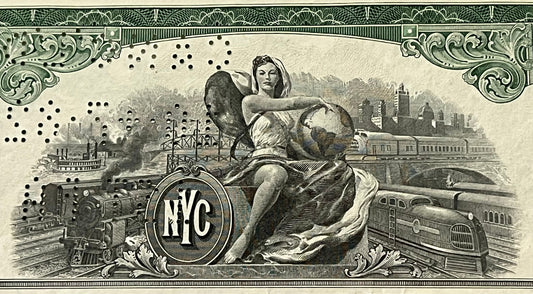
A real, issued capital stock certificate of THE NEW YORK CENTRAL RAILROAD COMPANY, engraved in blue and black by the AMERICAN BANK NOTE COMPANY. The 100 SHARES medallions sit in both upper corners, ONE HUNDRED shares of $1 par value each, CAPITAL STOCK runs diagonally underneath, and it's A CORPORATION ORGANIZED UNDER THE LAWS OF DELAWARE, TRANSFERABLE IN THE CITY OF NEW YORK OR IN CHICAGO. The oval portrait of the old gentleman with side whiskers and a white cravat isn't named on the sheet, but that's the face of Commodore Cornelius Vanderbilt himself, the same white hair, side whiskers and white cravat as his portrait photographs from around 1860 - fitting, since the Central was his railroad. Registrars are Manufacturers Hanover Trust Company and The Northern Trust Company of Chicago, and the seal, an eagle perched on a striped shield with DELAWARE arched above it, reads CORPORATE SEAL 1960. Each one was filled in, endorsed, tax-stamped and punch-cancelled.

📅 The 1960s

The seal's 1960 is the year of the Delaware company, and the printed registrar narrows it further: Manufacturers Hanover Trust only came into being in 1961, when Manufacturers Trust merged with the Hanover Bank. Since the New York Central disappeared into Penn Central in 1968, this printing belongs to 1961-1968, the railroad's last independent years. The one you get will carry its own date, number, owner and stamps, and may look a little different from the one in my pictures.

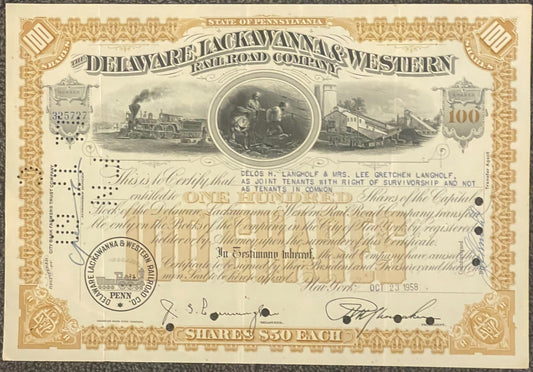
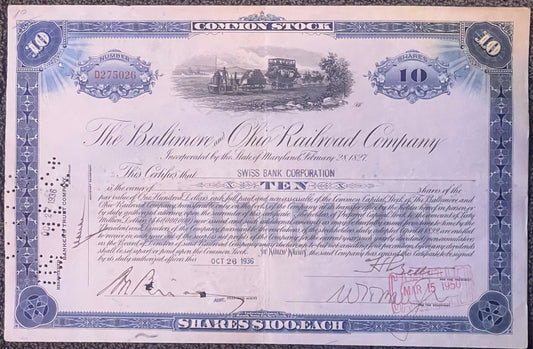
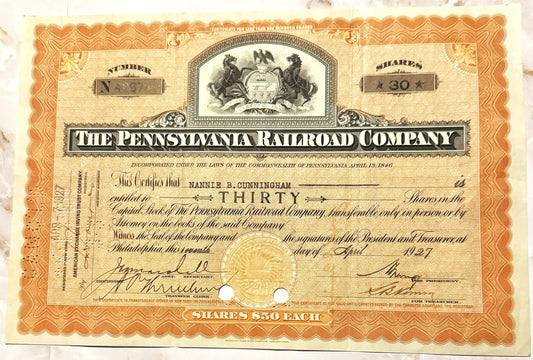
📜 Every one of these certificates had a working life, and it can show. Depending on the sheet, you may find staples or staple holes, cancellation punch holes (often right through the signatures), hand stamps from banks, brokers and transfer agents, real federal or state stock transfer tax stamps, handwriting or a filled-in transfer on the back, papers still attached, seals (a corporate seal pressed into the paper, a foil wafer seal, or a bank's signature-guarantee stamp signed across an endorsement), or a silver strip pasted over an officer's signature with the new officer's signature printed on top. That last one is what collectors call silvering: when the officers changed, the new signature could be pasted right over the old one on certificates already printed. None of that is damage. Each mark is part of the paper's own history, and they vary sheet to sheet, so no two are quite alike.

🚂 The Commodore's railroad

The Central itself goes back to 1853, when the New York legislature let a string of little separately chartered lines between Albany and Buffalo merge into one trunk railroad. Cornelius Vanderbilt got control of the New York Central in 1867 and in 1869 married it to his Hudson River Railroad, and the system grew from there to run from New York and Boston to Chicago and St. Louis, with Cleveland, Detroit, Buffalo and Cincinnati along the way - pretty near a map of industrial America, and of the Great Lakes cities. His son, William Henry Vanderbilt, is said to have doubled the family fortune running it, and the Vanderbilts that came after built the Fifth Avenue mansions and the Newport "cottages" that still stand for the Gilded Age. Its line followed the Hudson, the Mohawk Valley and the Erie Canal route through the gap in the Appalachians, and the company turned that geography into a marketing slogan that railroad old-timers still repeat with a grin: America's Water Level Route. Faster, smoother, heavier trains - and in 1913, Grand Central Terminal in the middle of Manhattan, on Park Avenue at 42nd Street. The New York Central Building went up behind it in 1929, built so Park Avenue runs straight through its base - one of Midtown's best oddities. The story everybody tells about its great concourse is that the starry ceiling was painted backwards, the zodiac reversed as if you were looking down on the heavens from outside.

🌹 The red carpet

Through the 1900s the Central's pride was the 20th Century Limited, the overnight express between New York and Chicago from 1902 to 1967, sixteen hours along the water level, streamlined by Henry Dreyfuss in 1938. Its great rival was the Pennsylvania Railroad's Broadway Limited, and the two overnight trains raced each other between New York and Chicago for decades. Legend passed down among rail fans holds that red carpet treatment comes straight from that train, from the crimson carpet rolled out at Grand Central for its passengers. True or polished with age, it's a piece of lore too good not to pass along.

🏦 The banks on the face

The printed banks tell the same story as the dates. Besides Manufacturers Hanover, the transfer agent in New York is Chemical Bank New York Trust Company, the name Chemical Bank carried after it took in the New York Trust Company in 1959 and dropped again in 1969. Out west the paperwork ran through The Northern Trust Company and The First National Bank of Chicago, because Chicago was the other end of the Central's main line - the sheet itself says the shares could change hands in New York or in Chicago.

📉 The end of the line

Alfred E. Perlman ran the Central from 1954, pushing diesels and modern operations as highways and airlines ate into the railroads, and that's his name, Perlman, signed over "President" on these certificates. It wasn't enough. On February 1, 1968 the New York Central merged with its old rival the Pennsylvania Railroad to form Penn Central, and in June 1970 Penn Central went bankrupt, the largest corporate bankruptcy the country had seen. Congress created Amtrak in 1971 for the passenger trains, and the freight went to Conrail in 1976, and the Central's name went into the history books.

🏛️ The fight over Grand Central

The Central's grandest piece of real estate nearly went the way of Penn Station. After the merger, Penn Central wanted to put an office tower on top of Grand Central Terminal, New York City's landmarks commission said no, and Jacqueline Kennedy Onassis was one of the loudest voices for saving it. The railroad took the city all the way to the Supreme Court, and in 1978 the Court sided with the city. That ruling is why Grand Central is still standing - it's the hub of the Metro-North commuter lines now, and Amtrak's Empire Corridor and Lake Shore Limited still run on stretches of the old Water Level Route - and why landmark laws all over the country have teeth today.

📜 About these

They're 12 by 8 inches, engraved on heavy paper. The Grand Central photographs at the end are there for history only and aren't included. Frame one for a train room, a home office, or anybody whose family rode the Century. The supply is finite - the New York Central is long gone, nobody's issuing its stock again, and once these last ones are framed, they'll be very difficult to acquire.

Shipping

🚚 Shipping & Handling

  • Shipping costs and timing are calculated at checkout.
  • Items curated and shipped directly by me include U.S. shipping at no additional cost, professionally packed to ensure safe arrival of your artifact.

Items from Vetted Pro Collectors
Shipping for items offered by vetted Pro Collectors is determined at checkout. All Pro Collector listings are reviewed to ensure fair, reasonable shipping practices.

For full details, please refer to our Shipping Policy.

Returns & Exchange

Take your time — you've got a full six months. If a piece isn't right for you, send it back the way it reached you and we're good.

In the first 30 days your money goes straight back the way you paid. After that it's store credit, so you can put it toward something you'd rather have.

Return shipping we sort out between us, case by case. I don't make this difficult.

If something arrives damaged, or it isn't what I said it was, send me a photo within 48 hours and I'll make it right.

Email info@vintageantiquesgifts.com or call 802-356-9872 — that's me answering, not a call center.

The only things I can't take back are custom or special-order pieces and gift cards.

View full details
  • 5 stars: 3 (100%)
  • 4 stars: 0 (0%)
  • 3 stars: 0 (0%)
  • 2 stars: 0 (0%)
  • 1 star: 0 (0%)
2
2***r (951)

Well packed, great communication. All good Ty

i
i***p (2205)

Share received as dicribed

y
y***e (811)

thanks so much!!

Rescuing American History Since 2007

— Travis & the Kids