Skip to product information
1 of 3

Vintage and Antique Gifts

Antique La Amita Habana Cigar Band Tampa Florida Perfecto Garcia and Bros Germany Printed Rampant Lion Collector Cigar Band 🚬

Antique La Amita Habana Cigar Band Tampa Florida Perfecto Garcia and Bros Germany Printed Rampant Lion Collector Cigar Band 🚬

Regular price 5.50 USD
Regular price Sale price 5.50 USD
Sale Sold out
Shipping calculated at checkout.
Quantity

What Does a Two-and-Three-Quarter-Inch Slip of Paper Tell You About the Golden Age of American Cigars? 🦁

More than you might expect. A lot more, actually. There is something quietly extraordinary about holding a piece of printed and embossed paper this small — something that once wrapped a single hand-rolled cigar, did its job in a humidor or on a tobacconist's shelf, and was meant to be slipped off and forgotten. Most were. The ones that weren't — the ones that landed in a drawer, a scrapbook, a cedar box, or the careful hands of a collector who recognized what they had — carry an outsized weight of history. They are, in a very real sense, the calling cards of an entire civilization of craft. And this one, this particular little band, is a genuine beauty.

Pick it up and you are holding Tampa, Florida in the 1910s and 1920s. You are holding the ambition of a family manufacturer, the artistry of an engraver, the quiet pride of a hand-roller who believed the cigar he finished deserved a crown worthy of its contents. You are holding a world that took small things seriously — and left evidence of that seriousness in gold and crimson on a strip of paper the width of two fingers.


🏷️ What This Is — The Object Itself

This is an antique New Old Stock cigar band from the La Amita Habana label, produced in Tampa, Florida during the 1910s through the 1930s — a precise, storied window in American tobacco history when Tampa was, without serious argument, the cigar capital of the United States. The band measures 2¾ inches by ¾ inches, a standard Perfecto-era proportioning that was designed to wrap the broadest part of a hand-rolled cigar with a tailored, jeweler's-fit elegance. The manufacturer named on the band is Perfecto Garcia & Bros, a firm whose name alone places this squarely in the elite tier of Tampa's golden-age cigar houses.

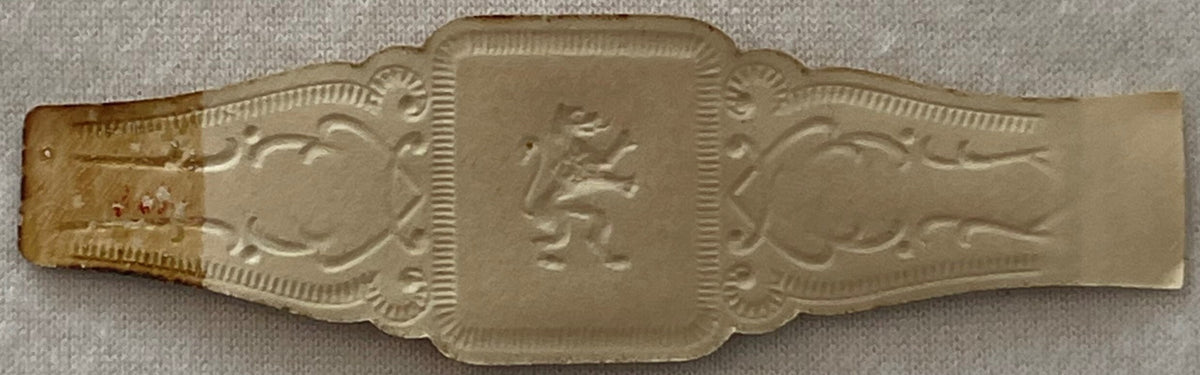
The band is built around a bold central cartouche in deep crimson red, trimmed throughout in rich gold embossing — embossing that is dimensional and tactile, the kind you can feel with a fingertip, raised from the paper surface in the manner of the finest commercial printing of the era.

At the top of that central cartouche, La Amita arches in clean white lettering. Along the bottom, Habana anchors the brand identity, a word that in the cigar world of the early twentieth century carried enormous commercial and aspirational weight. At the heart of the cartouche, a rampant lion rears upward in gold — a heraldic device straight from the visual grammar of old-world prestige, the kind of imagery that communicated premium quality without requiring a single word of explanation to any customer, in any language, in any shop from Ybor City to New York.

Flanking that central medallion, the two wings of the band carry the geographic and manufacturer's identity: on the left, Tampa, Fla in a red oval set against white; on the right, Perfecto Garcia & Bros, named with the same confident red-and-white palette. Gold embossed scrollwork — intricate, dimensional, curling into flourishes and shell forms — connects all of these elements and catches light in the way that only relief-printed gold on antique paper can.

This is New Old Stock: never mounted, never wet, never glued to anything. It survived intact, exactly as it left the print shop.


🌿 Tampa, Florida and the World That Made This Band

To understand why a cigar band this small carries this much gravity, you have to understand what Tampa was during the years this band was printed. By the 1880s, the neighborhood of Ybor City — platted by Vicente Martinez-Ybor just northeast of downtown Tampa — had become the beating heart of American cigar manufacturing. Ybor himself relocated his operations from Key West in 1886, drawn by the rail connections, the deep-water port access, the favorable climate for tobacco, and the extraordinary labor pool of skilled Cuban, Spanish, and Italian rollers who followed the industry north. Within a decade, dozens of factories had opened. By the early 1900s, Tampa was producing tens of millions of hand-rolled cigars per year. The city's economy, its architecture, its food, its music, its newspapers, and its social clubs were all built around the cigar.

The factories of Ybor City were not quiet places. They were famously loud — not with machinery, but with the human voice. Lectores, professional readers, sat on elevated platforms inside the rolling rooms and read aloud to the workers for hours each day: newspapers, novels, political philosophy, labor theory. The rollers paid the lectores out of their own collective wages. This practice, brought from Cuba, meant that the men and women who hand-rolled cigars in Tampa were, by many accounts, among the most broadly informed working people in the Americas. The cigars they rolled were, in a sense, made in the company of ideas.

Local legend holds that certain factories in Ybor City maintained a strict hierarchy of quality so fierce that rollers who produced substandard work would find their station quietly reassigned without a word spoken — the lector's reading simply continuing without pause over the transition. Whether that particular story is precisely true matters less than what it tells you about the culture: in these factories, craft reputation was everything. The band that went around a cigar was not decoration. It was a signed statement of quality. It was the manufacturer's promise, pressed in gold.


🏛️ Perfecto Garcia & Bros — The Name on the Band

Perfecto Garcia & Bros was one of Tampa's genuinely significant cigar manufacturing houses. Operating across the golden decades of Ybor City production, the Garcia family brought to their enterprise the combination of Cuban tobacco tradition and Florida manufacturing infrastructure that defined the finest Tampa cigars. The name Perfecto itself was a cigar shape — a classic tapered form, closed at both ends, thicker in the middle, requiring exceptional skill to roll correctly — and choosing that word as a family name in the cigar business was either an extraordinary coincidence or a piece of brand identity that went all the way to the bone.

The firm produced cigars under multiple brand labels, as was common practice among the larger Tampa manufacturers. Different labels addressed different price points, retail channels, and regional markets — but the underlying commitment to hand-rolling, to long-leaf filler, and to the Cuban-seed tobacco grown in the rich soils of the Vuelta Abajo region remained consistent across the house's output. La Amita Habana as a label name communicated both familiarity (amita, a term of affectionate address) and premium geographic origin (Habana, the gold standard reference in American cigar marketing of the era). It was a name designed to feel warm and trustworthy and, simultaneously, to gesture toward the finest tobacco-producing region on earth.

Lore passed down among Florida tobacco collectors holds that the Garcia family maintained personal relationships with specific leaf suppliers in Cuba well into the 1920s, traveling to inspect crops and select leaf in a manner more common among the finest European wine négociants than American manufacturers. Whether those specific sourcing trips can be documented to the letter, the broader practice of senior partners making personal buying trips to Havana was absolutely common among Tampa's elite houses — and the care that went into the labels and bands these firms produced was a direct reflection of how seriously they took the chain of quality from leaf to finished cigar.


🎨 The Art of the Cigar Band — Printing, Embossing, and Why These Objects Matter

A cigar band in the 1910s and 1920s was a finished piece of commercial printing art. The process that produced something like this La Amita Habana band typically involved multiple passes through lithographic or letterpress equipment, each pass laying down a separate color or applying the embossing die that gave the gold elements their dimensional, tactile quality. The embossing — that raised, three-dimensional feel of the gold scrollwork and central cartouche — required a separate male-and-female die set, precisely registered, pressed into the paper under significant mechanical force. This was not a fast or cheap process. Cigar manufacturers of this era spent real money on their bands because they understood that the band was the first thing a buyer saw, the thing that justified the price, and the thing a satisfied customer would remember when they came back for more.

The rampant lion at the center of this band is a particularly deliberate choice. Heraldic imagery — lions, eagles, shields, crowns — was the visual vocabulary of European quality assurance, the kind of imagery found on royal warrants, on fine spirits labels, on the livery of established trading houses. For a Tampa cigar manufacturer to place a rampant gold lion at the center of their band in 1915 or 1920 was to claim membership in that tradition of verified excellence. It was an argument made in image rather than text, and it was an argument that any buyer, literate or not, in any language, immediately understood.

New Old Stock bands like this one — never applied, never wetted, surviving in the condition in which they left the printer — are genuinely rare. The attrition rate for cigar bands across the twentieth century was enormous. Most were discarded. Many that were saved were later damaged by humidity, pests, or simply the passage of time in less-than-ideal conditions. A band that arrives today with its embossing still crisp, its red still saturated, its gold still catching light — that is a survivor in every meaningful sense of the word.


🌎 Why Tampa's Cigar History Still Resonates

The golden age of Ybor City cigar manufacturing essentially peaked in the 1920s and began a long structural decline through the Depression years and into the mid-twentieth century, as mechanization, changing tastes, and economic pressures transformed the industry. But the cultural imprint that era left on Tampa — on its food, its architecture, its music, its family histories — has never faded. The Columbia Restaurant, opened in Ybor City in 1905, is still operating. The mutual aid societies — the Centro Español, the Centro Asturiano, the Círculo Cubano — built magnificent buildings that still stand. The brick streets of the old factory district carry the weight of those decades in every course of their paving.

For collectors and historians, objects like this La Amita Habana band are among the most intimate surviving artifacts of that world. A photograph shows you a building or a street. A band shows you what was in a man's breast pocket on his way to a meeting in 1922. It shows you what a tobacconist placed in his window case to attract customers on a Saturday morning in 1918. It is evidence at human scale — small, personal, crafted with care, and against all reasonable odds, still here.


🖼️ Display Ideas

  • 🪞 Matted and framed as a standalone piece under UV-protective glass — the embossed gold catches gallery lighting beautifully, and the scale contrast against a generous mat gives the band tremendous visual presence.
  • 📚 Mounted in a collector's album or folio alongside other Florida or Tampa tobacco ephemera — maps, factory photographs, period advertisements — as part of a curated regional history display.
  • 🍂 Shadow-boxed with complementary artifacts — a vintage tobacco tin, a period matchbook, or a small hand-rolled cigar mold — to create a thematic still life that tells the story of the Ybor City era.
  • 🖊️ Displayed in an antique dealer's reference collection as a touchstone piece for the Tampa / Ybor City cigar category — the kind of object that educates the eye and provides a benchmark for condition and authenticity.
  • 🎁 Presented as a heritage gift for a family with Tampa, Cuban, or Florida tobacco roots — framed with a printed card carrying the provenance notes, it becomes an heirloom rather than a curiosity.
  • 🏛️ Incorporated into a local history or museum display about Florida's tobacco industry, the immigrant communities of Ybor City, or the commercial printing arts of the early twentieth century.

🎁 Who Collects These

Cigar band collecting — known formally as vitolphilia — has a history nearly as long as the commercial cigar industry itself. Victorian-era collectors assembled enormous albums of bands, treating them as the cigarette cards and postage stamps of the tobacco world: miniature printed works, serializable, tradeable, endlessly varied. That tradition never died. Today, serious collectors of American tobacco ephemera pursue bands with the same disciplined focus that paper money collectors bring to early currency — studying printing methods, tracking the evolution of individual brands, and placing premium value on NOS condition examples that have never been applied or damaged.

Beyond the dedicated vitolphilists, this band attracts several overlapping collector communities. Florida and Tampa local history collectors pursue any surviving artifact of the Ybor City era with genuine passion — the documentation of that world is thinner than its cultural importance deserves, and objects like this help fill the archive. Advertising and commercial art collectors recognize the band as a superb example of early twentieth-century chromolithographic and embossed printing, a category that has appreciated significantly as the field of ephemera collecting has matured. Cuban-American heritage collectors find in Tampa cigar bands a material connection to the families, firms, and craft traditions that their ancestors carried from Havana to Florida. And heraldic and graphic design enthusiasts are simply drawn to the extraordinary visual density of a well-designed band — the way that a designer in 1915 packed a complete brand identity, a quality argument, a geographic claim, and a visual pleasure into less than two square inches of paper.

Gift-givers with a sense for meaningful objects also find their way to pieces like this. A band from a Tampa cigar house, properly framed and presented, is a thoughtful and genuinely unusual gift for a history teacher, a Florida native, a collector who thinks they've seen everything, or anyone with family roots in the Cuban and Spanish immigrant communities that built Ybor City. These are objects with stories — and the stories travel with them.


❓ Frequently Asked Questions

What does "New Old Stock" mean for a cigar band, and why does it matter?

New Old Stock — NOS — means this band was never applied to a cigar. It was produced, survived in unapplied condition through the decades, and has reached us without having been moistened, stretched, torn, or glued. For a cigar band collector, NOS condition is the highest standard. A NOS band retains the embossing in its original crisp, dimensional state, the color saturation exactly as the printer intended, and the paper surface free from the handling artifacts that accumulate over a century of normal use. When you encounter a NOS band from the 1910s–1930s with intact embossing and saturated color, you are looking at the printshop's output, not a survivor's battle scars. That distinction matters enormously to serious collectors and significantly affects value.

Is the gold on this band real gold leaf, or a gold-toned ink?

The gold elements on period cigar bands of this quality were typically produced using one of two methods — gold-toned metallic ink applied by lithographic or letterpress printing, or genuine gold leaf applied through a bronzing or hot-stamping process. Both methods were in active commercial use during the 1910s–1930s, and both produce a result that catches light beautifully and reads as genuine metallic gold to the eye. The embossed dimension of the gold areas on this band — the fact that it is raised from the paper surface rather than flat — indicates a process that involved a die and significant mechanical pressure, consistent with the premium embossed printing that Tampa cigar manufacturers commissioned for their finest labels. Determining conclusively which specific gilding method was used requires spectroscopic analysis, but the visual and tactile quality is consistent with the finest commercial printing of the era.

How do I properly store or display this band to preserve it long-term?

Paper ephemera of this age and quality deserves thoughtful storage. For long-term archival storage, acid-free sleeves or envelopes — Mylar or polyethylene, available from any serious philatelic or ephemera supplier — are the standard. Keep the band away from direct sunlight, which fades both the crimson red and the metallic elements over time, and away from high humidity environments, which can cause the paper to wave, the embossing to soften, and any adhesive or sizing in the paper to activate. For display framing, UV-filtering conservation glass is strongly recommended — it blocks the ultraviolet wavelengths most responsible for color fading while allowing the piece to be seen clearly. A standard mat and frame with UV glass, professionally assembled, will protect this piece for decades while showcasing it beautifully. Avoid displaying it in direct window light regardless of the glass quality; indirect or artificial lighting is always gentler on antique paper.

What was the La Amita Habana brand, and how does it fit into Tampa's cigar history?

La Amita Habana was one of the branded labels produced by Perfecto Garcia & Bros, a Tampa cigar manufacturing house operating during the golden era of Ybor City production. The label name is a compound of warmth and aspiration: La Amita carries connotations of affection and familiarity in Spanish, while Habana — Havana — was the most powerful single word in American cigar marketing, invoking the finest Cuban tobacco and the long tradition of Havana cigar craftsmanship. This combination was a deliberate brand positioning: approachable and warm in personality, premium and aspirational in its tobacco identity. Tampa manufacturers of this era produced many brands under their roofs, often simultaneously, targeting different retail channels and price points while maintaining the same underlying commitment to hand-rolling and quality leaf. La Amita Habana occupied the premium end of that spectrum, as evidenced by the quality of the embossed band produced to wrap it.

Are cigar bands from this era appreciating in collector value?

Within the broader category of American tobacco and advertising ephemera, premium cigar bands — particularly NOS examples from named manufacturers in historically significant production centers like Tampa — have shown consistent collector interest and appreciation over the past several decades. The pool of genuinely fine material is finite and does not grow; attrition over the twentieth century was significant. At the same time, the collector communities pursuing this material — vitolphilists, Florida local history collectors, advertising art enthusiasts, Cuban-American heritage collectors — have remained active and in some categories have grown as the broader antique ephemera market has expanded. Bands with strong visual design, clear manufacturer attribution, NOS condition, and historical context (as this one has in abundance) occupy the upper tier of the category. As with any antique, individual piece values depend on condition, provenance, and the specific interests of the collector market at a given time — but the fundamentals here are strong.

Can this band be authenticated as genuinely period, or could it be a later reproduction?

Several characteristics of this band are consistent with genuine 1910s–1930s production and are difficult to replicate convincingly in later reproductions. The embossing — the dimensional, raised quality of the gold elements — requires period-appropriate die-pressing equipment and technique; modern reproductions of cigar bands are overwhelmingly flat-printed. The paper aging, the specific color characteristics of the crimson red (which behaves differently under aging than modern synthetic inks), and the overall printing register and quality are consistent with commercial lithographic and letterpress production of the era. The specific Perfecto Garcia & Bros attribution can be cross-referenced against documented Tampa manufacturer records. Collectors with deep experience in Florida tobacco ephemera consistently recognize period bands by the combination of paper hand, ink aging, embossing quality, and printing style — all of which align here with genuine early twentieth-century production.

What is the significance of the rampant lion on this band?

The rampant lion — a lion rearing upward on its hind legs, typically shown in profile — is one of the oldest and most widely recognized symbols in Western heraldry. It appears on the royal arms of England, Scotland, and numerous European noble houses, and in commercial application it carried a direct visual argument: this product belongs in the company of things approved by the highest authorities, of certified excellence, of verified premium quality. In the cigar world of the early twentieth century, heraldic imagery was common precisely because it communicated across language barriers — a Cuban roller, a Spanish tobacconist, an Italian retailer, and an Anglo-American buyer all read the rampant lion the same way, without a word of translation required. For Perfecto Garcia & Bros to place a gold rampant lion at the center of the La Amita Habana band was to make a quality claim in the most universally legible visual language available to them. It was, in the truest sense, the brand speaking without words — and a century later, it still does exactly that.

Shipping

🚚 Shipping & Handling

  • Shipping costs and timing are calculated at checkout.
  • Items curated and shipped directly by me include U.S. shipping at no additional cost, professionally packed to ensure safe arrival of your artifact.

Items from Vetted Pro Collectors
Shipping for items offered by vetted Pro Collectors is determined at checkout. All Pro Collector listings are reviewed to ensure fair, reasonable shipping practices.

For full details, please refer to our Shipping Policy.

Returns & Exchange

Take your time — you've got a full six months. If a piece isn't right for you, send it back the way it reached you and we're good.

In the first 30 days your money goes straight back the way you paid. After that it's store credit, so you can put it toward something you'd rather have.

Return shipping we sort out between us, case by case. I don't make this difficult.

If something arrives damaged, or it isn't what I said it was, send me a photo within 48 hours and I'll make it right.

Email info@vintageantiquesgifts.com or call 802-356-9872 — that's me answering, not a call center.

The only things I can't take back are custom or special-order pieces and gift cards.

View full details
  • 5 stars: 2 (100%)
  • 4 stars: 0 (0%)
  • 3 stars: 0 (0%)
  • 2 stars: 0 (0%)
  • 1 star: 0 (0%)
L
Lloyd

I’m a very happy customer! Thank you!!!

K
Kate

Nice product, speedy shipping, charming note included. Good purchase. Thank you.

Pleasure is all ours! We appreciate it.