Skip to product information
1 of 3

Vintage and Antique Gifts

Vintage 1910s-1930s Martin Mild Perfecto 🍂 Cigar Band Label Burgundy Red New Old Stock Collector

Vintage 1910s-1930s Martin Mild Perfecto 🍂 Cigar Band Label Burgundy Red New Old Stock Collector

Regular price 8.00 USD
Regular price Sale price 8.00 USD
Sale Sold out
Shipping calculated at checkout.
Quantity

Size: 2.75 x 0.75 inches

What Did This Little Red Strip of Paper Know That We've Forgotten? 🍂

There is a particular kind of quiet that settles over you when you hold a piece of printed ephemera that was never meant to survive. Cigar bands, wrapper strips, tear-tabs, sealing labels — these were the working clothes of the American tobacco trade. Printed by the thousands, applied by machine or by hand, and discarded the instant the cigar was lit. Nobody saved them on purpose. The ones that surface today do so almost by accident — tucked into a drawer, packed away in a box that moved house to house across three generations, forgotten in the back corner of a warehouse alongside stock that never shipped out the door. When a piece like this turns up whole, it carries something no reprint or reproduction can fake: the quiet weight of an object that was made to be used up, and simply wasn't. It passed through the middle of an earlier American century without ever meeting its cigar, and it comes to you now exactly as it left the press.

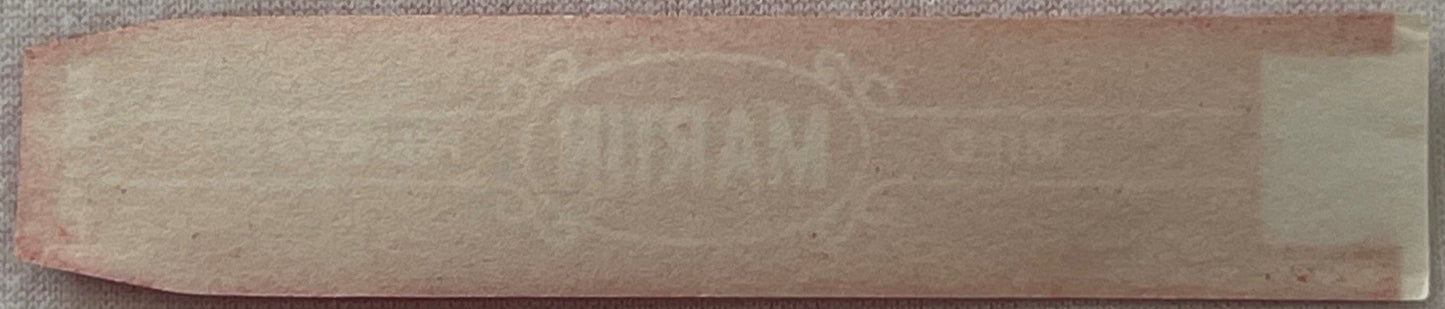
This is a Martin Mild Perfecto cigar band — a long, narrow lithographed wrapper strip, not the small decorative ring most people picture when they hear "cigar band." It's printed in deep burgundy red with crisp white lettering and ornament: an oval scrollwork medallion carrying the name MARTIN in bold, confident type, the word MILD to its left, PERFECTO to its right, twin horizontal rule lines running the length of the band, and at the far end a vertical TEAR HERE tab — the pull-strip that would have broken a cellophane seal and opened the package. A plain gummed tab sits at the opposite end, ready to adhere the strip closed around a cigar or its packaging. This piece is New Old Stock: manufactured, warehoused, and never applied. No manufacture date is legible on the piece itself, so rather than guess at a single year, it's best placed honestly in the broad window that its printing style and packaging feature support — the early twentieth century through the mid-twentieth century, an era spanning cigar culture's peak popularity through its long, slow eclipse by the cigarette.


🕵️ The Mystery of the Maker — A Brand Lost to Its Own Century

I'll be straight with you, because that's the only way I know how to sell old paper: I have not been able to pin down the specific cigar company, factory, or town behind this "Martin" brand. No trademark filing, no factory number, no printer's mark on the piece itself points me to an answer. That is not unusual — it is, in fact, the norm.

American cigar manufacturing in the era this band belongs to was not dominated by two or three giants the way cigarettes eventually would be. It was carried out in hundreds upon hundreds of small factories, family shops, and regional outfits, many of them named for nothing grander than the surname over the door — a Martin, a Schmidt, a Reyes, a Cohen.

Most left no corporate paper trail at all. Some ran for a decade and closed; others simply faded when cigarettes took over the pocket and the palate of the American smoker. What's left of them, more often than not, is exactly this: a single surviving band, unmoored from its factory, its town, and its people, asking to be identified by someone who never will be able to fully answer it.

That unresolved question is, honestly, part of what makes a piece like this worth keeping — it's a genuine artifact of a lost, undocumented corner of American small business.


🚬 America's Cigar Century — When Four Out of Five Men Lit Up

To understand why a band like this even needed to exist, you have to picture the sheer scale of American cigar culture at its height. Historians estimate that at the turn of the twentieth century, roughly four out of every five American men smoked cigars — and that in the single year 1900 alone, something like two billion cigar bands were printed and sold across the country. Two billion. That is an entire visual language of American commerce, built one small strip of colored paper at a time, wrapped around a product that was, for millions of men, a daily ritual rather than an occasional indulgence. Every one of those bands needed to say something fast: brand, strength, shape, quality — all legible at arm's length across a tobacconist's counter. "MILD MARTIN PERFECTO" does exactly that in four words. It's the commercial shorthand of an era when cigar brands numbered in the thousands and a band's job was to be recognized in a glance.


📛 The Perfecto Shape — Cigar Royalty in a Wrapper Strip

The word "Perfecto" printed here isn't a company name — it's a vitola, the trade term for a cigar's shape. Perfectos are tapered at both ends, closed at the foot, bulging generously through the middle before narrowing again toward the head — a silhouette that is, by every account, far harder to roll well than a simple straight-sided cigar. Cigar historians and rollers alike have long held the Perfecto up as a shape that, done properly, represents the height of the hand-rolling craft: a form that combines the elegance of an older, more ceremonial era of cigar-making with real blending skill. Naming a brand's strength and shape right on the band — Mild, Perfecto — was standard practice across twentieth-century American cigars, a little three-word résumé printed for a customer who wanted to know exactly what he was about to buy before he'd even opened the package.


✂️ Tear Here — The Little Tab That Tells a Bigger Story

That vertical TEAR HERE tab running down the end of this band is more than decoration — it's a genuine packaging artifact. Bands built with a tear-strip like this one were made to be pulled to break a seal, typically on cigars packaged in cellophane sleeves — a machine-packaging practice that spread through the American cigar trade as manufacturing modernized. It marks this band as a working piece of commercial design, built to do a physical job, not just to look handsome in a display case. Collectors prize this detail because it's a small, functional clue to how the product it once wrapped was actually sold and opened — a detail lost the instant the tab was actually torn, which is precisely why an unused example like this one is worth pausing over.


🎨 Lithography's Golden Hand — How This Band Was Made

The printing here is lithography, the same technique that carried the American cigar trade through its visual golden age. At its best, lithography could achieve smooth, even color coverage and crisp letterforms in a way no competing mass-printing method of the day could match — exactly what you see in the deep, even burgundy field and the sharp white scrollwork and lettering on this band. It's the same quiet proof of craftsmanship that period lithographed advertising is prized for today.


🧩 Not to Be Confused With — The Other "Martins" of Cigar History

Anyone who spends time digging through old cigar ephemera eventually runs into more than one "Martin." It's worth separating this band clearly from both. There was, in the early twentieth century, a well-documented five-cent "Abe Martin" cigar, licensed from humorist Kin Hubbard's popular newspaper character and manufactured by the Burdena Cigar Factory in Indianapolis — a completely different brand, with its own bands reading "Abe Martin," not the plain "Martin" seen here. And in the modern era, there is the Martin Family of Cigars, launched in 2011 in honor of Pedro Martín, founder of Tropical Tobacco, which he established in 1978 — a present-day premium cigar company whose bands read "Pedro Martin," again a different identity entirely. This "Martin Mild Perfecto" band stands apart from both — its own brand, its own era, its own small unanswered chapter in the long shelf of American cigar names.


📦 New Old Stock — Why a Band That Never Met Its Cigar Survives at All

Bands like this one belong to a recognized category within the hobby of vitolphilia, the collecting of cigar bands. Alongside the bands that actually made it onto a finished cigar, manufacturers also produced "factory bands" for their own product runs and "publicity bands" purely for advertising — and, inevitably, some printed bands simply never made it onto a cigar at all before a factory closed, a run was overprinted, or stock was simply set aside and forgotten. This is one of those survivors: a genuine unused example, never applied. Collectors organized under groups such as the International Label, Seal and Cigar Band Society have spent decades chasing down exactly this kind of piece — small, easily lost, and disappearing from circulation year over year as the paper itself ages out of existence.


🖼️ Display Ideas

  • 🖼️ Framed flat under glass alongside two or three other cigar bands, laid out as a small typographic study in red and white
  • 📖 Slipped into an archival sleeve inside a scrapbook or ephemera album devoted to early American advertising
  • 🗄️ Stored flat in an acid-free box as the centerpiece of a growing vitolphilia collection
  • 🏠 Displayed near a vintage humidor, tobacco tin, or smoking stand as a period-appropriate accent piece
  • 🎨 Used as reference material or inspiration for graphic designers studying early lithographic advertising typography
  • 🕯️ Set out on a library or study shelf as a small, conversation-starting piece of Americana

🎁 Who Collects These

This is a piece for the vitolphilist chasing complete, unused examples rather than bands salvaged off a smoked cigar. It appeals to collectors of early American advertising ephemera and lithographic printing, to those building out a shelf of tobacciana alongside old tins, cutters, and matchbook covers, and to anyone drawn to the small, disappearing paper trail of America's thousands of long-vanished small cigar factories. It's an approachable, affordable entry point into the hobby — a genuine, unused piece of early commercial art history for a collector who appreciates a mystery as much as a masterpiece.


❓ FAQ

Is this cigar band used or new?
It's New Old Stock (NOS) — manufactured and warehoused but never applied to a cigar or torn open. It comes to you exactly as it left the printer.

What does "Perfecto" mean on the band?
It refers to the cigar's shape, not the company — a Perfecto is tapered and closed at both ends with a bulging middle, one of the more demanding shapes to roll well and a mark of an older, more ceremonial cigar-making tradition.

What was the "Tear Here" tab for?
It's a functional pull-tab, designed to break the seal on a cellophane-wrapped cigar package — a genuine piece of mid-twentieth-century cigar packaging design.

How old is this cigar band, exactly?
There's no legible manufacture mark on the piece, so no single year or decade can be honestly claimed. Its printing style and packaging feature place it broadly within the early-to-mid twentieth century, spanning the peak of American cigar culture through its later, more utilitarian packaging era.

Is this connected to the modern Martin Family of Cigars or Pedro Martín?
No. That is a present-day premium cigar company launched in 2011 in honor of Pedro Martín, founder of Tropical Tobacco (founded in 1978). Its bands read "Pedro Martin." This is a separate, earlier "Martin" brand with no documented connection.

What is vitolphilia?
It's the formal term for cigar band collecting — a hobby with its own dedicated collector societies, built around exactly this kind of small, easily-lost printed ephemera.

Shipping

🚚 Shipping & Handling

  • Shipping costs and timing are calculated at checkout.
  • Items curated and shipped directly by me include U.S. shipping at no additional cost, professionally packed to ensure safe arrival of your artifact.

Items from Vetted Pro Collectors
Shipping for items offered by vetted Pro Collectors is determined at checkout. All Pro Collector listings are reviewed to ensure fair, reasonable shipping practices.

For full details, please refer to our Shipping Policy.

Returns & Exchange

Take your time — you've got a full six months. If a piece isn't right for you, send it back the way it reached you and we're good.

In the first 30 days your money goes straight back the way you paid. After that it's store credit, so you can put it toward something you'd rather have.

Return shipping we sort out between us, case by case. I don't make this difficult.

If something arrives damaged, or it isn't what I said it was, send me a photo within 48 hours and I'll make it right.

Email info@vintageantiquesgifts.com or call 802-356-9872 — that's me answering, not a call center.

The only things I can't take back are custom or special-order pieces and gift cards.

View full details