Skip to product information
1 of 10

Vintage and Antique Gifts

Vintage 1960s NOS Clockwork Tin Boy Drummer Wind-Up Toy 🥁 with Original Box

Vintage 1960s NOS Clockwork Tin Boy Drummer Wind-Up Toy 🥁 with Original Box

Regular price 20.00 USD
Regular price Sale price 20.00 USD
Sale Sold out
Shipping calculated at checkout.
Quantity

Size: 6 inches

🥁 Wind the Key and a Whole Vanished Toy World Marches Back to Life

This is a genuine 1960s clockwork tin wind-up drummer boy, complete and unplayed in its original illustrated box — New Old Stock, exactly as it left the toy works more than half a century ago. It was made in China for export and carries the model number MS 765, but it is best known by the wonderfully literal English name printed right across the front of its box: "Child Beating Drum. The era is given as our own records document it — the 1960s — with no false precision beyond that. What you are looking at is one of the most charming survivors of the golden age of tin toys: colorful, mechanical, complete with its box, and never wound down by a child's hands.


🎠 What You Are Actually Looking At

The little drummer stands about six inches tall and is a delightful mix of materials, each one chosen to give him personality. His head is bright orange vinyl, molded with a cheerful round face, big painted eyes and a single glossy black forelock combed across the crown — the unmistakable look of a mid-century Asian export toy. Over his shoulders and arms he wears a real cloth blouse with softly gathered, puffed sleeves; that touch of fabric, rather than more painted tin, is what gives him a strangely lifelike, almost animated quality when he moves. His torso is lithographed tin printed in a busy folk pattern of little blue-and-white hearts and teardrops, cinched with a printed belt, and his lower body is a candy-striped tin cylinder that houses the works. He stands on a sky-blue tin base edged with a scalloped, dotted border, and the whole assembly rolls on small wheels with pinwheel hubs in yellow and green.

In front of him sits the star of the show: a red tin drum, laced in the classic cross-hatch pattern of a real snare, decorated with cheerful cartoon animal roundels — a dancing bear grins from the drumhead, and a little rabbit in a blue jacket capers around the side. One arm is raised holding a bright brass-toned cymbal, poised as though he is about to bring it down with a crash. It is a complete, self-contained miniature one-boy band, and every element of it is intact.


⚙️ How the Little Drummer Works

Under that striped tin body is a clockwork motor — a coiled steel mainspring and a train of brass gears, wound by the key at the base. No batteries, no wires, no light-up gimmicks and no electronic sound: just the pure mechanical magic that made a child's eyes go wide before the age of plastic and microchips. When wound, a toy of this design trundles forward on its wheels while the arms swing to beat the drum and clash the cymbal, the sort of busy, jittering performance that a whole generation crowded around a dime-store counter to watch. The box itself names the mechanism in two languages — the English "CLOCKWORK" and the Chinese 发条 (fā tiáo, literally "spring"), the universal shorthand for a wind-up toy. Clockwork survivors of this age are usually enjoyed sparingly; collectors tend to wind them gently and rarely, protecting a decades-old spring that owes nobody a thing, and to prize them above all for how beautifully they display.


📦 "Child Beating Drum" — Reading the Original Box

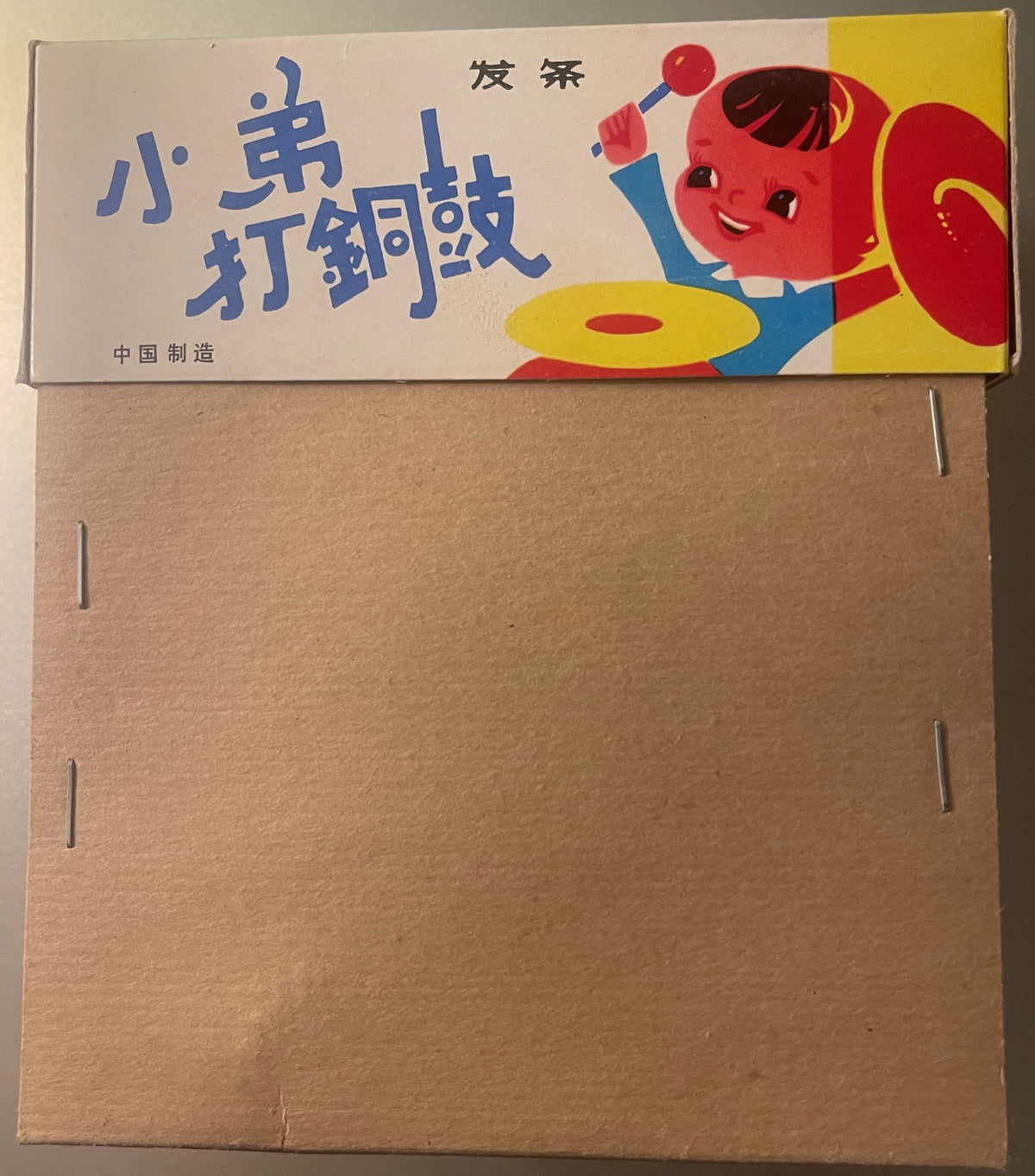
Half the joy of a boxed toy like this is the box, and this one is a small masterpiece of period packaging. The front panel bursts with color: a rosy, big-eyed cartoon child caught mid-swing at a drum, a golden cymbal spinning beside him, all under the playful blue balloon lettering "CHILD BEATING DRUM." Beneath that runs the Chinese title, 小弟打銅鼓 — which translates, charmingly, as "little brother beats the brass drum." The end flaps repeat the design and carry the export particulars: "CLOCKWORK," "MADE IN CHINA," and the model number, "MS 765," printed plainly on the panel. The phrase "Child Beating Drum" always makes modern collectors smile, but it is simply a literal period translation — "beating" a drum is exactly what a drummer does, the same way we still say a marching band "beats" its drums. That slightly-off, translated-straight-from-the-characters English is one of the most beloved hallmarks of mid-century export toys, and finding it intact and bright, still wrapped around the toy it was printed for, is a genuine treat.


🏭 The Golden Age of Tin Wind-Up Toys

To appreciate why a toy like this matters, it helps to picture the world that produced it. For roughly the first two-thirds of the twentieth century, the wind-up tin toy was the marvel of the nursery. Thin sheet steel was printed with brilliant color lithography, stamped, folded and tabbed together into figures, animals, cars and characters, then fitted with a clockwork motor and sold cheaply through variety stores, five-and-dimes and seaside gift shops. The craft moved from Germany to Japan and, by the postwar decades, increasingly to China's own toy works, whose export pieces were marked with tidy model codes like the MS 765 this drummer carries. Shanghai was the historic heart of that Chinese toy trade, and its little clockwork figures — musicians, acrobats, animals — traveled the world in bright cardboard boxes exactly like this one. Within a decade or two, battery power, molded plastic and licensed television characters swept the whole category away, and the lithographed tin wind-up became a thing of the past. That is why a complete, boxed, unused example is not merely a toy but a small artifact of an entire lost way of making and selling delight.


✨ Why New Old Stock, In the Box, Is the One to Own

Condition is everything with tin toys, and this is the very top of the ladder. Most drummers of this kind that survive at all are deeply playworn — the tin dented and scratched, the cloth blouse torn or missing, the cymbal long lost, the delicate wire arms bent, and, almost always, the box thrown away the same afternoon the toy came home. This one is the opposite: New Old Stock, meaning it was manufactured decades ago, held ever since as unused shop stock, and never handed to a child. The cloth is intact, the cymbal is present, the vinyl head and lithographed tin are bright, and it comes with the original box that so rarely survives. Complete boxed New Old Stock examples are the pieces collectors actually chase, and this one is offered as the most affordable boxed NOS example of this drummer currently on the market — the sole-source, cheapest boxed survivor for a buyer who wants the best version rather than a compromise. When something is this complete and this untouched, buying it now is simply buying the good copy while it exists.


🐻 The Cartoon Menagerie on the Drum

It is worth slowing down over the drum, because the small printed details are where a toy like this earns its charm. The red tin drum is lithographed with a whole little cast: on the head, a plump brown bear caught in a delighted, paws-up dance; around the side, a white rabbit in a smart blue jacket, capering along as though he has somewhere important to be. Dancing-animal bands were a favorite device of mid-century toy designers, who understood perfectly well that a child would rather watch a drumming bear than a plain drum, and the printer gave each creature its own bright circular frame like a circus poster shrunk to the size of a coin. It places the drummer in a long and lovely tradition — the mechanical one-figure band, an idea that runs back through European clockwork automata and the golden age of the music box, reborn here in cheerful, affordable tin for the postwar nursery. The whole toy is a tiny performance frozen mid-beat: the boy, the raised cymbal, the laced drum and its grinning menagerie, all held in suspense until someone turns the key.


🎨 The Craft of Tin Lithography

Toys like this were made by a process that has almost entirely vanished. Flat sheets of thin steel were printed with color artwork by offset lithography, then cut, stamped into shape, and joined with folded tabs rather than screws or glue — no molds, no injection plastic, just printed metal assembled by hand and machine. Every color you see on this drummer, from the folk-pattern torso to the striped base to the animal roundels on the drum, was laid onto the flat tin before it was ever bent into three dimensions, which is why the printing wraps so cleanly around the curves. The result has a depth and a faint sheen that modern printed reproductions never quite capture, and it is a large part of why collectors prize genuine period tin so highly. Holding one is a small lesson in how beautifully industry once dressed up a five-and-dime toy, and why so few of these delicate printed-metal figures survive in bright, unplayed condition.


🎁 Living With the Little Drummer

  • 🗄️ Stand him in a lit cabinet or on a shelf beside other tin wind-ups — the orange head and red drum read from across a room.
  • 📦 Keep the box displayed alongside or just behind him; the "Child Beating Drum" artwork is half the charm and doubles the visual impact.
  • 🎄 He makes a wonderful, unexpected shelf character at the holidays, when a wind-up drummer boy feels right at home.
  • 🎠 Group him with a nursery or circus theme — vintage clowns, musicians and animals — for an instant vignette of mid-century childhood.
  • 🎁 Give him to a tin-toy collector, a lover of clockwork mechanisms, or anyone charmed by the honest, hand-tabbed toys of the pre-plastic age.

❓ Questions Buyers Often Ask

Is this an original vintage toy or a reproduction?

It is a genuine period toy. The lithographed tin, the vinyl head, the cloth blouse and the printed box — including the "MADE IN CHINA," "CLOCKWORK" and "MS 765" markings — are all authentic to a mid-century export wind-up, and the piece is unused New Old Stock rather than a modern remake.

Does it still have its original box?

Yes. The original illustrated box is included, with its bright "Child Beating Drum" front artwork, its Chinese title characters, and the end flaps carrying the clockwork and model-number markings.

What is it made of?

A combination typical of the best export toys of the era: a lithographed tin body, drum and base, a molded vinyl head, real cloth for the blouse, a brass-toned cymbal, and a clockwork (wind-up) motor inside.

How old is it?

Our records place it in the 1960s. Toys of this pattern were made across a long export run, so we give the honest decade rather than pretending to a single exact year.

A wind-up drummer boy from the last great age of tin toys, still in his box, still smiling, and ready to keep the beat for whoever gives him his next shelf.

Shipping

🚚 Shipping & Handling

  • Shipping costs and timing are calculated at checkout.
  • Items curated and shipped directly by me include U.S. shipping at no additional cost, professionally packed to ensure safe arrival of your artifact.

Items from Vetted Pro Collectors
Shipping for items offered by vetted Pro Collectors is determined at checkout. All Pro Collector listings are reviewed to ensure fair, reasonable shipping practices.

For full details, please refer to our Shipping Policy.

Returns & Exchange

Take your time — you've got a full six months. If a piece isn't right for you, send it back the way it reached you and we're good.

In the first 30 days your money goes straight back the way you paid. After that it's store credit, so you can put it toward something you'd rather have.

Return shipping we sort out between us, case by case. I don't make this difficult.

If something arrives damaged, or it isn't what I said it was, send me a photo within 48 hours and I'll make it right.

Email info@vintageantiquesgifts.com or call 802-356-9872 — that's me answering, not a call center.

The only things I can't take back are custom or special-order pieces and gift cards.

View full details
  • 5 stars: 0 (0%)
  • 4 stars: 0 (0%)
  • 3 stars: 0 (0%)
  • 2 stars: 0 (0%)
  • 1 star: 1 (100%)
p
p***3 (583)

The seller agreed to a discount and after I paid he did not honour it .

Language might have been a barrier. I had no way to know this was an International order beforehand. The customer approached me about purchasing 3 items and receiving 15% off. I already have a 10% volume discount on 3 and 15% on more, so I replied, 'Why don't you just buy 4?' He said he only needed 3. I agreed to do it because I didn't have many reviews on the item. When I refunded him, he told me he 'was mad.' and wanted 25% off. I cancelled the order, apologized, but he was mad, so here we are