Skip to product information
1 of 4

Vintage and Antique Gifts

Antique 1900s-1930s Garcia y Vega Cigar Box Label ๐ŸŒฟ La Flor de Garcia y Vega NOS Embossed Gold Foil Tampa

Antique 1900s-1930s Garcia y Vega Cigar Box Label ๐ŸŒฟ La Flor de Garcia y Vega NOS Embossed Gold Foil Tampa

Regular price $9.00 USD
Regular price Sale price $9.00 USD
Sale Sold out
Shipping calculated at checkout.

Size: 8" x 7"

๐Ÿšš Free US Shipping โ€” ships within one business day. International shipping calculated at checkout.

Quantity

When Was Garcia y Vega Born? ๐ŸŒฟ A Woman, a Knife and a Cigar Company's Birthday

Size: 8" x 7"

She is carving a heart into a tree, the way sweethearts do, except the initials inside it read G y V 1882: the year Alvaro Garcia Longo, an immigrant from Asturias in northern Spain, started his cigar company in New York. This La Flor de Garcia y Vega inner lid label was printed for a box of 50 Napoleons cigars and never pasted into one. It is unused new old stock, embossed and gilded, with the printer's typed line still along its top edge.

What Is Printed on It

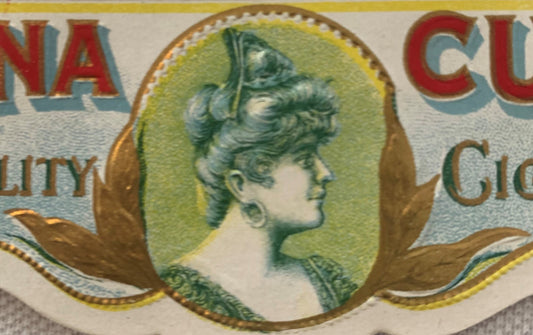
An inner lid cigar box label, 8 x 7 inches. Arched across the top in embossed gold: LA FLOR DE GARCIA Y VEGA. In the oval below, a dark-haired woman in a lavender-blue gown with white lace at the neck and cuff, a gold barrette in her hair, holds a small knife to a pale tree trunk where a heart encloses G y V 1882. Behind her is an autumn woodland in gold and green, with small figures among the trees. Crowned gold shields marked G y V stand on either side, and a garland of embossed gold flowers and green leaves runs around the base, over GARCIA Y VEGA in gold and a tiny REGISTERED IN U.S. PATENT OFFICE. Beneath the vignette is FINE CIGARS SINCE 1882, with 50 CIGARS at the lower right. A wide brown border with gold rules carries the name Garcia y Vega in script along the sides and bottom.

Outside the design, along the very top edge, is a typed printer's line with a registration target at each end: Napoleons 1/40 - 7 1/8 x 9 1/16 - B-1704. The back is blank, with the embossed portrait, lettering and flowers pressed through in reverse.

When It Was Printed

The 1882 on the tree is the company's founding year, not the day this sheet came off the press. Nothing on the sheet says when it was printed. Dealers who handle this design, the woman carving G y V 1882, do not agree: one offering the same 7 1/8 x 9 1/16 Napoleons label calls it 1900-1920, another lot calls it 1930s-40s.

Alvaro Garcia Longo and the Asturian Partners

Alvaro Garcia Longo was born in 1854 and came to New York from Asturias. In 1882 he started rolling cigars there as the Garcia & Gonzalez Cigar Co. In 1884 a fellow Asturian, Josรฉ Vega, bought in, and the firm became the Garcia & Vega Cigar Co., the name that would outlive them both. Pantaleรณn Fรฉlix Carcaba joined as a third partner in 1895, and for a time the business traded as Garcia, Vega & Carcaba. Carcaba had come from Spain to Cuba in 1866 and on to Cincinnati by way of New York in 1872, where he made cigars before opening a second factory in St. Augustine, Florida, in 1893; it burned in 1895 and was quickly rebuilt. The company bought Cosio & Co. in 1912, and in 1914 it began manufacturing in bond: its cigars were not taxed until they left a government-supervised warehouse. The factory it built in Tampa still carries the words The Bonded Havana Cigar. Garcia died in 1921.

West Tampa, the Other Cigar City

Garcia and Vega bought land in West Tampa, Florida, in 1907 and put up their factory there in 1908. I love that the ground under it has a story older than the town itself: the state first granted that land to Antonio Perria on March 10, 1884, before John Drew and Hugh Macfarlane developed what would become West Tampa. The inscription on the West Tampa building reads "1882 Garcia & Vega The Bonded Havana Cigar", and locals like to point out that 1882, the same year this label's woman carves into her tree, is the year the company was founded, not the year the bricks went up: the factory was built in 1908. West Tampa was a cigar town by design. Hugh Macfarlane, a Scottish immigrant and Tampa attorney, bought 200 acres of forest to build a new town that would lure cigar factories and their workers away from Ybor City, and its first factory started production on June 15, 1892. Free land and free buildings brought more factories, and on May 18, 1895 the City of West Tampa was incorporated with more than 2,000 residents, most of them Cuban and Spanish immigrants who had come to make cigars. It governed itself for 30 years before Tampa annexed it on January 1, 1925.

In West Tampa, Garcia y Vega shared the cigar trade with names like A. Santaella & Co., Cuesta, Rey & Co., Morgan Cigars and Monne Brothers. Old Tampa hands called the big West Tampa factories "industrial cathedrals": three- and four-story brick buildings with tall arched windows, built to flood the rolling floors with daylight. Tampa cigar people still tell it this way: at the rolling table you were paid for your skill, not your race, and that made cigar work one of the few Jim Crow-era Southern trades where Afro-Cuban and immigrant workers could earn their way to a middle-class wage.

El Lector: The Legend of the Reader

If there is one piece of Tampa cigar lore everyone knows, it is el lector. From 1886 to 1931 the workers in Tampa's cigar factories elected a reader, paid out of their own pockets, who read aloud to them as they rolled: newspaper articles, often from left-wing papers, and classic works, acted as much as read. For workers who could not read, the lector was their schooling.

It ended in a fight. During unrest in November 1931 a police officer was shot and another struck with a brick, twenty-four cigar workers were arrested, and the manufacturers blamed the lectors. On November 26, 1931 the owners banned the readers. Two days later the workers met at the Labor Temple in Ybor City and walked out, about 8,000 of them. The strike failed. On December 15, 1931 the Wall Street Journal reported that most of the strikers had gone back to work, and the lectors were never reinstated. It changed the sound of Tampa's factory floors for good.

From Bayuk to the Oliva Family

Garcia y Vega stayed an independent firm until the 1950s, when Bayuk Cigars, Inc. of Pennsylvania bought it and ran it as a subsidiary. Bayuk had been founded in Philadelphia in 1896 and by the early twentieth century was the city's largest cigar producer, the maker of Phillies. It closed its Philadelphia plant in 1976, and in 1982 Culbro Corporation acquired the Garcia y Vega line. In 1964 the Tampa manufacturing moved to Alabama. Accounts of the West Tampa building differ - one has it sold in 1970 to Villazon & Co. - and it was sold to Villazรณn & Co. for $125,000. Villazรณn's president, Frank Llaneza, made the purchase. General Cigar bought Villazรณn in 1997 for a reported $91 million, and on April 10, 2001 the building was sold to Angel Oliva Jr. and John E. Oliva Sr. Today it is home to the Oliva Tobacco Company, one of the few cigar companies still operating in West Tampa, and the Garcia & Vega name is still on the front of the building. The old Garcia y Vega factory is a contributing building in the West Tampa Historic District.

The Legacy of the Name

The brand outlived the factory, the founders and several owners. In 1999 General Cigar Holdings agreed to sell its mass-market cigar business to Swedish Match for $200 million in cash, and Garcia y Vega, described as its number one natural leaf wrapper brand, went in the deal along with White Owl, Tijuana Smalls and Tiparillo. Swedish Match's cigar lineup has since included Garcia y Vega, Game and a line called simply 1882, after the year on this label's tree.

Questions People Ask

Does "Since 1882" mean the label was printed in 1882?

No. 1882 is when the company was founded in New York.

What does "Napoleons" mean on the label?

It names the cigar the label was printed for, a box of 50 Garcia y Vega Napoleons.

Was this label ever used?

No. It was never glued into a box, and the back is blank.

How big is it?

8 x 7 inches. The printer's line along the top edge quotes a different figure, 7 1/8 x 9 1/16 โ€” that is the trade spec for the finished die, not the sheet as it comes.

Where were Garcia y Vega cigars made?

The company began in New York and built its West Tampa factory in 1908. Tampa production moved to Alabama in 1964.

Who is in the old Garcia y Vega factory now?

The Oliva Tobacco Company.

Shipping

๐Ÿšš Shipping & Handling

  • Shipping costs and timing are calculated at checkout.
  • Items curated and shipped directly by me include U.S. shipping at no additional cost, professionally packed to ensure safe arrival of your artifact.

Items from Vetted Pro Collectors
Shipping for items offered by vetted Pro Collectors is determined at checkout. All Pro Collector listings are reviewed to ensure fair, reasonable shipping practices.

For full details, please refer to our Shipping Policy.

Returns & Exchange

Take your time โ€” you've got a full six months. If a piece isn't right for you, send it back the way it reached you and we're good.

In the first 30 days your money goes straight back the way you paid. After that it's store credit, so you can put it toward something you'd rather have.

Return shipping we sort out between us, case by case. I don't make this difficult.

If something arrives damaged, or it isn't what I said it was, send me a photo within 48 hours and I'll make it right.

Email info@vintageantiquesgifts.com or call 802-356-9872 โ€” that's me answering, not a call center.

The only things I can't take back are custom or special-order pieces and gift cards.

View full details
  • 5 stars: 1 (100%)
  • 4 stars: 0 (0%)
  • 3 stars: 0 (0%)
  • 2 stars: 0 (0%)
  • 1 star: 0 (0%)
M
Marthe

The cigar label is perfect for giving my high end red trash bin character. I used Modge Podge to affix it and then put a glaze over it and it looks wonderful! I'm very pleased with the result.

Hello Marthe! We are absolutely delighted you chose to shop with us. Thank you so much for the 5-star rating and all the love for the Embossed Cigar Label. It always warms our hearts to share the beauty of history through our vintage collection with appreciative customers like you. Your support really means a lot to us!

Preserving History: Authentic Objects Across Eras

โ€” Curated by Travis Weigel