
Skip to product information
1 of 4

Vintage and Antique Gifts

Antique 1900s Little Rose Cigar Box Flap Label 🌹 Gold Embossed Chromolithograph NOS Art

Antique 1900s Little Rose Cigar Box Flap Label 🌹 Gold Embossed Chromolithograph NOS Art

Regular price $6.00 USD
Regular price Sale price $6.00 USD
Sale Sold out
Shipping calculated at checkout.

Size: 4" x 2 1/2"

🚚 Free US Shipping — ships within one business day. International shipping calculated at checkout.

Quantity

Who Is the Little Girl With the Roses? 🌹 Antique 1900s Little Rose Gold Embossed Cigar Box Flap Label

Size: 4" x 2 1/2"

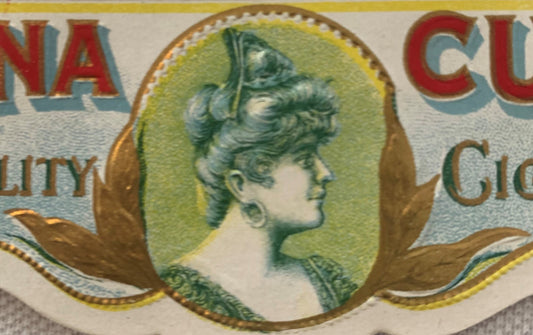
🌹 A dark-haired little girl clutches a bunch of red roses and looks straight out of a gold-rimmed medallion, while LITTLE ROSE arches over her head in red capitals edged in gold. This die-cut flap label was printed to dress a box of cigars, the wooden box that federal law had required since 1865, in the years when American cigar makers competed under more than a million and a half brand names and paid for some of the most lavish commercial printing the country ever produced. It is new old stock from the 1900s, never glued to a box, and the roses in the girl's hands carry a meaning straight out of the Victorian language of flowers.

The Label

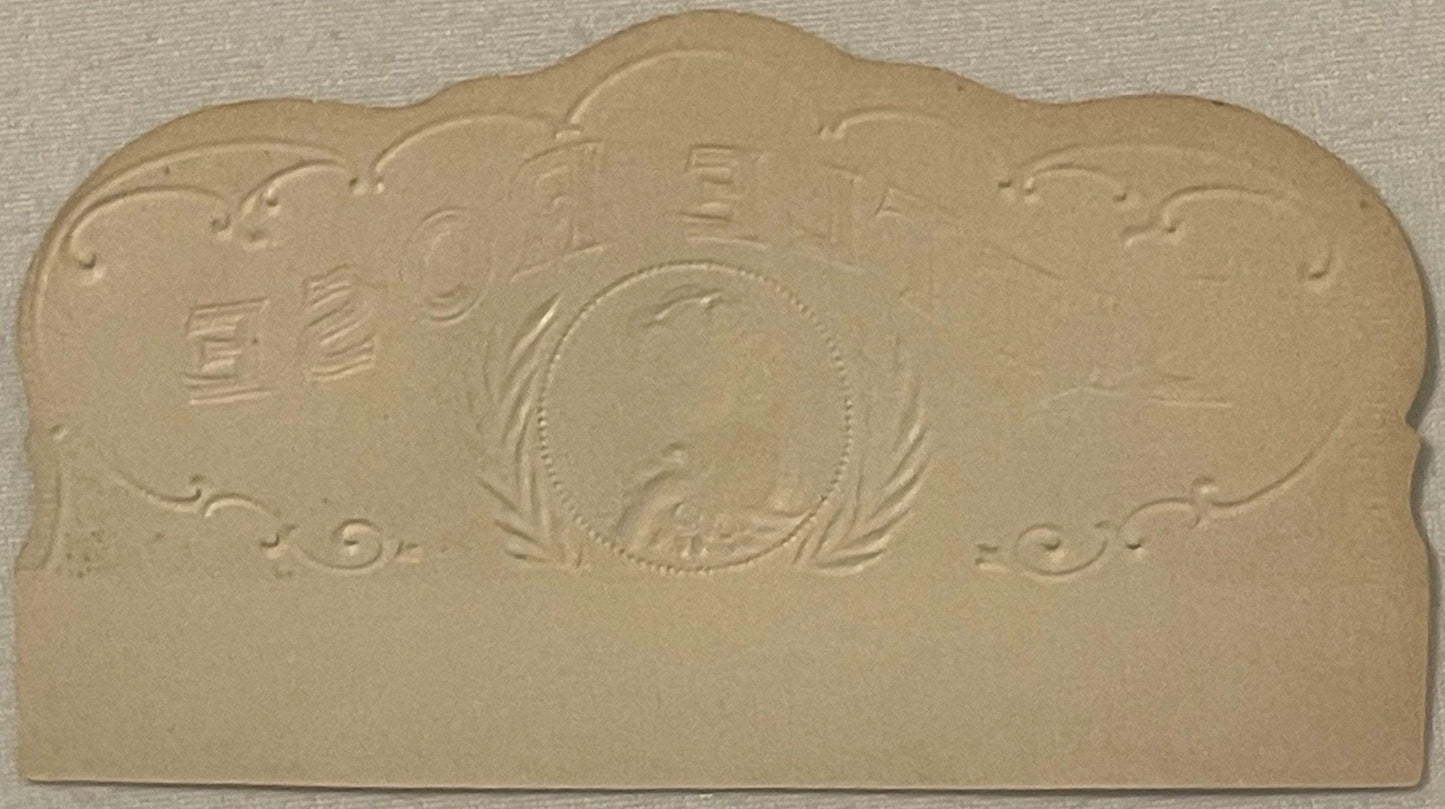
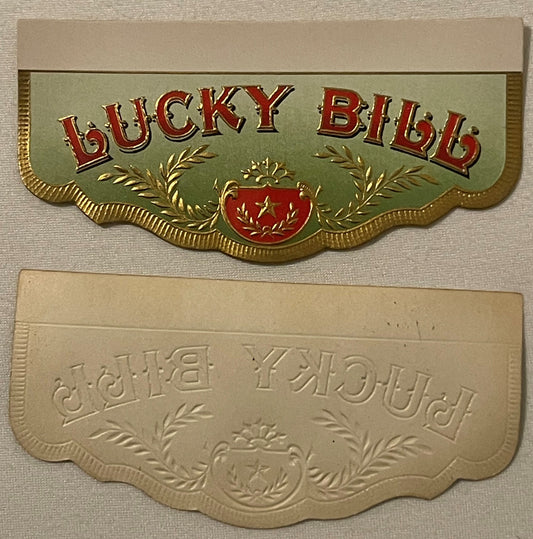
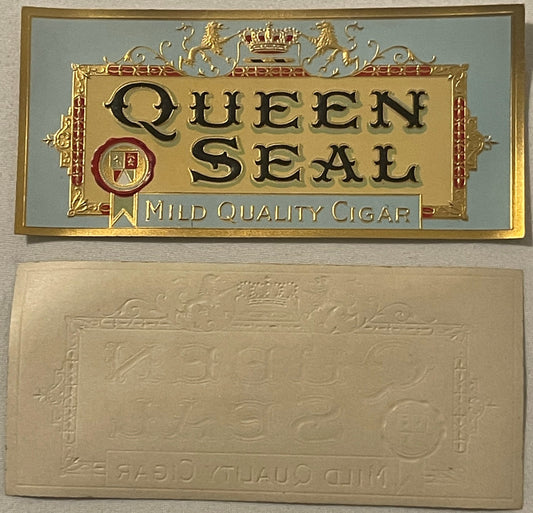
The label measures 4 x 2.5 inches. Its top edge is die-cut into a scalloped crown of rounded arches and framed in a broad band of finely ribbed embossed gold. LITTLE ROSE runs across in raised capitals, and at the center a round medallion with a beaded rim frames a girl with dark curls and a wrap around her shoulders, holding roses against her chest between two sprays of leaves, with scrollwork curling into both lower corners. Turn it over and the back is plain paper with the whole design pressed through in reverse, the lettering reading backward. It is new old stock and has never been attached to a box.

Why Cigars Came in Boxes

The cigar box was a tax invention. The Revenue Act of 1864 required cigars to be packed in "boxes or bundles," and cigar makers answered with odd lots that turned the tax collectors' record keeping into a mess. The laws of 1865 settled it: every cigar, foreign or domestic, had to be packed in a wooden box holding 25, 50, 100 or 250 cigars, which gave the revenue agent a fixed place to paste the stamp proving the tax was paid. Once every cigar sold in America lived in a box, the box became the maker's billboard. Collectors today sort its paper into an inner label for the lid, an outer label for the top, a top sheet laid over the cigars, a flap above the cigars, edging strips for the raw wood and a nail tag over the closure.

A Million and a Half Brand Names

Between 1870 and 1920 more than 1.5 million cigar brands appeared in the United States. The paper that dressed their boxes came from a handful of specialists. Seven printers turned out roughly 80 percent of American cigar labels: George Schlegel, O. L. Schwencke, Schmidt & Co., Witsch & Schmitt, Schumacher & Ettlinger and F. Heppenheimer's Sons in lower Manhattan, and Moehle Litho in Brooklyn, New York. Lithographers also issued trade catalogs of their label designs, and O. L. Schwencke's catalog of cigar box labels from around 1905 still survives.

Gold, Bronze and a Buffing Wheel

A first-rate label could take up to 12 colors, each laid down in its own press run. After 1890 the best labels went back through the presses again for embossing and gilding, and the gold was not leaf but bronze powder, rubbed onto the sheet and polished with a buff wheel much like the ones in a shoe-shine stand. Raised, ribbed gold like the border on this label was the finishing touch of that extra work, and it still catches the light unevenly as the label turns.

The Girl With the Roses

Cigar labels leaned hard on pretty faces. One history of the cigar box describes the art of the period as "women by the carload, generally staring virtuously into space," alongside flags, eagles, horses and hunting dogs. The Little Rose label goes gentler, with a child in place of a society beauty, and the picture plays on the brand name: a little girl holding roses for a cigar called Little Rose.

The Language of Roses

The roses would not have been a random choice to the people buying these boxes. The Victorians turned flowers into a coded language, called floriography, in which a bouquet could say what polite conversation could not. The fashion took off in France, where Charlotte de la Tour published Le langage des fleurs in 1819, spread through Britain and reached the United States between about 1830 and 1850, when illustrated flower dictionaries became fashionable in middle- and upper-class homes. In that language the red rose meant love. The tradition holds that small hand-tied bouquets called tussie-mussies carried messages only the sender and the receiver could read, and a girl offering red roses on a cigar box spoke a language many buyers of the day would have recognized.

What Changed

The golden age did not last. After 1920 the cigarette took the market, cigar labels grew plainer and scarcer, and about four in five American cigar factories closed within a decade. The small shops that ordered bright labels by the thousand disappeared, and the labels that survived unused, like this one, are what remain of that crowded, competitive trade. These days museums and libraries keep them too. The Museum of Florida History holds more than 1,500 cigar box labels running from the late 1800s into the mid-1900s, and the University of South Florida library has the collection John Osterweil started chasing down across the country in 1979, bands and box labels printed between 1900 and 1950 for more than 600 brands. Not bad company for a little label that was only ever meant to help sell a box of cigars.

Good For

  • Cigar label and tobacciana collections
  • A small frame for a study, den or home bar
  • Rose, flower-language and Victorian ephemera displays
  • Scrapbooks and junk journals that call for real period paper

Questions People Ask

What is a cigar box flap label?

One of the several printed papers that dressed a wooden cigar box. Collectors list the flap as the piece that sits above the cigars, alongside the inner lid label, outer label, edging and nail tag.

How old is this Little Rose label?

It dates to the 1900s and is new old stock, never applied to a box.

How big is it?

Four inches wide and two and a half inches tall.

Why does the back show the design backward?

The gold border, lettering and medallion were embossed, pressed up into relief from behind, so the back of the paper carries the same design in reverse.

Is the gold real gold?

The usual method for American cigar labels after 1890 was bronze powder polished on a buff wheel rather than gold leaf.

What does a red rose mean in the language of flowers?

Love. The Victorian flower language that became popular in America in the middle of the nineteenth century gave the red rose that meaning.

Shipping

🚚 Shipping & Handling

  • Shipping costs and timing are calculated at checkout.
  • Items curated and shipped directly by me include U.S. shipping at no additional cost, professionally packed to ensure safe arrival of your artifact.

Items from Vetted Pro Collectors
Shipping for items offered by vetted Pro Collectors is determined at checkout. All Pro Collector listings are reviewed to ensure fair, reasonable shipping practices.

For full details, please refer to our Shipping Policy.

Returns & Exchange

Take your time — you've got a full six months. If a piece isn't right for you, send it back the way it reached you and we're good.

In the first 30 days your money goes straight back the way you paid. After that it's store credit, so you can put it toward something you'd rather have.

Return shipping we sort out between us, case by case. I don't make this difficult.

If something arrives damaged, or it isn't what I said it was, send me a photo within 48 hours and I'll make it right.

Email info@vintageantiquesgifts.com or call 802-356-9872 — that's me answering, not a call center.

The only things I can't take back are custom or special-order pieces and gift cards.

View full details

Preserving History: Authentic Objects Across Eras

— Curated by Travis Weigel