Skip to product information
1 of 5

Vintage and Antique Gifts

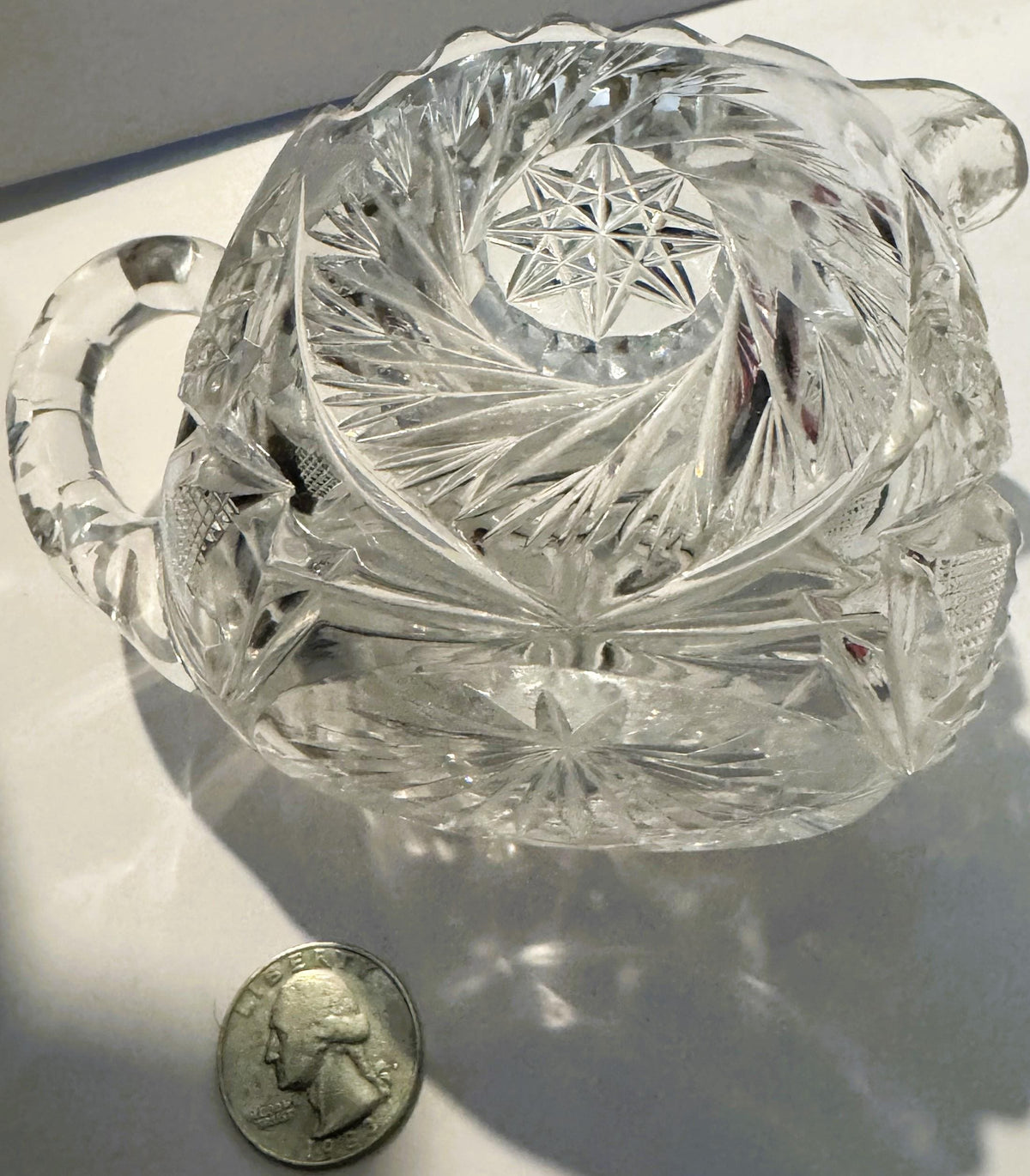
Antique American Brilliant Cut Glass Creamer 📌 Pinwheel & Hobstar, Unsigned ABP, Choice of Two Silhouettes c 1900-1915

Antique American Brilliant Cut Glass Creamer 📌 Pinwheel & Hobstar, Unsigned ABP, Choice of Two Silhouettes c 1900-1915

Regular price 16.00 USD
Regular price Sale price 16.00 USD
Sale Sold out
Shipping calculated at checkout.
Size
Quantity

Size: 4.5 inches ~ No chips or cracks. That toothed edge running around the rim is the cut itself, not damage.

Pick your creamer: the taller one or the fatter one.

I've got two of these on the shelf and they're sold separately, one buyer each. Both are unsigned American Brilliant cut glass, heavy clear glass cut nearly edge to edge with whirling pinwheels circling small hobstars, crosshatched diamond panels, fans, a sawtooth rim, a pinched spout and a notched loop handle that throws as much light as the body does. Whichever one you pick ships exactly as photographed — that's the one you're getting, not a similar one from a back shelf.

🌀 The Two, Side by Side

The taller creamer stands about 3 inches tall and 3 inches across the body, about 4 1/2 inches wide once you measure past the handle, and there's a many-rayed star cut into its base. The fatter creamer is shorter and rounder — about 2 1/2 inches tall, 3 1/2 inches across the body, 5 1/2 inches wide with the handle — with a hobstar cut into its base instead. Same pinwheels, same crosshatching, same toothed rim and notched handle on both. They're close cousins, not twins.

  • Taller: about 4 1/2" wide with the handle, 3" across the body, 3" tall — many-rayed star base
  • Fatter: about 5 1/2" wide with the handle, 3 1/2" across the body, 2 1/2" tall — hobstar base
  • Heavy clear glass, cut on the wheel
  • Unsigned — no maker's mark on either one
  • Sold singly: one of each, you choose

✨ Healy's Pinwheel

The motif spinning around both of these creamers is called a pinwheel, sometimes a buzz star, and it's about as home-grown as American cut glass gets. Patrick H. Healy patented the design — No. 30,267, granted February 28, 1899 — and it's listed among the patterns of the American Cut Glass Company, a Chicago cutting house William C. Anderson started in 1897 after years at Libbey and the New England Glass Company. That firm later moved out to Lansing, Michigan, and shut its doors in 1914, but the pinwheel outlasted it: it was one of the most popular motifs on the market from 1900 into the 1920s, and cutters kept reworking it — one later version, the "tornado" pinwheel, swaps in a different star at the center and turns up on pieces cut around 1904 to 1909 at the Quaker City Cut Glass Company in Philadelphia.

💎 What "Brilliant" Means

American cut glass spent its early years in Europe's shadow, and then in 1876 eight American companies — Gillinder and Dorflinger and Hawkes among them — showed up at the Centennial Exposition in Philadelphia with crystal cut deep enough to throw light like a prism, and people took notice. That's the start of what collectors call the Brilliant Period, and it ran for the next four decades. Hawkes of Corning, New York took a grand prize at the Paris Exposition in 1889, and Libbey of Toledo, Ohio walked off with the top cut-glass honors — the Columbia and Isabella patterns took the awards — at Chicago's World's Columbian Exposition in 1893. Every facet on a piece like this one is a descendant of that competition to out-sparkle the next company's booth.

🛠️ Three Men, Three Wheels

Here's how the Brilliant shops cut a piece like this. A rougher pressed the blank against a beveled metal wheel to lay in the first deep cuts, a smoother went over those same cuts on a stone wheel to clean up the lines, and a polisher brought the frosted grooves back to full shine on a wooden wheel charged with rottenstone or pumice. Three different men, three different wheels, every single piece.

🏛️ The White House Story

Collectors tell it this way: in 1885, in Grover Cleveland's first term, the White House ordered 336 pieces from Hawkes in the Russian pattern, cut on 28 dozen blanks shipped up from Christian Dorflinger's glassworks at White Mills, Pennsylvania. The story runs ahead of the facts a little — that order was actually a supplement to the table service the Lincolns had ordered back in 1861, and Hawkes never patented the Russian pattern at all, since it sat too close to the Star and Hobnail pattern other houses were already cutting. Hawkes glass did serve at the White House from 1885 clear through 1938, patent or no patent, and the legend has outlasted the correction.

💍 The Wedding Gift

Before the Brilliant Period ran its course, a piece of cut glass was close to a given at a wedding. Plenty of new brides had a piece or two in the cabinet, and a creamer like this would have sat on the breakfast or tea table next to its matching sugar bowl, doing exactly the job it can still do today.

📖 The End, and Where the Story Lives Now

Two things closed out the Brilliant Period. Cheap pressed glass, molded to fake the look of cutting, undercut the market from below, and the First World War took away the lead oxide that made this kind of glass soft enough to cut so deep in the first place. By around 1917 the style had had its run. Collectors never let it go, though — the American Cut Glass Association was founded in 1978, has grown past 1,700 members, and still publishes a magazine named for the motif sitting right at the center of these creamers: The Hobstar.

Shipping

🚚 Shipping & Handling

  • Shipping costs and timing are calculated at checkout.
  • Items curated and shipped directly by me include U.S. shipping at no additional cost, professionally packed to ensure safe arrival of your artifact.

Items from Vetted Pro Collectors
Shipping for items offered by vetted Pro Collectors is determined at checkout. All Pro Collector listings are reviewed to ensure fair, reasonable shipping practices.

For full details, please refer to our Shipping Policy.

Returns & Exchange

Take your time — you've got a full six months. If a piece isn't right for you, send it back the way it reached you and we're good.

In the first 30 days your money goes straight back the way you paid. After that it's store credit, so you can put it toward something you'd rather have.

Return shipping we sort out between us, case by case. I don't make this difficult.

If something arrives damaged, or it isn't what I said it was, send me a photo within 48 hours and I'll make it right.

Email info@vintageantiquesgifts.com or call 802-356-9872 — that's me answering, not a call center.

The only things I can't take back are custom or special-order pieces and gift cards.

View full details