Skip to product information
1 of 11

Vintage and Antique Gifts

Antique Chinese Republic Period Bronze Crab Figurine ๐Ÿฆ€ in Bamboo-Form Cage Scholar's Object

Antique Chinese Republic Period Bronze Crab Figurine ๐Ÿฆ€ in Bamboo-Form Cage Scholar's Object

Regular price 150.00 USD
Regular price Sale price 150.00 USD
Sale Sold out
Shipping calculated at checkout.
Quantity

๐Ÿฆ€ What Did a Chinese Scholar Wish for When He Set a Bronze Crab on His Desk?

Long before "good luck charms" became a Western marketing phrase, Chinese scholars were quietly stacking their desks with small, dense, symbolic objects โ€” a rock shaped like a mountain, a brush pot carved with pine, a tiny bronze creature meant to be turned over in the hand between thoughts. This little crab, caught mid-stride inside a ring cast to look like a length of jointed bamboo, belongs to exactly that world. It's not a toy and it was never meant to be admired from across a room. It was meant to sit within arm's reach of an inkstone, to be picked up, studied, and set back down โ€” a private nudge toward ambition, and a reminder of the character it takes to earn it.

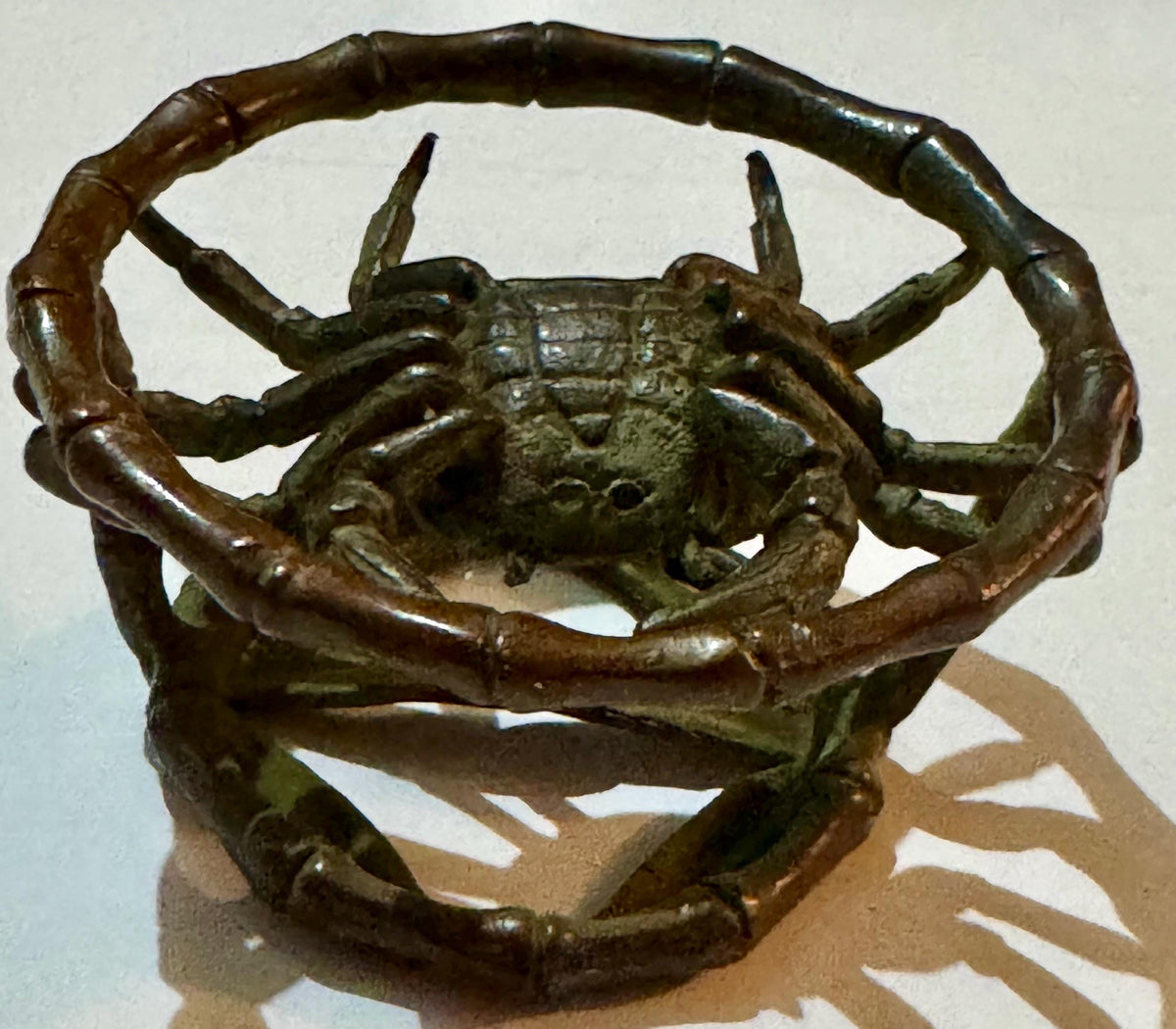
This is a Chinese bronze figural ornament from the Republic Period (1912โ€“1949): a crab, cast in a fixed, lifelike pose with its legs and claws frozen mid-motion, held inside a bronze ring formed to resemble a segment of bamboo. The ring itself is not real bamboo โ€” it is bronze, cast and finished to imitate bamboo's jointed, tubular form, right down to the raised segment lines. The whole piece stands 1.1 inches high and measures 2.2 inches across, with the crab's body sitting just a touch larger than a US quarter โ€” small enough to close a hand around, dense enough to feel substantial when you do. The surface carries a rich, dark green-and-brown patina with polished bronze glinting through at the high points of the shell and the bamboo's rounded segments โ€” the kind of layered, uneven coloring that only comes from age and handling, never from a factory finish. This is a one-of-a-kind piece: there is no twin sitting in a drawer somewhere, no production run behind it. What you're looking at is what exists.


๐Ÿ€„ The Crab's Secret Language: A Pun Worth Casting in Bronze

To understand why anyone would bother casting a crab in bronze, you have to understand how the Chinese language plays with itself โ€” and how deeply that wordplay runs through Chinese art. The crab's hard shell is called jiวŽ (็”ฒ) in Chinese. That same word, jiวŽ, also means "first" โ€” it's the first of the ten heavenly stems, the traditional counting system once used to rank students by score. A crab, then, isn't just a crab. It's a shell-shaped pun, a small bronze wish for coming out on top.

That wish had real weight behind it for centuries. The imperial examination system was, for most of Chinese history, the single door through which a commoner's son could walk into government office, status, and a family's entire fortune turning on the strength of one exam. Fail, and you went home to the fields. Pass at the top, and you might spend your life in the company of emperors. Against that backdrop, a crab motif carried genuine stakes โ€” it wasn't decorative flattery, it was a wish for the one outcome that could change a family's future. Artists leaned on the pun so heavily that crabs appearing among reeds or rushes became their own little rebus, understood at a glance by anyone raised in that world: a wish for first place, dressed as a still life.

The crab carries a second pun as well, gentler than the first. Its name echoes xiรจ (็‡ฎ), a word meaning harmony โ€” the blending of things into balance. Scholars saw something fitting in the crab's sideways scuttle, its odd, angled way of moving that somehow still gets it exactly where it means to go. It became a small emblem of navigating a complicated world without losing your footing. And because crabs traditionally appeared in abundance during the harvest season, they picked up a third, simpler meaning too โ€” plain prosperity, the wish for a full table and a full purse. First place, harmony, abundance โ€” three wishes folded into one small shelled creature, which is precisely why artisans kept returning to it for objects meant to sit within a scholar's daily reach.


๐ŸŽ‹ Bamboo's Quiet Lesson: Bending Without Breaking

The ring holding this crab wasn't shaped like bamboo by accident. In Chinese art, bamboo is one of the "Four Gentlemen" โ€” four plants (plum blossom, orchid, bamboo, and chrysanthemum) that generations of scholars treated as a kind of moral shorthand, each one standing in for a virtue worth aspiring to. The plum blossom meant perseverance through hardship. The orchid meant quiet integrity. The chrysanthemum meant the wisdom that comes with age. And bamboo โ€” evergreen, upright, hollow at its core yet strong enough to bend in a storm without snapping โ€” meant moral strength and honest, unyielding character.

There's something almost architectural about why bamboo earned that reputation. It grows straight, without branching sideways to hide its shape. It stays green through winter when showier plants have gone bare. And it bends under pressure instead of breaking โ€” a trait scholars read as the ideal response to hardship: give a little, hold your shape, and outlast the wind. To cast a ring in bamboo's likeness and place a first-place crab inside it is to layer one wish over another โ€” success, yes, but success held together by integrity rather than success alone. It's the kind of quiet double-meaning that Chinese literati built entire art forms around, and it's exactly the kind of thing a scholar would have appreciated without anyone needing to explain the joke to him.


๐Ÿ–Œ๏ธ On a Scholar's Desk: The World of Wenwan

Objects like this one belonged to a category the Chinese literati themselves had a name for: wenwan, loosely translated as "toys for the literati" โ€” though "toys" undersells it considerably. These were the small, handled, contemplated objects that surrounded a scholar's actual work: brush pots, water droppers, ink stones, scholar's rocks, small figural pieces cast in jade, porcelain, bamboo, hardwood, lacquer, and bronze. They weren't clutter. They were chosen, one at a time, over years, and they said something about the taste and inner life of the person who kept them.

Bronze held a particular place in that world. It was heavier in the hand than porcelain, cooler to the touch, capable of holding fine detail in a way that softer materials couldn't always manage โ€” the ridged texture of a crab's shell, the jointed knuckle of a bamboo segment, the small folded legs tucked beneath a shell just so. A scholar might have kept a piece like this one near his inkstone not to impress a visitor, but simply because he liked it โ€” because turning it over between thoughts, feeling the cool weight of the bronze, was its own small pleasure between lines of writing. That's the part of scholar's-object collecting that doesn't always make it into the history books: these pieces were companions to solitary work, not showpieces for company.


๐Ÿ™๏ธ A Nation in Transition: China's Republic Years

The Republic Period โ€” the decades between the fall of the Qing dynasty in 1912 and the founding of the People's Republic in 1949 โ€” was one of the most turbulent stretches in modern Chinese history, and also one of the most artistically restless. The old imperial examination system that had given the crab its meaning had already been abolished by then, but the symbols it left behind didn't disappear โ€” they simply kept circulating, carried forward by artisans and collectors who understood exactly what they meant even after the system itself was gone. At the same time, China's cities were opening outward. Treaty ports like Shanghai saw Western commerce pour in alongside old court traditions pouring out, and crafts that had once been the property of the imperial court and the literati class increasingly found buyers among a broader, more commercially minded public. Traditional forms didn't vanish in that shift โ€” they adapted, made their way into new markets, and kept being produced by craftsmen who had learned their trade the old way even as the world around them changed at a startling pace. A small bronze scholar's object from this era is, in a sense, a survivor of both worlds at once: old symbolism, carried into a genuinely new China.


๐Ÿ•ฐ๏ธ Why a Little Bronze Crab Still Matters Today

Bronze doesn't rust away the way iron does, but it also doesn't survive a century untouched by accident. Small figural pieces like this one were handled daily, moved between desks and drawers, packed and unpacked across generations and, in China's case, across a century that saw war, revolution, and enormous social upheaval. Countless small bronzes from this era were melted down, lost, or simply didn't make it this far. The dark, uneven patina on this crab โ€” that deep green-brown coloring pooling in the crevices of the shell and the bamboo joints, with bronze still catching the light on the raised, handled surfaces โ€” isn't a flaw to explain away. It's the visible record of exactly how many hands this piece has passed through and how many decades it has quietly outlasted. A cleaned or reproduced piece can't fake that kind of layered coloring; it only comes from time.

Today, collectors of Chinese scholar's objects and wenwan pieces prize exactly this kind of small figural bronze โ€” not for its size, but for how much cultural shorthand it manages to pack into two inches. A crab pun, a bamboo virtue, and the ghost of an examination system that once decided entire futures, all sitting quietly in a ring you could close your fist around. It's easy to imagine a scholar a century ago picking this piece up between drafts of an essay, turning it over once, and setting it back down without a second thought โ€” never guessing that a hundred years later, someone else would be doing the exact same thing, for the exact same reason.


๐Ÿ–ผ๏ธ Display Ideas

  • ๐Ÿ“š Set it on a stack of old books or beside an inkwell to echo its original life as a scholar's desk companion.
  • ๐Ÿ” Place it under a small glass dome or cloche where the patina and fine leg detail can be appreciated up close.
  • ๐Ÿชต Rest it on a dark wood stand or riser to let the bronze tones stand out against a lighter surface.
  • ๐Ÿ–‹๏ธ Pair it with a brush pot or scholar's rock for a small grouping that tells the wenwan story as a set.
  • ๐Ÿ’ก Angle a single warm light source across it to bring out the polished highlights against the darker patina.
  • ๐ŸŽ‹ Display it near any bamboo-themed art or dรฉcor to carry the "Four Gentlemen" symbolism into the room.

๐ŸŽ Who Collects These

This piece speaks to a specific, devoted corner of the collecting world: those drawn to Chinese scholar's objects and wenwan miniatures, where the appeal is less about scale and more about density of meaning. It also draws collectors of Chinese Republic-period bronze and metalwork generally, who look for exactly this kind of naturalistic, hand-finished figural casting. Anyone with a fondness for crab imagery, animal symbolism, or East Asian rebus art will find plenty here, and collectors of small tabletop sculpture โ€” the kind of piece meant to be picked up and studied rather than simply glanced at โ€” tend to gravitate toward objects with this much story packed into so little bronze.


โ“ FAQ

What does the crab symbolize in Chinese scholar's art?

The crab's shell, jiวŽ in Chinese, is a pun on the word for "first" โ€” historically a wish for top scores in the imperial examinations. It also echoes the word for harmony and, through its harvest-season abundance, carries associations with prosperity.

Why is the ring shaped like bamboo?

Bamboo is one of the "Four Gentlemen" of Chinese art, standing for integrity, resilience, and moral strength โ€” its evergreen, upright, bend-but-don't-break nature made it a favorite symbol among scholars. Framing the crab inside a bamboo-form ring layers a wish for success together with a wish for the character to carry it well.

Do the crab's legs and claws move?

No. The crab is cast in a fixed, lifelike pose โ€” the legs and claws are sculpted in place and do not move.

How old is this piece?

It dates to China's Republic Period, 1912โ€“1949.

Is the dark surface finish original, or has it been cleaned?

The rich green-brown patina with polished bronze showing through at the high points is a natural result of age and handling โ€” the kind of finish that develops over decades and can't be reproduced artificially. It's part of what marks this as a genuine survivor of its era.

How big is the piece?

It stands 1.1 inches high with a diameter of 2.2 inches โ€” small enough to hold in one hand, with the crab's body sitting just slightly larger than a US quarter.

Is this a one-of-a-kind piece?

Yes. This is a single, unique bronze figural piece โ€” not part of a matched pair or a production series.

Shipping

๐Ÿšš Shipping & Handling

  • Shipping costs and timing are calculated at checkout.
  • Items curated and shipped directly by me include U.S. shipping at no additional cost, professionally packed to ensure safe arrival of your artifact.

Items from Vetted Pro Collectors
Shipping for items offered by vetted Pro Collectors is determined at checkout. All Pro Collector listings are reviewed to ensure fair, reasonable shipping practices.

For full details, please refer to our Shipping Policy.

Returns & Exchange

Take your time โ€” you've got a full six months. If a piece isn't right for you, send it back the way it reached you and we're good.

In the first 30 days your money goes straight back the way you paid. After that it's store credit, so you can put it toward something you'd rather have.

Return shipping we sort out between us, case by case. I don't make this difficult.

If something arrives damaged, or it isn't what I said it was, send me a photo within 48 hours and I'll make it right.

Email info@vintageantiquesgifts.com or call 802-356-9872 โ€” that's me answering, not a call center.

The only things I can't take back are custom or special-order pieces and gift cards.

View full details