Skip to product information
1 of 9

Vintage and Antique Gifts

Antique Chinese Bronze Censer 🐉 — Lidded Incense Burner, Peach & Leaf Lid, Chilong Dragon, Late Qing

Regular price 199.00 USD
Regular price Sale price 199.00 USD
Sale Sold out
Shipping calculated at checkout.

Description

🕯️ The Small Fire at the Heart of the Room

There was a time, not so very long ago, when a room was made ready not by flipping a switch but by lighting a thread of incense. In a Chinese household of the late nineteenth century the day had its scented hours: a stick lit before the family altar at dawn, a curl of smoke to greet an honoured guest, a slow coil burning down through the long evening. The censer was the little hearth of that ritual -- the vessel that held the smouldering incense, caught the ash, and let the fragrant smoke rise and thin into the air. This is one of those censers: an antique Chinese bronze lidded incense burner, cast solid and heavy, dressed on every surface in the old auspicious language of peaches and dragons. In the trade a piece like this is simply a 铜盖香炉, a bronze lidded incense burner, and that plain name carries a whole vanished world of daily devotion.

What makes this one worth slowing down for is that it was never meant to be a background object. A censer sat out in the open, made to be looked at -- worked in deep relief and finished with symbols chosen to bless the household that owned it. Everything written below describes only what the photographs show and what the piece honestly is: no invented pedigree, no maker's name conjured from nothing, no story the bronze cannot back up itself. It came to us through a Chinese-antiques sale, and we describe it as what it plainly is: a genuine, characterful old censer, offered exactly as pictured.


🪶 What You Are Actually Looking At

This is a lidded bronze censer of drum form -- a short, wide cylindrical body that stands a little over five and a half inches tall (about 14 cm) and measures roughly four inches across the drum (about 10.2 cm), lifting to a domed, pierced lid crowned with a sculpted finial. It is not a large object, but it is a surprisingly heavy one: just over two pounds of solid cast bronze, the real copper-alloy metal, not thin sheet brass or a hollow decorative shell. That weight is the first thing that tells you it is old and honestly made. A US quarter appears beside it in several of the photographs so you can judge its true scale directly from the images.

Read the piece from the ground up and it tells a clear story. Four little pad feet lift the body just clear of the surface. The drum itself is wrapped, top and bottom, in a cast rope-twist band, as though the whole vessel had been bound with a heavy plaited cord -- and from that same rope idea spring two twisted-rope loop handles, one at each side. On the front face sits a raised roundel, a circular medallion filled with a coiled chilong dragon in deep relief. And over the open mouth of the drum rests the domed lid, pierced with two smoke vents and crowned by a cast peach with its leaf and stem -- the lift-knob and the crowning ornament in one. Every part of it is worked, made in an age and a culture that believed a sacred object should be beautiful to the last detail.


🐉 The Chilong Coiled on the Drum

The face of this censer -- the side it was made to show -- carries a single raised roundel, and inside that circle a dragon coils back on itself in tight, muscular relief. This is a chilong: the hornless, serpentine dragon of the old Chinese vocabulary, an archaistic motif revived from the vessels of antiquity. You can read its scrolling body, its clawed limbs and the curling scrollwork of cloud and vapour packed into the medallion around it. Look closely at the macro photograph and you will see how the high points of the coils have rubbed to a warm, brassy gold where the metal caught light and handling over the years, while the deep grounds of the roundel stay dark -- the design lit, quite literally, by its own wear.

The dragon was never chosen at random. In Chinese art it is the emblem of power, of protection, of good fortune and of the yang force that brings the rains and blesses what it guards. Coiled inside its roundel it becomes a small guardian medallion, set to face the room and watch over the household that burned incense before it -- a wish for the family's strength and continuance, cast permanently into the metal. That the casters put their finest, deepest work into this one face, and left the opposite face plain, tells you which way the censer was meant to sit: dragon out, toward the worshipper.


🍑 The Peaches of Long Life on the Lid

If the dragon speaks of power, the lid speaks of long life, and it is one continuous botanical composition rather than a scatter of ornaments. At its centre rises the finial: a cast peach, plump and rounded, with its curling stem looping down to meet the lid. That looping stem is a deliberate piece of design -- it gives you a comfortable little knob to hook a finger under and lift the lid clear. It is not a pin, it is not bent out of shape, and it is not a repair; it is simply the way the maker turned a peach and its stem into a working handle. Spreading out from the finial across the domed lid is a large peach leaf, boldly veined and tied with a ribbon, with budding sprigs curling off to one side -- the whole living branch of the peach tree, fruit and leaf and bud together.

The peach is the single most beloved emblem of longevity in all of Chinese symbolism. In myth it is the fruit of the garden of the Queen Mother of the West, whose peaches ripened only once in thousands of years and granted long life, and the God of Longevity himself is shown cradling an enormous peach; to this day a birthday table may carry 寿桃, longevity peaches. So a peach cast onto a censer lid is a blessing in metal. And here it is doubled, because the two smoke vents cut through the lid are themselves peach-shaped, echoing the finial above them: as the incense burned, the fragrant smoke rose and slipped out through those two little peaches of longevity -- the wish made visible in the drifting smoke. They are peaches, not hearts; the shape is the ancient shou emblem, chosen on purpose, repeated on purpose.


🥁 The Bound-Drum Form

Stand back and the whole silhouette reveals its cleverness. The body is a drum -- the round war-drum and temple-drum of Chinese life -- and the caster has wrapped it, top and bottom, in a rope-twist band so that it reads as a drum lashed and bound with cord. This bound-drum conceit is carried all the way through: the two side handles are themselves lengths of twisted rope looped to the body, as if you might thread a carrying pole through them and shoulder the drum away. The rope is not real rope, of course; it is bronze cast to imitate the plait and lay of a cord, and that trick of one material pretending to be another is exactly the sort of wit period Chinese metalworkers loved.

Underneath, four ribs run down the corners of the drum and end in small rounded pad feet that raise the censer just off the table -- practical, for a vessel that once held live embers, and elegant, giving the heavy body a light-footed stance. Turn it over and the recessed base is plain and unsigned: no reign mark, no maker's seal, just the honest cast underside of a working object. Many censers of this kind were left unmarked, and we will not invent a signature the metal does not carry.


🌿 The Colour That Only Time Can Mix

One of the most beautiful things about this censer is something no caster put there and no one could convincingly fake: the way the decades have coloured it. The overall tone is a deep, dark chocolate-brown patina, the settled skin a copper alloy grows when it is left alone for a long time. Against that dark ground, the raised high points -- the crown of the peach, the ridges of the leaf's veins, the coils of the dragon, the twist of the rope -- have rubbed to a warm brassy gold, burnished by the touch of hands and the pass of light. It is a two-tone surface, dark in the hollows and bright on the ridges, and it is the single clearest sign that the object has genuinely lived.

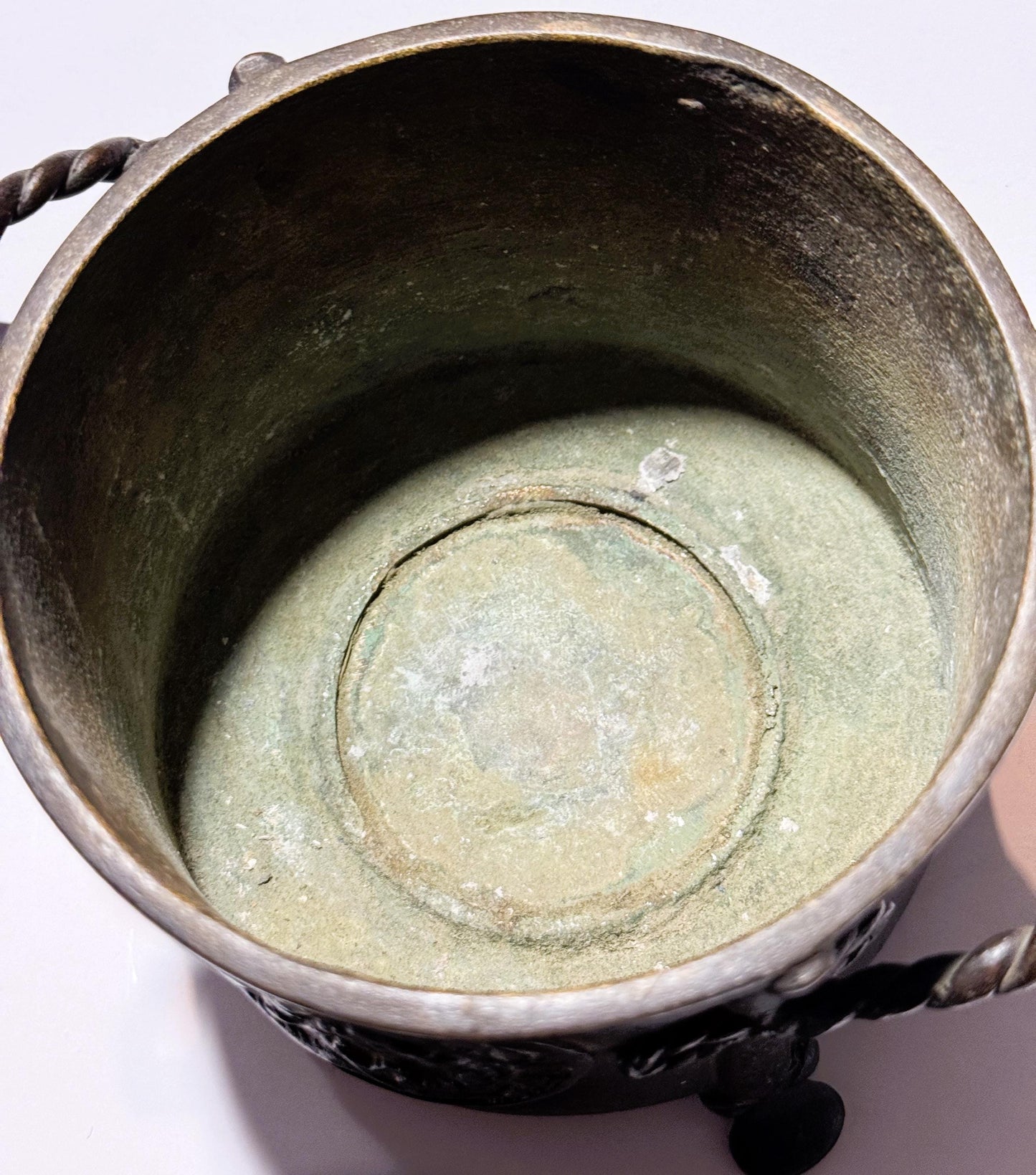
Lift the lid and the interior tells the same story in a different colour. The inside of the drum has gone verdigris-green -- the soft, powdery blue-green bloom that only aged copper and bronze grow, and only slowly. On the floor of the interior sits an inset circular boss, a raised disc softened now by that green patina. This is not grime to be scrubbed away; it is age made visible. A brand-new casting is uniform and dead; this one carries a whole map of its own age -- chocolate and gold on the outside, green within -- and no two square inches of it are quite alike.


🔍 An Honest Look at the Condition

We would always rather tell you exactly what you are receiving than let a flattering photograph do the talking, so here is the plain state of the piece, read from the same pictures you can see.

One drum face is plain, and it shows old abrasion scars. The dragon roundel is cast onto the front; the opposite face of the drum was deliberately left plain, and at some point in its long life that plain face was cleaned or rubbed, leaving a set of fine diagonal abrasion scars across the bare metal, clearly visible in the photographs. We point them out not because they are a fault -- they are simply the honest marks of a handled old object -- but because we would rather you know every characteristic of this censer before it arrives than after. It is the plain face; it sits at the back when the dragon faces the room.

There is one tiny casting flaw on the underside of the lid. Whoever first examined this piece, going over it for a long time under bright light, found a single small casting-and-finish flaw on the underside of the lid, which corresponds to the same spot on the inside of the barrel. It took careful looking to notice at all, it does not affect the fit of the lid or the function of the censer in any way, and it is visible in the close-up photographs for you to judge for yourself.

Beyond those two honest points, the censer is sound and complete: body and lid present and matched, all four feet and both rope handles intact, no cracks and no repairs visible anywhere. The surface is the genuine, untouched aged patina described above -- not stripped, not polished bright -- with the verdigris interior left exactly as age made it. It is offered exactly as pictured, with nothing added, nothing altered and nothing hidden.


🏮 Incense in a Late-Qing Household

To hold this object is to hold a piece of an everyday rite that ran through Chinese life for centuries. Burning incense -- 香, xiang -- was woven into the ordinary day: a mark of respect before the tablets of the ancestors in the family hall, an offering to the household gods, a purification of a room before a ceremony, a quiet companion in the scholar's studio where the slow smoke measured out the hours. The rising smoke was understood to carry reverence upward, a thread between the living family and the generations and deities it honoured. A censer like this stood at the centre of that: you set the smouldering incense within the drum, closed the pierced lid, and let the fragrant smoke find its way out through the two peach-shaped vents while the ash gathered safely inside.

By the late nineteenth century -- roughly the years between 1870 and 1910, which is the taste and period this censer belongs to as a style -- bronze censers of exactly this kind were being cast in great number and variety, for genuine devotional use and as handsome household objects prized for their craftsmanship. Four-footed drum censers were less common than the classic three-legged tripod form, and a bound-drum body with rope handles and a peach-and-dragon program is a particularly characterful example. We offer the dating as an honest style attribution rather than a certificate: everything about the piece -- the archaistic chilong, the longevity peaches, the rope-twist conceit, and above all the deep, genuine patina -- is consistent with a late-Qing censer, without pretending to a precision the object itself does not carry.


🖼️ How to Live With It Now

A censer like this no longer has to hold fire to earn its place. Its second life is as a small, dense piece of sculpture with real history in it, and it settles into a modern room in more ways than one:

  • 🕯️ Use it as it was made to be used -- a pinch of loose incense or a cone inside the drum, the pierced lid closed, and a thin ribbon of scented smoke rising through the two peach vents. It still does exactly what it was cast to do.
  • 🐉 Or keep it purely as an object, turned dragon-forward on a shelf, mantel or altar table, where a directed lamp can catch the brassy high points against the dark patina.
  • 🎁 Lift off the lid and let the little drum hold something small and precious -- a ring, a seal, a few coins -- so it stays in daily use even out of its old role.
  • 🌸 Or simply give it room to be admired: a genuine antique Chinese censer that real hands once lit, closed and tended, over and over, in the ordinary sacred work of a household.

💝 Who This Belongs With

This censer will mean the most to a few very different people: the collector of Chinese bronzes and scholar's objects, who knows a bound-drum censer when they see one; the lover of Asian antiques and altar pieces, who reads the longevity peaches and the guardian dragon at a glance and wants a good, honest, deeply patinated example; the person who actually burns incense and would far rather do it over a genuine old bronze than a modern reproduction; and the gift-giver hunting for something with real age and meaning -- a piece whose every symbol is a blessing of strength and long life. For any of them, this is a single, individual object, and there is only the one.


❓ Questions Worth Answering

Is it really an antique, and really Chinese?

Yes, it is a genuine antique Chinese bronze censer, offered in the late-Qing taste of roughly 1870 to 1910 as an honest style attribution. The archaistic chilong dragon, the longevity peaches, the bound-drum form and -- above all -- the deep, genuine patina and verdigris interior are all consistent with that period and origin. We name no maker and claim no exact year, because the piece is unsigned and we will not invent what it does not tell us.

What are the symbols on it?

Two of the great auspicious emblems of Chinese art. The coiled chilong dragon on the drum's front face stands for power, protection and good fortune. The peach crowning the lid -- with its leaf, its budding sprigs and the two peach-shaped smoke vents that echo it -- is the emblem of longevity. Together they read as a blessing: strength for the household, and long years to enjoy it.

Is the loop on top of the lid meant to be like that?

Yes. The finial is a cast peach whose curling stem loops down to the lid on purpose, giving you a comfortable little knob to lift the lid by. It is a deliberate design element, not a pin, not bent, and not a repair.

Are there any flaws I should know about?

Two honest points, both shown in the photos and neither structural. The plain face of the drum (opposite the dragon) carries old diagonal abrasion or cleaning scars. And there is one tiny casting/finish flaw on the underside of the lid, corresponding to a matching spot inside the barrel, which does not affect the fit or the function. No cracks and no repairs are visible. Offered exactly as pictured.

Can I actually burn incense in it?

You can -- the drum holds the incense and ash and the pierced lid lets the smoke escape through the two peach vents, exactly as intended. As a genuine antique it is equally at home kept purely as a decorative and collectible object; the choice is yours.


✨ Why It Matters

Some objects are collected because they are rare; this one is worth having because it is real. It is a genuine antique Chinese censer -- a solid cast-bronze drum bound in rope-twist, guarded by a coiled chilong on its face and crowned with the peaches of long life, its smoke once rising through two little peach-shaped vents in a household's daily act of devotion. It carries no invented history and needs none. What it offers is the thing itself: the small bronze hearth of a vanished ritual, heavy in the hand, dark and gold with a century of honest patina and green within, plain-faced and abraded on one side and flaw-marked on the lid exactly as an old worked object should be. Bring it home and you are keeping a real piece of that world of altars and incense and blessings.

Shipping

🚚 Shipping & Handling

  • Shipping costs and timing are calculated at checkout.
  • Items curated and shipped directly by me include U.S. shipping at no additional cost, professionally packed to ensure safe arrival of your artifact.

Items from Vetted Pro Collectors
Shipping for items offered by vetted Pro Collectors is determined at checkout. All Pro Collector listings are reviewed to ensure fair, reasonable shipping practices.

For full details, please refer to our Shipping Policy.

Returns & Exchange

Take your time — you've got a full six months. If a piece isn't right for you, send it back the way it reached you and we're good.

In the first 30 days your money goes straight back the way you paid. After that it's store credit, so you can put it toward something you'd rather have.

Return shipping we sort out between us, case by case. I don't make this difficult.

If something arrives damaged, or it isn't what I said it was, send me a photo within 48 hours and I'll make it right.

Email [email protected] or call 802-356-9872 — that's me answering, not a call center.

The only things I can't take back are custom or special-order pieces and gift cards.

View full details