Skip to product information
1 of 2

Rugistan

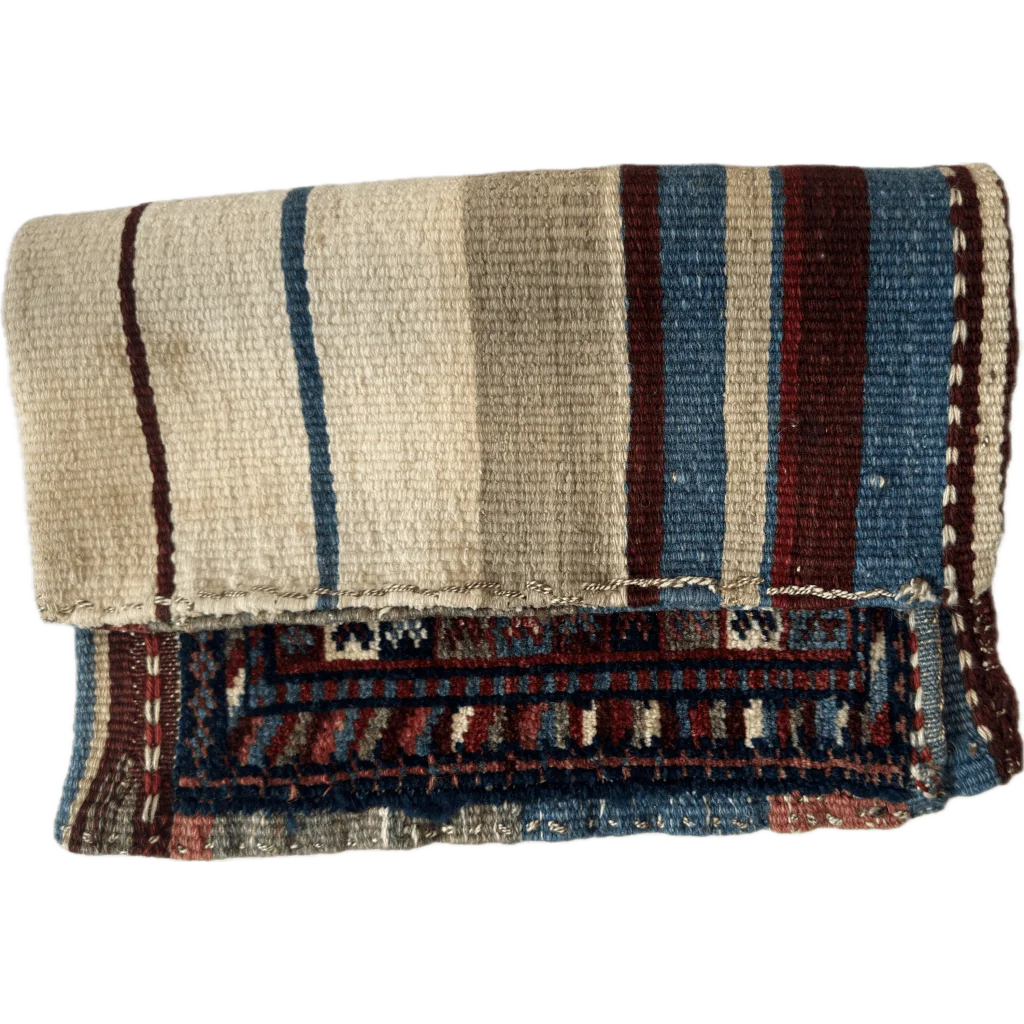
Antique Caucasus Hand-Knotted Wool Bag Face Tribal Geometric

Antique Caucasus Hand-Knotted Wool Bag Face Tribal Geometric

Regular price 499.00 USD
Regular price 650.00 USD Sale price 499.00 USD
Sale Sold out
Shipping calculated at checkout.

Description

🏔️ From the High Passes of the Caucasus: An Antique Hand-Knotted Wool Bag Face

Long before the term textile art found its way into gallery catalogs, the nomadic weavers of the Caucasus Mountains were creating objects of extraordinary visual force — not as decoration, but as necessity. 🧵 This antique hand-knotted wool bag face, crafted in the early 1900s and measuring 26 in by 18 in, is one of those objects. Its geometric tribal patterns in beige, blue, and maroon, woven from natural wool pile and foundation, carry the unmistakable confidence of makers who understood their craft at the deepest level — people for whom weaving was not a hobby or a trade but a complete visual language.

🌍 What Is a Bag Face?

A bag face — sometimes called a khorjin face or saddlebag panel — is one of the most intimate forms of Caucasian weaving. 🐎 Unlike floor rugs, which served a practical covering function, bag faces were the visible panels of the woven storage bags that nomadic and semi-nomadic peoples used to transport their world across the mountain passes during seasonal migration. These bags — made in pairs, thrown over a pack animal's back — held the family's most valued possessions: clothing, tools, food stores, and ceremonial objects.

The face of the bag — the visible panel that faced outward when the bag was in use — was always the showpiece. 🎨 It was woven with the finest wool, the most controlled pattern work, the most carefully calibrated dye combinations. The Caucasian bag face tradition in particular produced panels of astonishing density and color: bold geometric forms in saturated natural dyes, their repetition creating visual rhythms that read as almost musical in their regularity.

This panel, identified as KJ5, is a genuine example of that tradition at the turn of the 20th century — a period when Caucasian tribal weaving was still largely untouched by commercial pressures, when the weavers still chose their patterns from inherited visual vocabularies rather than from export market demands. 📜 What you are looking at is a primary document of a living textile culture at its most authentic.

🏔️ The Caucasus: Where Weaving Traditions Met the Mountains

The Caucasus region — the mountainous land bridge between the Black Sea and the Caspian, encompassing modern Georgia, Armenia, Azerbaijan, and adjacent territories — was one of the great crucibles of world textile culture. 🗺️ Its geography guaranteed this: a meeting point of trade routes, ethnic groups, religious traditions, and aesthetic systems, all pressed against each other by the dramatic topography of high mountain ranges.

The weavers of the Caucasus produced rugs and textiles that stood apart from their Persian neighbors to the south and their Turkic neighbors to the north. 🐺 Where Persian weaving tended toward curvilinear elegance, Caucasian work was angular, bold, geometric — the abstracted wolf's tooth, the ram's horn, the star medallion, the running dog border. Where Persian coloring was subtle and harmonized, Caucasian coloring was assertive: maximum contrast, maximum saturation, maximum presence. These qualities were not accident — they were the visual grammar of mountain peoples who lived in dramatic landscapes and wove that drama into every textile they made.

The early 1900s represent the final chapter of genuinely traditional Caucasian tribal weaving. 🕰️ The political disruptions of the early 20th century — the Russian consolidation of the Caucasus, the regional conflicts, the eventual Soviet collectivization — gradually eroded the nomadic lifestyle that had sustained these weaving traditions for centuries. Pieces from this transitional era, still anchored in genuine tribal practice but coming to us through the accidents of time and collection, are among the most historically significant Caucasian textiles that circulate in the collector market today.

🧶 Construction and Condition: What Makes This Piece Last

This bag face is hand-knotted in natural wool pile with a wool foundation — the material and structural choices that define authentic Caucasian tribal weaving of the era. ✋ The wool itself, sourced from the hardy mountain sheep of the region, has a natural lanolin richness that gives Caucasian pile a distinctive hand: slightly coarser than the finely combed wool of Persian urban workshops, but with a dimensional solidity that gives these textiles their remarkable durability across the decades.

The dyes are natural — derived from plant and mineral sources that have proven their lightfastness across a century of existence. 🌿 Deep reds from madder root, blues from indigo and its derivatives, neutral grounds from undyed or lightly processed wool — these natural dyes age into the specific warmth and depth that distinguishes antique Caucasian textiles from later production. The colors do not fade so much as they mellow, gaining in richness what they sacrifice in the initial brightness of newness.

At 26 in by 18 in, this panel is in good condition for its age — a meaningful distinction for a textile that has moved through a century of use and storage. 🛡️ Good condition in a genuine 1900s Caucasian piece means the pile retains integrity, the foundation is sound, the patterns read clearly, and the overall presence of the piece is that of a survivor rather than a remnant. The beige, blue, and maroon geometric stripe patterning remains legible across the full field — the tribal vocabulary intact despite the passage of time.

📐 Display: Living With a Bag Face

At its dimensions, this bag face works beautifully in several display contexts. Framed — either with a simple mat and deep-set frame or as a floating textile behind conservation glass — it functions as a museum-grade piece of textile art, drawing the eye with the same authority as a painting. 🖼️ Unframed, laid flat on a surface, it works as a table accent, dresser cover, or shelf display. Mounted and hung, it works as a wall piece in any room where a compact, historically charged textile adds depth and meaning that decorative reproductions cannot match.

In collector circles, antique Caucasian bag faces are increasingly recognized as individual art works — the most highly crafted component of the nomadic material world, produced with the same intentionality and skill as any object displayed in a fine arts context. 🎨 Interior designers working in both traditional and contemporary aesthetics have discovered that a genuine antique Caucasian panel brings the kind of grounded authenticity to a space that reproduction textiles, however well made, simply cannot provide. The age is visible, the hand is visible, and those qualities do something in a room that cannot be replicated at scale.

The geometric boldness of Caucasian patterning makes these pieces work against a wide range of color palettes. 🎭 Against white plaster walls, the piece reads as bold graphic art. Against wood paneling or warm-toned rooms, it reads as historical artifact. Against the spare geometry of contemporary interiors, the traditional patterns create productive visual tension that keeps the eye interested and the mind engaged.

🎁 Rarity and Collector Value

Genuine antique Caucasian bag faces from the early 1900s are not easy to find in good condition. 💎 The combination of authenticated age, intact construction, clear pattern work, and traditional natural-dye color has always made them desirable among serious collectors — and their relative scarcity compared to full-size rugs from the same period means they frequently represent strong value within the antique Caucasian textile category.

What this piece offers is entry into one of the most respected corners of the antique textile world — Caucasian tribal weaving from the final era of genuine nomadic production — at a size that makes it accessible, displayable, and livable. 🏡 Whether it ends up framed on a study wall, displayed on a collector's shelf, or laid flat in a curated interior, it will do what the best antique textiles always do: become more interesting the longer you live with it, revealing more of itself as the eye learns to read what the hands that made it put there.

Item ID: KJ5 🏷️

Shipping

🚚 Shipping & Handling

  • Shipping costs and timing are calculated at checkout.
  • Items curated and shipped directly by me include U.S. shipping at no additional cost, professionally packed to ensure safe arrival of your artifact.

Items from Vetted Pro Collectors
Shipping for items offered by vetted Pro Collectors is determined at checkout. All Pro Collector listings are reviewed to ensure fair, reasonable shipping practices.

For full details, please refer to our Shipping Policy.

Returns & Exchange

Product Page Return Policy

  • 60-Day Returns – Items must be in original condition.
  • Refunds – Issued after inspection (excluding shipping costs).
  • Return Shipping – Customer is responsible unless item is damaged or incorrect.
  • Damaged/Incorrect Items – Contact us within 48 hours for a replacement or refund.
  • Easy Returns – Email info@vintageantiquesgifts.com or call 802-356-9872 to initiate a return.

For full details, visit our Refund Policy.

View full details