Skip to product information
1 of 8

Vintage and Antique Gifts

Vintage 1960s-1970s Coca-Cola Bottle Cap 🥤 Silver Ground Ingredients List, Lithographed Metal Soda Crown, Cork Lined Closure

Vintage 1960s-1970s Coca-Cola Bottle Cap 🥤 Silver Ground Ingredients List, Lithographed Metal Soda Crown, Cork Lined Closure

Regular price 7.00 USD
Regular price Sale price 7.00 USD
Sale Sold out
Shipping calculated at checkout.
Quantity

🥤 Remember the Hiss and the Pop of a Coke Bottle Letting Go?

There's a sound that anyone who grew up pulling a glass Coca-Cola bottle out of an ice-cold cooler never forgets — that quick metallic hiss, the little pop of the crown cap giving way, and the cold fizz that followed right behind it. Long before pull-tabs, long before plastic two-liters and recycling bins full of aluminum cans, that sound came from a small fluted disc of tin no bigger than a nickel, crimped tight around a bottle's neck by a machine in a bottling plant somewhere, doing its one small job perfectly: keeping the bubbles in until you were ready for them. This is one of those caps — pulled from the long, sprawling story of the world's most recognized soft drink, and never once used.

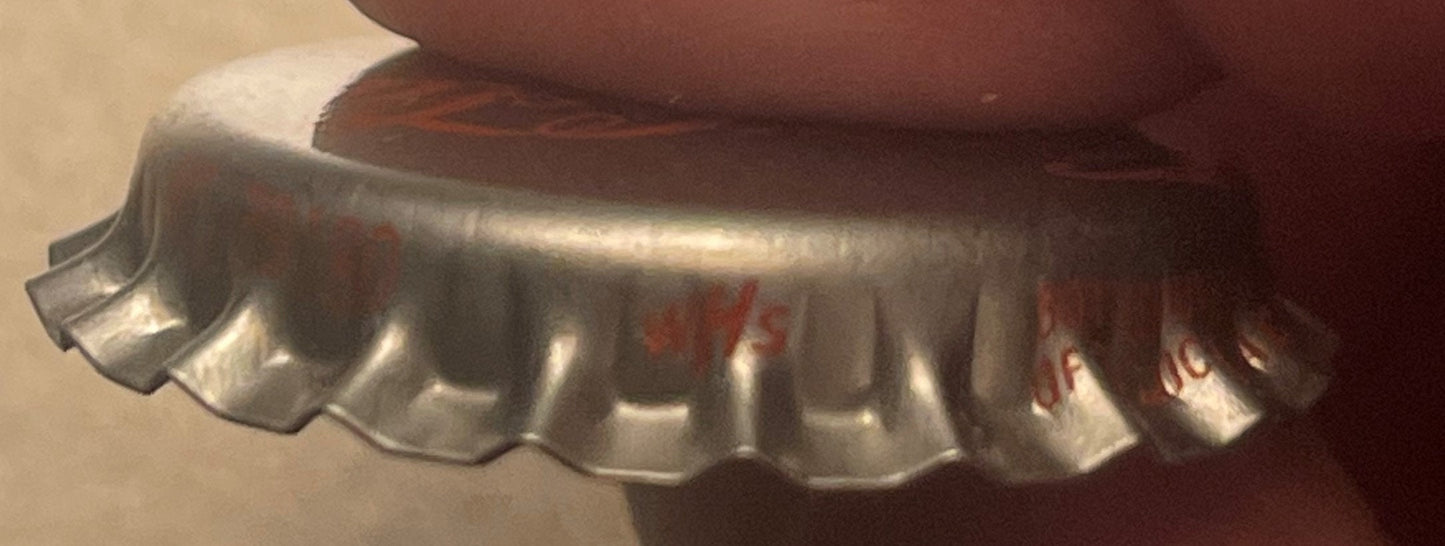
What you're looking at is an original Coca-Cola crown cap — new old stock, meaning it never made it onto a bottle and never left the case it was packed in decades ago. The top is printed on a silver ground in the familiar Coca-Cola red, carrying the flowing script "Coca-Cola" trademark, the words "Trade-mark ®" set neatly beneath it, and — a little unusual for a plain bottle cap — a full ingredient statement running around the lower half of the cap: carbonated water, sugar, caramel color, phosphoric acid, natural flavorings, caffeine. The fluted edge, crimped into the crown shape that's sealed soda bottles for well over a century, carries its own small piece of local history too: pressed right into the metal skirt, in the same red ink as the logo, is text identifying it as bottled under authority of The Coca-Cola Company by the local bottling company of Vicksburg, Mississippi — the zip code 39180 stamped directly into the tin. Style-wise, this script logo, the "Trade-mark ®" notation, and a printed ingredients list on a silver-ground, cork-lined crown place this cap in the 1960s–1970s window of Coca-Cola bottling — a design era well after the crown cap itself was invented, but still well before the shift to plastic-lined closures became standard across the industry.


🏛️ From an Atlanta Pharmacy Counter to a Household Name

Every Coca-Cola cap, bottle, or can traces back to one afternoon in May of 1886, when Atlanta pharmacist John Stith Pemberton perfected a syrup in his own laboratory and carried it a short walk down the street to Jacobs' Pharmacy, a popular soda fountain in downtown Atlanta. The first glass was poured and sold there on May 8, 1886, for five cents — and the Georgia Historical Society has since marked the spot as the "Birthplace of Coca-Cola." Pemberton's bookkeeper, Frank Robinson, is the one credited with naming the new drink and hand-lettering it in the flowing script that's barely changed in the century-plus since — the very same script printed on the top of this cap.

Pemberton sold off pieces of the business before his death in 1888, and it was fellow Atlanta pharmacist and businessman Asa Griggs Candler who bought up the recipe — for roughly $2,300 — and built it into something far bigger than a drugstore tonic. Candler formally organized The Coca-Cola Company as a Georgia corporation in 1892, and his marketing instincts turned a regional curiosity into a national phenomenon; within just three years he was able to say Coca-Cola was being drunk in every state and territory in the country. Candler's Atlanta footprint runs deep — he served as the city's 41st mayor from 1916 to 1919, Candler Field (the site that eventually became Hartsfield-Jackson Atlanta International Airport) carries his name, as does Candler Park, and his gifts of land and money helped establish Emory University, where his total donations eventually topped $8 million.

Candler sold the company in 1919 for $25 million to a group of investors led by Ernest Woodruff. It was Ernest's son, Robert Woodruff, who then took the reins and spent more than half of the twentieth century building Coca-Cola into the global business the world recognizes today — the very company still printing that same script onto crowns like this one, decades and decades after Frank Robinson first put pen to paper.


🍾 The Crown Cap That Changed the Soda Business

Coca-Cola started life almost entirely as a soda fountain drink, mixed and served glass by glass — bottling it for people to carry home simply wasn't practical until an inventor named William Painter solved the sealing problem. Painter patented the crown cork on February 2, 1892 (U.S. Patent 468,258), a fluted metal disc with a cork-and-paper liner that could be crimped onto a bottle's lip and pried back off — his original design used 24 teeth around the rim, refined over the years down to the 21-tooth crown that became the industry standard. Soda bottlers saw the benefit immediately, and the crown cap remains, in principle, the same closure used on glass soda and beer bottles to this day.

Once bottling became practical, Candler granted exclusive bottling rights in 1899 to Benjamin Thomas and Joseph Whitehead of Chattanooga, Tennessee — and from there the model exploded. Over the following twenty years the number of Coca-Cola bottling plants grew from two to more than a thousand, roughly 95 percent of them independently, locally owned. That franchise system is exactly why a small cap like this one carries the name of a hometown bottler rather than Atlanta itself — Vicksburg, Mississippi, in this case, was one of hundreds of towns across the country with its own family-run Coca-Cola bottling works, each one turning out crowns just like this by the thousands for the local trade.


📜 What's Actually in the Bottle

Most vintage crown caps carry nothing but the logo — no ingredients, no fine print, just the script and the trademark notice. This one goes a step further, spelling out carbonated water, sugar, caramel color, phosphoric acid, natural flavorings, and caffeine right on the crown itself, which makes it a nice little time capsule of the formula as it stood before the industry's next big shift. The "natural flavorings" line is the closest Coca-Cola ever gets to giving away its secret — that particular blend has always been the company's own closely guarded formula, while everything else listed here is exactly what's always gone into the bottle.

That word "sugar" is worth pausing on. Through most of Coca-Cola's American history, cane sugar was the sweetener — it wasn't until the 1980s that U.S. bottlers largely switched over to high-fructose corn syrup as the cheaper alternative. A cap reading "sugar" rather than corn syrup is a small, honest marker of that earlier era of the formula, printed right into the metal for anyone who cares to notice.


🌊 Vicksburg, Mississippi — A River Town With Its Own Legend

The crimped skirt of this cap ties it directly to Vicksburg, Mississippi — a town perched high on the bluffs above the Mississippi River with a history far bigger than its size. Long before Coca-Cola ever arrived there, Vicksburg earned the nickname "Gibraltar of the Confederacy" for its commanding position over the river, and the city endured a brutal siege during the Civil War that ended with its surrender on July 4, 1863. Local legend passed down for generations holds that the town was so stung by surrendering on the nation's birthday that Vicksburg refused to formally celebrate the Fourth of July for decades afterward — a piece of folklore Vicksburg residents still tell today.

By the time this cap was rolling off a bottling line, that Civil War history was already a century behind the town, and Vicksburg — like so many small and mid-sized American cities — had its own locally owned Coca-Cola bottling works turning out crowns for the soda fountains, five-and-dimes, and corner stores of the region. It's a small thing, a bottle cap, but it's also a little piece of documentary evidence: proof that a national brand born in an Atlanta pharmacy was, town by town, being bottled, capped, and sold by local hands hundreds of miles away on the Mississippi River.


🖼️ Display Ideas

  • 🧲 Mount a small grouping on a magnetic board alongside other vintage soda and advertising crowns for a colorful kitchen or bar wall
  • 🪟 Set it in a small riker mount or shadow box to protect the printed top while still showing off the script and lettering
  • 🥂 Pair it with a vintage Coca-Cola bottle or glass on a bar cart or soda-fountain-themed shelf
  • 📌 Pin it to a corkboard alongside other Mississippi or Southern Americana pieces for a regional history corner
  • 🎁 Give it as a small, meaningful gift to a Coca-Cola collector or anyone with roots in Vicksburg or the Mississippi Delta
  • 🔑 Tuck it into a display case or curio cabinet as one piece of a broader vintage advertising collection

🎁 Who Collects These

Crown cap collecting is its own quiet corner of the advertising and Americana world — some collectors chase every design variation Coca-Cola ever printed, others focus specifically on caps from small hometown bottlers like this one, hunting down every town that ever had its own Coca-Cola works. It's a natural pickup for Coca-Cola memorabilia collectors broadly, for soda fountain and diner-decor enthusiasts furnishing a kitchen or bar, for anyone building out a shadow box of American advertising history, and for Mississippi and Southern history buffs who like their collectibles tied to a real place on the map. It's also simply a small, affordable, genuinely old piece of a brand nearly everyone has a personal memory attached to.


❓ FAQ

Is this cap new old stock, and what does that mean?

Yes — this is new old stock (NOS), meaning it was manufactured decades ago but never applied to a bottle or put into circulation. It's been kept back in inventory all this time rather than used.

Why does this cap list ingredients when most Coca-Cola caps just show the logo?

A plain logo crown was the norm for most of Coca-Cola's history — this variant, with a full printed ingredient statement, is a less common style that gives it a bit of extra character for collectors who like to compare label variations over time.

Why does it say "sugar" instead of high-fructose corn syrup?

Cane sugar was Coca-Cola's American sweetener for most of the company's history; the switch to corn syrup for most U.S. bottlers didn't happen until the 1980s, so this wording reflects the formula from before that change.

What does the text around the crimped edge mean?

That skirt text identifies the cap as bottled under authority of The Coca-Cola Company by the local bottling company operating out of Vicksburg, Mississippi — part of the franchise system of independently owned bottlers that once numbered over a thousand across the country.

What is a "crown cap," and why the fluted shape?

Crown cap (or crown cork) is the proper name for this style of bottle closure, patented by William Painter in 1892. The fluted, toothed rim crimps tightly around a bottle's lip to hold the seal in while still allowing the cap to be pried off — the same basic design still used on glass soda and beer bottles.

How old is this cap?

The script logo style, the "Trade-mark ®" notation, and the printed ingredients list together place this cap in the 1960s–1970s era of Coca-Cola bottling.

Shipping

🚚 Shipping & Handling

  • Shipping costs and timing are calculated at checkout.
  • Items curated and shipped directly by me include U.S. shipping at no additional cost, professionally packed to ensure safe arrival of your artifact.

Items from Vetted Pro Collectors
Shipping for items offered by vetted Pro Collectors is determined at checkout. All Pro Collector listings are reviewed to ensure fair, reasonable shipping practices.

For full details, please refer to our Shipping Policy.

Returns & Exchange

Take your time — you've got a full six months. If a piece isn't right for you, send it back the way it reached you and we're good.

In the first 30 days your money goes straight back the way you paid. After that it's store credit, so you can put it toward something you'd rather have.

Return shipping we sort out between us, case by case. I don't make this difficult.

If something arrives damaged, or it isn't what I said it was, send me a photo within 48 hours and I'll make it right.

Email info@vintageantiquesgifts.com or call 802-356-9872 — that's me answering, not a call center.

The only things I can't take back are custom or special-order pieces and gift cards.

View full details
  • 5 stars: 2 (100%)
  • 4 stars: 0 (0%)
  • 3 stars: 0 (0%)
  • 2 stars: 0 (0%)
  • 1 star: 0 (0%)
S
Sarah

Excellent as always! Looking forward to shopping here again :)

N
Natalie

Such great customer service and packaged with a lot of care!!