Skip to product information
1 of 2

Vintage and Antique Gifts

Antique K and R Countrymaid Food Products Sign K and R Inc Hastings Nebraska Meat Packing New Old Stock NOS 1920s 1930s ✨

Antique K and R Countrymaid Food Products Sign K and R Inc Hastings Nebraska Meat Packing New Old Stock NOS 1920s 1930s ✨

Regular price 12.00 USD
Regular price Sale price 12.00 USD
Sale Sold out
Shipping calculated at checkout.
Quantity

Size: 7.25 x 4.25 inches

What Does a Country Grocer's Sign Tell You About the Soul of a City? 🥩

There is a moment, when you hold a piece of printed ephemera like this, when the distance between you and the past collapses entirely. The ink is still vivid. The paper still carries that faint mechanical smell of a commercial press doing its finest work. And suddenly you are not a collector standing at a desk in the twenty-first century — you are a grocer in southern Nebraska, circa 1929, lifting this sign from a stack of hundreds, its navy and orange ink still bright from the press before the week is out. The Countrymaid brand wasn't just a trade name. It was a promise — made in Hastings, Nebraska, backed by local livestock, local labor, and local pride — offered to a region that understood exactly what those words meant.

This is the kind of object that doesn't survive in large numbers. Most were used, discarded, forgotten. The ones that surface today as New Old Stock — untouched, unglued, never applied — are the accidental time capsules of American commerce. And this one carries a story dense enough to anchor an entire chapter of Great Plains economic history.


🏷️ What It Is — The Object Itself

This is an original K & R Countrymaid Food Products Sign, produced for K and R, Inc. of Hastings, Nebraska, dating to the 1920s–1930s. It is New Old Stock (NOS) — meaning it was never applied to a product, never circulated in commerce, never subjected to the glue, moisture, cold-storage condensation, or handling that would have destroyed ninety-nine percent of its companions. It survived, unused, from the era of its printing to the present day, which is the rarest and most collectible condition a piece of commercial paper ephemera can achieve.

Printed advertising of this period were produced through lithographic or letterpress printing processes, the dominant commercial printing technologies of the 1920s and '30s. American advertising printing houses — concentrated in cities like Chicago, Cincinnati, and St. Louis — supplied regional meat packers, canneries, and food processors across the Midwest with highly designed, color-rich advertising that served as the primary visual marketing tool of the era. There were no television commercials. There was no social media. The sign was the brand. It sat on the shelf, it sat in the case, and it told the consumer everything they needed to know about who made this product and why they should trust it. The artistry that went into these signs was considerable, and the best of them — like this Countrymaid example — were genuinely beautiful pieces of commercial graphic design, worthy of framing and display on their own merits.

The Countrymaid name itself is evocative in a way that feels very deliberately chosen for its market. It conjures wholesome rurality, fresh air, honest farm-to-table sourcing — all of it accurate to what K and R, Inc. was actually doing, which makes the branding unusually authentic for its era. This was not aspirational fiction. This was a sign that told the truth.


🏭 The Company — Two Men, a Brewery Building, and a Nebraska Dream

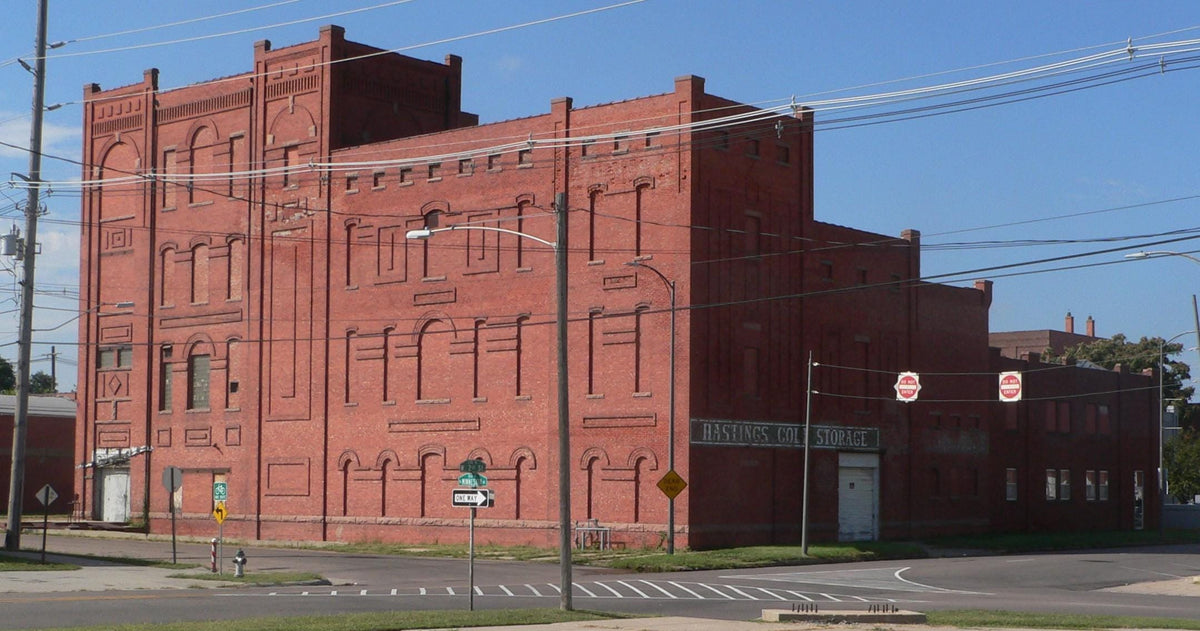
The story of K and R, Inc. begins at the precise intersection of Prohibition and Midwestern entrepreneurial instinct. In 1923, Karl Kauf and George Rinderspacher relocated their meat processing and grocery wholesale operation into the former Hastings Brewery building at 219 West 2nd Street. The timing was almost poetic. The Volstead Act had silenced the brewery's copper kettles two years earlier, leaving behind a building with exactly the infrastructure a serious food-processing operation required: cold storage, loading docks, commercial-grade flooring, and the kind of sturdy brick construction that kept temperatures stable through Nebraska's punishing seasonal swings.

Where the brewery had once fermented lager for Adams County, K and R began processing fresh Nebraska pork, preparing sausage casings, and distributing Kraft cheese, canned goods, and margarine to grocery stores across the high plains. The Countrymaid sausage brand became the flagship of that operation — the product that consumers in southern Nebraska associated with the K & R name the way they associated a familiar face with a trusted neighbor. This was Midwestern reinvention at its most elegant: a building built for one Great Plains industry seamlessly converted to serve another, with no waste and no nostalgia for what had been.

By 1929 — the same year the stock market collapsed and much of American commerce began its long, painful contraction — K and R, Inc. had grown into one of the three largest businesses in the entire city of Hastings. That is a remarkable achievement in any context, but especially so in a city that functioned as a genuine regional commercial hub for southern Nebraska. Hastings in 1929 was not a sleepy agricultural village. It was a distribution center, a railroad junction, a city of ambition and infrastructure. To be among the top three businesses in that environment required scale, reputation, and operational excellence that went well beyond local novelty.

The founders made a deliberate choice that distinguished them from national competitors operating on the high plains at the same time: they sourced their livestock locally, buying directly from Nebraska producers rather than routing through the massive Chicago stockyards and packing houses that supplied so many regional brands. This wasn't simply an economic preference — though keeping dollars in Nebraska's agricultural economy would have resonated with their retail grocery customers, many of whom were themselves farmers or had farming relatives. It was a quality commitment. Nebraska livestock, Nebraska pork, Nebraska sausage. The Countrymaid brand meant something specific, and that specificity was its strength.

Local legend has it that the cold-storage rooms in the old brewery building were so reliably consistent in temperature — the thick brick walls, the original brewery insulation, the north-facing positioning on West 2nd Street — that sausage cured in that building had a quality and shelf stability that K and R's competitors couldn't replicate, even in purpose-built facilities. Whether the old brewery's architecture was genuinely responsible, or whether that was simply the kind of story that grows up around a successful business, the reputation was real. Countrymaid moved product, and loyal customers credited the building as much as the recipe.


🌾 The Town — Hastings, Nebraska, and the High Plains Commercial World

Hastings, Nebraska sits in Adams County in the south-central part of the state, approximately 150 miles southwest of Omaha and 100 miles south of the Platte River valley. Founded in 1872 as a railroad town on the Burlington and Missouri River Railroad, Hastings grew quickly into one of the most commercially significant cities in Nebraska's interior. By the time Karl Kauf and George Rinderspacher were establishing their operation in 1923, Hastings had a population of roughly 11,000 people and served as the wholesale and distribution center for a vast agricultural hinterland stretching south toward the Kansas border and west across the Republican River valley.

The meat packing and food processing industry was a natural fit for this geography. South-central Nebraska was — and remains — exceptional livestock country. The Republican River valley, just south of Hastings, supported extensive hog and cattle operations that had been feeding Midwestern processing houses since the 1880s. What K and R recognized was that there was no particular reason to ship that livestock to Omaha or Kansas City for processing when Hastings itself had the cold storage, the railroad access, the retail grocery network, and the workforce to handle regional production. The economics of the high plains food system, when you looked at them clearly, argued for local processing — and K and R built their business on that argument.

Hastings in the 1920s was also a city that took its commercial identity seriously. The Adams County Courthouse, completed in 1905, anchored a downtown commercial district that supported banks, department stores, hardware wholesalers, implement dealers, and the full apparatus of a regional economy at its productive peak. The city's newspapers — particularly the Hastings Daily Tribune — tracked local business milestones with the kind of attention that reflected how seriously the community took its economic life. K and R's growth was local news precisely because local business success was understood to be a communal achievement, not merely a private one.

The NOS examples that surface today are believed to come almost entirely from the 219 West 2nd Street facility itself, discovered in back rooms or storage areas during later building transitions, rather than from grocery back-stock. If that lore is accurate, it suggests that every NOS Countrymaid sign in existence today passed through that original brewery building — which gives this small piece of paper a more specific geographic provenance than most ephemera of its era can claim.


🖨️ The Industry — American Food Advertising Printing at Its Peak

The 1920s and 1930s represent the golden age of American commercial food advertising design. The convergence of improved color lithography, increasingly sophisticated commercial printing presses, and the fierce competition among regional food brands for shelf presence produced a body of printed commercial art that is now recognized — by collectors, design historians, and museum curators alike — as genuinely important American graphic heritage.

For meat packing advertising specifically, the design conventions of the era were distinct and recognizable: strong typography, often in bold serif faces that communicated reliability and tradition; color palettes that evoked freshness and wholesomeness (creams, greens, warm reds); and brand names chosen for their emotional resonance with the consumer base. Countrymaid fits this template precisely — and the quality of the printing reflects the serious investment that K and R made in their brand presentation. This was not a budget sign. This was the work of a company that understood that the sign was, quite literally, the face of the product.

Regional meat packing advertising from Nebraska and the broader high plains are underrepresented in major ephemera collections compared to their counterparts from coastal states or from the larger Midwest packing centers like Chicago and Kansas City. The sheer volume of output from those larger markets has meant that smaller regional brands — even significant ones like Countrymaid — are less commonly encountered. This relative scarcity, combined with the NOS condition of this example, makes it an object of genuine interest to serious collectors of Americana and food ephemera.


🖼️ Display Ideas

  • 🪵 Frame it simply in a deep-set shadowbox — natural wood or black frame, cream mat — and hang it in a kitchen, dining room, or farmhouse-style breakfast nook where its graphic character can anchor the wall the way a museum-quality piece should.
  • 🧺 Group it with other Great Plains food ephemera — seed packet labels, grain elevator trade cards, creamery advertising — into a curated gallery wall that tells the story of the high plains food economy from farm to table.
  • 📚 Archive it flat in a museum-quality mylar sleeve in an archival box if display isn't the goal — NOS condition this good deserves acid-free, UV-protected preservation so it remains pristine for the next collector or institution that stewards it.
  • 🏛️ Donate or loan it to local history institutions — the Adams County Historical Society, the Hastings Museum, or the Nebraska State Historical Society would recognize this as a primary-source artifact of Hastings commercial history, and institutions of that caliber are actively seeking material of this specificity.
  • 🍽️ Use it as a centerpiece in a vintage kitchen vignette — paired with period crockery, a wooden cutting board, and other 1920s–30s kitchen objects, framed and propped on an open shelf, it reads as both art and history.
  • 🎨 Commission a larger art print inspired by it — collectors and graphic designers often use NOS advertising art as reference for reproduction art; owning the original gives you the authoritative source piece from which any inspired work descends.

🎁 Who Collects These

The universe of collectors who would find this sign genuinely compelling is wider than you might expect, and each community brings its own reasons for caring deeply about exactly this kind of object.

Nebraska and Great Plains local history collectors are the most obvious audience. For anyone with roots in Adams County, in Hastings, or in the broader south-central Nebraska region, a K & R Countrymaid sign is a tangible connection to a specific chapter of their community's commercial past. These collectors are not buying novelty — they are recovering heritage, and they treat objects like this with corresponding seriousness.

American food ephemera and advertising collectors represent a sophisticated and growing field. Labels, trade cards, tin signs, and packaging from the pre-WWII American food industry have been recognized for decades as legitimate collectible Americana. Meat packing and Countrymaid signs specifically — because of their graphic richness and their connection to the deeply American story of livestock, butchery, and regional food culture — command real collector attention and real secondary market value.

Prohibition-era history enthusiasts will be drawn to the brewery-building backstory. The fact that this operation was built specifically in the space that Prohibition had rendered idle gives the K & R story a texture that resonates with collectors who are piecing together the full social and economic picture of 1920s America — not just the speakeasies and the gangsters, but the quiet economic reshuffling that the Volstead Act caused in every American city that had supported a brewing industry.

Graphic design historians and vintage typography collectors appreciate NOS food advertising as primary documents of commercial art history. The fonts, the color choices, the compositional conventions of the 1920s and '30s are all embedded in this sign, and for design professionals or academics working in this period, an original artifact is always more valuable than a reproduction or a scan.

Vintage kitchen and farmhouse décor collectors — a large and enthusiastic community — are drawn to the warmth and authenticity that objects like this bring to a space. There is no manufactured vintage object that carries the same weight as an original NOS sign from the actual era.


❓ Frequently Asked Questions

What does "New Old Stock" (NOS) mean for this sign, and why does it matter so much?

New Old Stock means that this sign was produced during the original period of use — in this case, the 1920s–1930s — but was never actually applied to a product. It sat in storage, unused, from its printing date until now. For paper ephemera, NOS condition is the rarest and most desirable state, because the vast majority of printed advertising from any production run was used up and discarded, exposed to moisture, cold, handling, and eventual disposal. For a sign this old — approaching a century — NOS condition represents a genuinely unusual survival, and it is the primary factor in both the collectibility and the display quality of this piece.

Is this a one-of-a-kind item, or were many of these signs produced?

Commercial food advertising of this era were produced in large print runs — hundreds or thousands at a time — so this sign was never unique in the way a hand-made object would be. However, the survival rate of NOS examples from any given print run is extremely low. Most were used. Of those that weren't used, most were discarded when the brand changed, the company evolved, or the storage space was needed. The ones that survive today do so by accident — forgotten in back rooms, in old filing cabinets, in the corners of buildings that changed hands without anyone cataloguing what was left behind. Lore among Great Plains ephemera collectors suggests that surviving NOS Countrymaid signs almost certainly came from the original 219 West 2nd Street facility in Hastings, making each surviving example a direct survivor from that specific building and that specific business. Rarity is always relative to survival, not original production.

How should I store or care for this sign to preserve it long-term?

Paper ephemera of this age does best in stable, low-humidity environments away from direct sunlight and UV exposure. For archival storage, acid-free mylar or polypropylene sleeves, paired with acid-free backing boards, are the standard approach used by paper conservators and museum collections. If you choose to frame it for display, use UV-filtering glazing (museum glass or UV-filtering acrylic) and avoid hanging it in direct sunlight or in rooms with significant humidity fluctuation, such as kitchens near stoves or bathrooms. The NOS condition of this sign — the fact that it has no prior adhesive on the back — means it does not have the degradation risk that a used piece with old adhesive residue would carry. Treat it like any fine work on paper: stable environment, archival materials, minimal handling.

What can you tell me about Karl Kauf and George Rinderspacher as historical figures?

Karl Kauf and George Rinderspacher were Hastings businessmen who built K and R, Inc. into one of the three largest companies in the city by 1929 — a genuine commercial achievement in a city of Hastings' regional significance. Their decision to move into the former Hastings Brewery building in 1923 was both economically savvy and historically meaningful: they converted a Prohibition-idled facility into a productive food-processing operation at a moment when the Great Plains food economy was growing rapidly. Their insistence on sourcing Nebraska livestock locally, rather than relying on national supply chains, reflects a business philosophy that prioritized product quality and regional economic relationships over the cost efficiencies that distant sourcing might have offered. Beyond these documented facts, the historical record on both men at the individual level is the kind of local business history that lives in city directories, county histories, and newspaper archives rather than in national records — which makes physical artifacts like this sign among the most direct surviving evidence of their enterprise.

Is this sign appropriate for institutional or museum donation?

Absolutely, and it would be recognized as a meaningful primary-source artifact by any institution focused on Nebraska history, Great Plains commercial history, or American food industry history. The Adams County Historical Society and the Hastings Museum in Hastings, Nebraska, along with the Nebraska State Historical Society in Lincoln, maintain collections that document exactly this kind of local commercial heritage. A NOS label from a company that was, by 1929, one of the three largest businesses in Hastings represents precisely the kind of material evidence that local and state history institutions work to preserve. If you are a collector who ultimately wants this piece to live in a publicly accessible collection rather than a private archive, those institutions would be logical recipients and would likely welcome the conversation.

How does the Prohibition connection enhance the historical significance of this sign?

The fact that K and R, Inc. built their Countrymaid sausage operation specifically in the former Hastings Brewery building — a facility rendered idle by the Volstead Act of 1919 — gives this sign a layered historical resonance that goes beyond simple food industry ephemera. Prohibition's economic effects on American cities are often discussed in terms of organized crime and speakeasy culture, but the quieter story — the story of what happened to all those brewery buildings, all that cold-storage infrastructure, all those commercial spaces that had been built around the business of fermentation and were suddenly empty — is equally important and far less often documented in surviving material culture. This sign is, in a sense, an artifact of Prohibition's economic aftermath: evidence that Hastings entrepreneurs looked at a silenced brewery and saw, not a loss, but an opportunity. That narrative gives the Countrymaid sign a hook that reaches well beyond Nebraska food history into the broader story of 1920s American economic adaptation.

What makes this sign particularly valuable compared to other vintage food advertising from the same era?

Several factors combine to make this sign stand out within the broader category of vintage American food ephemera. First, the NOS condition is the single most important factor in paper ephemera collectibility, and this sign has it. Second, the specificity of the backstory — the documented company history, the brewery building, the named founders, the regional significance — gives this sign a narrative depth that generic NOS advertising from anonymous producers lack. Third, the geographic specificity of Hastings, Nebraska, and the high plains food economy makes it meaningful to a defined collector community with strong regional identity. Fourth, the Prohibition-era industrial conversion angle gives it cross-category appeal to collectors who work in 1920s social history, brewing history, and American economic history as well as food ephemera. And fifth, the relative scarcity of surviving NOS examples from this specific brand and company means that demand, when it exists, is not easily satisfied by supply. Each of these factors contributes independently; together, they make this sign an object of genuine collector significance.

Shipping

🚚 Shipping & Handling

  • Shipping costs and timing are calculated at checkout.
  • Items curated and shipped directly by me include U.S. shipping at no additional cost, professionally packed to ensure safe arrival of your artifact.

Items from Vetted Pro Collectors
Shipping for items offered by vetted Pro Collectors is determined at checkout. All Pro Collector listings are reviewed to ensure fair, reasonable shipping practices.

For full details, please refer to our Shipping Policy.

Returns & Exchange

Take your time — you've got a full six months. If a piece isn't right for you, send it back the way it reached you and we're good.

In the first 30 days your money goes straight back the way you paid. After that it's store credit, so you can put it toward something you'd rather have.

Return shipping we sort out between us, case by case. I don't make this difficult.

If something arrives damaged, or it isn't what I said it was, send me a photo within 48 hours and I'll make it right.

Email info@vintageantiquesgifts.com or call 802-356-9872 — that's me answering, not a call center.

The only things I can't take back are custom or special-order pieces and gift cards.

View full details
  • 5 stars: 1 (100%)
  • 4 stars: 0 (0%)
  • 3 stars: 0 (0%)
  • 2 stars: 0 (0%)
  • 1 star: 0 (0%)
m
michaelyoung1234

fast shipping. great price. thanks for the card and bonus item.

Thank you!